Loading page, please wait…
India's Nuclear Disarmament Policy & Export Control Regimes - UPSC International Relations
What is India's Nuclear Disarmament Policy & Export Control Regimes in UPSC International Relations?
India's Nuclear Disarmament Policy & Export Control Regimes is a key topic under International Relations for UPSC Civil Services Examination. Key points include: India advocates for universal, non-discriminatory, time-bound nuclear disarmament.. India supports non-proliferation while maintaining a credible minimum deterrence and No First Use policy.. India is a member of key export control regimes: Wassenaar Arrangement, Australia Group, and MTCR.. Understanding this topic is essential for both UPSC Prelims and Mains preparation.
Why is India's Nuclear Disarmament Policy & Export Control Regimes important for UPSC exam?
India's Nuclear Disarmament Policy & Export Control Regimes is a Medium-level topic in UPSC International Relations. It is tested in both Prelims (factual MCQs) and Mains (analytical answer writing). Previous year UPSC questions have frequently covered aspects of India's Nuclear Disarmament Policy & Export Control Regimes, making it essential for comprehensive IAS preparation.
How to prepare India's Nuclear Disarmament Policy & Export Control Regimes for UPSC?
To prepare India's Nuclear Disarmament Policy & Export Control Regimes for UPSC: (1) Study the comprehensive notes covering all key concepts on Vaidra. (2) Practice previous year questions on this topic. (3) Connect it with current affairs using daily updates. (4) Revise using key takeaways and mind maps available for International Relations. (5) Write practice answers linking India's Nuclear Disarmament Policy & Export Control Regimes to related GS Paper topics.
Key takeaways of India's Nuclear Disarmament Policy & Export Control Regimes for UPSC
- India advocates for universal, non-discriminatory, time-bound nuclear disarmament.
- India supports non-proliferation while maintaining a credible minimum deterrence and No First Use policy.
- India is a member of key export control regimes: Wassenaar Arrangement, Australia Group, and MTCR.
- These memberships enhance India's global standing and access to critical technologies.
- India's participation in these regimes reflects its commitment to international security and stability.
- Membership aids India's bid for Nuclear Suppliers Group (NSG) entry.
India's Nuclear Disarmament Policy & Export Control Regimes
Medium⏱️ 8 min read
international relations
📖 Introduction
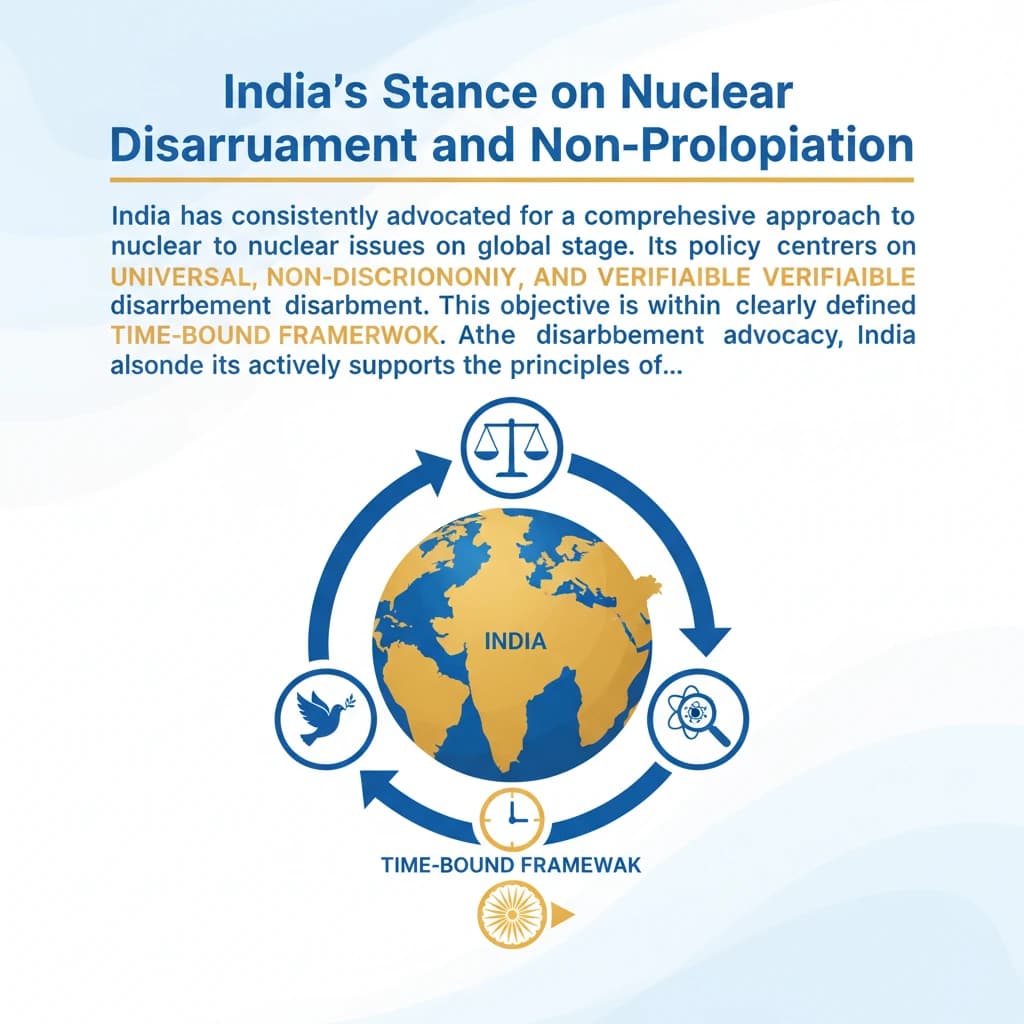
India's Stance on Nuclear Disarmament and Non-Proliferation
India has consistently advocated for a comprehensive approach to nuclear issues on the global stage. Its policy centers on achieving universal, non-discriminatory, and verifiable nuclear disarmament. This objective is pursued within a clearly defined time-bound framework.
Alongside its disarmament advocacy, India also actively supports the principles of non-proliferation. This dual approach underscores India's commitment to global peace and security, ensuring that nuclear weapons do not spread while working towards their eventual elimination.
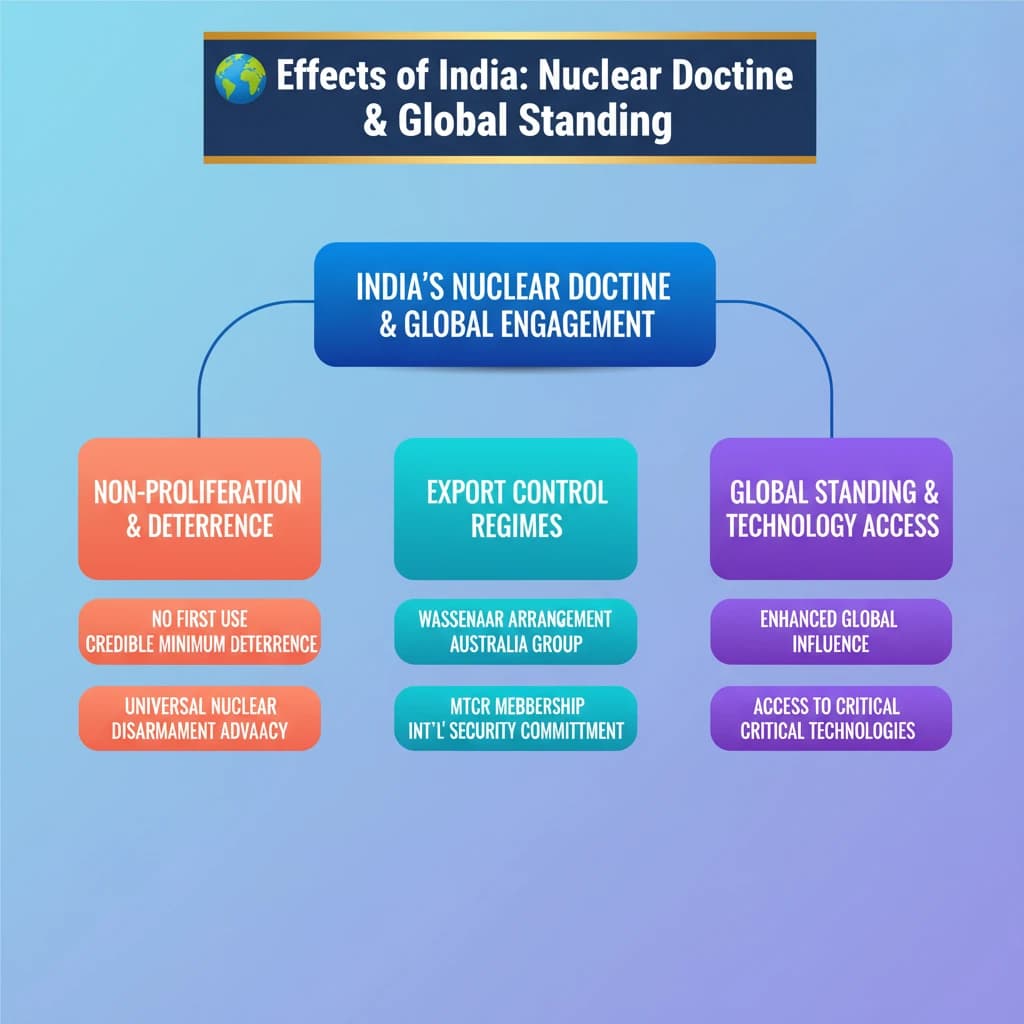
India's Nuclear Doctrine: India maintains a credible minimum deterrence and a No First Use (NFU) policy. This doctrine emphasizes a responsible and restrained approach to its nuclear capabilities.
India's Role in Global Export Control Regimes
To further its commitment to international security, India participates in various multilateral export control regimes. These groups are designed to prevent the transfer of sensitive technology, materials, or components.
The primary goal is to restrict these transfers to entities that pose a significant threat to international security and stability. India's membership in these regimes reflects its growing stature as a responsible global actor.
Key Export Control Regimes India is Part Of:
- Wassenaar Arrangement: Controls conventional arms and dual-use goods and technologies.
- Australia Group (AG): Aims to counter the proliferation of chemical and biological weapons.
- Missile Technology Control Regime (MTCR): Prevents the proliferation of missile and unmanned aerial vehicle technology capable of delivering weapons of mass destruction.
UPSC Insight: Understanding India's nuclear policy and its participation in export control regimes is crucial for GS Paper II (International Relations). Questions often focus on India's role in global governance and its strategic autonomy.
💡 Key Takeaways
- •India advocates for universal, non-discriminatory, time-bound nuclear disarmament.
- •India supports non-proliferation while maintaining a credible minimum deterrence and No First Use policy.
- •India is a member of key export control regimes: Wassenaar Arrangement, Australia Group, and MTCR.
- •These memberships enhance India's global standing and access to critical technologies.
- •India's participation in these regimes reflects its commitment to international security and stability.
- •Membership aids India's bid for Nuclear Suppliers Group (NSG) entry.
🧠 Memory Techniques
98% Verified Content
📚 Reference Sources
•Ministry of External Affairs, Government of India official statements
•United Nations Office for Disarmament Affairs (UNODA)
•Official websites of Wassenaar Arrangement, Australia Group, MTCR