Loading page, please wait…
India’s Push for Security Council Reform: The G4 Model - UPSC International Relations
What is India’s Push for Security Council Reform: The G4 Model in UPSC International Relations?
India’s Push for Security Council Reform: The G4 Model is a key topic under International Relations for UPSC Civil Services Examination. Key points include: India, Brazil, Germany, and Japan form the G4, advocating for UN Security Council reform since 2004.. The G4 model proposes new permanent members, democratically elected by the UN General Assembly.. The model shows flexibility on the controversial veto power issue, indicating a willingness to negotiate.. Understanding this topic is essential for both UPSC Prelims and Mains preparation.
Why is India’s Push for Security Council Reform: The G4 Model important for UPSC exam?
India’s Push for Security Council Reform: The G4 Model is a Medium-level topic in UPSC International Relations. It is tested in both Prelims (factual MCQs) and Mains (analytical answer writing). Previous year UPSC questions have frequently covered aspects of India’s Push for Security Council Reform: The G4 Model, making it essential for comprehensive IAS preparation.
How to prepare India’s Push for Security Council Reform: The G4 Model for UPSC?
To prepare India’s Push for Security Council Reform: The G4 Model for UPSC: (1) Study the comprehensive notes covering all key concepts on Vaidra. (2) Practice previous year questions on this topic. (3) Connect it with current affairs using daily updates. (4) Revise using key takeaways and mind maps available for International Relations. (5) Write practice answers linking India’s Push for Security Council Reform: The G4 Model to related GS Paper topics.
Key takeaways of India’s Push for Security Council Reform: The G4 Model for UPSC
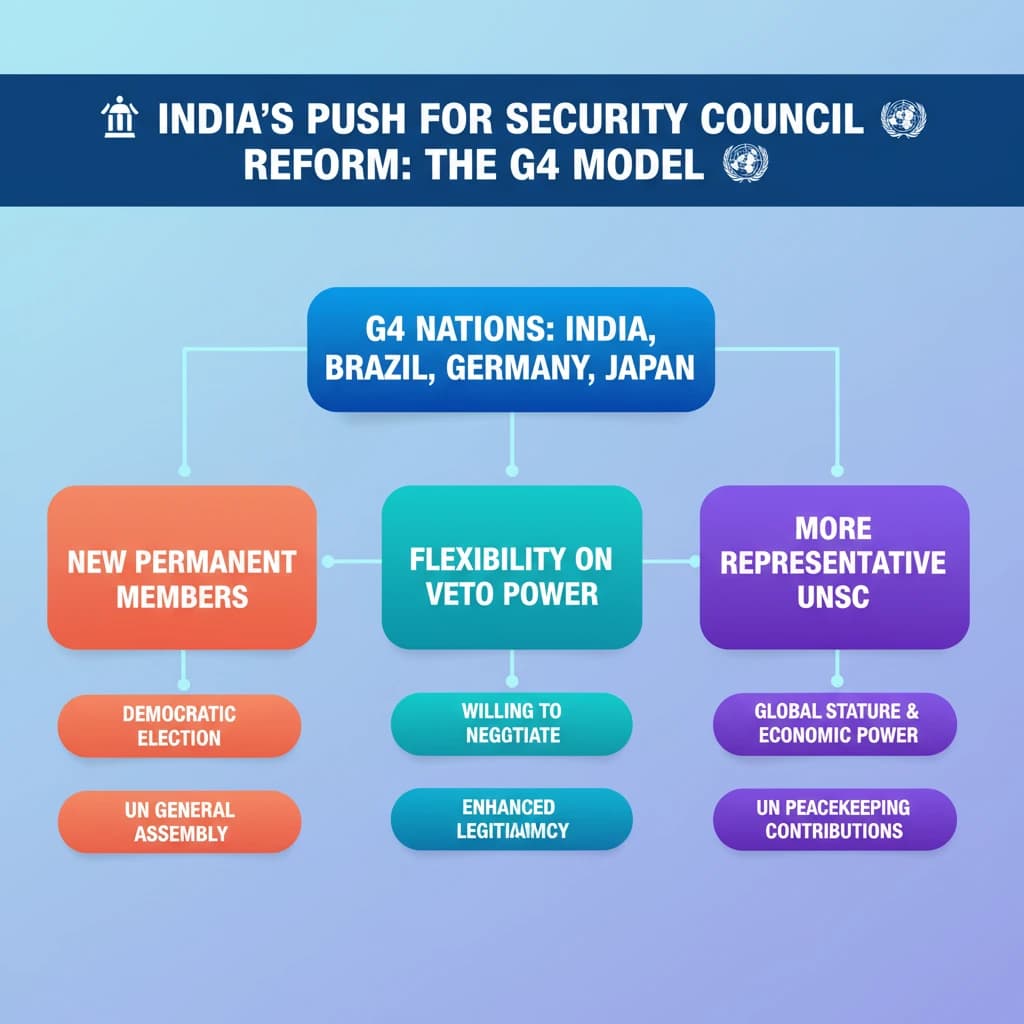
- India, Brazil, Germany, and Japan form the G4, advocating for UN Security Council reform since 2004.
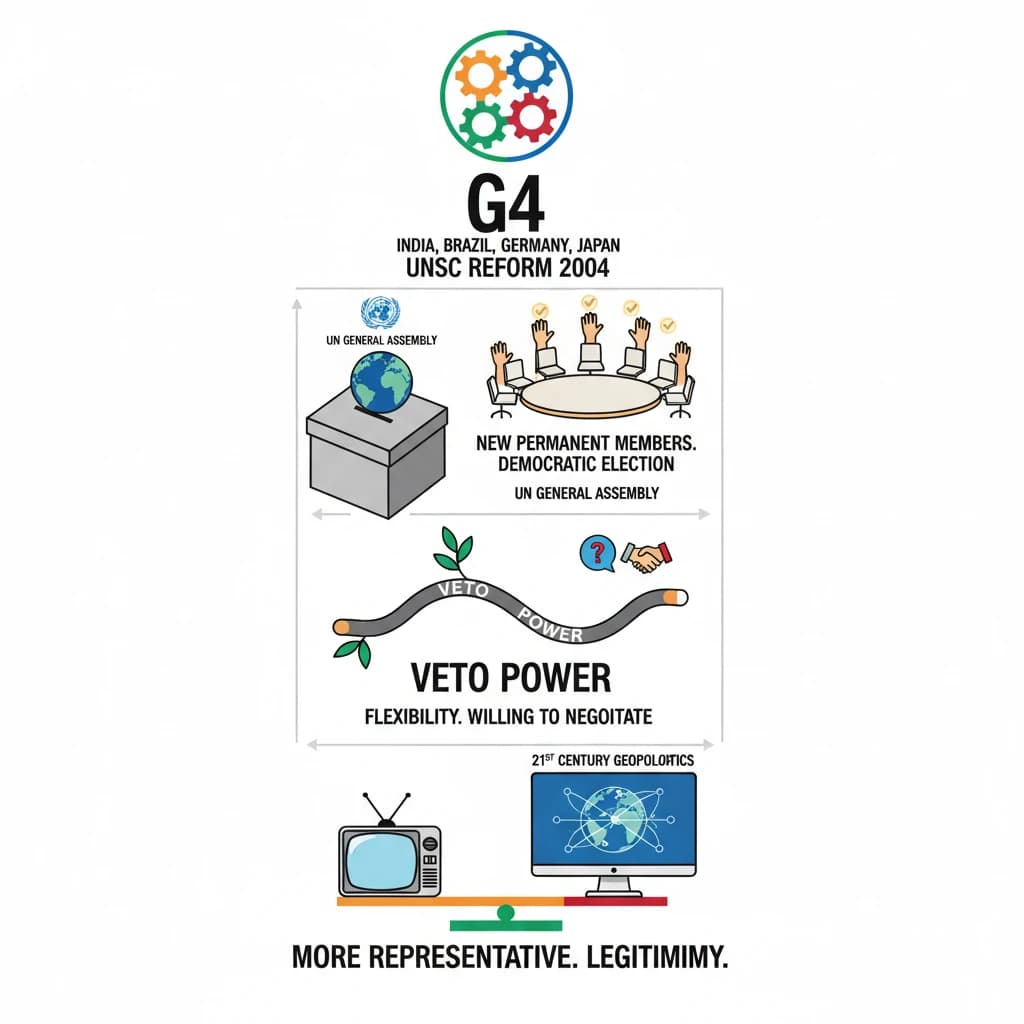
- The G4 model proposes new permanent members, democratically elected by the UN General Assembly.
- The model shows flexibility on the controversial veto power issue, indicating a willingness to negotiate.
- Reform aims to make the UNSC more representative of 21st-century geopolitical realities and enhance its legitimacy.
- India's growing global stature, economic power, and contributions to UN peacekeeping strengthen its claim for a permanent seat.
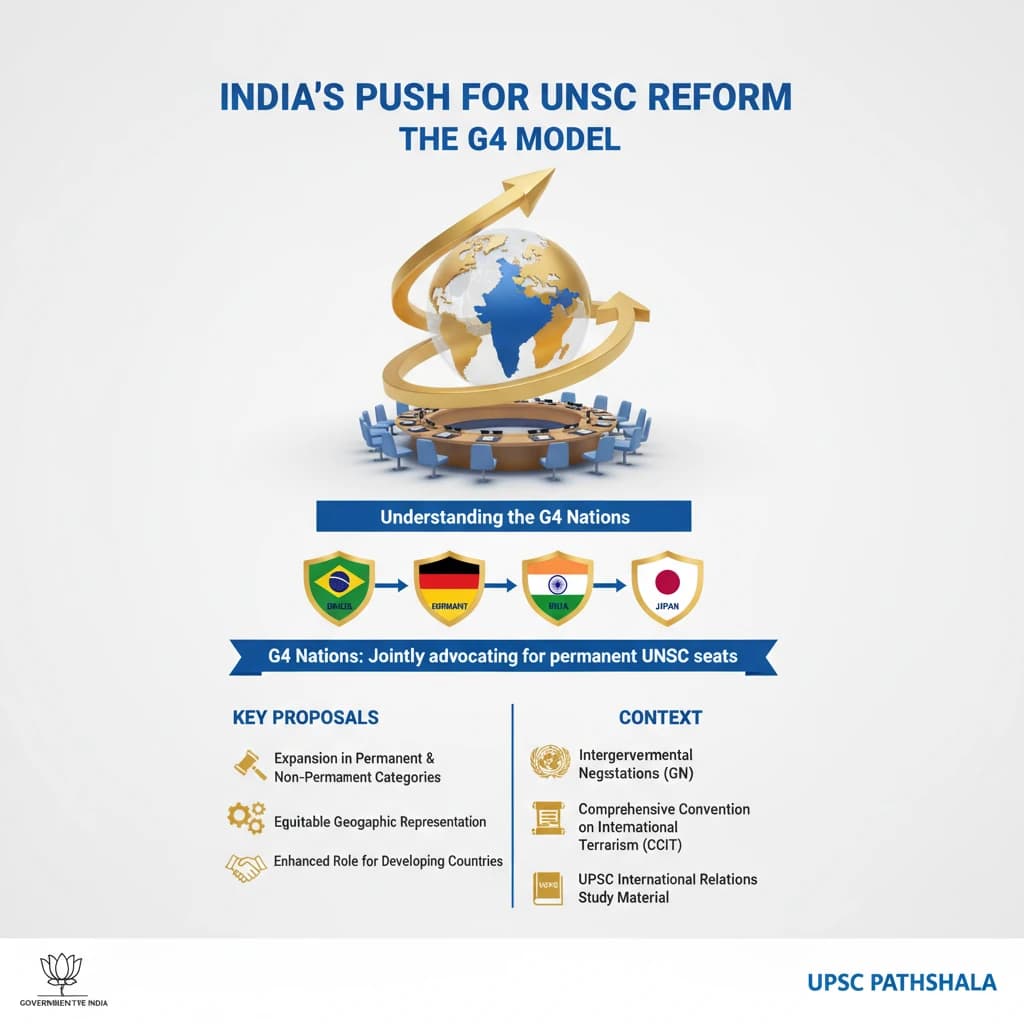
India’s Push for Security Council Reform: The G4 Model
Medium⏱️ 6 min read
international relations
📖 Introduction
India's Push for UNSC Reform: The G4 Model
India is actively advocating for the reform of the United Nations Security Council (UNSC).
This push is articulated through a detailed model presented on behalf of the G4 nations during the Intergovernmental Negotiations (IGN) on Security Council Reform.
Understanding the G4 Nations
The G4 is a group of four countries: Brazil, Germany, India, and Japan.
The G4 alliance was established in 2004 with the primary objective of promoting and achieving comprehensive reforms within the UN Security Council.
Key Features of the G4 Model for Reform
The model proposed by the G4 nations outlines significant changes to the current structure of the UNSC.
- It advocates for the inclusion of new permanent members to reflect contemporary global realities.
- These new permanent members would be elected democratically by the UN General Assembly, ensuring broader representation.
A crucial aspect of the G4 model is its expressed flexibility on the veto issue. This indicates a willingness to negotiate the specifics of veto power for new permanent members.
India's Rationale for Permanent Membership
India's demand for a permanent seat in the UNSC is underpinned by its growing global stature, economic power, and significant contributions to UN peacekeeping operations.
UPSC aspirants should note that India's internal strengthening (e.g., National Investigation Agency, Unlawful Activities (Prevention) Amendment Act, National Intelligence Grid (NATGRID), National Security Guard) also contributes to its credentials as a responsible global power deserving of a greater role in global governance.
💡 Key Takeaways
- •India, Brazil, Germany, and Japan form the G4, advocating for UN Security Council reform since 2004.
- •The G4 model proposes new permanent members, democratically elected by the UN General Assembly.
- •The model shows flexibility on the controversial veto power issue, indicating a willingness to negotiate.
- •Reform aims to make the UNSC more representative of 21st-century geopolitical realities and enhance its legitimacy.
- •India's growing global stature, economic power, and contributions to UN peacekeeping strengthen its claim for a permanent seat.
🧠 Memory Techniques
90% Verified Content
📚 Reference Sources
•Ministry of External Affairs (India) official statements and reports
•Council on Foreign Relations (CFR) analyses
•Academic journals on International Relations and UN Studies