Loading page, please wait…
Indus River and its Tributaries - UPSC International Relations
What is Indus River and its Tributaries in UPSC International Relations?
Indus River and its Tributaries is a key topic under International Relations for UPSC Civil Services Examination. Key points include: The Indus River originates in Tibet near Manasarovar Lake (Sengge Chu).. It flows through Tibet, India (Ladakh, J&K), and Pakistan, emptying into the Arabian Sea near Karachi.. Major left-bank tributaries: Zaskar, Suru, Soan, Jhelum, Chenab, Ravi, Beas, Satluj, Panjnad.. Understanding this topic is essential for both UPSC Prelims and Mains preparation.
Why is Indus River and its Tributaries important for UPSC exam?
Indus River and its Tributaries is a Medium-level topic in UPSC International Relations. It is tested in both Prelims (factual MCQs) and Mains (analytical answer writing). Previous year UPSC questions have frequently covered aspects of Indus River and its Tributaries, making it essential for comprehensive IAS preparation.
How to prepare Indus River and its Tributaries for UPSC?
To prepare Indus River and its Tributaries for UPSC: (1) Study the comprehensive notes covering all key concepts on Vaidra. (2) Practice previous year questions on this topic. (3) Connect it with current affairs using daily updates. (4) Revise using key takeaways and mind maps available for International Relations. (5) Write practice answers linking Indus River and its Tributaries to related GS Paper topics.
Key takeaways of Indus River and its Tributaries for UPSC
- The Indus River originates in Tibet near Manasarovar Lake (Sengge Chu).
- It flows through Tibet, India (Ladakh, J&K), and Pakistan, emptying into the Arabian Sea near Karachi.
- Major left-bank tributaries: Zaskar, Suru, Soan, Jhelum, Chenab, Ravi, Beas, Satluj, Panjnad.
- Major right-bank tributaries: Shyok, Gilgit, Hunza, Swat, Kunar, Kurram, Gomal, Kabul.
- The Indus River System is crucial for water resources, agriculture, and hydroelectric power in India and Pakistan.
- The Indus Water Treaty (1960) governs water sharing between India and Pakistan.
Indus River and its Tributaries
Medium⏱️ 8 min read
international relations
📖 Introduction
Origin and Nomenclature
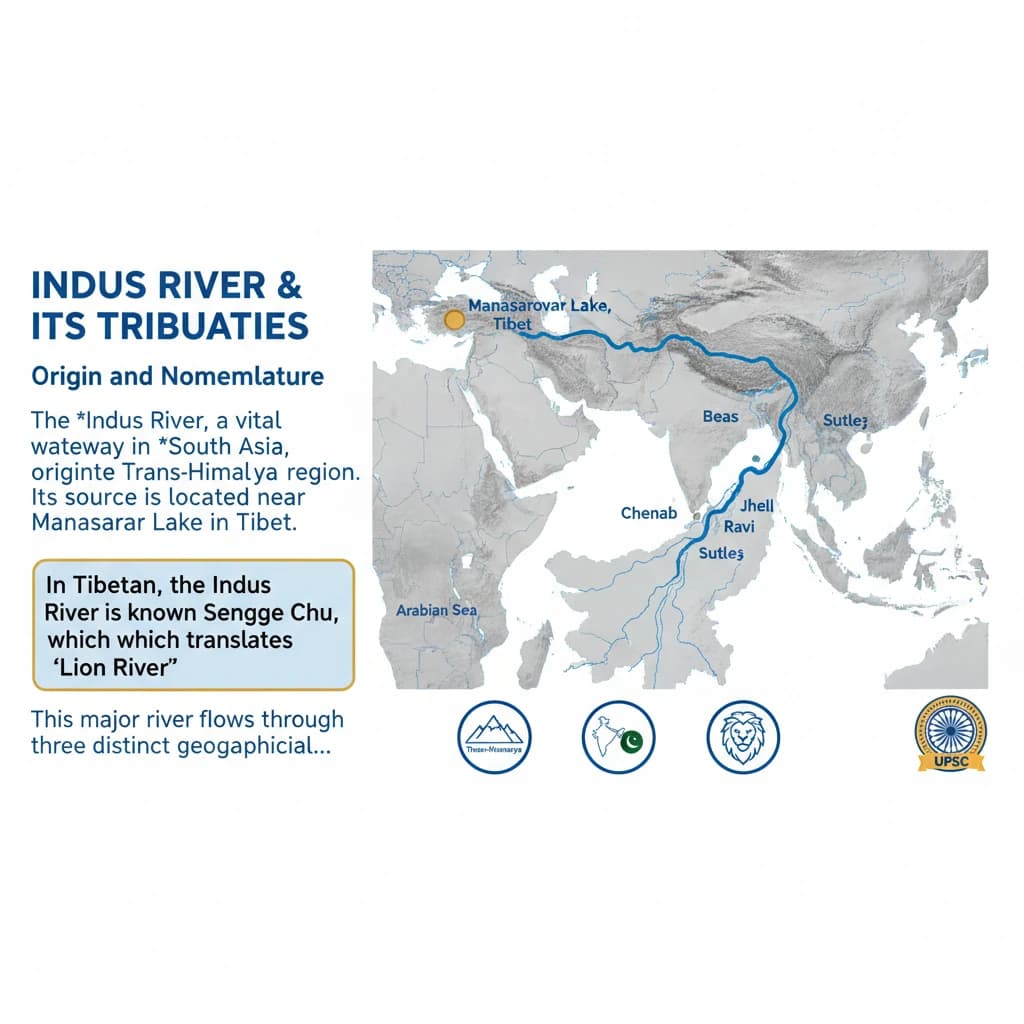
The Indus River, a vital waterway in South Asia, originates in the Trans-Himalaya region. Its source is located near Manasarovar Lake in Tibet.
In Tibetan, the Indus River is known as Sengge Chu, which translates to ‘Lion River’.
This major river flows through three distinct geographical entities: Tibet, India, and Pakistan. Its extensive drainage basin supports approximately 200 million people.
Course through India and Pakistan
Upon entering India, the Indus River first traverses through Ladakh. It then continues its journey through the region of Jammu and Kashmir.
After flowing through Indian territory, the river proceeds into Pakistan, specifically through its Gilgit-Baltistan region. Its final destination is the Arabian Sea.
The Indus River discharges into the Arabian Sea near the city of Karachi, located in southern Pakistan.
Major Tributaries: Left Bank
The Indus River System is characterized by numerous tributaries that feed into its main course. These are categorized based on whether they join from the left or right bank.
The left-bank tributaries are crucial components of the Indus system, contributing significantly to its volume and geographical spread.
- Zaskar River
- Suru River
- Soan River
- Jhelum River
- Chenab River
- Ravi River
- Beas River
- Satluj River
- Panjnad River (a confluence of the Jhelum, Chenab, Ravi, Beas, and Satluj)
Major Tributaries: Right Bank
Complementing the left-bank rivers, several significant tributaries join the Indus from its right bank. These rivers originate primarily from the Karakoram and Hindu Kush ranges.
The right-bank tributaries often play a vital role in the regions they traverse, especially for irrigation and local economies.
- Shyok River
- Gilgit River
- Hunza River
- Swat River
- Kunar River
- Kurram River
- Gomal River
- Kabul River
For UPSC Prelims, it is essential to remember the names of both left-bank and right-bank tributaries, as questions often test this specific factual knowledge. Pay attention to their geographical sequence or associated regions.
💡 Key Takeaways
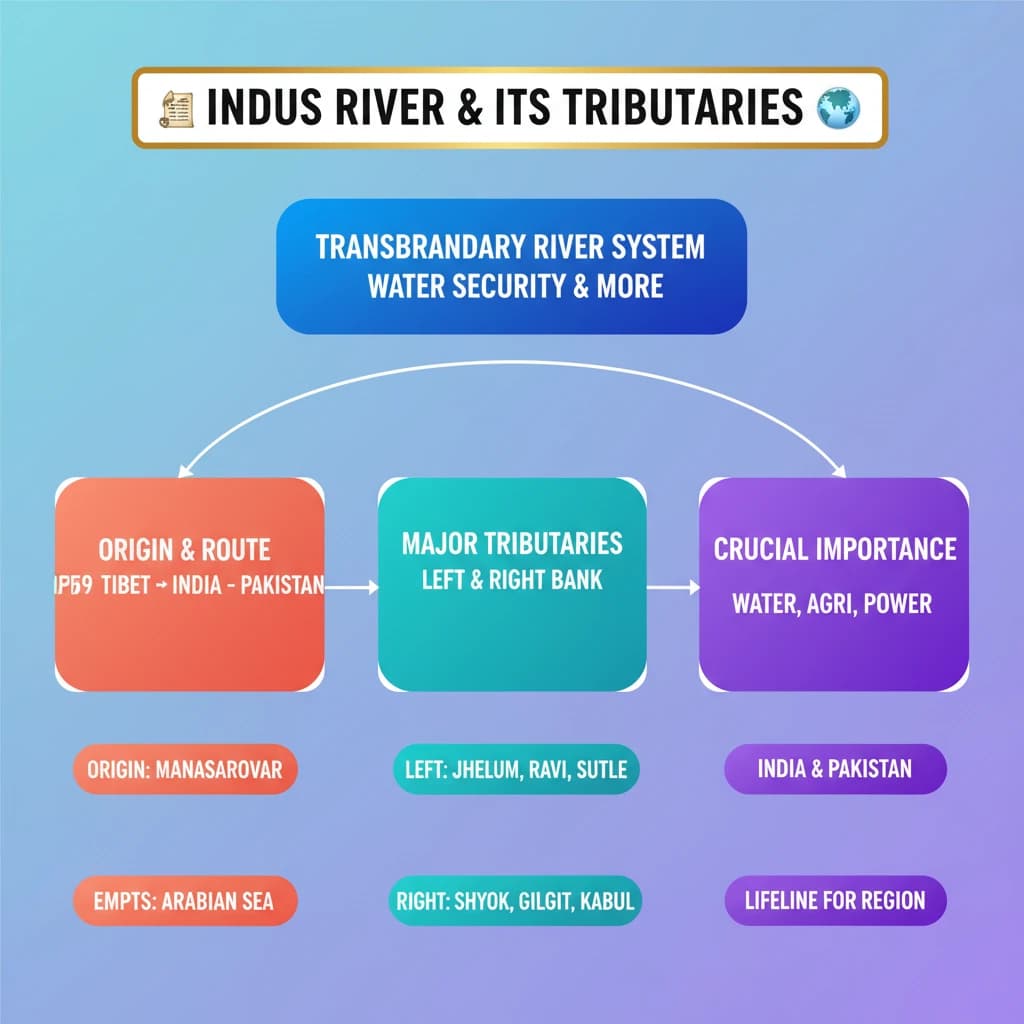
- •The Indus River originates in Tibet near Manasarovar Lake (Sengge Chu).
- •It flows through Tibet, India (Ladakh, J&K), and Pakistan, emptying into the Arabian Sea near Karachi.
- •Major left-bank tributaries: Zaskar, Suru, Soan, Jhelum, Chenab, Ravi, Beas, Satluj, Panjnad.
- •Major right-bank tributaries: Shyok, Gilgit, Hunza, Swat, Kunar, Kurram, Gomal, Kabul.
- •The Indus River System is crucial for water resources, agriculture, and hydroelectric power in India and Pakistan.
- •The Indus Water Treaty (1960) governs water sharing between India and Pakistan.
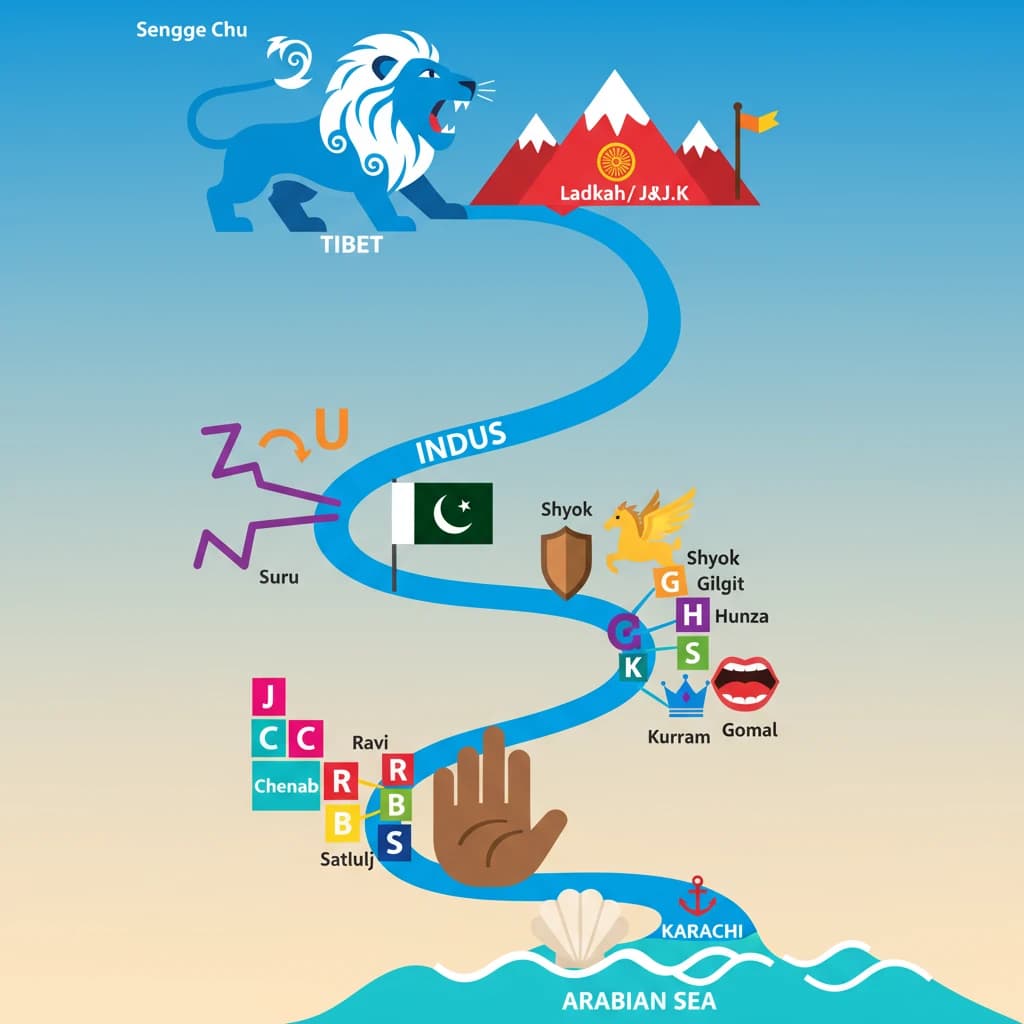
🧠 Memory Techniques
98% Verified Content
📚 Reference Sources
•NCERT Geography Textbooks (Class XI, India Physical Environment)
•Ministry of Jal Shakti, Government of India