Loading page, please wait…
International Treaties for Nuclear Programs - UPSC International Relations
What is International Treaties for Nuclear Programs in UPSC International Relations?
International Treaties for Nuclear Programs is a key topic under International Relations for UPSC Civil Services Examination. Key points include: Nuclear treaties aim to prevent proliferation, ban testing, and promote disarmament.. NPT is the cornerstone, distinguishing between Nuclear-Weapon States and Non-Nuclear-Weapon States.. PTBT banned tests in atmosphere, outer space, and underwater; CTBT aims for a comprehensive ban but is not in force.. Understanding this topic is essential for both UPSC Prelims and Mains preparation.
Why is International Treaties for Nuclear Programs important for UPSC exam?
International Treaties for Nuclear Programs is a Medium-level topic in UPSC International Relations. It is tested in both Prelims (factual MCQs) and Mains (analytical answer writing). Previous year UPSC questions have frequently covered aspects of International Treaties for Nuclear Programs, making it essential for comprehensive IAS preparation.
How to prepare International Treaties for Nuclear Programs for UPSC?
To prepare International Treaties for Nuclear Programs for UPSC: (1) Study the comprehensive notes covering all key concepts on Vaidra. (2) Practice previous year questions on this topic. (3) Connect it with current affairs using daily updates. (4) Revise using key takeaways and mind maps available for International Relations. (5) Write practice answers linking International Treaties for Nuclear Programs to related GS Paper topics.
Key takeaways of International Treaties for Nuclear Programs for UPSC
- Nuclear treaties aim to prevent proliferation, ban testing, and promote disarmament.
- NPT is the cornerstone, distinguishing between Nuclear-Weapon States and Non-Nuclear-Weapon States.
- PTBT banned tests in atmosphere, outer space, and underwater; CTBT aims for a comprehensive ban but is not in force.
- TPNW is a newer treaty explicitly prohibiting nuclear weapons, but lacks NWS participation.
- India has not signed NPT or CTBT, citing their discriminatory nature, while advocating for universal disarmament.
International Treaties for Nuclear Programs
Medium⏱️ 6 min read
international relations
📖 Introduction
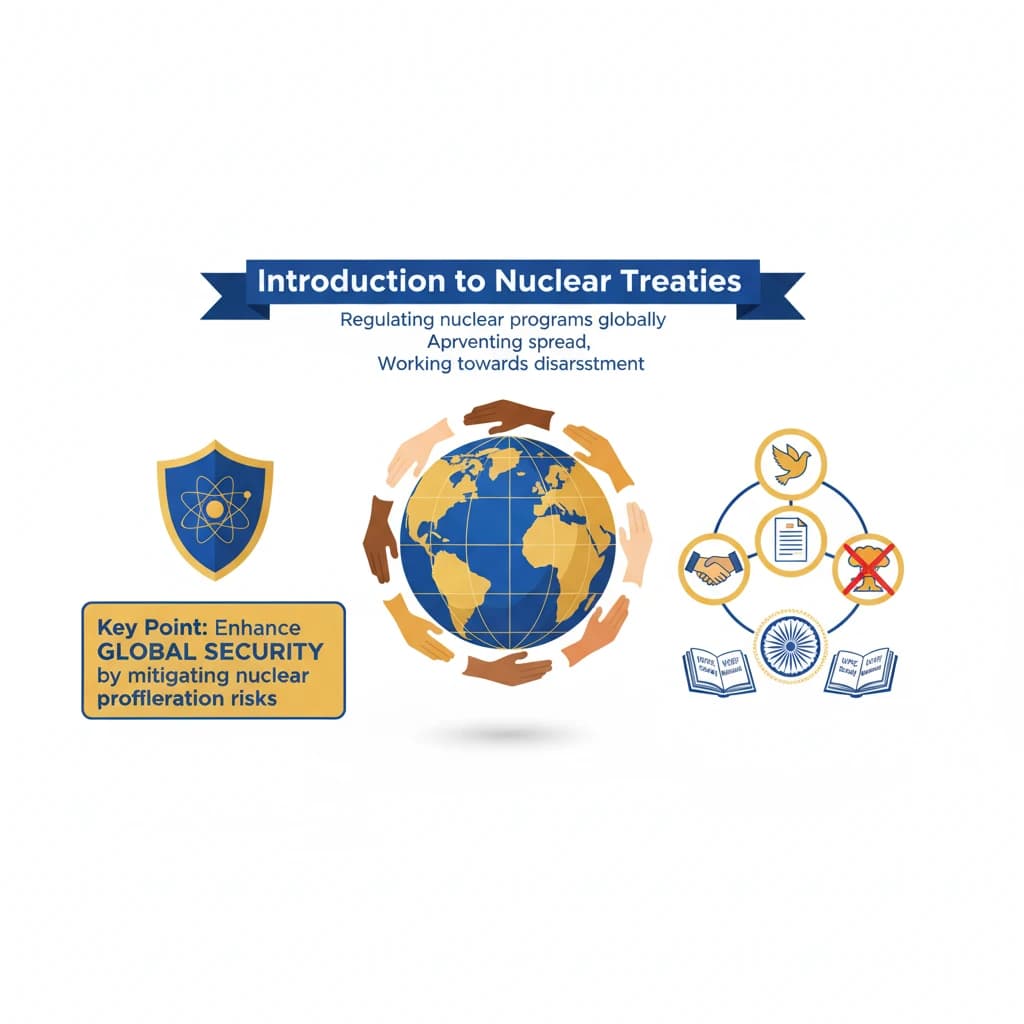
Introduction to Nuclear Treaties
International treaties play a crucial role in regulating nuclear programs globally. These agreements aim to prevent the spread of nuclear weapons, control their testing, and ultimately work towards disarmament.
The primary goal of these treaties is to enhance global security by mitigating the risks associated with nuclear proliferation and nuclear weapons testing.
The Treaty on the Non-Proliferation of Nuclear Weapons (NPT)
The NPT is a landmark international treaty whose objective is to prevent the spread of nuclear weapons and weapons technology, to promote cooperation in the peaceful uses of nuclear energy, and to further the goal of achieving nuclear disarmament.
It was opened for signature in 1968 and entered into force in 1970. It divides states into Nuclear-Weapon States (NWS) and Non-Nuclear-Weapon States (NNWS) based on whether they had tested a nuclear weapon before 1967.
UPSC often asks about India's stance on the NPT, as India is one of the few countries that has not signed it, citing its discriminatory nature.
Partial Test Ban Treaty (PTBT)
The Partial Test Ban Treaty (PTBT) was an early effort to limit nuclear testing. It specifically prohibited nuclear weapon tests in certain environments to reduce radioactive fallout.
Signed in 1963, the PTBT bans nuclear weapon tests in the atmosphere, outer space, and under water. Underground tests were still permitted under this treaty.
Comprehensive Nuclear Test Ban Treaty (CTBT)
Building upon the PTBT, the Comprehensive Nuclear Test Ban Treaty (CTBT) aims for a complete prohibition of all nuclear weapon test explosions. This includes tests conducted underground, which were allowed under the PTBT.
The CTBT was signed in 1996. However, it has not yet entered into force due to non-ratification by several key states, including India, Pakistan, North Korea, and others whose ratification is required for its entry into force.
Understanding the difference between PTBT and CTBT is crucial for Mains. Note the shift from partial to comprehensive bans.
Treaty on the Prohibition of Nuclear Weapons (TPNW)
The Treaty on the Prohibition of Nuclear Weapons (TPNW) represents a more recent and absolute approach to nuclear disarmament. It seeks to completely outlaw nuclear weapons, similar to how chemical and biological weapons are prohibited.
The TPNW was adopted in 2017 and entered into force on January 22nd, 2021. It prohibits states parties from developing, testing, producing, manufacturing, otherwise acquiring, possessing, or stockpiling nuclear weapons or other nuclear explosive devices.
Unlike the NPT, which aims to prevent proliferation, the TPNW directly seeks the total elimination of nuclear weapons. However, no nuclear-weapon states have signed the TPNW.
💡 Key Takeaways
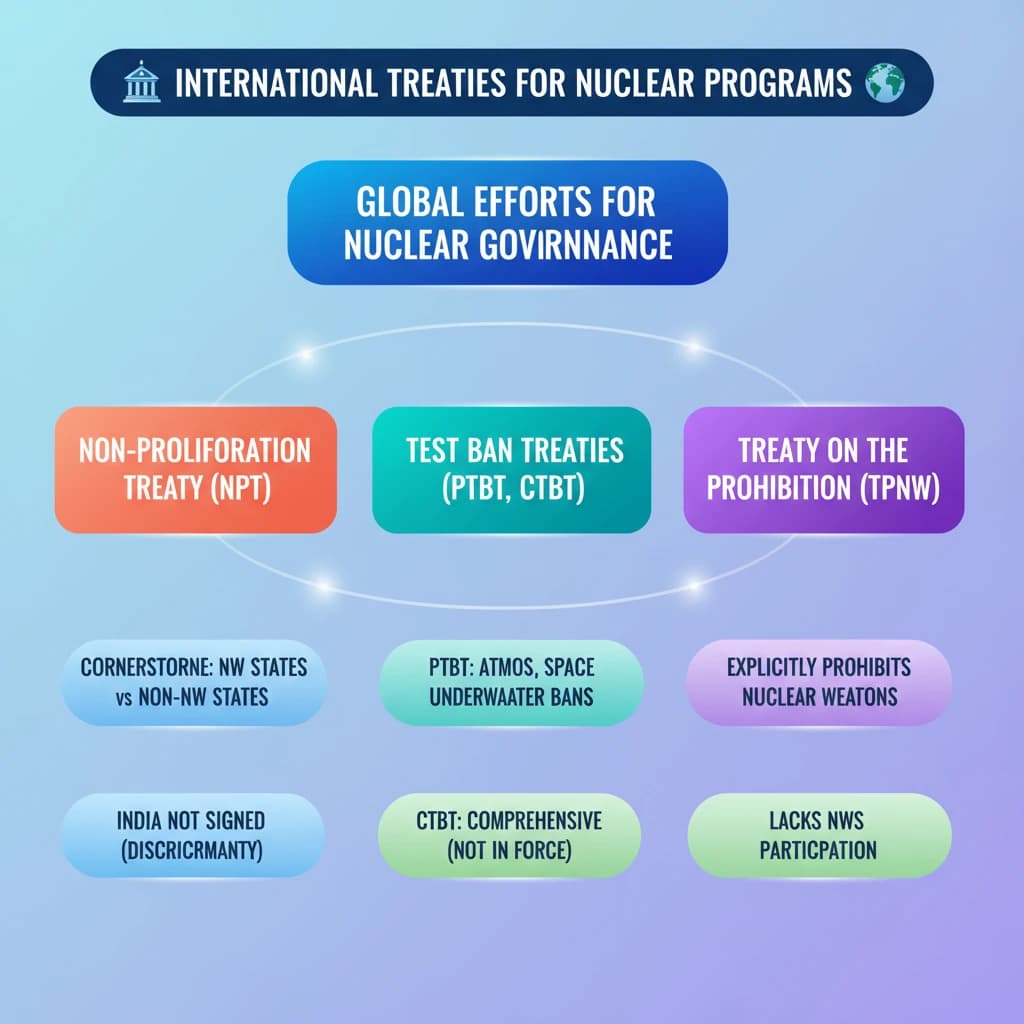
- •Nuclear treaties aim to prevent proliferation, ban testing, and promote disarmament.
- •NPT is the cornerstone, distinguishing between Nuclear-Weapon States and Non-Nuclear-Weapon States.
- •PTBT banned tests in atmosphere, outer space, and underwater; CTBT aims for a comprehensive ban but is not in force.
- •TPNW is a newer treaty explicitly prohibiting nuclear weapons, but lacks NWS participation.
- •India has not signed NPT or CTBT, citing their discriminatory nature, while advocating for universal disarmament.
🧠 Memory Techniques
95% Verified Content