Loading page, please wait…
IPEF Ministerial Meeting 2024 - UPSC International Relations
What is IPEF Ministerial Meeting 2024 in UPSC International Relations?
IPEF Ministerial Meeting 2024 is a key topic under International Relations for UPSC Civil Services Examination. Key points include: India participated in the IPEF Ministerial Meeting 2024 in Singapore, demonstrating Indo-Pacific economic engagement.. IPEF members signed three agreements: Clean Economy, Fair Economy, and an overarching IPEF Agreement.. India did not formally sign these agreements, citing ongoing domestic approval processes.. Understanding this topic is essential for both UPSC Prelims and Mains preparation.
Why is IPEF Ministerial Meeting 2024 important for UPSC exam?
IPEF Ministerial Meeting 2024 is a Medium-level topic in UPSC International Relations. It is tested in both Prelims (factual MCQs) and Mains (analytical answer writing). Previous year UPSC questions have frequently covered aspects of IPEF Ministerial Meeting 2024, making it essential for comprehensive IAS preparation.
How to prepare IPEF Ministerial Meeting 2024 for UPSC?
To prepare IPEF Ministerial Meeting 2024 for UPSC: (1) Study the comprehensive notes covering all key concepts on Vaidra. (2) Practice previous year questions on this topic. (3) Connect it with current affairs using daily updates. (4) Revise using key takeaways and mind maps available for International Relations. (5) Write practice answers linking IPEF Ministerial Meeting 2024 to related GS Paper topics.
Key takeaways of IPEF Ministerial Meeting 2024 for UPSC
- India participated in the IPEF Ministerial Meeting 2024 in Singapore, demonstrating Indo-Pacific economic engagement.
- IPEF members signed three agreements: Clean Economy, Fair Economy, and an overarching IPEF Agreement.
- India did not formally sign these agreements, citing ongoing domestic approval processes.
- Under the Clean Economy Agreement, India leads a 'Cooperative Work Programme' on e-waste urban mining.
- The IPEF Catalytic Capital Fund was launched with USD 33 million initial grant to catalyze USD 3.3 billion in private investment for clean projects.
- Under the Fair Economy Agreement, India offered a training program in Digital Forensics & Scam-Driven Risk Analysis.
- The IPEF Upskilling Initiative provided 10.5 million opportunities, with 4 million in India, focusing on women and girls.
IPEF Ministerial Meeting 2024
Medium⏱️ 7 min read
international relations
📖 Introduction
Introduction to the IPEF Ministerial Meeting 2024
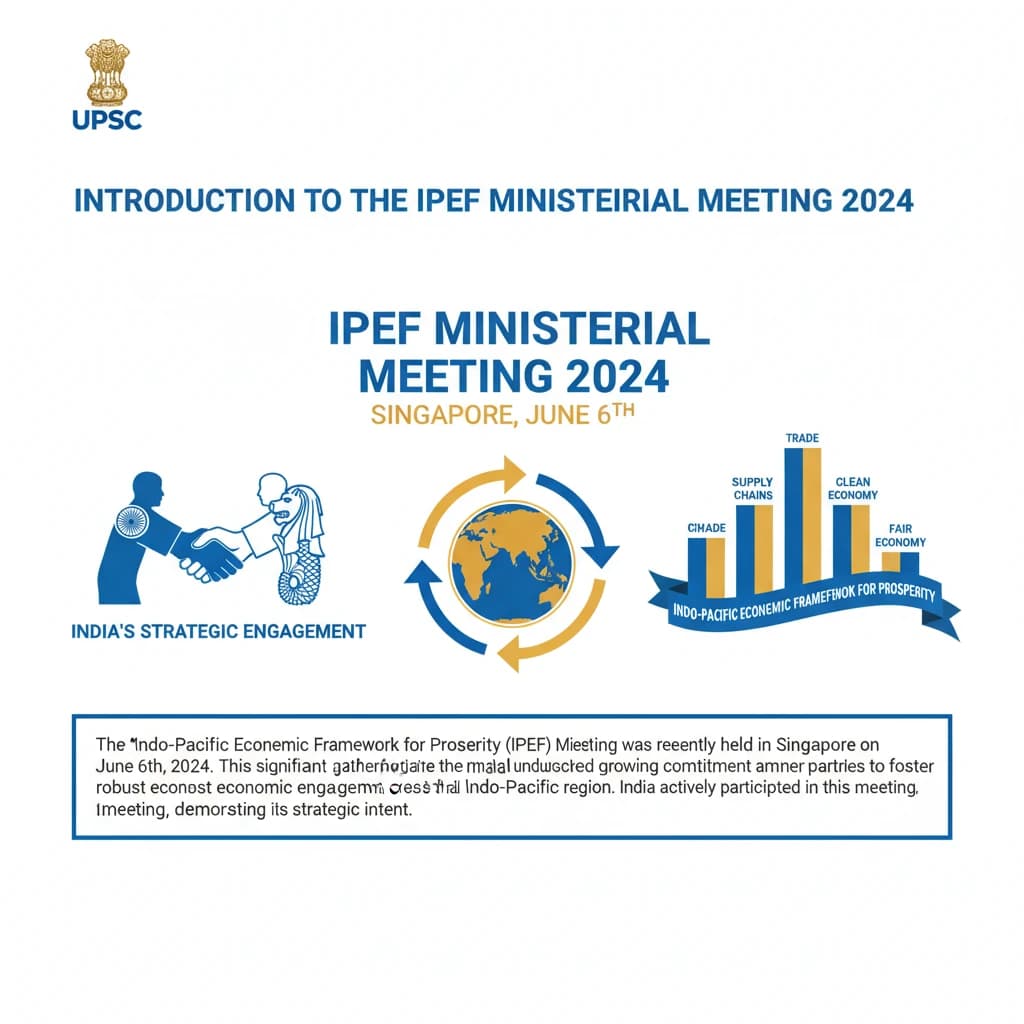
The Indo-Pacific Economic Framework for Prosperity (IPEF) Ministerial Meeting was recently held in Singapore on June 6th, 2024. This significant gathering underscored the growing commitment among partner countries to foster robust economic engagement across the vital Indo-Pacific region.
India actively participated in this meeting, demonstrating its strategic interest and proactive involvement in shaping regional economic architecture.
Event: IPEF Ministerial Meeting 2024
Location: Singapore
Date: June 6th, 2024
Key Participant: India
Key Outcomes and Agreements
During the meeting, IPEF members achieved a significant milestone by signing three crucial agreements. These agreements are centered around the Clean Economy, the Fair Economy, and an overarching IPEF Agreement, aiming to streamline economic cooperation.
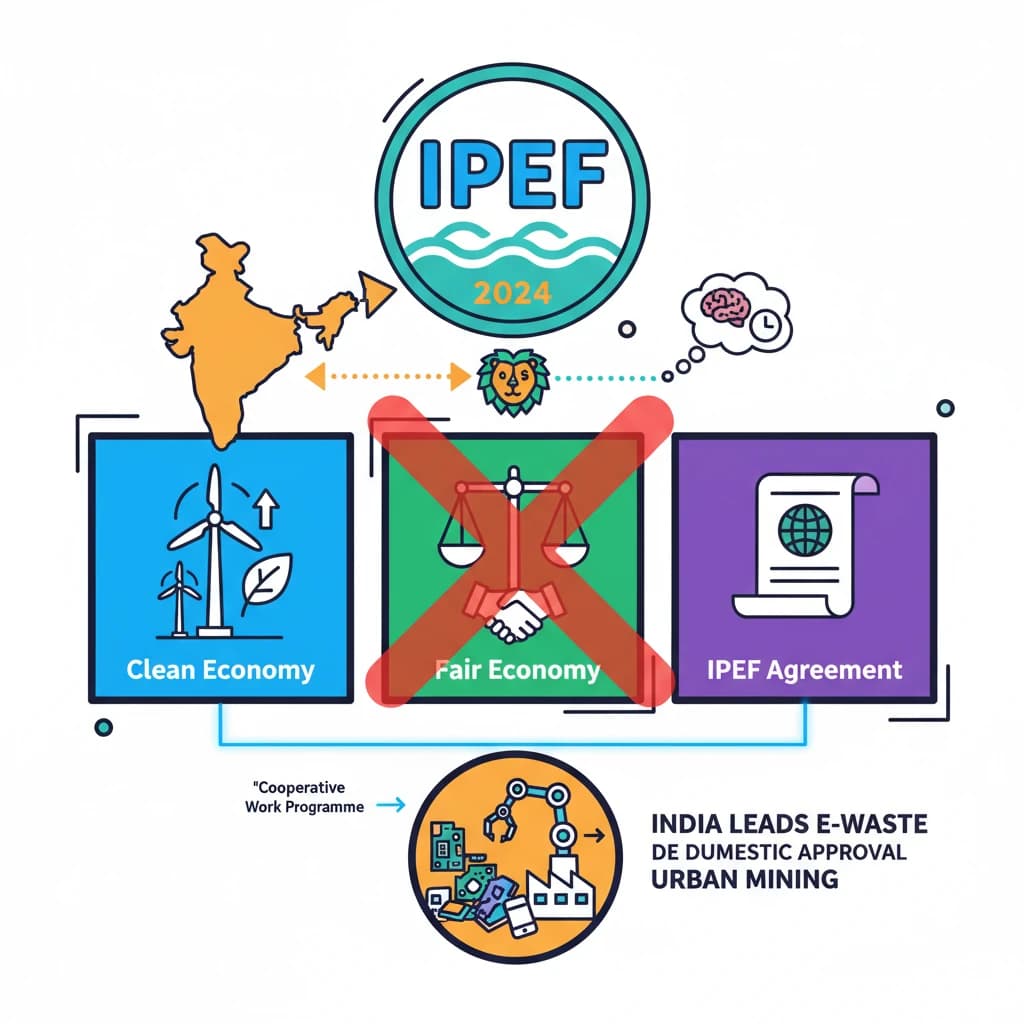
It is important to note that India did not formally sign these agreements at the meeting. The reason cited was that the domestic approval process for these frameworks is still underway within India.
The Clean Economy Agreement
The Clean Economy Agreement is designed to accelerate collective efforts towards achieving crucial environmental and energy goals. Its primary objectives include enhancing energy security, bolstering climate resilience, and significantly reducing Greenhouse Gas (GHG) emissions across the region.
India has taken a leading role under this pillar by launching a new collaborative initiative. This initiative is called the “Cooperative Work Programme” (CWP).
The Cooperative Work Programme (CWP) specifically focuses on recovering valuable resources from electronic waste. This process is commonly known as e-waste urban mining, highlighting a commitment to circular economy principles.
IPEF Catalytic Capital Fund
A major development under the Clean Economy pillar was the launch of the IPEF Catalytic Capital Fund. This fund is specifically designed to provide essential financial support for clean economy infrastructure projects in IPEF’s emerging and upper-middle-income economies.
The fund has garnered substantial backing from its founding supporters, which include Australia, Japan, Korea, and the United States. These nations have collectively provided an initial grant funding of USD 33 million.
The initial USD 33 million grant is strategically aimed at catalyzing a much larger sum: an estimated USD 3.3 billion in private investment for clean infrastructure projects.
The Fair Economy Agreement
The Fair Economy Agreement seeks to establish a more equitable and predictable business environment within the Indo-Pacific. Its core aims include fostering transparent business practices, promoting fair competition, and intensifying regional efforts against corruption.
Under this agreement, India has offered a significant contribution. It will provide a specialized training program to other IPEF partners.
India's training program is focused on Digital Forensics & Scam-Driven Risk Analysis. This initiative aims to enhance the capabilities of partner countries in combating financial fraud and cybercrime.
IPEF Upskilling Initiative
The IPEF Upskilling Initiative is a vital program focused on human capital development. It provides crucial digital skills training, with a particular emphasis on empowering women and girls in IPEF partner countries.
Over the past two years, this initiative has made remarkable progress, providing approximately 10.5 million upskilling opportunities across the participating nations.
Of the 10.5 million upskilling opportunities generated by the IPEF Upskilling Initiative, a substantial portion, approximately 4 million, were provided to beneficiaries within India.
💡 Key Takeaways
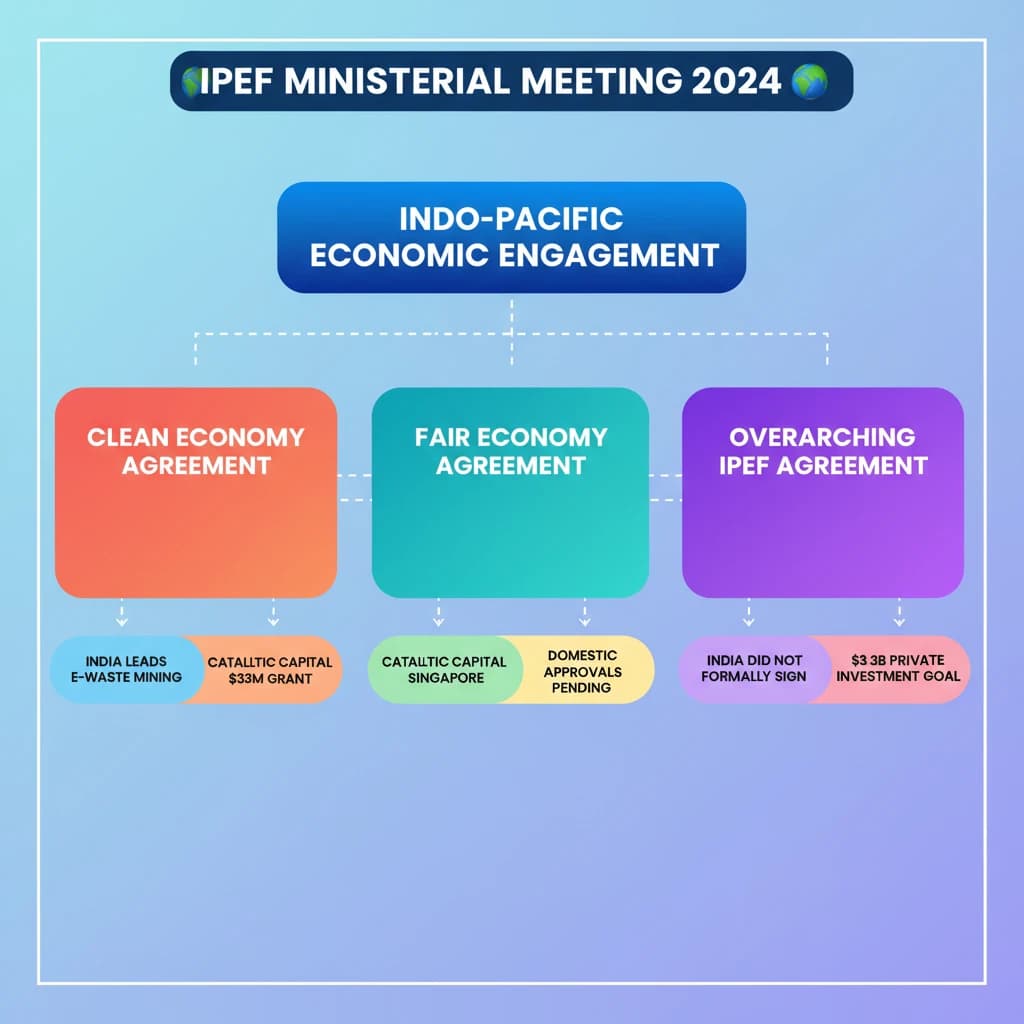
- •India participated in the IPEF Ministerial Meeting 2024 in Singapore, demonstrating Indo-Pacific economic engagement.
- •IPEF members signed three agreements: Clean Economy, Fair Economy, and an overarching IPEF Agreement.
- •India did not formally sign these agreements, citing ongoing domestic approval processes.
- •Under the Clean Economy Agreement, India leads a 'Cooperative Work Programme' on e-waste urban mining.
- •The IPEF Catalytic Capital Fund was launched with USD 33 million initial grant to catalyze USD 3.3 billion in private investment for clean projects.
- •Under the Fair Economy Agreement, India offered a training program in Digital Forensics & Scam-Driven Risk Analysis.
- •The IPEF Upskilling Initiative provided 10.5 million opportunities, with 4 million in India, focusing on women and girls.
🧠 Memory Techniques
95% Verified Content