Loading page, please wait…
Issue of Indians Jailed Abroad - UPSC International Relations
What is Issue of Indians Jailed Abroad in UPSC International Relations?
Issue of Indians Jailed Abroad is a key topic under International Relations for UPSC Civil Services Examination. Key points include: Over 9,500 Indians are jailed abroad, with the Middle East and Asia having the highest concentrations.. Saudi Arabia (2,200) and Nepal (1,227) host the largest numbers of Indian prisoners in their respective regions.. Government provides legal assistance through local lawyer panels and the Indian Community Welfare Fund (ICWF).. Understanding this topic is essential for both UPSC Prelims and Mains preparation.
Why is Issue of Indians Jailed Abroad important for UPSC exam?
Issue of Indians Jailed Abroad is a Medium-level topic in UPSC International Relations. It is tested in both Prelims (factual MCQs) and Mains (analytical answer writing). Previous year UPSC questions have frequently covered aspects of Issue of Indians Jailed Abroad, making it essential for comprehensive IAS preparation.
How to prepare Issue of Indians Jailed Abroad for UPSC?
To prepare Issue of Indians Jailed Abroad for UPSC: (1) Study the comprehensive notes covering all key concepts on Vaidra. (2) Practice previous year questions on this topic. (3) Connect it with current affairs using daily updates. (4) Revise using key takeaways and mind maps available for International Relations. (5) Write practice answers linking Issue of Indians Jailed Abroad to related GS Paper topics.
Key takeaways of Issue of Indians Jailed Abroad for UPSC
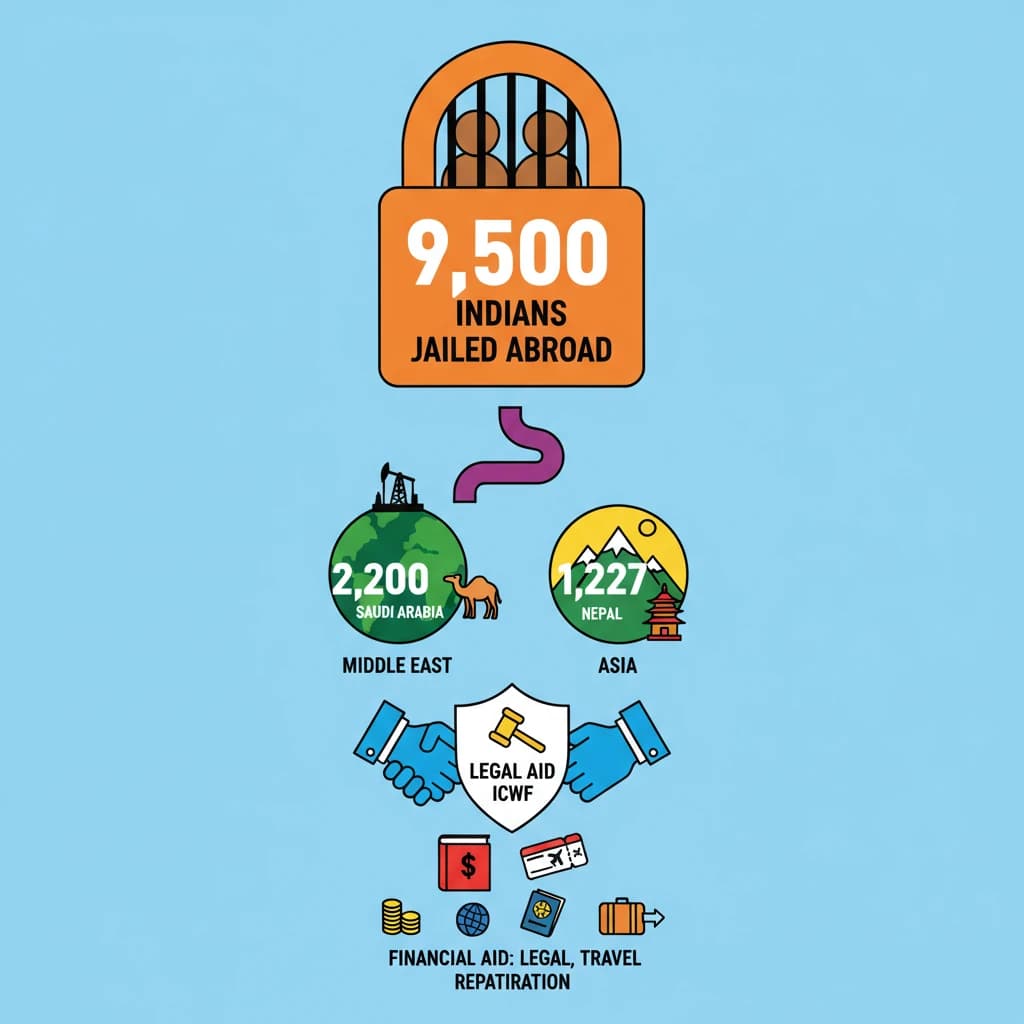
- Over 9,500 Indians are jailed abroad, with the Middle East and Asia having the highest concentrations.
- Saudi Arabia (2,200) and Nepal (1,227) host the largest numbers of Indian prisoners in their respective regions.
- Government provides legal assistance through local lawyer panels and the Indian Community Welfare Fund (ICWF).
- ICWF offers financial aid for legal costs, travel documents, and repatriation for distressed overseas Indians.
- India actively pursues pardons/sentence reductions, resulting in 4,597 such cases since 2014.
- Transfer of Sentenced Persons (TSP) Agreements with 31 countries allow prisoners to serve sentences in their home country.
- India is also a signatory to multilateral TSP conventions, broadening its humanitarian efforts.
Issue of Indians Jailed Abroad
Medium⏱️ 8 min read
international relations
📖 Introduction
Context and Scale of the Issue
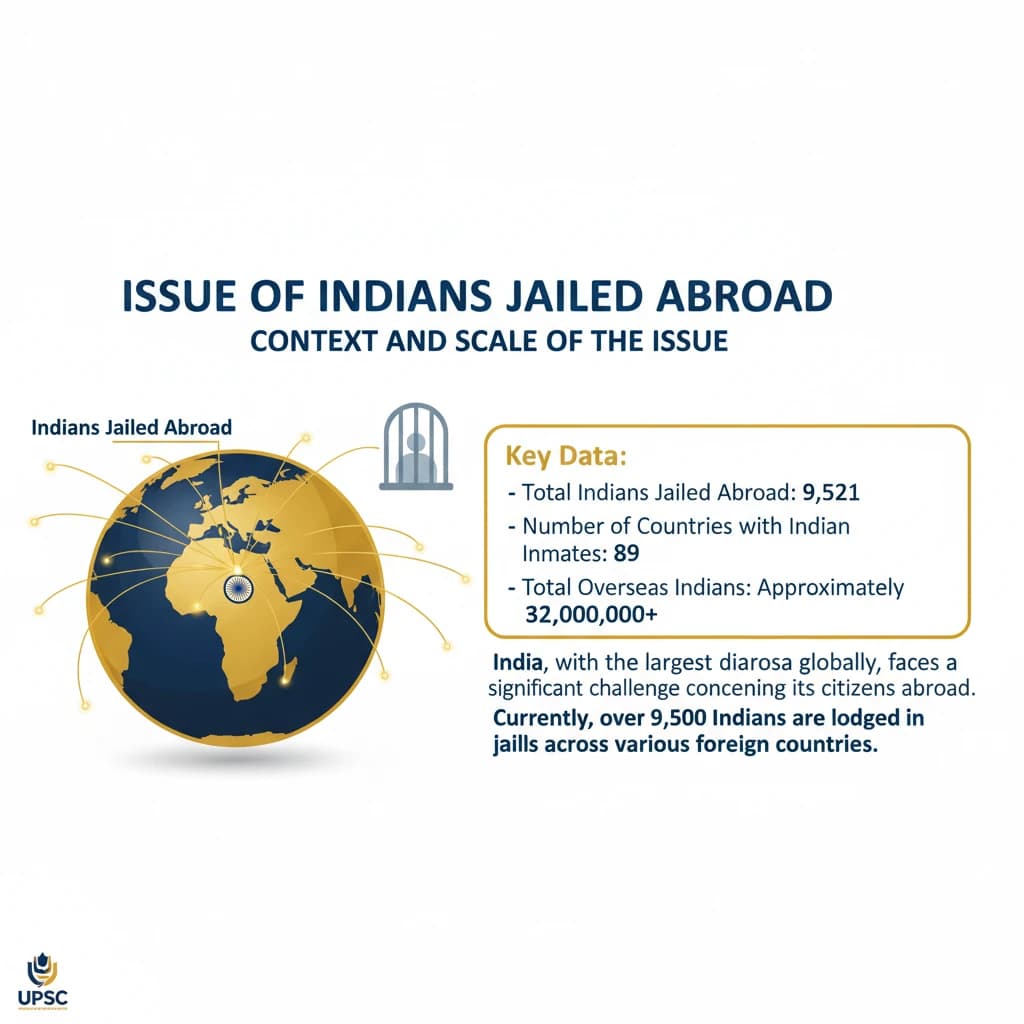
India, with the largest diaspora globally, faces a significant challenge concerning its citizens abroad. Currently, over 9,500 Indians are lodged in jails across various foreign countries.
Key Data:
- Total Indians Jailed Abroad: 9,521
- Number of Countries with Indian Inmates: 89
- Total Overseas Indians: Approximately 3.2 crore across 210 countries (MEA data).
Geographical Distribution of Indian Prisoners
The majority of Indian prisoners are concentrated in specific regions, primarily the Middle East and Asia, reflecting major destinations for Indian migrant workers and expatriates.
Middle East Concentration
More than 62% of all Indian prisoners abroad are held in the Middle East. This region has the highest number of Indian inmates, indicating strong economic ties and labor migration.
Top Countries in Middle East:
- Saudi Arabia: 2,200 prisoners (highest globally)
- United Arab Emirates (UAE): Significant numbers
- Qatar: 752 prisoners (third-largest population in the region)
- Other notable countries: Kuwait, Bahrain, Oman
Asian Countries with Indian Prisoners
Following the Middle East, Asia accounts for a substantial portion of Indian prisoners, representing over 23% of the total. These numbers often reflect proximity and regional migration patterns.
Top Countries in Asia:
- Nepal: 1,227 prisoners (highest in Asia)
- Other notable countries: Malaysia, Pakistan, China, Singapore, Bhutan, Bangladesh
European and Other Regions
While smaller in comparison, European countries also house a notable number of Indian prisoners. The reasons can vary from immigration issues to criminal offenses.
Top Countries in Europe:
- United Kingdom (UK): 278 prisoners (highest in Europe)
- Other notable countries: Italy, Germany, France, Spain
Government Steps for Assistance to Prisoners Abroad
The Government of India, primarily through the Ministry of External Affairs (MEA) and its missions, implements various measures to provide legal, financial, and diplomatic assistance to Indian nationals in foreign prisons.
Legal Assistance Mechanisms
Indian Missions and Posts abroad play a crucial role in ensuring legal support for distressed citizens. They maintain a network of legal professionals to assist inmates.
- Local Panel of Lawyers: Missions maintain a panel of lawyers in countries with significant Indian populations.
- No Fee Charged: Legal facilities extended by the Embassy are provided free of charge to the prisoners.
Indian Community Welfare Fund (ICWF):
The ICWF is a vital fund established at Missions and Posts abroad. It provides financial assistance to overseas Indian nationals facing distress, including those in prisons.
- Financial Aid: Covers legal aid expenses.
- Repatriation Support: Provides funds for travel documents and air tickets for repatriation.
Repatriation Efforts
The government actively pursues the release and repatriation of Indian nationals. This involves diplomatic engagements and consular consultations with host countries.
- Diplomatic Follow-up: The issue is regularly raised during consular and bilateral consultations.
Pardon and Sentence Reduction
Efforts are also made to secure pardons or reductions in sentences for Indian prisoners through diplomatic channels. This often depends on the laws and policies of the foreign government.
Impact of Government Efforts:
- Since 2014, 4,597 Indian nationals have received pardons or sentence reductions due to the Indian Government's interventions.
Agreement(s) on Transfer of Sentenced Persons (TSP)
The Transfer of Sentenced Persons (TSP) Agreements are crucial bilateral and multilateral instruments that allow Indian prisoners to serve the remainder of their sentences in India, and vice-versa for foreign nationals.
Purpose of TSP Agreements:
These agreements facilitate the transfer of prisoners, enabling them to be closer to their families and cultural environment, and often aiding in their rehabilitation.
India has signed TSP agreements with a significant number of countries, reflecting a global commitment to humanitarian considerations for prisoners.
Countries with Bilateral TSP Agreements (31):
- Australia, Bahrain, Bangladesh, Bosnia & Herzegovina, Brazil, Bulgaria, Cambodia, Egypt, Estonia, France, Hong Kong, Iran, Israel, Italy, Kazakhstan, Korea, Kuwait, Maldives, Mauritius, Mongolia, Qatar, Russia, Saudi Arabia, Somalia, Spain, Sri Lanka, Thailand, Turkey, United Arab Emirates (UAE), United Kingdom, Vietnam.
Beyond bilateral agreements, India is also a signatory to multilateral conventions that facilitate the transfer of sentenced persons, broadening the scope of such humanitarian efforts.
Multilateral Conventions:
- Inter-American Convention on Serving Criminal Sentences Abroad
- Council of Europe Convention on the Transfer of Sentenced Persons
UPSC Insight: Understanding the mechanisms like ICWF and TSP Agreements is crucial for Mains GS-2. Questions can focus on India's diaspora policy, human rights, and consular diplomacy. Be prepared to discuss both the challenges and the government's proactive steps.
💡 Key Takeaways
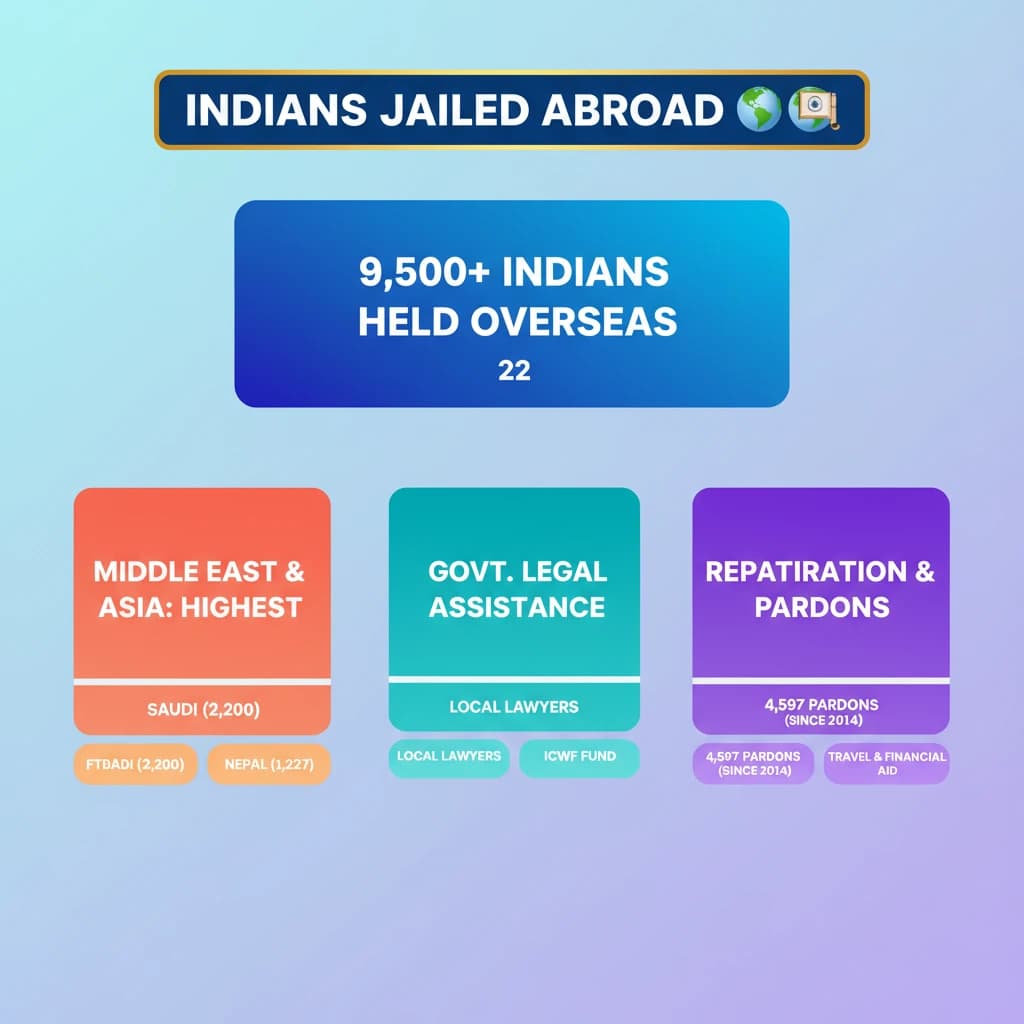
- •Over 9,500 Indians are jailed abroad, with the Middle East and Asia having the highest concentrations.
- •Saudi Arabia (2,200) and Nepal (1,227) host the largest numbers of Indian prisoners in their respective regions.
- •Government provides legal assistance through local lawyer panels and the Indian Community Welfare Fund (ICWF).
- •ICWF offers financial aid for legal costs, travel documents, and repatriation for distressed overseas Indians.
- •India actively pursues pardons/sentence reductions, resulting in 4,597 such cases since 2014.
- •Transfer of Sentenced Persons (TSP) Agreements with 31 countries allow prisoners to serve sentences in their home country.
- •India is also a signatory to multilateral TSP conventions, broadening its humanitarian efforts.
🧠 Memory Techniques
95% Verified Content
📚 Reference Sources
•Ministry of External Affairs (MEA) Reports and Public Statements (implied by content)