Loading page, please wait…
Kalapani Territorial Dispute: Nepal's Claims and Historical Context - UPSC International Relations
What is Kalapani Territorial Dispute: Nepal's Claims and Historical Context in UPSC International Relations?
Kalapani Territorial Dispute: Nepal's Claims and Historical Context is a key topic under International Relations for UPSC Civil Services Examination. Key points include: Kalapani is a disputed territory between India and Nepal.. Nepal claims the Kali River originates at Limpiyadhura, placing Kalapani, Limpiyadhura, and Lipu Lekh within its Dharchula district.. Historically, King Mahendra of Nepal reportedly offered Kalapani to India after the 1962 India-China war for security reasons.. Understanding this topic is essential for both UPSC Prelims and Mains preparation.
Why is Kalapani Territorial Dispute: Nepal's Claims and Historical Context important for UPSC exam?
Kalapani Territorial Dispute: Nepal's Claims and Historical Context is a Medium-level topic in UPSC International Relations. It is tested in both Prelims (factual MCQs) and Mains (analytical answer writing). Previous year UPSC questions have frequently covered aspects of Kalapani Territorial Dispute: Nepal's Claims and Historical Context, making it essential for comprehensive IAS preparation.
How to prepare Kalapani Territorial Dispute: Nepal's Claims and Historical Context for UPSC?
To prepare Kalapani Territorial Dispute: Nepal's Claims and Historical Context for UPSC: (1) Study the comprehensive notes covering all key concepts on Vaidra. (2) Practice previous year questions on this topic. (3) Connect it with current affairs using daily updates. (4) Revise using key takeaways and mind maps available for International Relations. (5) Write practice answers linking Kalapani Territorial Dispute: Nepal's Claims and Historical Context to related GS Paper topics.
Key takeaways of Kalapani Territorial Dispute: Nepal's Claims and Historical Context for UPSC
- Kalapani is a disputed territory between India and Nepal.
- Nepal claims the Kali River originates at Limpiyadhura, placing Kalapani, Limpiyadhura, and Lipu Lekh within its Dharchula district.
- Historically, King Mahendra of Nepal reportedly offered Kalapani to India after the 1962 India-China war for security reasons.
- The dispute stems from differing interpretations of the 1816 Treaty of Sugauli regarding the Kali River's origin.
- The region holds strategic importance due to its location at the India-China-Nepal trijunction.
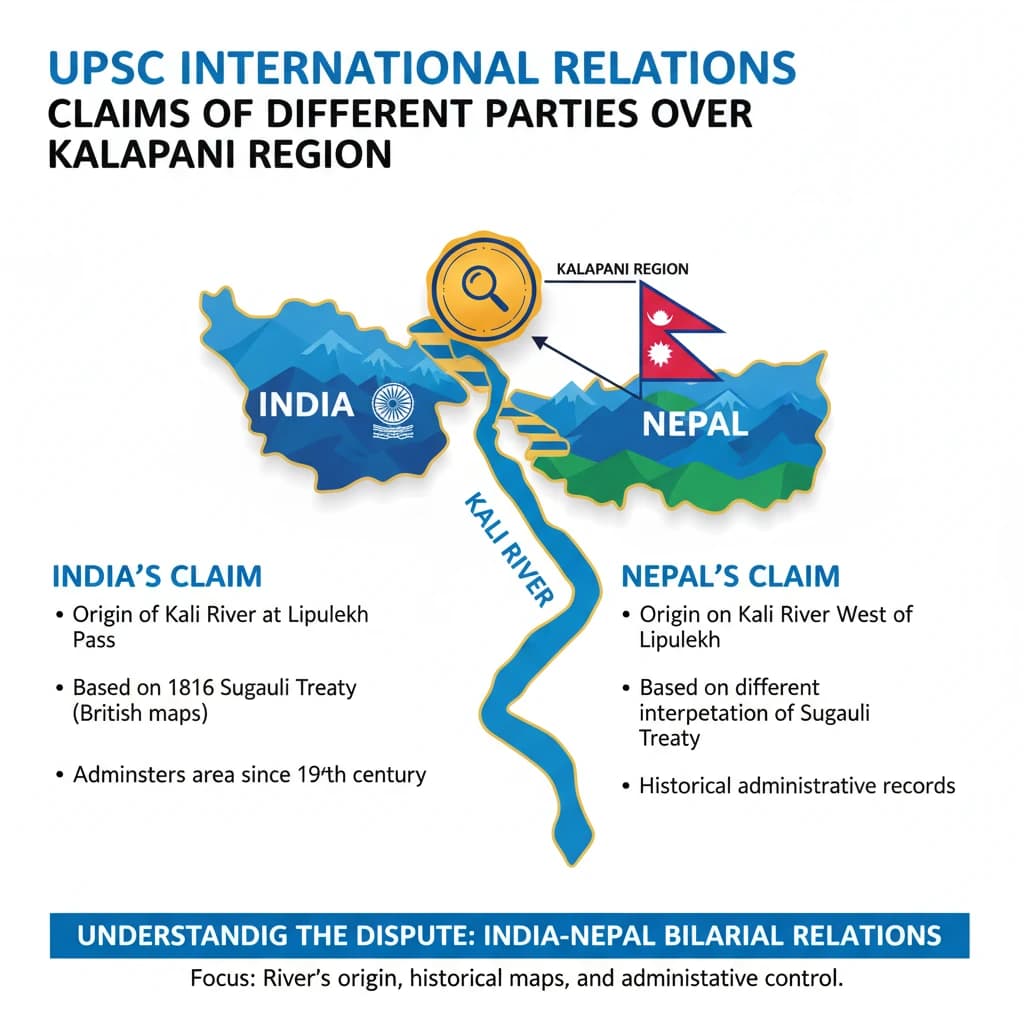
Kalapani Territorial Dispute: Nepal's Claims and Historical Context
Medium⏱️ 6 min read
international relations
📖 Introduction
Understanding the Kalapani Region Dispute
The Kalapani region is a significant area of contention between India and Nepal. This dispute primarily revolves around the origin of the Kali River, which forms a natural boundary between the two nations.
Understanding the claims of both parties is crucial for comprehending the complexities of India-Nepal bilateral relations and regional geopolitics.
Nepal's Core Claim on Kalapani
Nepal's primary claim asserts that the Kali River originates from a stream located at Limpiyadhura. This specific point is situated to the northwest of Lipu Lekh, a mountain pass.
According to Nepal's perspective, if the Kali River originates at Limpiyadhura, then the territories lying to the east of this river should rightfully belong to Nepal.
Consequently, Nepal claims that Kalapani, Limpiyadhura, and Lipu Lekh all fall to the east of the river's main course. Therefore, these areas are considered integral parts of Nepal's Dharchula district.
Historical Context of Nepal's Stance
A notable aspect of Nepal's claim involves a historical offer. Following the 1962 India-China war, King Mahendra of Nepal reportedly offered the territory of Kalapani to India.
This offer was made to assist India with its security concerns. It was driven by the perceived lingering threats from China in the aftermath of the conflict.
UPSC Insight: The Kalapani dispute highlights the importance of historical treaties and geographical interpretations in border demarcations. Candidates should be prepared to analyze both historical and contemporary aspects of such disputes in GS Paper 2 (International Relations).
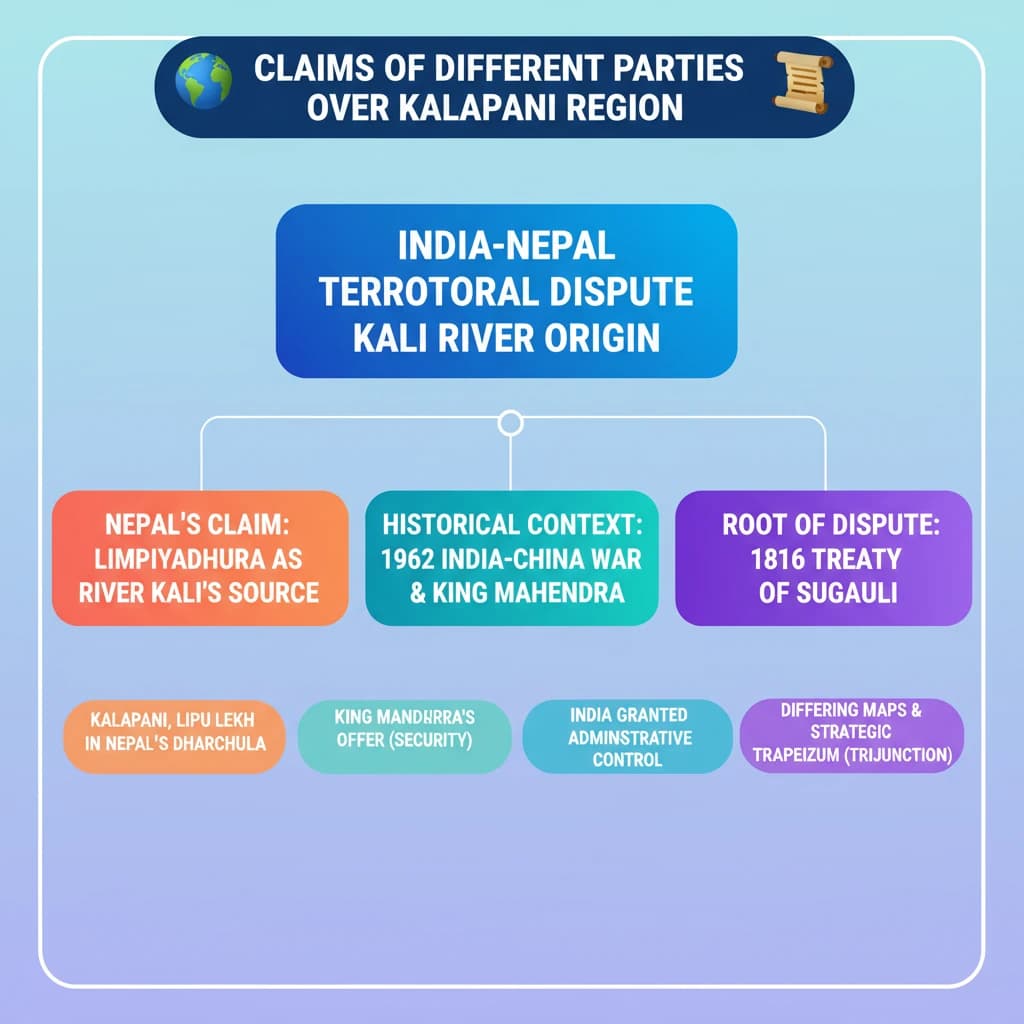
💡 Key Takeaways
- •Kalapani is a disputed territory between India and Nepal.
- •Nepal claims the Kali River originates at Limpiyadhura, placing Kalapani, Limpiyadhura, and Lipu Lekh within its Dharchula district.
- •Historically, King Mahendra of Nepal reportedly offered Kalapani to India after the 1962 India-China war for security reasons.
- •The dispute stems from differing interpretations of the 1816 Treaty of Sugauli regarding the Kali River's origin.
- •The region holds strategic importance due to its location at the India-China-Nepal trijunction.
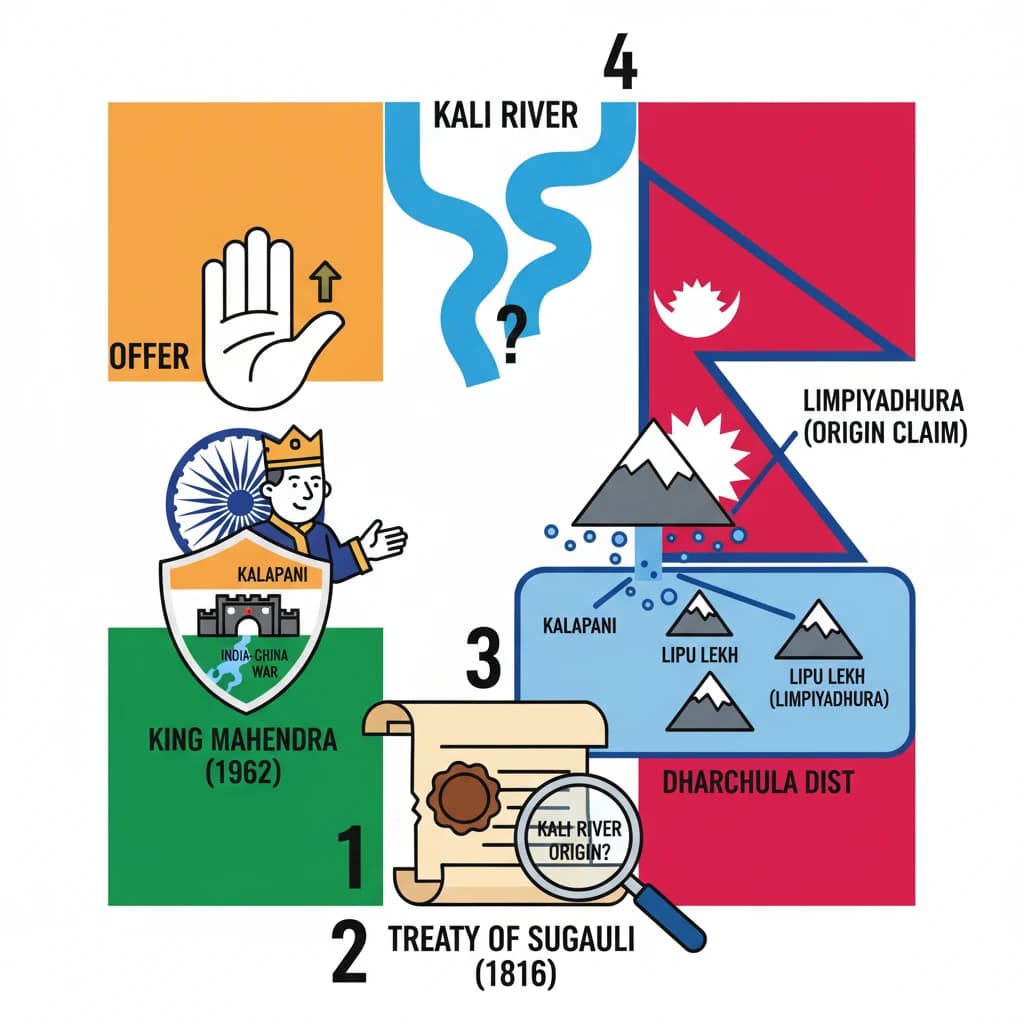
🧠 Memory Techniques
90% Verified Content
📚 Reference Sources
•General knowledge of India-Nepal border disputes and the Treaty of Sugauli
•Public domain information on the 1962 India-China War and its aftermath