Loading page, please wait…
Katchatheevu Island - UPSC International Relations
What is Katchatheevu Island in UPSC International Relations?
Katchatheevu Island is a key topic under International Relations for UPSC Civil Services Examination. Key points include: Katchatheevu is a small, uninhabited island in the Palk Strait, ceded to Sri Lanka by India through agreements in 1974 and 1976.. The core of the dispute revolves around traditional fishing rights of Indian (Tamil Nadu) fishermen in waters around Katchatheevu, leading to frequent arrests by the Sri Lankan Navy.. India considers Katchatheevu's sovereignty a settled matter under international law, while political parties in Tamil Nadu often demand its retrieval or renegotiation of fishing rights.. Understanding this topic is essential for both UPSC Prelims and Mains preparation.
Why is Katchatheevu Island important for UPSC exam?
Katchatheevu Island is a Medium-level topic in UPSC International Relations. It is tested in both Prelims (factual MCQs) and Mains (analytical answer writing). Previous year UPSC questions have frequently covered aspects of Katchatheevu Island, making it essential for comprehensive IAS preparation.
How to prepare Katchatheevu Island for UPSC?
To prepare Katchatheevu Island for UPSC: (1) Study the comprehensive notes covering all key concepts on Vaidra. (2) Practice previous year questions on this topic. (3) Connect it with current affairs using daily updates. (4) Revise using key takeaways and mind maps available for International Relations. (5) Write practice answers linking Katchatheevu Island to related GS Paper topics.
Key takeaways of Katchatheevu Island for UPSC
- Katchatheevu is a small, uninhabited island in the Palk Strait, ceded to Sri Lanka by India through agreements in 1974 and 1976.
- The core of the dispute revolves around traditional fishing rights of Indian (Tamil Nadu) fishermen in waters around Katchatheevu, leading to frequent arrests by the Sri Lankan Navy.
- India considers Katchatheevu's sovereignty a settled matter under international law, while political parties in Tamil Nadu often demand its retrieval or renegotiation of fishing rights.
- The issue consistently strains India-Sri Lanka bilateral relations but is managed through ongoing diplomatic channels and efforts to promote sustainable fishing practices.
- It exemplifies the complex interplay of maritime boundaries, livelihoods, historical claims, and the influence of domestic politics on foreign policy.
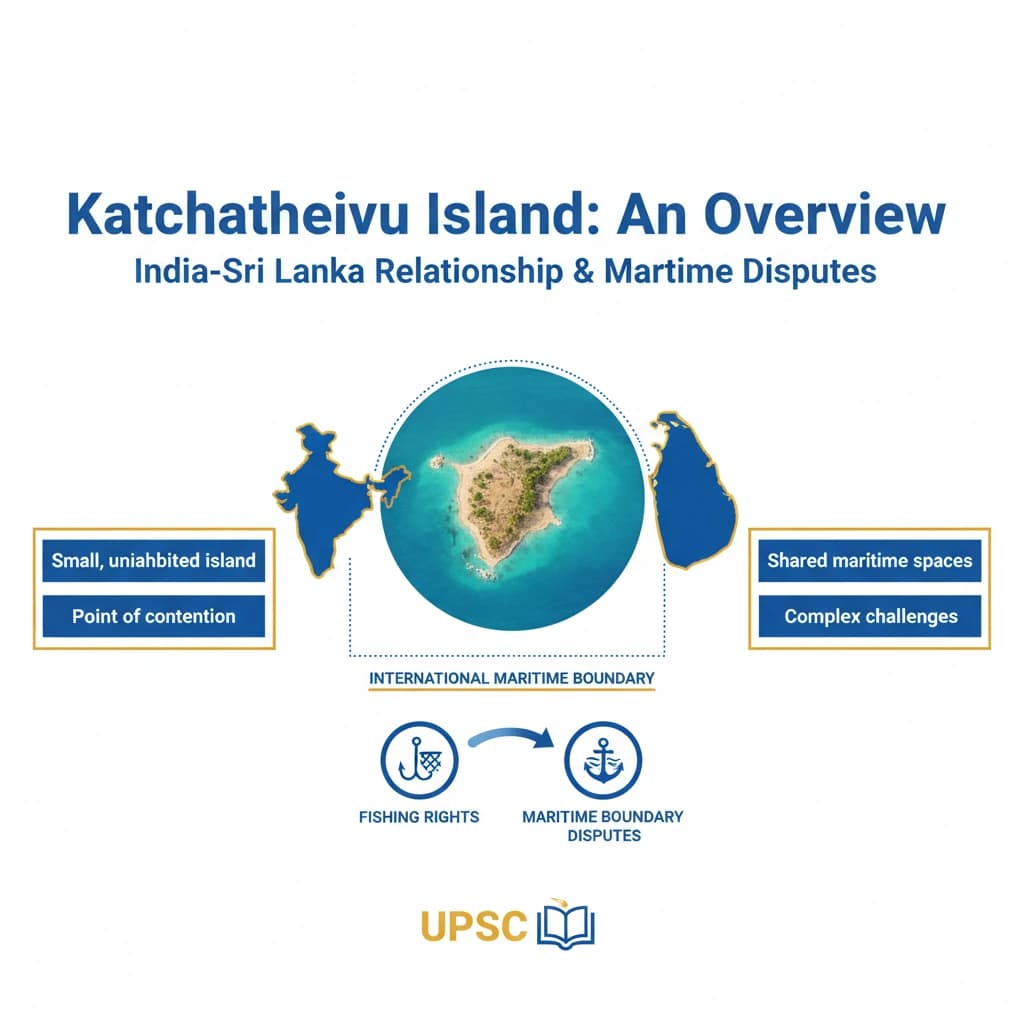
Katchatheevu Island
Medium⏱️ 8 min read
international relations
📖 Introduction
Katchatheevu Island: An Overview
The Katchatheevu Island has garnered significant attention due to its central role in the complex India-Sri Lanka relationship. It represents a persistent point of contention, primarily concerning maritime boundary disputes and the contentious issue of fishing rights.
This small, uninhabited island highlights the intricate challenges involved in managing shared maritime spaces and the livelihoods of traditional fishing communities.
Geographical Location and Strategic Importance
Katchatheevu is located in the Palk Strait, a narrow strip of water separating the Indian state of Tamil Nadu from Sri Lanka. Its position is strategically significant for both nations.
It lies approximately 16 nautical miles (30 km) southwest of Jaffna, Sri Lanka, and about 10.5 nautical miles (19 km) northeast of Rameswaram, India.
Location: Palk Strait, between India and Sri Lanka.
Area: Approximately 285 acres (1.15 sq km).
Status: Uninhabited, ceded to Sri Lanka in 1974.
The Contentious Fishing Rights Issue
The most prominent aspect of the Katchatheevu dispute is the issue of traditional fishing rights. Indian fishermen, particularly from Tamil Nadu, have historically fished in the rich waters around the island.
Despite the island being formally ceded to Sri Lanka, these fishermen continue to venture into these waters, often leading to confrontations with the Sri Lankan Navy.
Maritime Boundary Disputes and Demarcation
The status of Katchatheevu became a key factor in the demarcation of the maritime boundary between India and Sri Lanka. Agreements in 1974 and 1976 formally established the International Maritime Boundary Line (IMBL).
These agreements placed Katchatheevu firmly on the Sri Lankan side of the IMBL, thereby restricting Indian fishermen's access to what they consider their traditional fishing grounds.
The Katchatheevu Island issue encapsulates the complexities of historical claims, national sovereignty, international maritime law, and the crucial aspect of livelihoods of fishing communities in bilateral relations.
Impact on India-Sri Lanka Relations
The recurring incidents of Indian fishermen being arrested by the Sri Lankan Navy frequently strain India-Sri Lanka relations. These events often trigger strong political reactions in Tamil Nadu and become a significant domestic issue in India.
Both governments face continuous pressure to find a sustainable and mutually acceptable solution that respects national sovereignty while protecting the economic interests and safety of their respective fishing populations.
When addressing India-Sri Lanka relations in UPSC Mains (GS Paper 2), the Katchatheevu issue and associated fishing rights are critical examples to illustrate ongoing challenges and areas of diplomatic engagement.
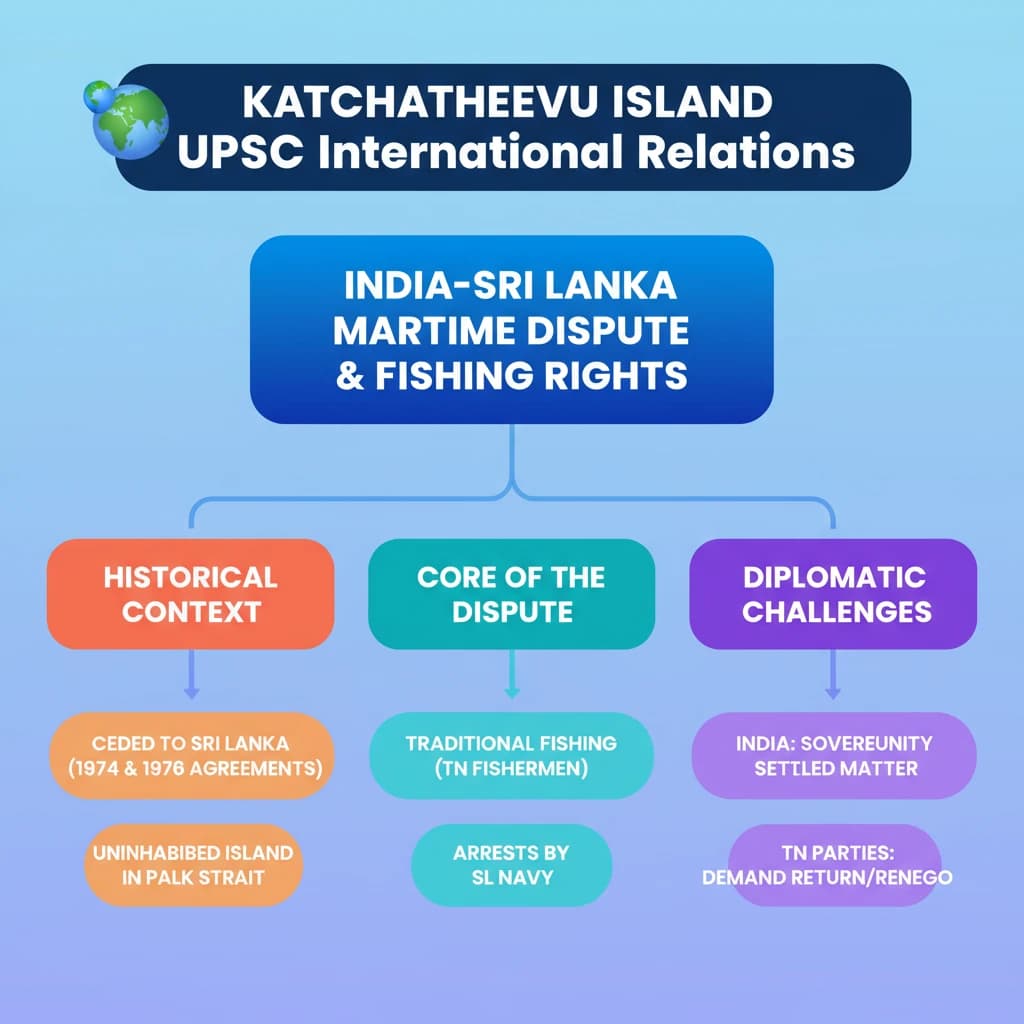
💡 Key Takeaways
- •Katchatheevu is a small, uninhabited island in the Palk Strait, ceded to Sri Lanka by India through agreements in 1974 and 1976.
- •The core of the dispute revolves around traditional fishing rights of Indian (Tamil Nadu) fishermen in waters around Katchatheevu, leading to frequent arrests by the Sri Lankan Navy.
- •India considers Katchatheevu's sovereignty a settled matter under international law, while political parties in Tamil Nadu often demand its retrieval or renegotiation of fishing rights.
- •The issue consistently strains India-Sri Lanka bilateral relations but is managed through ongoing diplomatic channels and efforts to promote sustainable fishing practices.
- •It exemplifies the complex interplay of maritime boundaries, livelihoods, historical claims, and the influence of domestic politics on foreign policy.
🧠 Memory Techniques
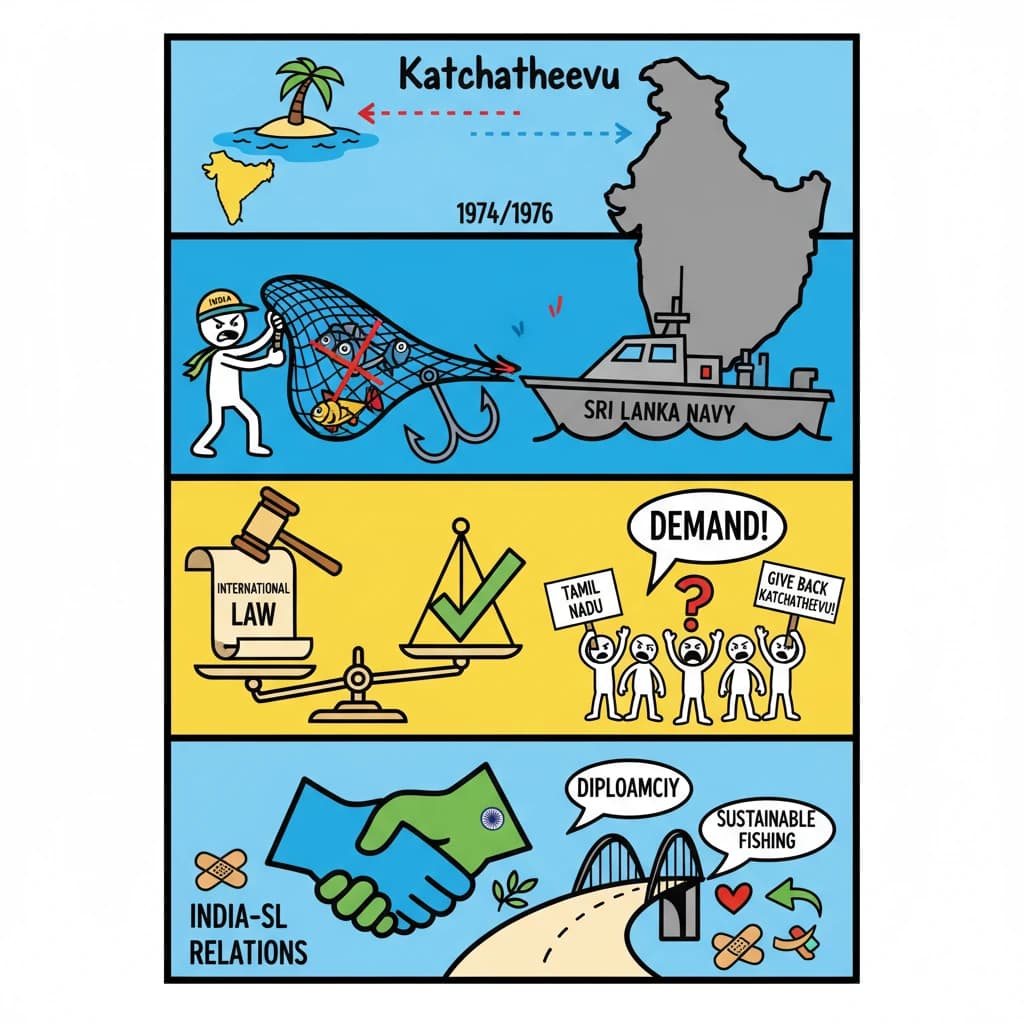
95% Verified Content
📚 Reference Sources
•United Nations Convention on the Law of the Sea (UNCLOS) document
•Archival records of India-Sri Lanka agreements (1974, 1976)
•Reports from reputable Indian and international news agencies (e.g., The Hindu, PTI, Reuters)
•Academic papers and analyses on India-Sri Lanka relations and maritime disputes