Loading page, please wait…
Key Facts About Africa - UPSC International Relations
What is Key Facts About Africa in UPSC International Relations?
Key Facts About Africa is a key topic under International Relations for UPSC Civil Services Examination. Key points include: Africa is the second-largest and second-most populous continent, strategically located and divided by the Equator.. It has diverse geography (Sahara, rainforests, Great Lakes) and is the world's hottest continent.. By 2034, Africa will have the largest working-age population (1.1 billion), with its total population projected to double in 35 years.. Understanding this topic is essential for both UPSC Prelims and Mains preparation.
Why is Key Facts About Africa important for UPSC exam?
Key Facts About Africa is a Easy-level topic in UPSC International Relations. It is tested in both Prelims (factual MCQs) and Mains (analytical answer writing). Previous year UPSC questions have frequently covered aspects of Key Facts About Africa, making it essential for comprehensive IAS preparation.
How to prepare Key Facts About Africa for UPSC?
To prepare Key Facts About Africa for UPSC: (1) Study the comprehensive notes covering all key concepts on Vaidra. (2) Practice previous year questions on this topic. (3) Connect it with current affairs using daily updates. (4) Revise using key takeaways and mind maps available for International Relations. (5) Write practice answers linking Key Facts About Africa to related GS Paper topics.
Key takeaways of Key Facts About Africa for UPSC
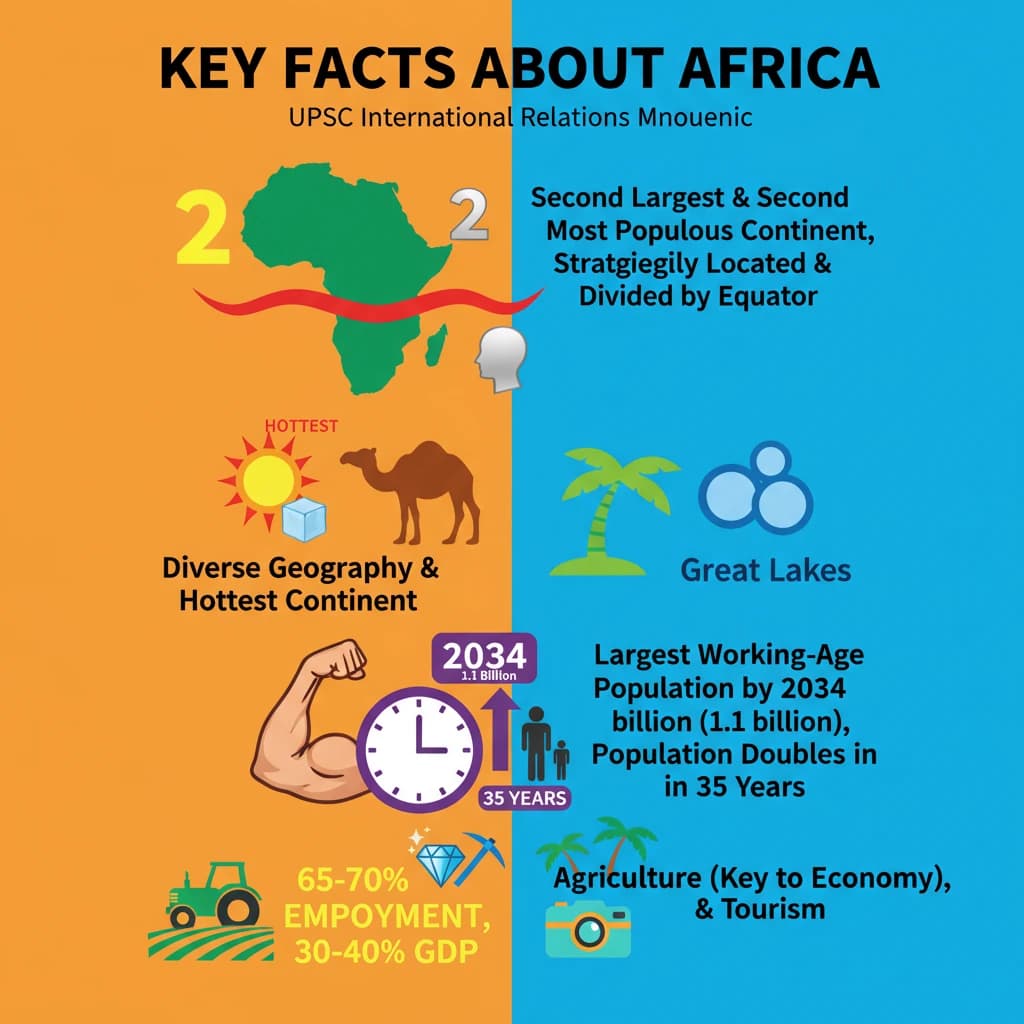
- Africa is the second-largest and second-most populous continent, strategically located and divided by the Equator.
- It has diverse geography (Sahara, rainforests, Great Lakes) and is the world's hottest continent.
- By 2034, Africa will have the largest working-age population (1.1 billion), with its total population projected to double in 35 years.
- Agriculture is key to its economy (65-70% employment, 30-40% GDP), alongside significant mining and tourism sectors.
- Africa is rich in gold (680.3 MT in 2021, Witwatersrand), diamonds (65% global value), petroleum, and coal.
- China is Africa's top trade partner, with annual trade nearing USD 200 billion, reflecting growing economic ties.
Key Facts About Africa
Easy⏱️ 8 min read
international relations
📖 Introduction
Geographical Overview
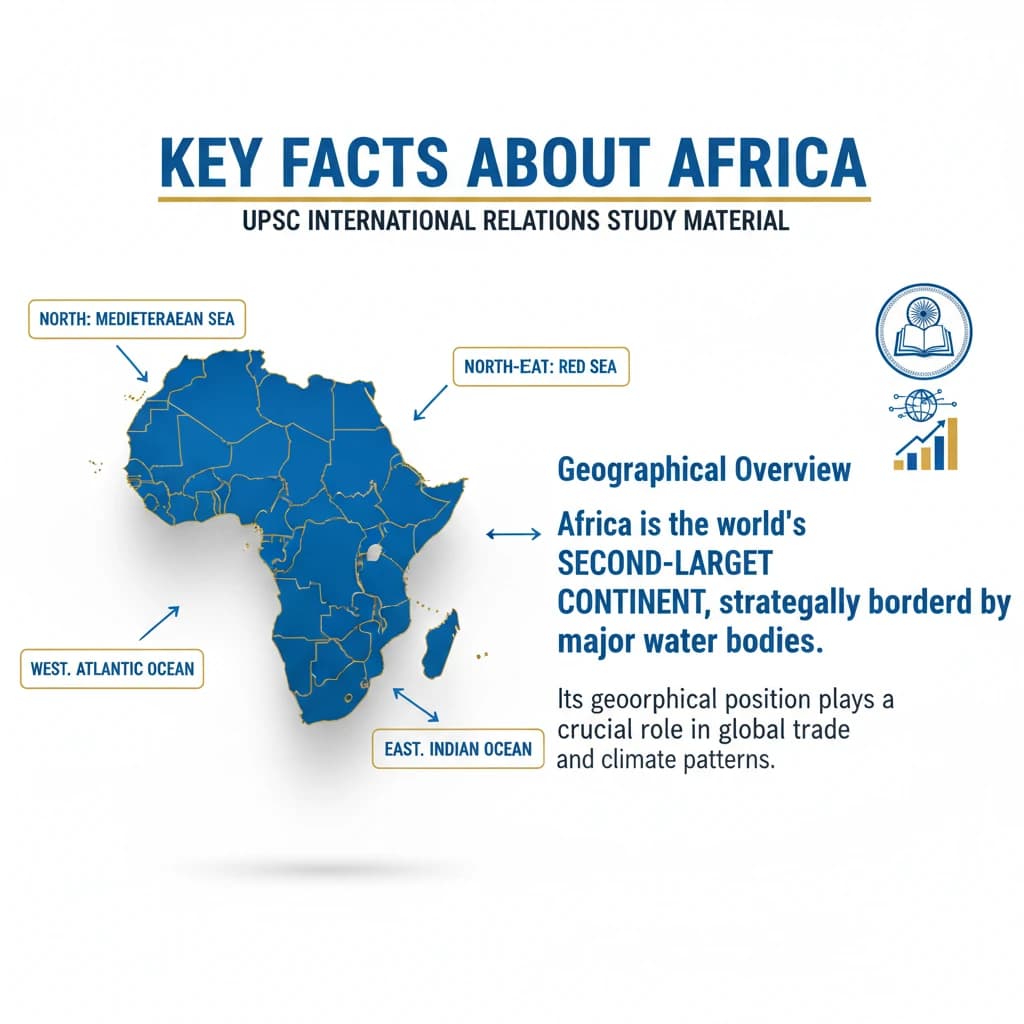
Africa is the world's second-largest continent, strategically bordered by major water bodies. Its geographical position plays a crucial role in global trade and climate patterns.
- North: Mediterranean Sea
- North-East: Red Sea
- East: Indian Ocean
- West: Atlantic Ocean
The continent is almost equally divided by the Equator, resulting in a diverse range of climates and ecosystems across its vast expanse.
Major Physical Regions
Africa boasts eight major physical regions, each contributing to its unique biodiversity and environmental characteristics. These regions influence local economies and human settlements.
- The vast Sahara Desert
- The semi-arid Sahel region
- The elevated Ethiopian Highlands
- Extensive savannas
- The coastal Swahili Coast
- Dense rainforests
- The geological marvels of the African Great Lakes
- The diverse landscapes of Southern Africa
Population and Demographics
Africa is the second-most populous continent globally, following Asia. This large and rapidly growing population presents both opportunities and challenges for development.
By 2034, Africa is projected to have the world's largest working-age population, reaching an estimated 1.1 billion people. This demographic dividend holds immense potential for economic growth.
The continent's population is expected to double in the next 35 years, reaching nearly 2.4 billion people, with a significant increase in the under-18 population. This highlights future demands on education, health, and employment.
Economic Landscape
Africa's economy is characterized by a significant reliance on agriculture, which forms the backbone of livelihoods for a large portion of its populace.
- Agriculture employs 65-70% of Africa’s labor force.
- It accounts for 30-40% of its Gross Domestic Product (GDP).
Beyond agriculture, Africa has a diverse economic base. Sectors such as mining and tourism contribute significantly to the continent's overall economic output and offer avenues for diversification and growth.
Climate Characteristics
Africa is recognized as the world's hottest continent. Its vast size and geographical features lead to a wide array of climatic conditions across its regions.
Climate zones range from the extremely arid conditions of the Sahara Desert in the north to the lush, humid rainforests found in equatorial regions.
The continent's highest point is Mount Kilimanjaro in Tanzania, an iconic landmark that also showcases its varied topography.
Trade Relations and Partners
In terms of international trade, China has emerged as Africa's top trade partner. This partnership underscores the growing economic ties between the two regions.
Sino-African trade volumes are nearing USD 200 billion per year. This robust trade relationship involves various goods and services.
The presence of Chinese residents is notable in several African nations, with Angola, for example, hosting a large Chinese population, indicative of deeper economic and social connections.
Mineral Resources and Production
Africa is exceptionally rich in mineral resources, with gold and diamonds being its two most profitable mineral resources, significantly contributing to global supply chains.
- In 2021, Africa produced 680.3 metric tons of gold.
- The Witwatersrand region in South Africa is a major gold-producing area, renowned for its extensive gold deposits.
The continent also holds a dominant position in the global diamond market. Africa produces approximately 65% of the world’s diamonds by value each year, highlighting its critical role in the jewelry and industrial diamond sectors.
Beyond precious metals and gems, petroleum and coal are among the most abundant minerals. These energy resources are vital for 22 out of Africa’s 54 countries, impacting their energy security and economic development.
💡 Key Takeaways
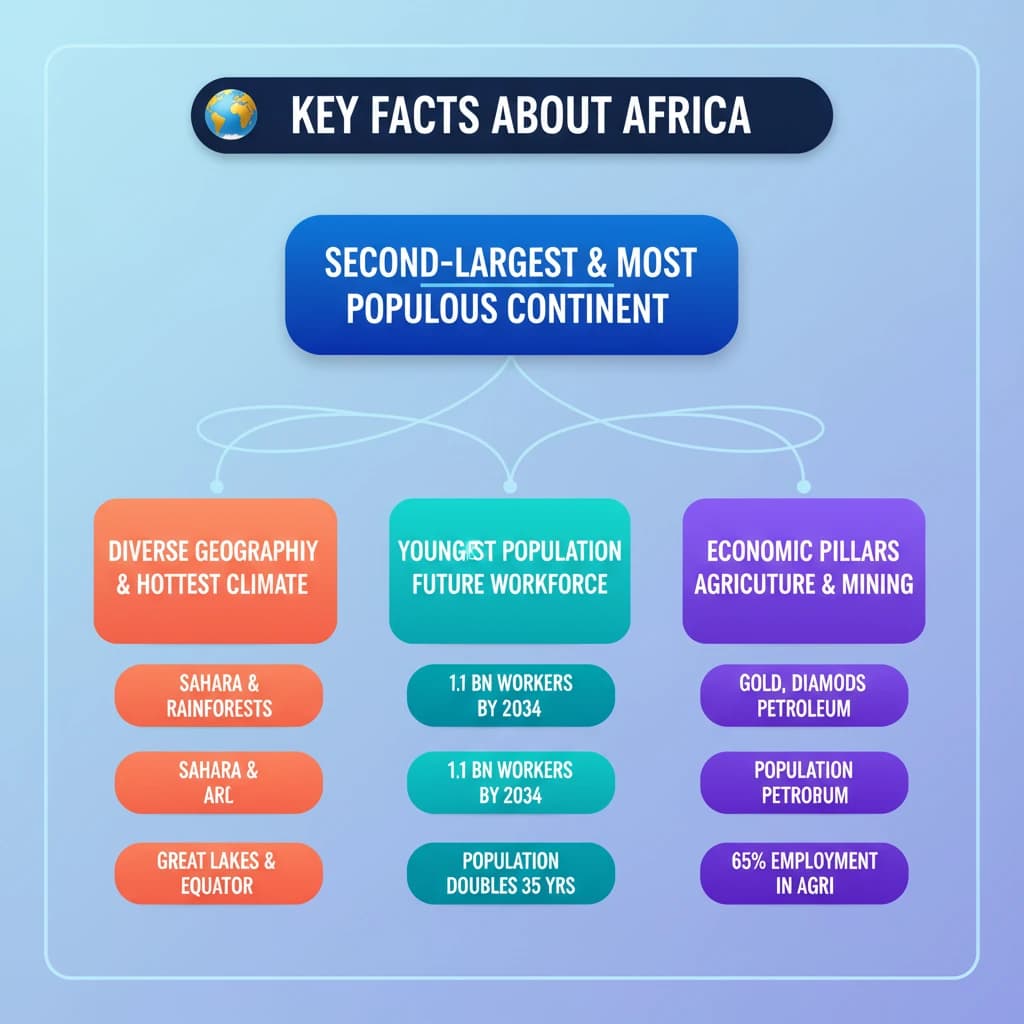
- •Africa is the second-largest and second-most populous continent, strategically located and divided by the Equator.
- •It has diverse geography (Sahara, rainforests, Great Lakes) and is the world's hottest continent.
- •By 2034, Africa will have the largest working-age population (1.1 billion), with its total population projected to double in 35 years.
- •Agriculture is key to its economy (65-70% employment, 30-40% GDP), alongside significant mining and tourism sectors.
- •Africa is rich in gold (680.3 MT in 2021, Witwatersrand), diamonds (65% global value), petroleum, and coal.
- •China is Africa's top trade partner, with annual trade nearing USD 200 billion, reflecting growing economic ties.
🧠 Memory Techniques
95% Verified Content