Loading page, please wait…
Key Facts About Vietnam - UPSC International Relations
What is Key Facts About Vietnam in UPSC International Relations?
Key Facts About Vietnam is a key topic under International Relations for UPSC Civil Services Examination. Key points include: India provides a USD 300 million credit line to Vietnam for military security and development.. An Indian-funded Army Software Park has been inaugurated in Khanh Hoa, Vietnam.. Both nations aim to increase bilateral trade to USD 20 billion and review the ASEAN-India Trade in Goods Agreement.. Understanding this topic is essential for both UPSC Prelims and Mains preparation.
Why is Key Facts About Vietnam important for UPSC exam?
Key Facts About Vietnam is a Medium-level topic in UPSC International Relations. It is tested in both Prelims (factual MCQs) and Mains (analytical answer writing). Previous year UPSC questions have frequently covered aspects of Key Facts About Vietnam, making it essential for comprehensive IAS preparation.
How to prepare Key Facts About Vietnam for UPSC?
To prepare Key Facts About Vietnam for UPSC: (1) Study the comprehensive notes covering all key concepts on Vaidra. (2) Practice previous year questions on this topic. (3) Connect it with current affairs using daily updates. (4) Revise using key takeaways and mind maps available for International Relations. (5) Write practice answers linking Key Facts About Vietnam to related GS Paper topics.
Key takeaways of Key Facts About Vietnam for UPSC
- India provides a USD 300 million credit line to Vietnam for military security and development.
- An Indian-funded Army Software Park has been inaugurated in Khanh Hoa, Vietnam.
- Both nations aim to increase bilateral trade to USD 20 billion and review the ASEAN-India Trade in Goods Agreement.
- India and Vietnam emphasize freedom of navigation in the South China Sea, based on UNCLOS 1982.
- NCGG conducts capacity-building programs for Vietnamese civil servants, promoting good governance.
- Key geographical facts: Capital Hanoi, Annam Cordillera, Mekong and Red Rivers, diverse wildlife, and ongoing reforestation efforts.
Key Facts About Vietnam
Medium⏱️ 7 min read
international relations
📖 Introduction
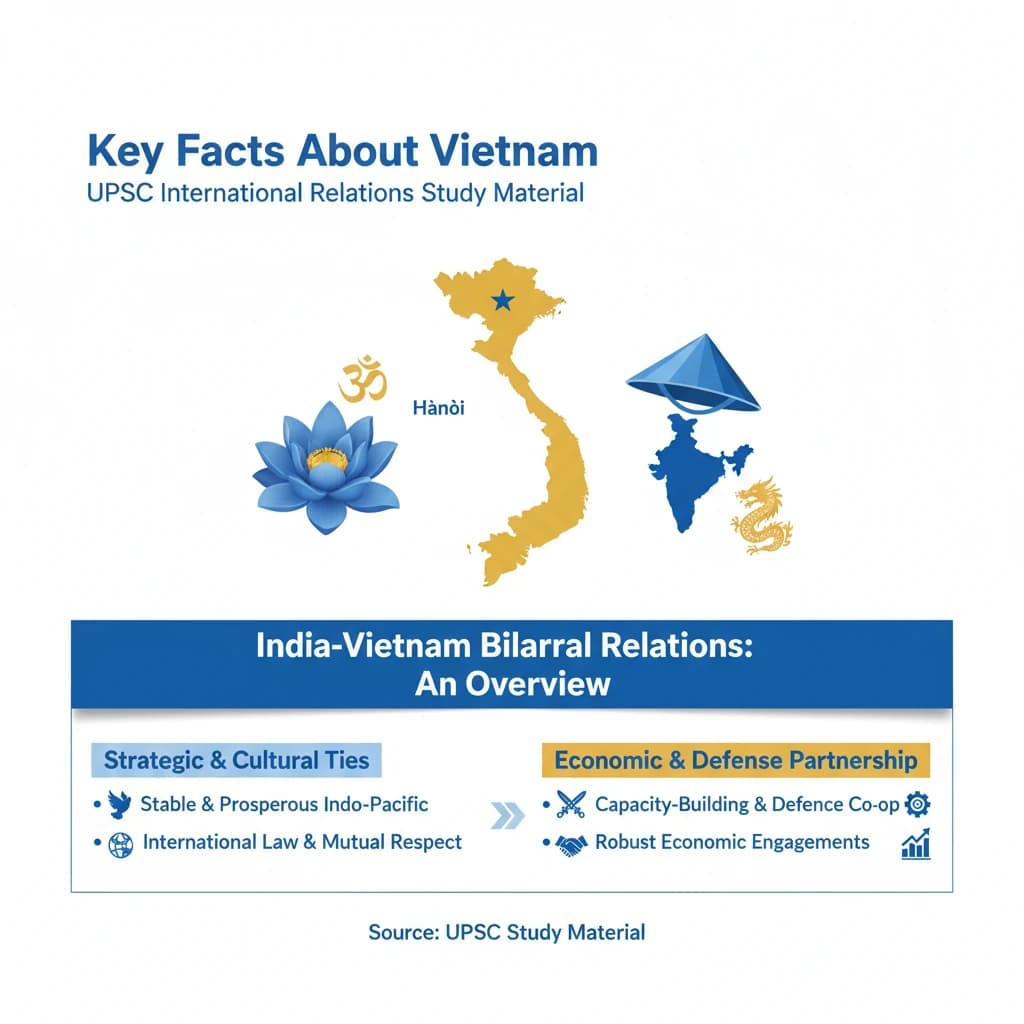
India-Vietnam Bilateral Relations: An Overview
The relationship between India and Vietnam is multifaceted, encompassing strategic, economic, and cultural dimensions. Both nations share a vision for a stable and prosperous Indo-Pacific region, underpinned by international law and mutual respect.
Recent engagements highlight a deepening partnership, marked by capacity-building initiatives, defence cooperation, and robust economic diplomacy. These efforts aim to strengthen bilateral ties and foster regional stability.
Capacity Building Initiatives
The National Centre of Good Governance (NCGG), operating under India's Ministry of External Affairs, plays a crucial role in international capacity building. It conducts specialized programs for civil servants from various countries.
NCGG's Reach: The NCGG has extended its capacity-building programs to civil servants from nations including Bangladesh, Tanzania, Gambia, Maldives, Sri Lanka, and notably, Cambodia and Vietnam.
These programs are vital for fostering knowledge exchange and promoting collaboration on best practices in public policy and governance globally.
Defence Cooperation and Credit Line
India has committed significant support to Vietnam's defence and security sector. This includes financial assistance aimed at bolstering Vietnam's military capabilities and supporting its development projects.
Credit Line Extension: India will provide a USD 300 million credit line to Vietnam. This financial aid is specifically designated to support military security and various development projects within Vietnam.
A tangible outcome of this cooperation is the establishment of an Army Software Park in Khanh Hoa, Vietnam. This facility was funded through a direct Indian grant, signifying a strong commitment to defence technology sharing.
Furthermore, both nations have emphasized increased cooperation in critical areas such as combating terrorism and enhancing cyber security, reflecting shared concerns over regional and global threats.
Economic Ties and Trade Goals
Economic relations between India and Vietnam are robust and expanding. Both countries are actively working towards increasing bilateral trade volume and diversifying investment opportunities.
Trade Expansion Proposal: Vietnam has proposed elevating the annual bilateral trade target from the current USD 14.8 billion to an ambitious USD 20 billion.
To facilitate enhanced trade, India and Vietnam are expediting the review of the ASEAN-India Trade in Goods Agreement (AITIGA). This review aims to streamline trade processes and reduce barriers.
Vietnam actively welcomes Indian investments across several key sectors. These include Information Technology (IT), manufacturing, textiles, semiconductors, and renewable energy, indicating diverse opportunities for collaboration.
Strategic Alignment in Indo-Pacific
A core aspect of the India-Vietnam partnership is their shared commitment to the Indo-Pacific region. Both countries advocate for a free, open, and inclusive Indo-Pacific.
They are dedicated to strengthening cooperation, particularly focusing on maintaining freedom of navigation and overflight in the strategically vital South China Sea.
International Law Adherence: Both nations underscore the importance of peaceful settlement of disputes. This principle is firmly based on international law, with particular emphasis on the United Nations Convention on the Law of the Sea (UNCLOS) of 1982.
To further enhance economic collaboration and address trade-related issues, a new mechanism for dialogue has been established. This economic diplomacy dialogue will operate at the deputy foreign minister level.
Key Geographical and Ecological Facts About Vietnam
Vietnam possesses a rich geographical landscape and diverse ecology, which are integral to its national identity and economy.
Capital: Hanoi
Official Language: Vietnamese
The country is characterized by significant topographical features and vital river systems that support its large population and agricultural sector.
- Major Mountain Range: The Annam Cordillera forms a prominent geographical spine.
- Major Rivers: The Mekong River in the south and the Red River in the north are critical. These rivers form extensive, fertile deltas that sustain the majority of Vietnam's population and its extensive agriculture.
Vietnam is also home to a unique array of wildlife, though its natural habitats face environmental challenges.
- Notable Wildlife: Species include the Giant catfish, Indochinese tigers, Saola, Antelopes, and Sumatran Rhinos.
Environmental concerns, particularly deforestation, have impacted Vietnam's forest cover. However, the government is actively implementing measures to address this issue.
Forest Cover: Deforestation has reduced forest cover to approximately 19%. The Vietnamese government is undertaking significant replanting efforts to restore woodlands and promote environmental sustainability.
💡 Key Takeaways
- •India provides a USD 300 million credit line to Vietnam for military security and development.
- •An Indian-funded Army Software Park has been inaugurated in Khanh Hoa, Vietnam.
- •Both nations aim to increase bilateral trade to USD 20 billion and review the ASEAN-India Trade in Goods Agreement.
- •India and Vietnam emphasize freedom of navigation in the South China Sea, based on UNCLOS 1982.
- •NCGG conducts capacity-building programs for Vietnamese civil servants, promoting good governance.
- •Key geographical facts: Capital Hanoi, Annam Cordillera, Mekong and Red Rivers, diverse wildlife, and ongoing reforestation efforts.
🧠 Memory Techniques

95% Verified Content