Loading page, please wait…
Other Initiatives to Counter Terrorism - UPSC International Relations
What is Other Initiatives to Counter Terrorism in UPSC International Relations?
Other Initiatives to Counter Terrorism is a key topic under International Relations for UPSC Civil Services Examination. Key points include: International initiatives are crucial for countering transnational terrorism effectively.. UNODC's Terrorism Prevention Branch (TPB) provides legal and technical assistance to states.. The Financial Action Task Force (FATF) sets global standards to combat money laundering and terror financing.. Understanding this topic is essential for both UPSC Prelims and Mains preparation.
Why is Other Initiatives to Counter Terrorism important for UPSC exam?
Other Initiatives to Counter Terrorism is a Medium-level topic in UPSC International Relations. It is tested in both Prelims (factual MCQs) and Mains (analytical answer writing). Previous year UPSC questions have frequently covered aspects of Other Initiatives to Counter Terrorism, making it essential for comprehensive IAS preparation.
How to prepare Other Initiatives to Counter Terrorism for UPSC?
To prepare Other Initiatives to Counter Terrorism for UPSC: (1) Study the comprehensive notes covering all key concepts on Vaidra. (2) Practice previous year questions on this topic. (3) Connect it with current affairs using daily updates. (4) Revise using key takeaways and mind maps available for International Relations. (5) Write practice answers linking Other Initiatives to Counter Terrorism to related GS Paper topics.
Key takeaways of Other Initiatives to Counter Terrorism for UPSC
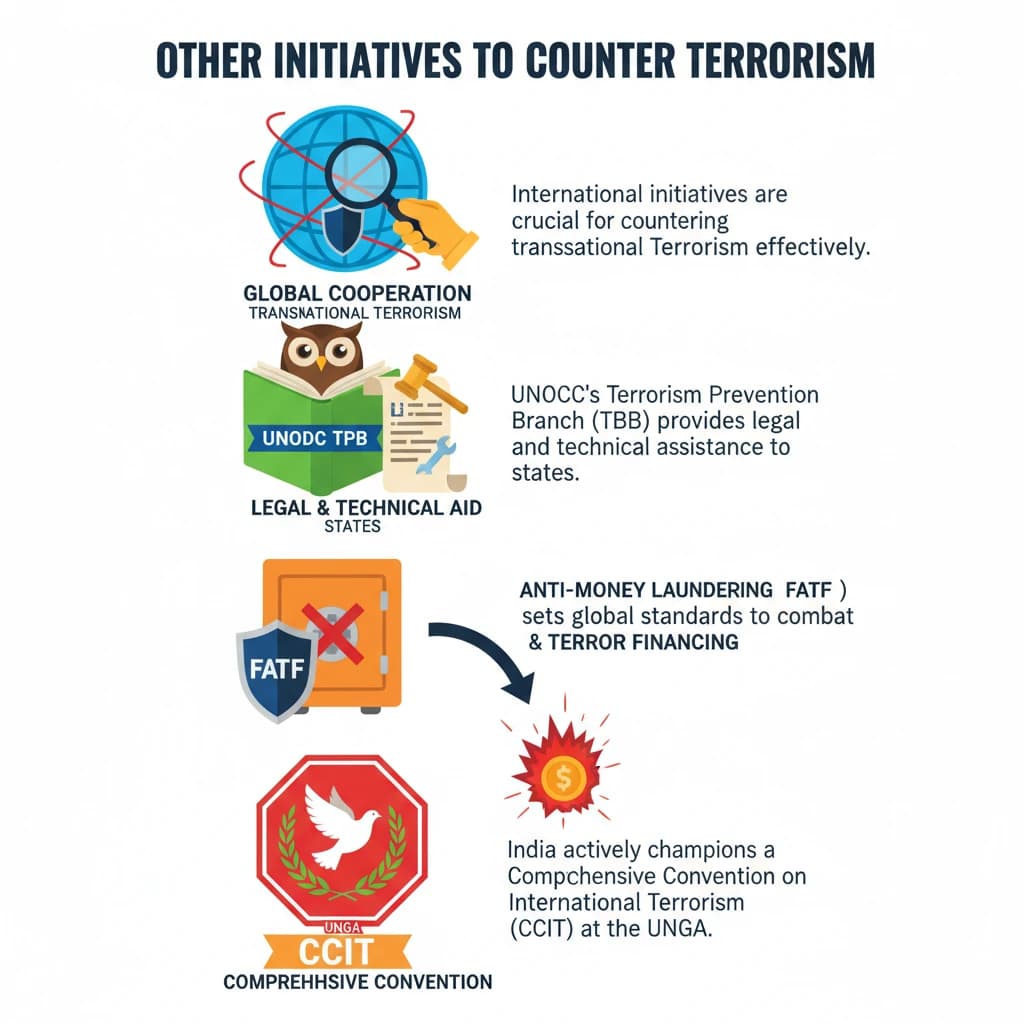
- International initiatives are crucial for countering transnational terrorism effectively.
- UNODC's Terrorism Prevention Branch (TPB) provides legal and technical assistance to states.
- The Financial Action Task Force (FATF) sets global standards to combat money laundering and terror financing.
- India actively champions a Comprehensive Convention on International Terrorism (CCIT) at the UNGA.
- These initiatives collectively address legal frameworks, financial disruption, and capacity building against terrorism.
Other Initiatives to Counter Terrorism
Medium⏱️ 7 min read
international relations
📖 Introduction
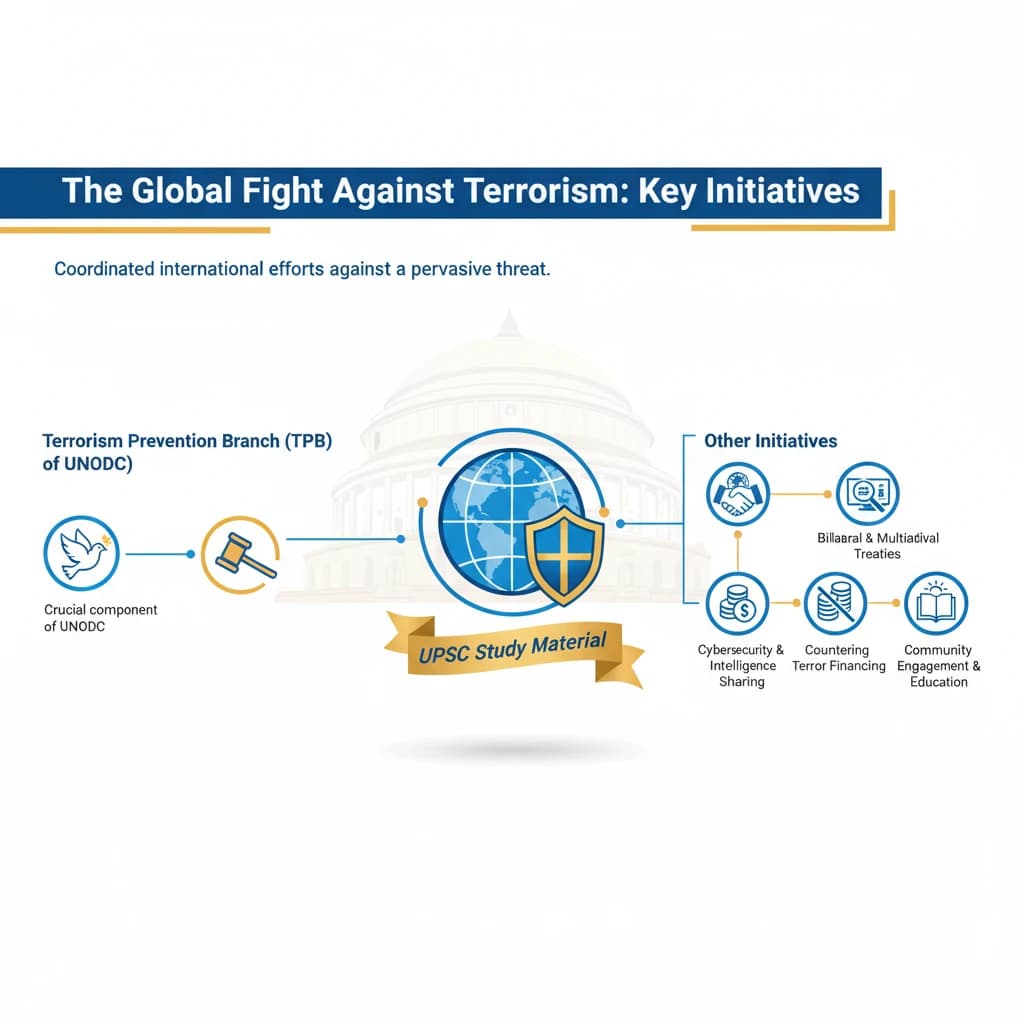
The Global Fight Against Terrorism: Key Initiatives
The fight against terrorism is a complex global challenge requiring coordinated international efforts. Various organizations and mechanisms have been established to address different facets of this pervasive threat.
Terrorism Prevention Branch (TPB) of UNODC
The Terrorism Prevention Branch (TPB) is a crucial component of the United Nations Office on Drugs and Crime (UNODC). It plays a vital role in assisting member states to prevent and counter terrorism.
- Mandate: To provide legal and technical assistance to countries for implementing the universal legal instruments against terrorism.
- Focus: Strengthening criminal justice responses to terrorism.
- Activities: Legislative drafting, capacity building for law enforcement and judiciary, international cooperation, and research.
Financial Action Task Force (FATF)
The Financial Action Task Force (FATF) is an intergovernmental organization established to combat money laundering and terrorist financing. It sets international standards to prevent these illicit activities.
FATF's primary objective is to protect the global financial system from the threats of money laundering, terrorist financing, and the financing of proliferation of weapons of mass destruction (WMD).
- Establishment: By the G7 Summit in Paris, 1989.
- Role: Develops Recommendations (standards) which are recognized as the global anti-money laundering and counter-terrorist financing (AML/CFT) benchmark.
- Monitoring: Assesses countries' compliance with these standards through peer reviews, identifying high-risk jurisdictions.
India's Annual Resolution on Counter-Terror at UNGA
India annually adopts a significant Resolution on Counter-Terrorism in the United Nations General Assembly (UNGA). This demonstrates India's consistent commitment to global counter-terrorism efforts.
This resolution often emphasizes the need for a Comprehensive Convention on International Terrorism (CCIT), a long-standing demand by India, and highlights the principle of 'zero tolerance' for terrorism.
- Objective: To strengthen international cooperation, condemn terrorism in all its forms and manifestations, and promote effective implementation of UN counter-terrorism strategies.
- Significance: It reflects India's proactive diplomacy in shaping global counter-terrorism norms and galvanizing international support against cross-border terrorism.
💡 Key Takeaways
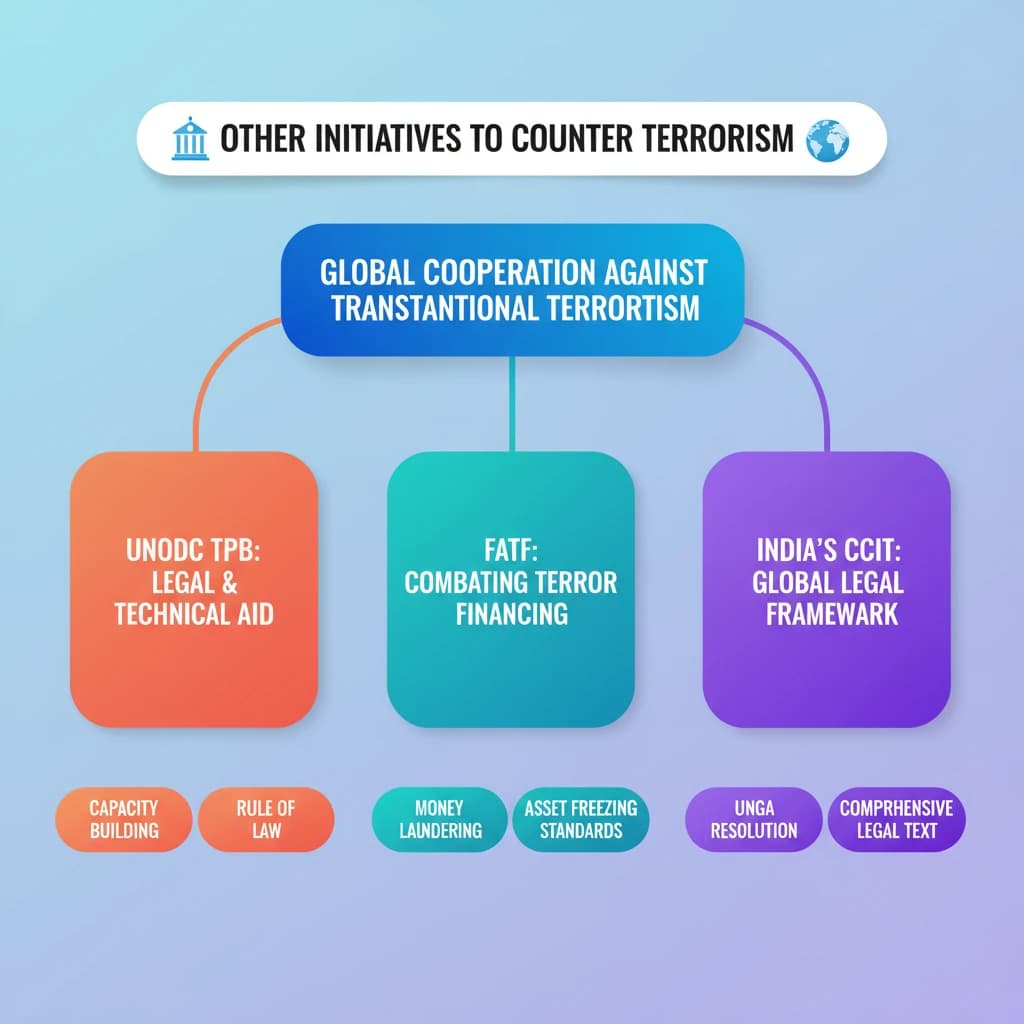
- •International initiatives are crucial for countering transnational terrorism effectively.
- •UNODC's Terrorism Prevention Branch (TPB) provides legal and technical assistance to states.
- •The Financial Action Task Force (FATF) sets global standards to combat money laundering and terror financing.
- •India actively champions a Comprehensive Convention on International Terrorism (CCIT) at the UNGA.
- •These initiatives collectively address legal frameworks, financial disruption, and capacity building against terrorism.
🧠 Memory Techniques
95% Verified Content
📚 Reference Sources
•United Nations Office on Drugs and Crime (UNODC) official website
•Financial Action Task Force (FATF) official website
•United Nations General Assembly (UNGA) records