Loading page, please wait…
Quad Foreign Ministers Meeting - UPSC International Relations
What is Quad Foreign Ministers Meeting in UPSC International Relations?
Quad Foreign Ministers Meeting is a key topic under International Relations for UPSC Civil Services Examination. Key points include: The Quad is an informal diplomatic partnership of Australia, India, Japan, and the US.. Its primary goal is to support an open, stable, and prosperous Indo-Pacific region.. Proposed by Shinzo Abe in 2007, it was formalized in 2017 after a period of dormancy.. Understanding this topic is essential for both UPSC Prelims and Mains preparation.
Why is Quad Foreign Ministers Meeting important for UPSC exam?
Quad Foreign Ministers Meeting is a Medium-level topic in UPSC International Relations. It is tested in both Prelims (factual MCQs) and Mains (analytical answer writing). Previous year UPSC questions have frequently covered aspects of Quad Foreign Ministers Meeting, making it essential for comprehensive IAS preparation.
How to prepare Quad Foreign Ministers Meeting for UPSC?
To prepare Quad Foreign Ministers Meeting for UPSC: (1) Study the comprehensive notes covering all key concepts on Vaidra. (2) Practice previous year questions on this topic. (3) Connect it with current affairs using daily updates. (4) Revise using key takeaways and mind maps available for International Relations. (5) Write practice answers linking Quad Foreign Ministers Meeting to related GS Paper topics.
Key takeaways of Quad Foreign Ministers Meeting for UPSC
- The Quad is an informal diplomatic partnership of Australia, India, Japan, and the US.
- Its primary goal is to support an open, stable, and prosperous Indo-Pacific region.
- Proposed by Shinzo Abe in 2007, it was formalized in 2017 after a period of dormancy.
- Recent meeting emphasized ending violence in Ukraine, Gaza, and Myanmar.
- Quad intends to expand the Indo-Pacific Partnership for Maritime Domain Awareness (IPMDA) into the Indian Ocean Region.
- It addresses security, economic, and humanitarian challenges through cooperation.
Quad Foreign Ministers Meeting
Medium⏱️ 7 min read
international relations
📖 Introduction
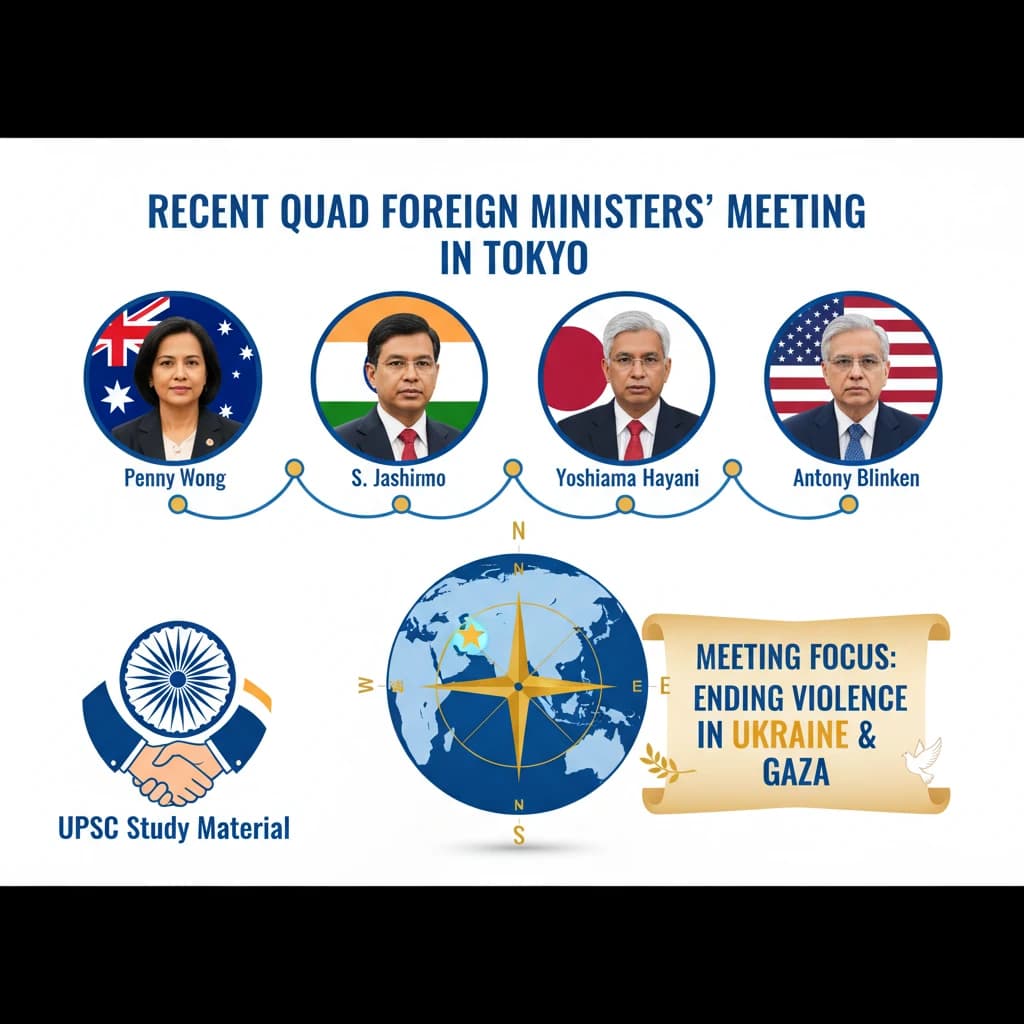
Recent Quad Foreign Ministers Meeting in Tokyo
Recently, the Quad foreign ministers’ meeting took place in Tokyo. This gathering brought together representatives from Australia, India, Japan, and the United States.
A primary focus of the meeting was to emphasize the urgent need to end violence in several critical regions. These included Ukraine, Gaza, and Myanmar, highlighting the Quad's commitment to global peace and stability.
Another significant outcome was the expressed intention to expand the Indo-Pacific Partnership for Maritime Domain Awareness (IPMDA). This expansion is specifically aimed at enhancing maritime security capabilities within the Indian Ocean Region.
UPSC Insight: The Quad's focus on both geopolitical conflicts (Ukraine, Gaza) and regional initiatives (IPMDA expansion) showcases its evolving mandate beyond traditional security, touching upon humanitarian and strategic cooperation. This is crucial for GS Paper 2 (International Relations).
Understanding the Quad: An Informal Diplomatic Partnership
The Quad, formally known as the Quadrilateral Security Dialogue, is an informal diplomatic partnership. It comprises four key democratic nations: Australia, India, Japan, and the United States.
The core commitment of the Quad is to support an open, stable, and prosperous Indo-Pacific. This vision emphasizes a region that is both inclusive and resilient, promoting adherence to international law and norms.
Key Definition: The Indo-Pacific concept refers to the interconnectedness of the Indian and Pacific Oceans, emphasizing a strategic continuum from Africa's east coast to the Americas' west coast.
Origin and Evolution of the Quad
The concept of the Quad was first proposed by then Japanese Prime Minister Shinzo Abe in 2007. His vision was to create an 'Arc of Freedom and Prosperity' to counterbalance rising geopolitical influences in the region.
Initially, the group faced setbacks, including Australia’s withdrawal due to significant Chinese pressure. This led to a period of dormancy for the informal grouping.
The Quad became a more formal group in 2017. This re-establishment saw India, Australia, the US, and Japan coming together again to form this “quadrilateral” coalition, primarily to address shared concerns and promote regional stability.
Important Concept: The Quad's re-emergence in 2017 marked a significant shift in regional geopolitics, signaling a renewed commitment among member states to cooperate on strategic issues in the Indo-Pacific.
💡 Key Takeaways
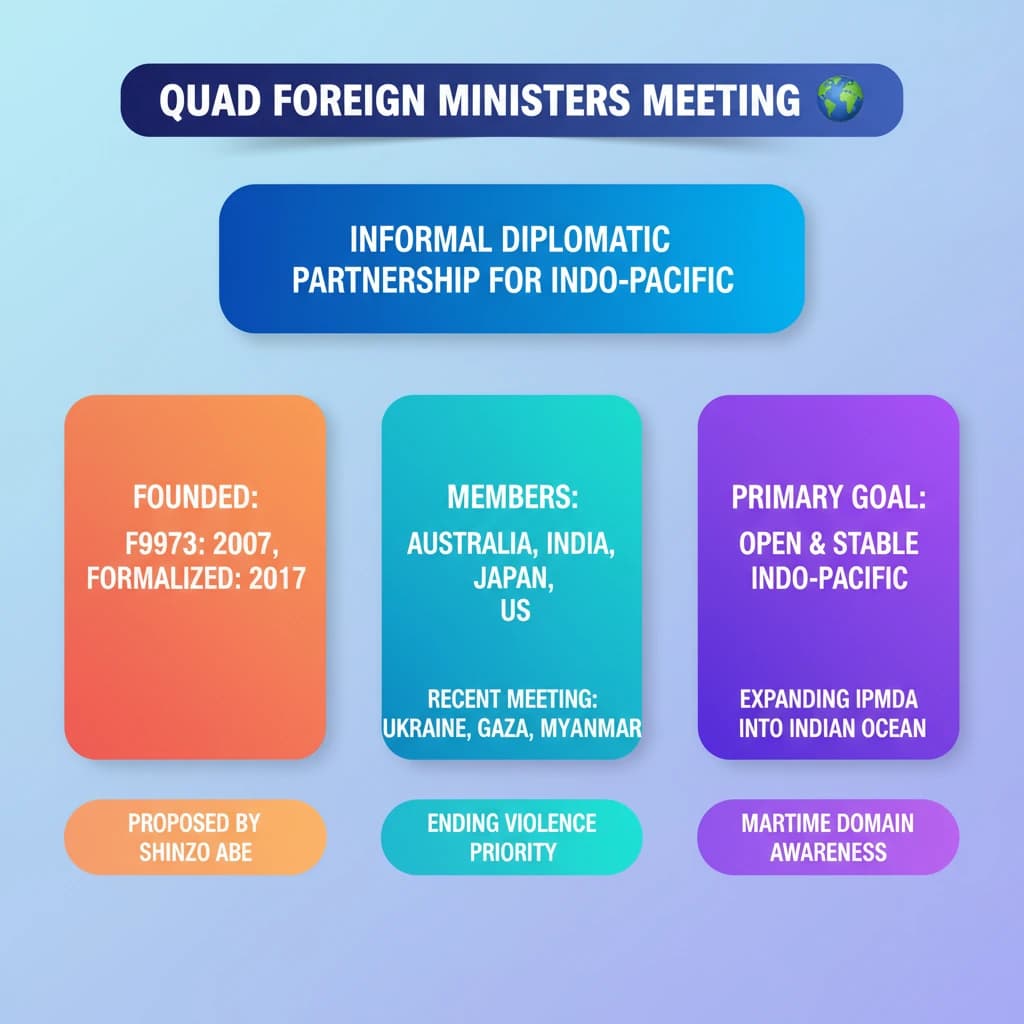
- •The Quad is an informal diplomatic partnership of Australia, India, Japan, and the US.
- •Its primary goal is to support an open, stable, and prosperous Indo-Pacific region.
- •Proposed by Shinzo Abe in 2007, it was formalized in 2017 after a period of dormancy.
- •Recent meeting emphasized ending violence in Ukraine, Gaza, and Myanmar.
- •Quad intends to expand the Indo-Pacific Partnership for Maritime Domain Awareness (IPMDA) into the Indian Ocean Region.
- •It addresses security, economic, and humanitarian challenges through cooperation.
🧠 Memory Techniques
95% Verified Content
📚 Reference Sources
•Ministry of External Affairs (MEA), Government of India official statements on Quad
•The White House official statements on Quad Leaders' Summits
•Council on Foreign Relations (CFR) analyses on the Quad
•Reputable news sources (e.g., The Hindu, Indian Express, The Diplomat) for recent meetings and initiatives