Loading page, please wait…
Technology and Infrastructure Investment - UPSC International Relations
What is Technology and Infrastructure Investment in UPSC International Relations?
Technology and Infrastructure Investment is a key topic under International Relations for UPSC Civil Services Examination. Key points include: India's non-fossil fuel capacity grew by nearly 300% in the last decade, showing a strong shift to clean energy.. Green Hydrogen is a critical component for decarbonizing hard-to-electrify sectors (refineries, steel, transport) and storing renewable energy.. India is pushing for R&D, industry-academia partnerships, and start-ups in Green Hydrogen.. Understanding this topic is essential for both UPSC Prelims and Mains preparation.
Why is Technology and Infrastructure Investment important for UPSC exam?
Technology and Infrastructure Investment is a Medium-level topic in UPSC International Relations. It is tested in both Prelims (factual MCQs) and Mains (analytical answer writing). Previous year UPSC questions have frequently covered aspects of Technology and Infrastructure Investment, making it essential for comprehensive IAS preparation.
How to prepare Technology and Infrastructure Investment for UPSC?
To prepare Technology and Infrastructure Investment for UPSC: (1) Study the comprehensive notes covering all key concepts on Vaidra. (2) Practice previous year questions on this topic. (3) Connect it with current affairs using daily updates. (4) Revise using key takeaways and mind maps available for International Relations. (5) Write practice answers linking Technology and Infrastructure Investment to related GS Paper topics.
Key takeaways of Technology and Infrastructure Investment for UPSC
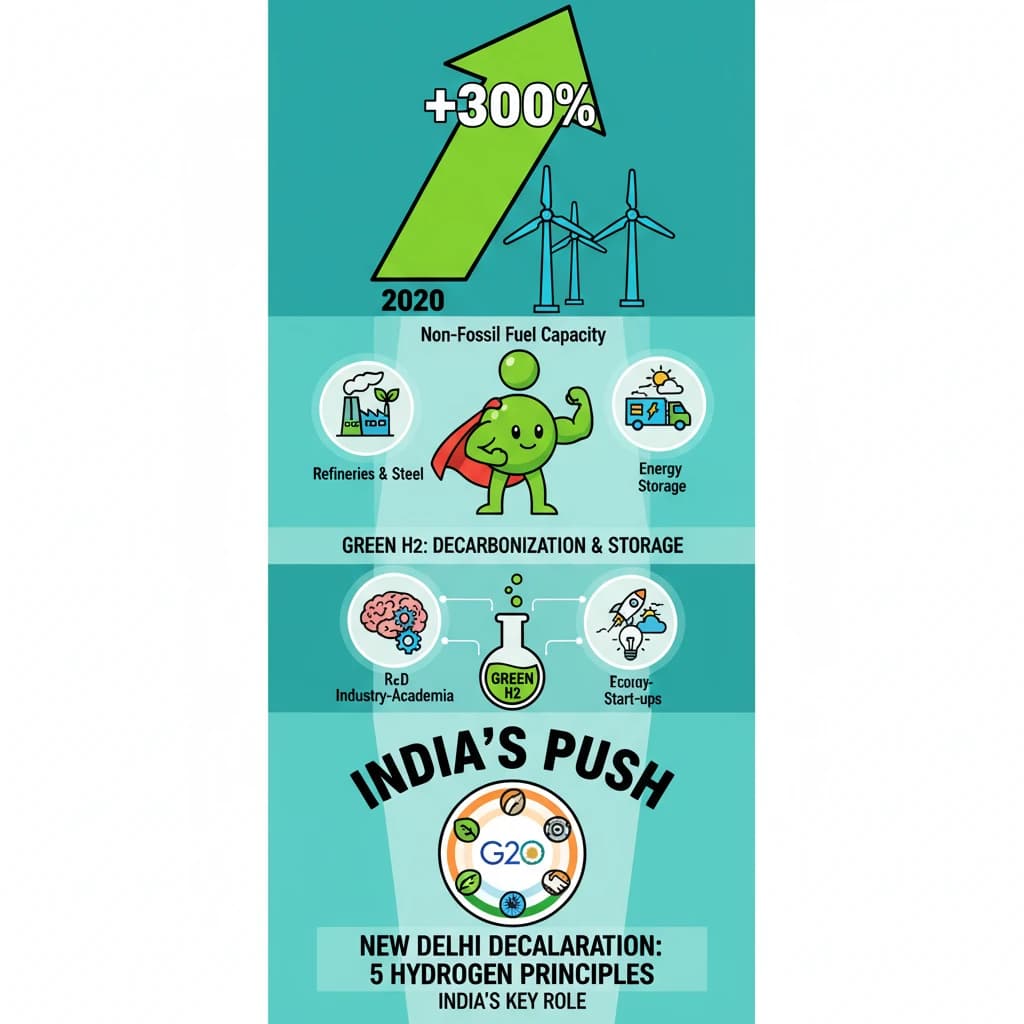
- India's non-fossil fuel capacity grew by nearly 300% in the last decade, showing a strong shift to clean energy.
- Green Hydrogen is a critical component for decarbonizing hard-to-electrify sectors (refineries, steel, transport) and storing renewable energy.
- India is pushing for R&D, industry-academia partnerships, and start-ups in Green Hydrogen.
- The New Delhi G20 Leaders’ Declaration adopted five voluntary principles on Hydrogen, with India playing a key role.
- India is partnering with European Hydrogen Week (Nov 2024) and Indian Railways plans hydrogen train trials by Jan 2025.
- PM highlighted critical questions on improving electrolyser efficiency and utilizing seawater for Green Hydrogen production.
Technology and Infrastructure Investment
Medium⏱️ 8 min read
international relations
📖 Introduction
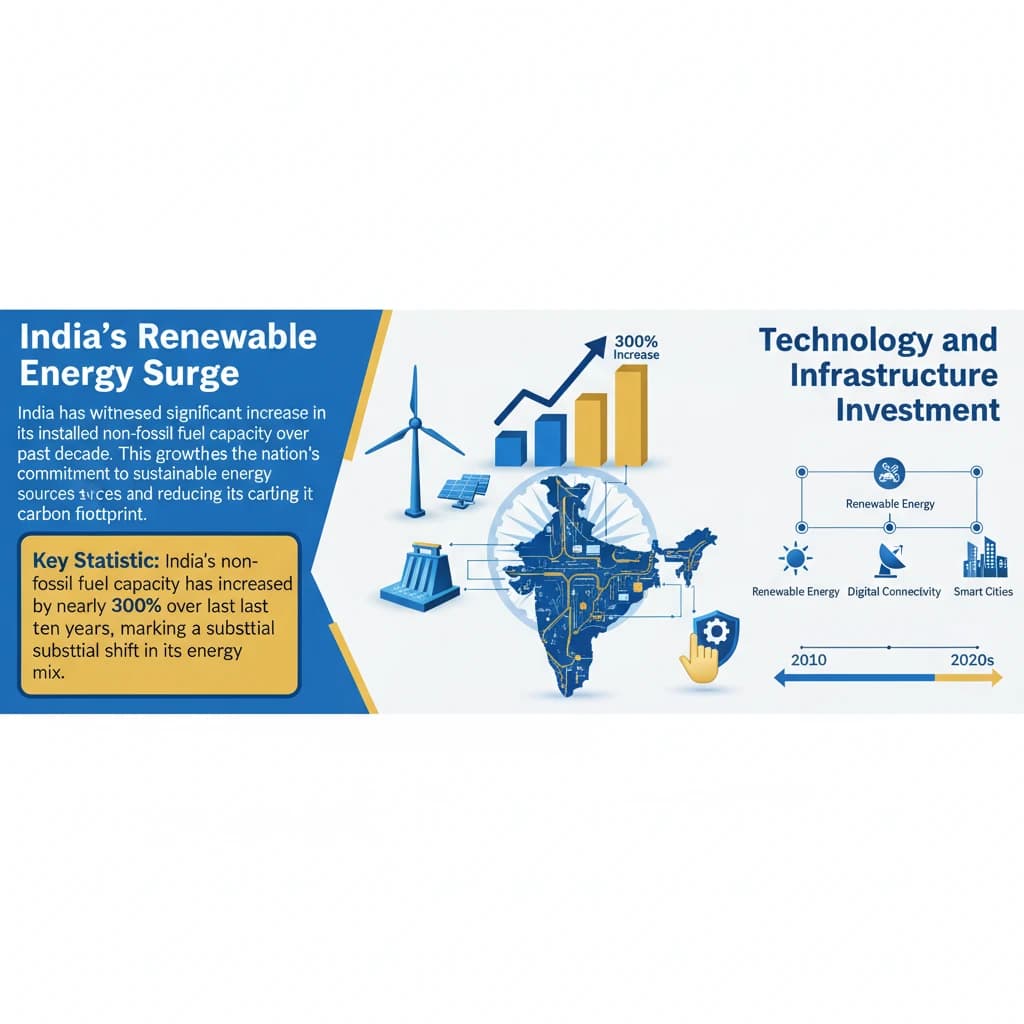
India's Renewable Energy Surge
India has witnessed a significant increase in its installed non-fossil fuel capacity over the past decade. This growth underscores the nation's commitment to sustainable energy sources and reducing its carbon footprint.
Key Statistic: India's non-fossil fuel capacity has increased by nearly 300% over the last ten years, marking a substantial shift in its energy mix.
Emerging Role of Green Hydrogen
Green Hydrogen is increasingly recognized as a crucial element in the global energy transition. It holds immense potential for decarbonizing sectors that are challenging to electrify directly.
Green Hydrogen's Potential: It can decarbonize industries like refineries, fertilizers, steel production, and heavy-duty transportation. Furthermore, it serves as an effective storage solution for surplus renewable energy.
Investment in Research and Development
There is a strong call for increased investment in cutting-edge research and development for Green Hydrogen technologies. This includes fostering collaboration between industry and academia.
- Encouragement for start-ups and entrepreneurs in the Green Hydrogen sector is vital.
- The Prime Minister has urged domain experts and the scientific community to lead the charge in Green Hydrogen adoption.
G20 Summit and Unified Roadmap
The New Delhi G-20 Leaders’ Declaration adopted five high-level voluntary principles on Hydrogen. These principles are instrumental in creating a unified roadmap for global Green Hydrogen development.
UPSC Insight: The G20 Leaders' Declaration on Hydrogen principles highlights India's leadership in global energy governance and its focus on multilateral cooperation in sustainable development (GS Paper II: International Relations).
Critical Questions for Innovation
The Prime Minister has posed critical questions aimed at advancing Green Hydrogen technology and application:
- How to improve electrolyser efficiency for cost-effective production?
- Exploring the use of readily available resources like seawater and municipal wastewater for hydrogen production.
- Investigating Green Hydrogen's role in diverse applications such as public transport, shipping, and waterways.
India's Global Partnerships and Domestic Initiatives
India is actively forging international partnerships and implementing domestic projects to accelerate Green Hydrogen adoption.
India-EU Partnership: India has announced an exclusive partnership with the European Hydrogen Week, scheduled for November 2024. This collaboration signifies India's intent to align with the European Union's green regulations.
Domestically, Indian Railways is at the forefront of adopting Green Hydrogen technology in its operations.
Hydrogen-Fuelled Train Trials: Indian Railways plans field trials of its first hydrogen-fuelled train in January 2025. A 1,600 KW DEMU (Diesel Electric Multiple Unit) will be converted into a hydrogen fuel cell-based DPRS (Distributed Power Rolling Stock) for these trials.
💡 Key Takeaways
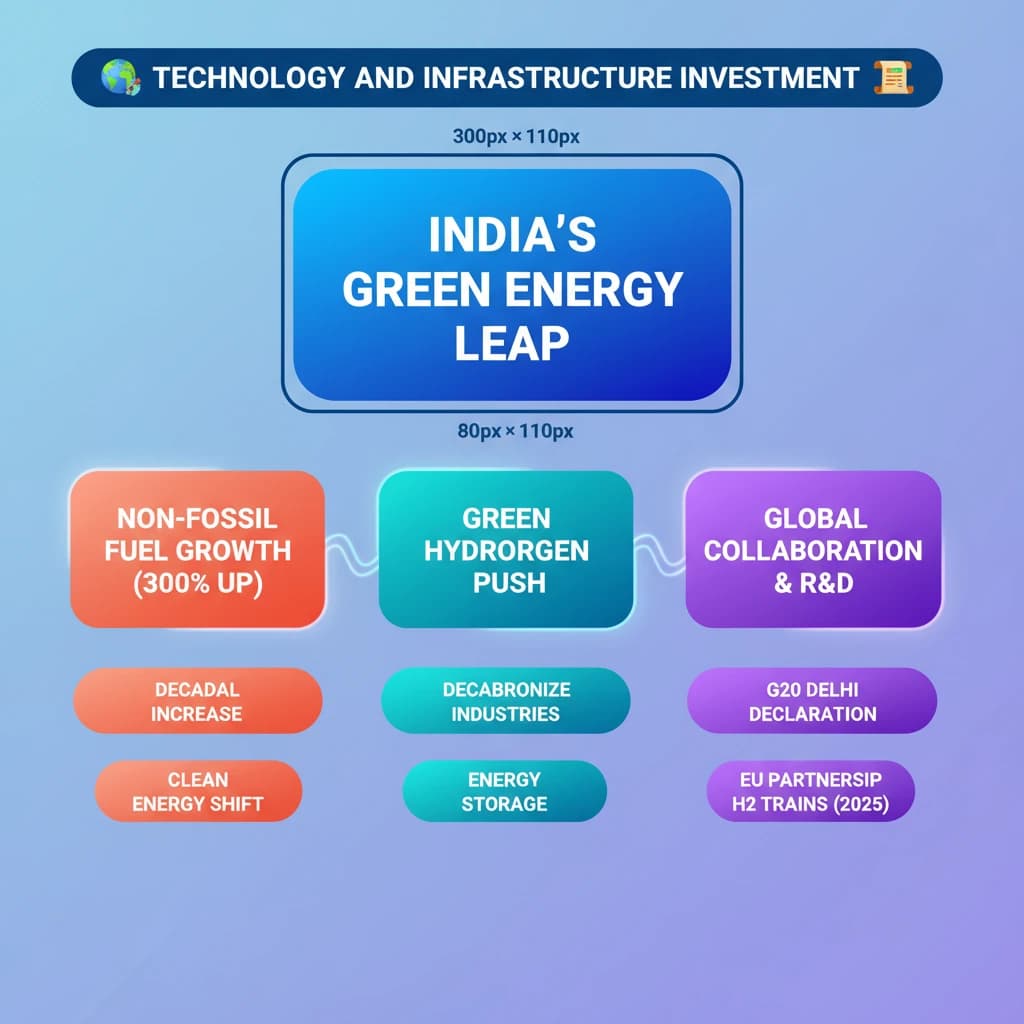
- •India's non-fossil fuel capacity grew by nearly 300% in the last decade, showing a strong shift to clean energy.
- •Green Hydrogen is a critical component for decarbonizing hard-to-electrify sectors (refineries, steel, transport) and storing renewable energy.
- •India is pushing for R&D, industry-academia partnerships, and start-ups in Green Hydrogen.
- •The New Delhi G20 Leaders’ Declaration adopted five voluntary principles on Hydrogen, with India playing a key role.
- •India is partnering with European Hydrogen Week (Nov 2024) and Indian Railways plans hydrogen train trials by Jan 2025.
- •PM highlighted critical questions on improving electrolyser efficiency and utilizing seawater for Green Hydrogen production.
🧠 Memory Techniques
95% Verified Content