Loading page, please wait…
Turkmenistan-Afghanistan-Pakistan-India Pipeline - UPSC International Relations
What is Turkmenistan-Afghanistan-Pakistan-India Pipeline in UPSC International Relations?
Turkmenistan-Afghanistan-Pakistan-India Pipeline is a key topic under International Relations for UPSC Civil Services Examination. Key points include: TAPI is a 1,814-km natural gas pipeline from Turkmenistan (Galkynysh field) to India, via Afghanistan and Pakistan.. It aims to deliver 33 BCM of gas annually, supplying Afghanistan (5%), Pakistan (47.5%), and India (47.5%).. Known as the 'Peace Pipeline,' it promotes regional cooperation and stability.. Understanding this topic is essential for both UPSC Prelims and Mains preparation.
Why is Turkmenistan-Afghanistan-Pakistan-India Pipeline important for UPSC exam?
Turkmenistan-Afghanistan-Pakistan-India Pipeline is a Medium-level topic in UPSC International Relations. It is tested in both Prelims (factual MCQs) and Mains (analytical answer writing). Previous year UPSC questions have frequently covered aspects of Turkmenistan-Afghanistan-Pakistan-India Pipeline, making it essential for comprehensive IAS preparation.
How to prepare Turkmenistan-Afghanistan-Pakistan-India Pipeline for UPSC?
To prepare Turkmenistan-Afghanistan-Pakistan-India Pipeline for UPSC: (1) Study the comprehensive notes covering all key concepts on Vaidra. (2) Practice previous year questions on this topic. (3) Connect it with current affairs using daily updates. (4) Revise using key takeaways and mind maps available for International Relations. (5) Write practice answers linking Turkmenistan-Afghanistan-Pakistan-India Pipeline to related GS Paper topics.
Key takeaways of Turkmenistan-Afghanistan-Pakistan-India Pipeline for UPSC
- TAPI is a 1,814-km natural gas pipeline from Turkmenistan (Galkynysh field) to India, via Afghanistan and Pakistan.
- It aims to deliver 33 BCM of gas annually, supplying Afghanistan (5%), Pakistan (47.5%), and India (47.5%).
- Known as the 'Peace Pipeline,' it promotes regional cooperation and stability.
- Origins in the 1990s, with India joining in 2008; managed by TAPI Pipeline Company Limited (TPCL).
- Significantly aids India's transition to cleaner energy, supporting its Net-Zero Emissions Target by reducing reliance on coal.
- Recent Afghan commitment signals a potential breakthrough after years of security-related delays.
Turkmenistan-Afghanistan-Pakistan-India Pipeline
Medium⏱️ 8 min read
international relations
📖 Introduction
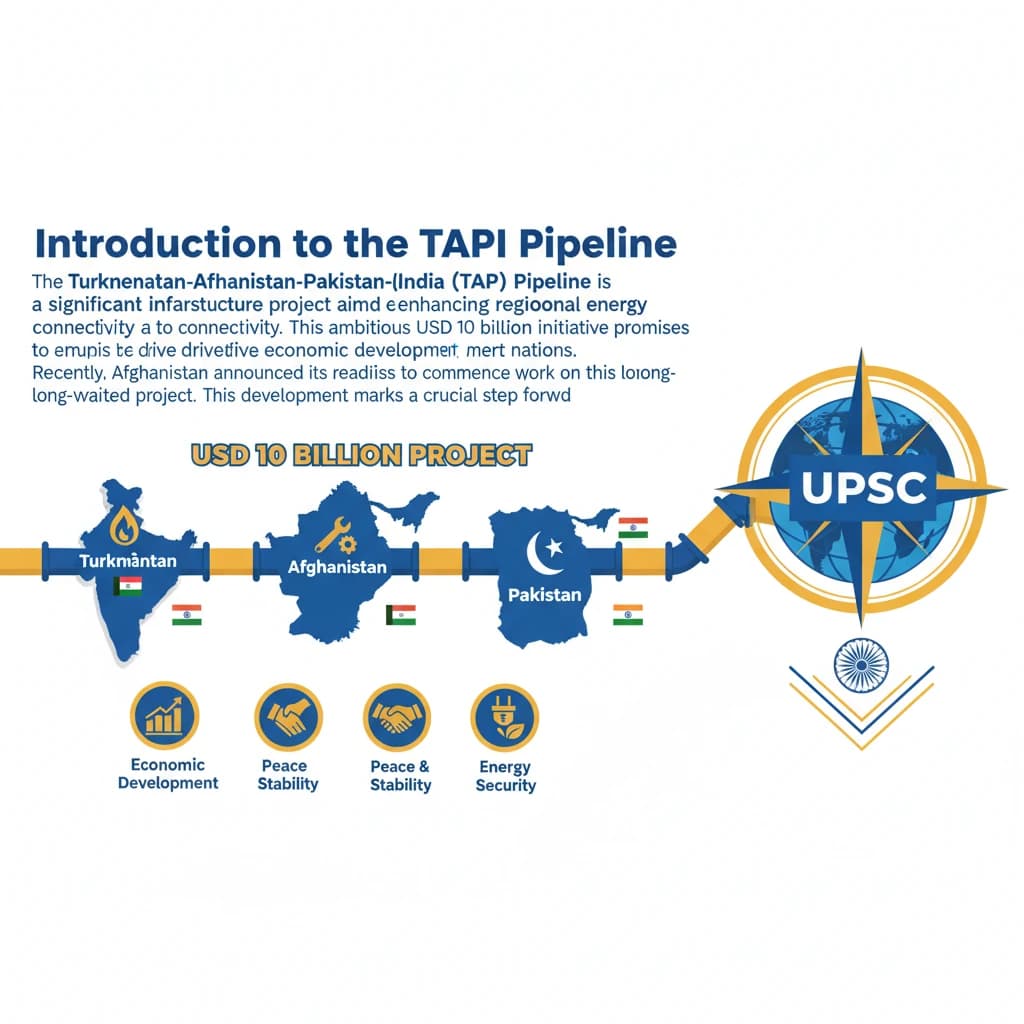
Introduction to the TAPI Pipeline
The Turkmenistan-Afghanistan-Pakistan-India (TAPI) Pipeline is a significant infrastructure project aimed at enhancing regional energy connectivity. This ambitious USD 10 billion initiative promises to drive economic development across the participating nations.
Recently, Afghanistan announced its readiness to commence work on this long-awaited project. This development marks a crucial step forward after years of delays, primarily attributed to prevailing security concerns within Afghanistan.
What is the TAPI Pipeline?
The TAPI Pipeline is an extensive natural gas pipeline designed to transport gas from Turkmenistan's Galkynysh gas field. It will traverse through Afghanistan and Pakistan before reaching India.
Key Specifications:
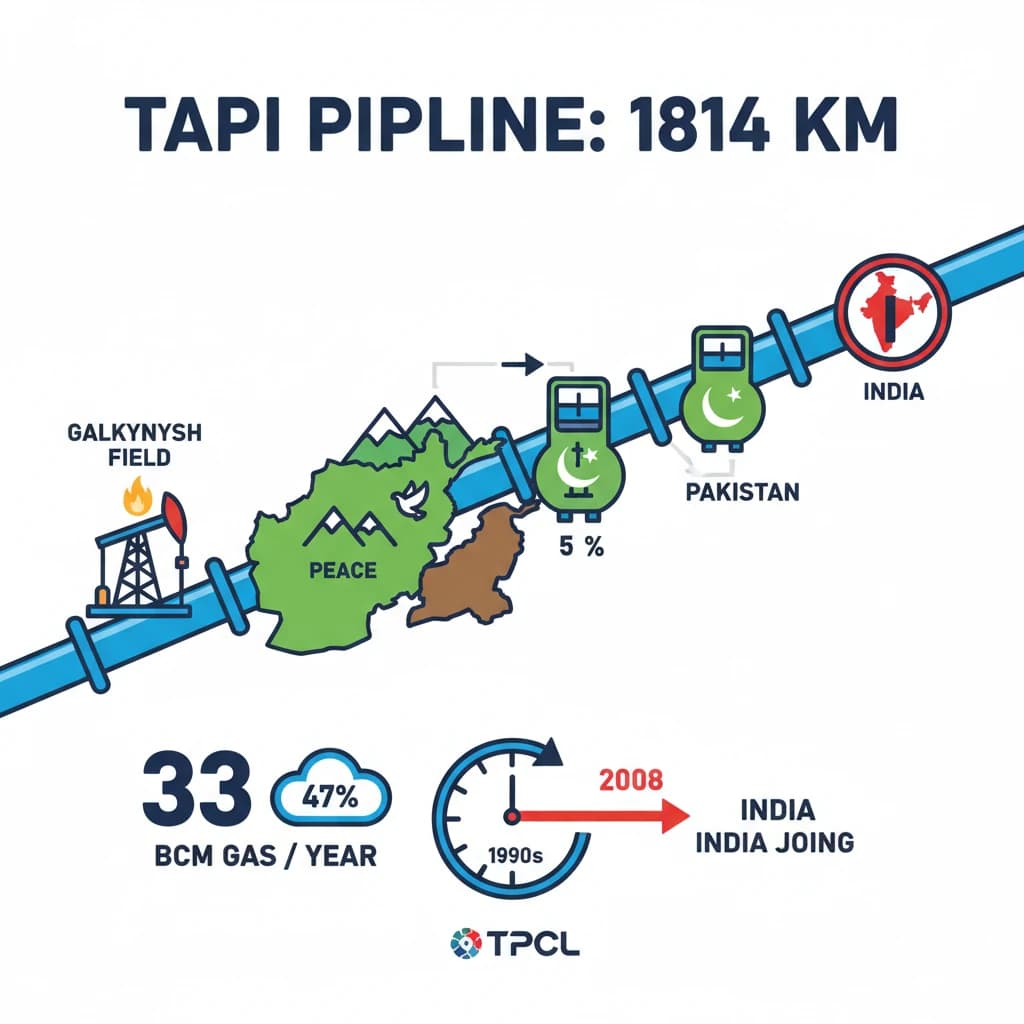
- Length: Approximately 1,814-kilometres
- Annual Capacity: Expected to deliver around 33 billion cubic metres (BCM) of natural gas
- Operational Period: Projected to operate for 30 years
The pipeline is also widely known as the ‘Peace Pipeline’. This moniker reflects its significant potential to foster greater regional cooperation and contribute to stability among the involved countries.
Gas Distribution and Beneficiaries
The natural gas transported through the TAPI Pipeline will be distributed among the four participating nations. Each country has a specific share allocated for its energy needs.
Annual Gas Allocation:
- Afghanistan: 5%
- Pakistan: 47.5%
- India: 47.5%
Historical Development and Ownership
The concept of the TAPI Pipeline originated in the 1990s, laying the groundwork for future energy collaboration. Significant progress on the project was achieved in 2003, with strong backing from the Asian Development Bank (ADB).
India officially joined the initiative in 2008, marking a pivotal moment in the pipeline's development and solidifying its regional scope. The project is managed by a dedicated entity.
The TAPI Pipeline Company Limited (TPCL) is responsible for both the construction and ongoing operation of the pipeline. It operates as a joint venture with shares held by Turkmengas (Turkmenistan), Afghan Gas (Afghanistan), and entities from Pakistan and India.
Significance of the TAPI Pipeline
The pipeline holds immense significance for energy security, environmental sustainability, and regional geopolitics. It presents a crucial alternative to traditional energy sources.
Environmental Impact: The TAPI Pipeline offers a vital alternative to coal, which is a major contributor to carbon emissions. By facilitating the use of natural gas, it can significantly reduce carbon dioxide emissions compared to coal-fired energy generation.
For India, which currently relies heavily on coal for its energy requirements, TAPI could play a transformative role. It is expected to facilitate a smoother transition towards cleaner energy sources, thereby assisting India in achieving its ambitious emission reduction goals and its Net-Zero Emissions Target.
UPSC Insight: Understand TAPI not just as an energy project, but as a geopolitical tool for regional stability and a key component of India's energy diversification strategy. Connect it to India's 'Act East' policy and climate commitments like Net-Zero by 2070.
💡 Key Takeaways
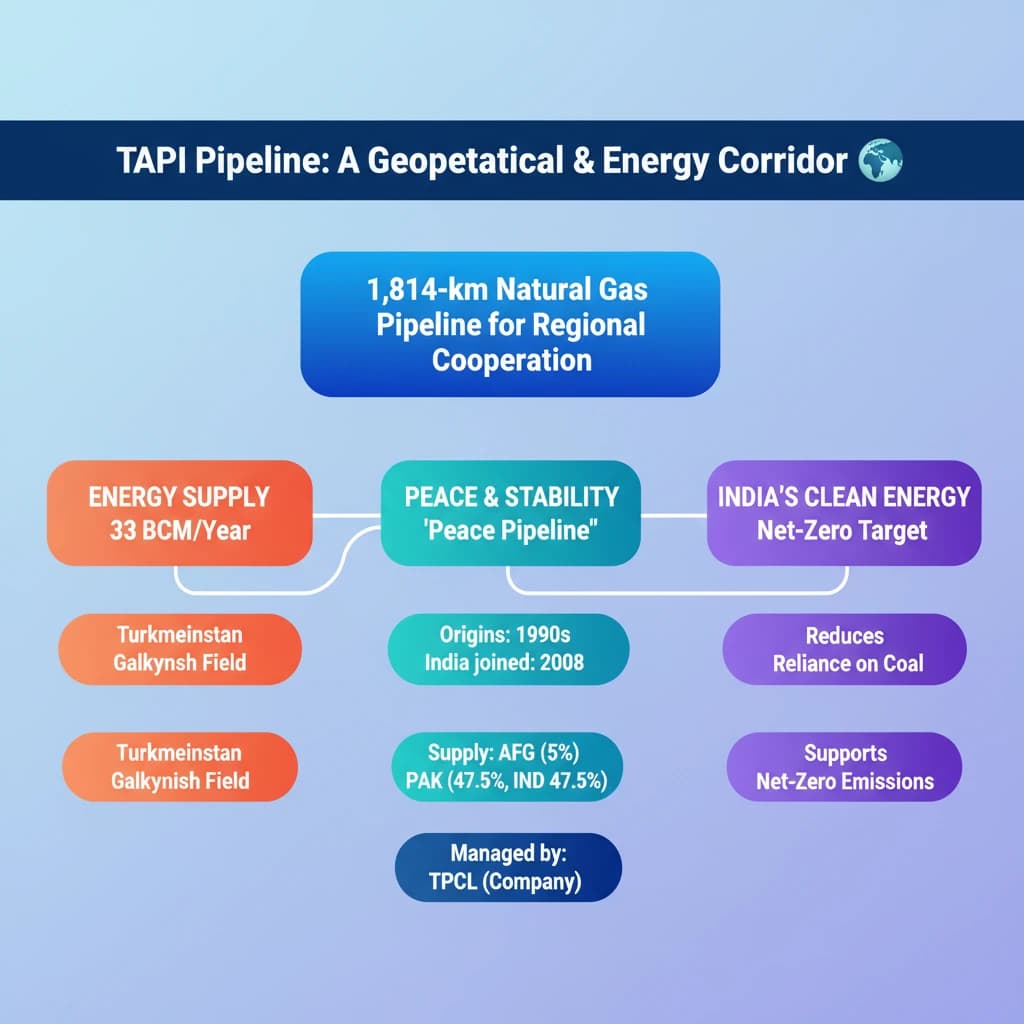
- •TAPI is a 1,814-km natural gas pipeline from Turkmenistan (Galkynysh field) to India, via Afghanistan and Pakistan.
- •It aims to deliver 33 BCM of gas annually, supplying Afghanistan (5%), Pakistan (47.5%), and India (47.5%).
- •Known as the 'Peace Pipeline,' it promotes regional cooperation and stability.
- •Origins in the 1990s, with India joining in 2008; managed by TAPI Pipeline Company Limited (TPCL).
- •Significantly aids India's transition to cleaner energy, supporting its Net-Zero Emissions Target by reducing reliance on coal.
- •Recent Afghan commitment signals a potential breakthrough after years of security-related delays.
🧠 Memory Techniques
95% Verified Content
📚 Reference Sources
•Asian Development Bank (ADB) official reports on TAPI
•Official websites/statements from TAPI Pipeline Company Limited (TPCL) member countries