Loading page, please wait…
What are Other Major Water Bodies Facing Territorial Disputes? - UPSC International Relations
What is What are Other Major Water Bodies Facing Territorial Disputes? in UPSC International Relations?
What are Other Major Water Bodies Facing Territorial Disputes? is a key topic under International Relations for UPSC Civil Services Examination. Key points include: Major water bodies like the East China Sea, Aegean Sea, and Arctic Ocean face significant territorial disputes.. Disputes involve sovereignty over islands (Senkaku/Diaoyu), maritime boundaries (Aegean), and extended EEZ claims (Arctic).. Key countries involved include China, Japan, Taiwan (East China Sea); Greece, Turkey (Aegean); and US, Canada, Russia, Denmark, Norway (Arctic).. Understanding this topic is essential for both UPSC Prelims and Mains preparation.
Why is What are Other Major Water Bodies Facing Territorial Disputes? important for UPSC exam?
What are Other Major Water Bodies Facing Territorial Disputes? is a Medium-level topic in UPSC International Relations. It is tested in both Prelims (factual MCQs) and Mains (analytical answer writing). Previous year UPSC questions have frequently covered aspects of What are Other Major Water Bodies Facing Territorial Disputes?, making it essential for comprehensive IAS preparation.
How to prepare What are Other Major Water Bodies Facing Territorial Disputes? for UPSC?
To prepare What are Other Major Water Bodies Facing Territorial Disputes? for UPSC: (1) Study the comprehensive notes covering all key concepts on Vaidra. (2) Practice previous year questions on this topic. (3) Connect it with current affairs using daily updates. (4) Revise using key takeaways and mind maps available for International Relations. (5) Write practice answers linking What are Other Major Water Bodies Facing Territorial Disputes? to related GS Paper topics.
Key takeaways of What are Other Major Water Bodies Facing Territorial Disputes? for UPSC
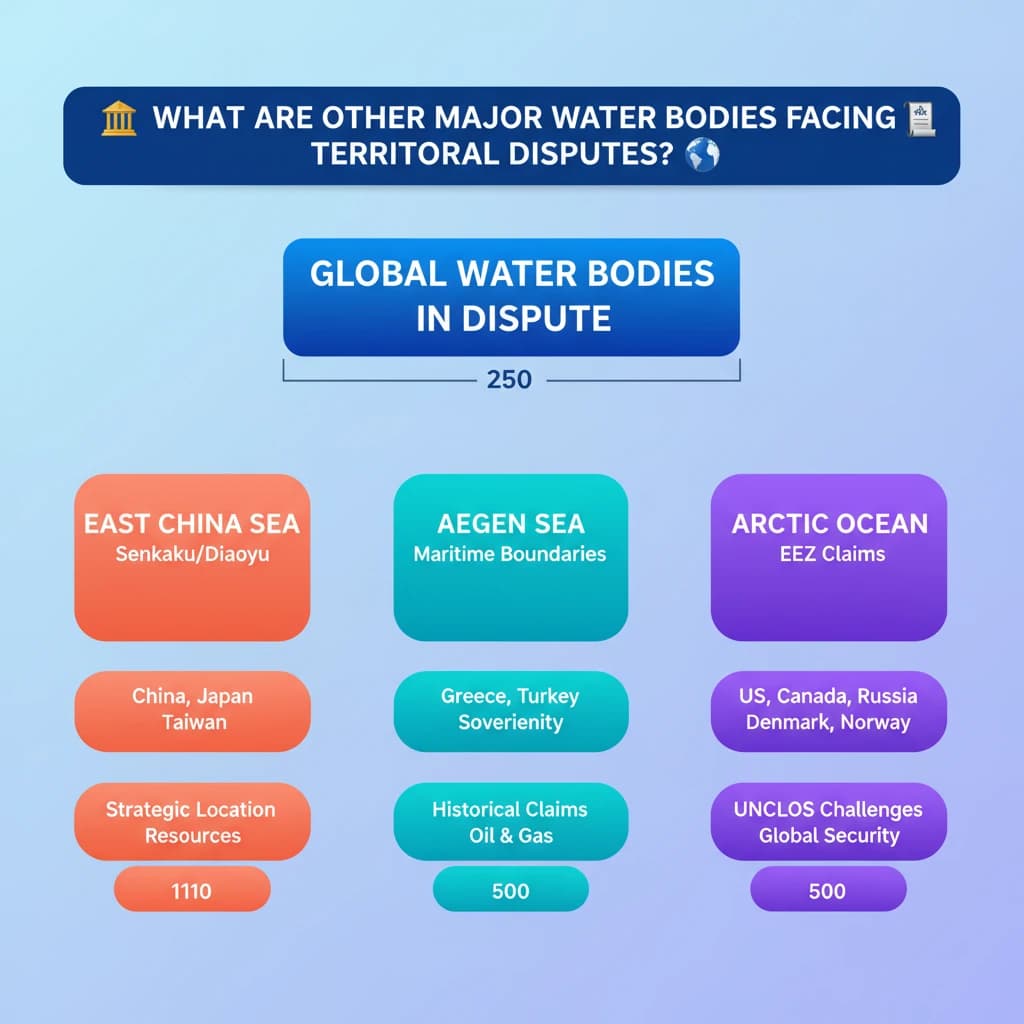
- Major water bodies like the East China Sea, Aegean Sea, and Arctic Ocean face significant territorial disputes.
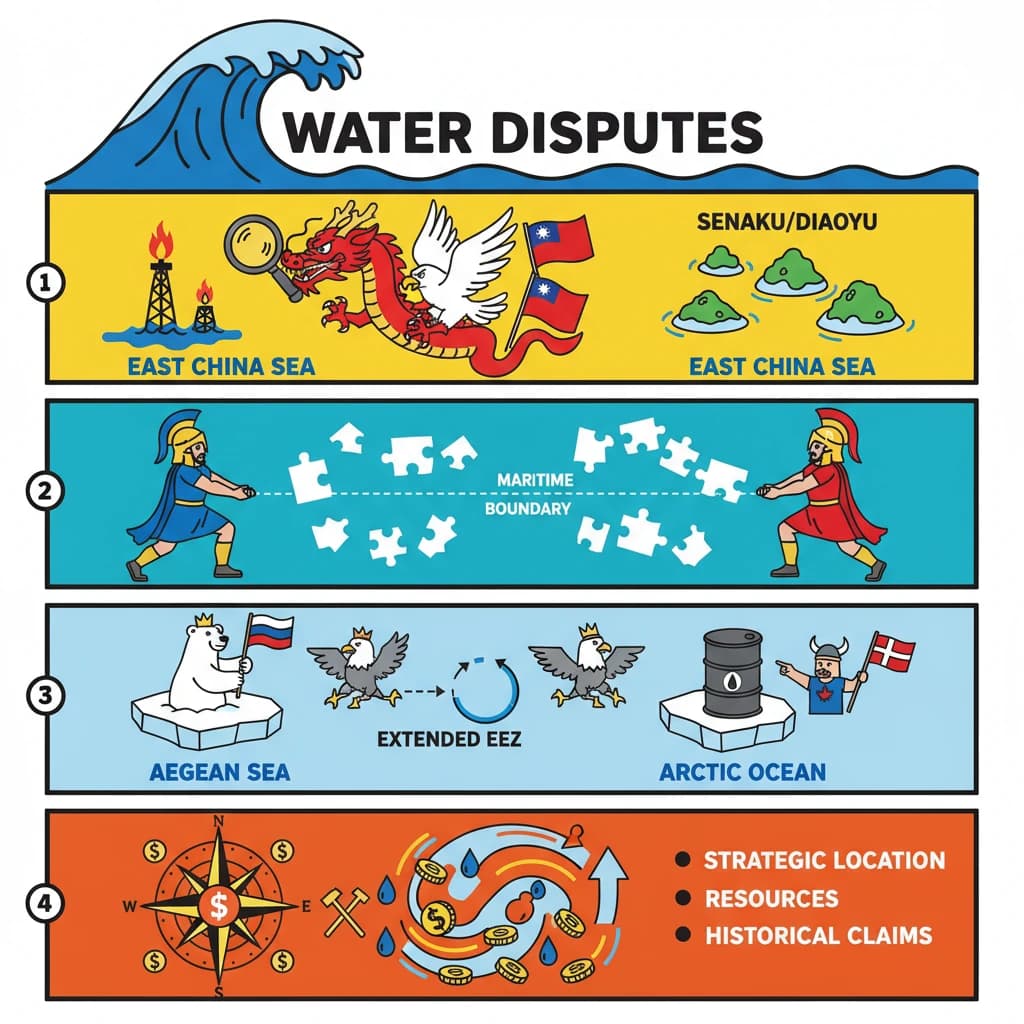
- Disputes involve sovereignty over islands (Senkaku/Diaoyu), maritime boundaries (Aegean), and extended EEZ claims (Arctic).
- Key countries involved include China, Japan, Taiwan (East China Sea); Greece, Turkey (Aegean); and US, Canada, Russia, Denmark, Norway (Arctic).
- These disputes are driven by strategic location, potential resource wealth (oil, gas), and historical claims.
- They pose challenges to international law (UNCLOS), regional stability, and global resource security.
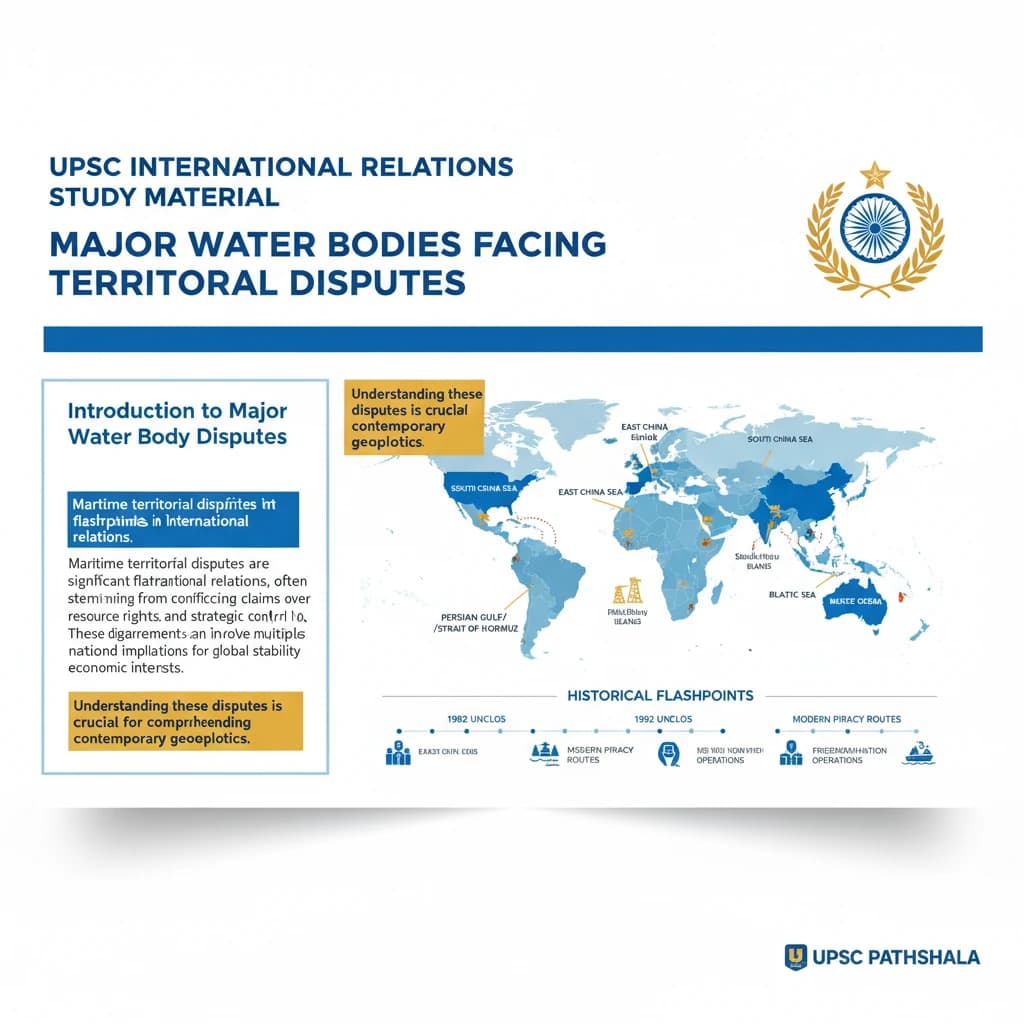
What are Other Major Water Bodies Facing Territorial Disputes?
Medium⏱️ 7 min read
international relations
📖 Introduction
Introduction to Major Water Body Disputes
Maritime territorial disputes are significant flashpoints in international relations, often stemming from conflicting claims over sovereignty, resource rights, and strategic control of sea lanes. These disagreements can involve multiple nations and have profound implications for global stability and economic interests.
Understanding these disputes is crucial for comprehending contemporary geopolitics and international law, particularly the United Nations Convention on the Law of the Sea (UNCLOS).
East China Sea: Senkaku/Diaoyu Islands Dispute
The East China Sea is a region of intense geopolitical rivalry, primarily due to the uninhabited Senkaku Islands (known as Diaoyu Islands in China).
These islands are strategically located and are believed to sit atop significant hydrocarbon reserves, making their control highly contentious.
- Primary Countries Involved: China, Japan, Taiwan
- Nature of Dispute: Sovereignty over the Senkaku/Diaoyu Islands. Both China and Taiwan assert historical claims, while Japan maintains administrative control.
The East China Sea dispute often features in discussions on Indo-Pacific geopolitics and maritime security challenges in UPSC Mains GS Paper 2.
Aegean Sea: Greece-Turkey Overlapping Claims
The Aegean Sea, situated between the Balkan and Anatolian peninsulas, is a complex area marked by long-standing disputes between Greece and Turkey. These disputes encompass various issues, including territorial waters, airspace, and continental shelf rights.
The numerous islands in the Aegean, many of which are Greek, complicate the delimitation of maritime boundaries and Exclusive Economic Zones (EEZs).
- Primary Countries Involved: Greece, Turkey
- Nature of Dispute: Overlapping claims regarding territorial waters, airspace, continental shelf, and potential resource exploration rights.
Arctic Ocean: Extended EEZ Claims
The Arctic Ocean is emerging as a new frontier for territorial and resource disputes, primarily driven by the melting of Arctic ice. This melting opens up new shipping routes and makes previously inaccessible natural resources, such as oil and gas, more reachable.
Coastal states are actively asserting claims for Extended Exclusive Economic Zones (EEZs) and continental shelf rights beyond the standard 200 nautical miles, based on geological continuity.
- Primary Countries Involved: United States (US), Canada, Russia, Denmark (via Greenland), Norway
- Nature of Dispute: Claims for Extended Exclusive Economic Zones and control over potential shipping lanes and vast energy resources beneath the seabed.
The Arctic Council and its role in managing these competing claims are important for UPSC Mains GS Paper 2 (International Institutions) and GS Paper 3 (Environmental Degradation/Resource Management).
💡 Key Takeaways
- •Major water bodies like the East China Sea, Aegean Sea, and Arctic Ocean face significant territorial disputes.
- •Disputes involve sovereignty over islands (Senkaku/Diaoyu), maritime boundaries (Aegean), and extended EEZ claims (Arctic).
- •Key countries involved include China, Japan, Taiwan (East China Sea); Greece, Turkey (Aegean); and US, Canada, Russia, Denmark, Norway (Arctic).
- •These disputes are driven by strategic location, potential resource wealth (oil, gas), and historical claims.
- •They pose challenges to international law (UNCLOS), regional stability, and global resource security.
🧠 Memory Techniques
95% Verified Content
📚 Reference Sources
•United Nations Convention on the Law of the Sea (UNCLOS) documents
•Council on Foreign Relations (CFR) analyses on maritime disputes
•General knowledge of international relations and geopolitics