Loading page, please wait…
What are the Historical Efforts of Nuclear Disarmament Efforts - UPSC International Relations
What is What are the Historical Efforts of Nuclear Disarmament Efforts in UPSC International Relations?
What are the Historical Efforts of Nuclear Disarmament Efforts is a key topic under International Relations for UPSC Civil Services Examination. Key points include: Nuclear disarmament aims to reduce/eliminate nuclear weapons for global peace.. NPT (1970) prevents proliferation but is criticized as discriminatory.. CTBT (1996) bans all nuclear explosions but is not yet fully in force.. Understanding this topic is essential for both UPSC Prelims and Mains preparation.
Why is What are the Historical Efforts of Nuclear Disarmament Efforts important for UPSC exam?
What are the Historical Efforts of Nuclear Disarmament Efforts is a Medium-level topic in UPSC International Relations. It is tested in both Prelims (factual MCQs) and Mains (analytical answer writing). Previous year UPSC questions have frequently covered aspects of What are the Historical Efforts of Nuclear Disarmament Efforts, making it essential for comprehensive IAS preparation.
How to prepare What are the Historical Efforts of Nuclear Disarmament Efforts for UPSC?
To prepare What are the Historical Efforts of Nuclear Disarmament Efforts for UPSC: (1) Study the comprehensive notes covering all key concepts on Vaidra. (2) Practice previous year questions on this topic. (3) Connect it with current affairs using daily updates. (4) Revise using key takeaways and mind maps available for International Relations. (5) Write practice answers linking What are the Historical Efforts of Nuclear Disarmament Efforts to related GS Paper topics.
Key takeaways of What are the Historical Efforts of Nuclear Disarmament Efforts for UPSC
- Nuclear disarmament aims to reduce/eliminate nuclear weapons for global peace.
- NPT (1970) prevents proliferation but is criticized as discriminatory.
- CTBT (1996) bans all nuclear explosions but is not yet fully in force.
- TPNW (2021) explicitly prohibits nuclear weapons, a significant legal step.
- Historical efforts stem from WWII and Cold War arms race fears.
- Current relevance includes geopolitical tensions, arsenal modernization, and non-state actor threats.
- India advocates for universal, non-discriminatory disarmament.
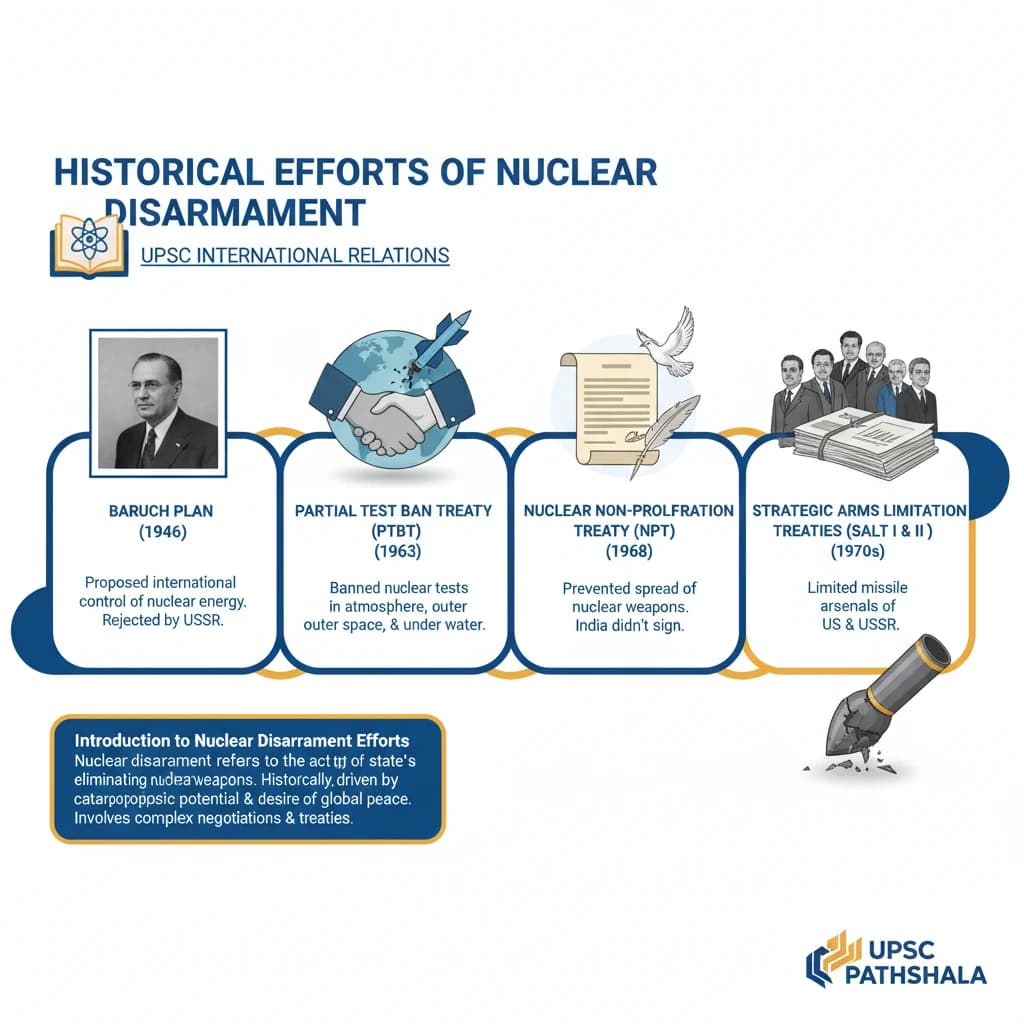
What are the Historical Efforts of Nuclear Disarmament Efforts
Medium⏱️ 8 min read
international relations
📖 Introduction
Introduction to Nuclear Disarmament Efforts
Nuclear disarmament efforts refer to the international initiatives and treaties aimed at reducing, limiting, or completely eliminating nuclear weapons. These efforts are crucial for global peace and security, preventing the proliferation of these destructive devices.
The primary goal is to mitigate the existential threat posed by nuclear weapons, fostering a world free from their use or threat of use.
Treaty on the Non-Proliferation of Nuclear Weapons (NPT)
The Treaty on the Non-Proliferation of Nuclear Weapons (NPT) is a landmark international treaty. It entered into force in 1970, becoming a cornerstone of the global non-proliferation regime.
- Purpose: To prevent the spread of nuclear weapons and weapons technology.
- Goal: To promote cooperation in the peaceful uses of nuclear energy and further the goal of achieving nuclear disarmament.
Despite its widespread acceptance, the NPT has faced significant criticism. It is often perceived as discriminatory, creating a clear division between nuclear-armed states (NWS) and non-nuclear-weapon states (NNWS).
Critics argue that the treaty legitimizes the possession of nuclear weapons by five states while imposing strict obligations on others, leading to an unequal framework.
Comprehensive Nuclear-Test-Ban Treaty (CTBT)
The Comprehensive Nuclear-Test-Ban Treaty (CTBT) is another pivotal instrument in nuclear disarmament. Its primary objective is to ban all nuclear explosions, regardless of their environment.
- Objective: To curb the development of new types of nuclear weapons.
- Scope: Prohibits nuclear weapons test explosions and any other nuclear explosion.
Although widely supported, the CTBT has not yet fully entered into force. This is due to the non-ratification by several key states whose adherence is necessary for its full legal effect.
UPSC often asks about the status of international treaties like CTBT and the reasons for their non-entry into force, especially concerning India's stance.
Treaty on the Prohibition of Nuclear Weapons (TPNW)
The Treaty on the Prohibition of Nuclear Weapons (TPNW) represents a more recent and robust effort towards complete nuclear disarmament. It was adopted in 2017 and entered into force in 2021.
The TPNW includes a comprehensive set of prohibitions on participating in any nuclear weapon activities. This makes it a significant step towards stigmatizing nuclear weapons.
Under the TPNW, states parties undertake not to develop, test, produce, acquire, possess, stockpile, use, or threaten to use nuclear weapons. It also prohibits assisting or encouraging any of these activities.
This treaty goes further than previous agreements by explicitly outlawing nuclear weapons, treating them similarly to chemical and biological weapons.
💡 Key Takeaways
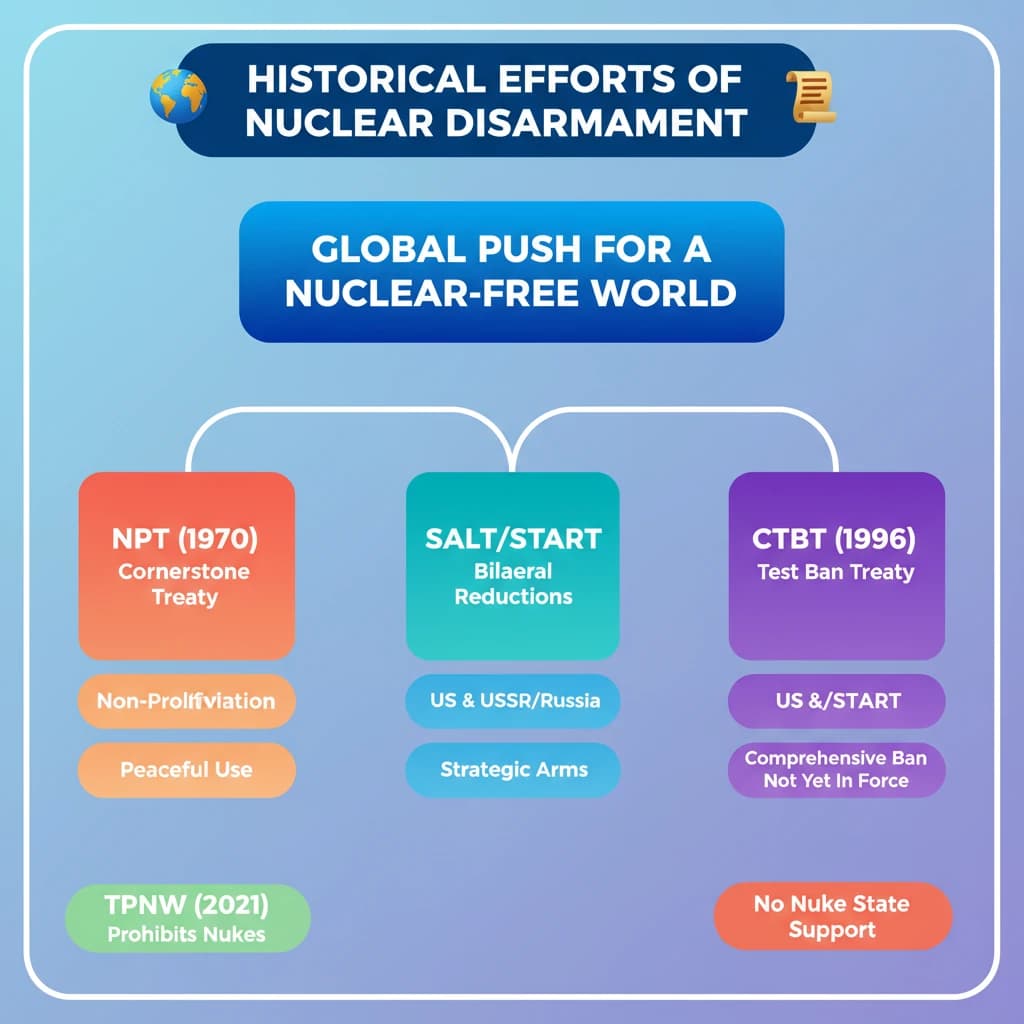
- •Nuclear disarmament aims to reduce/eliminate nuclear weapons for global peace.
- •NPT (1970) prevents proliferation but is criticized as discriminatory.
- •CTBT (1996) bans all nuclear explosions but is not yet fully in force.
- •TPNW (2021) explicitly prohibits nuclear weapons, a significant legal step.
- •Historical efforts stem from WWII and Cold War arms race fears.
- •Current relevance includes geopolitical tensions, arsenal modernization, and non-state actor threats.
- •India advocates for universal, non-discriminatory disarmament.
🧠 Memory Techniques
95% Verified Content
📚 Reference Sources
•United Nations Office for Disarmament Affairs (UNODA)
•International Atomic Energy Agency (IAEA)
•Comprehensive Nuclear-Test-Ban Treaty Organization (CTBTO)
•International Campaign to Abolish Nuclear Weapons (ICAN)