Loading page, please wait…
What are the Key Highlights of the Summit? - UPSC International Relations
What is What are the Key Highlights of the Summit? in UPSC International Relations?
What are the Key Highlights of the Summit? is a key topic under International Relations for UPSC Civil Services Examination. Key points include: BRICS expanded significantly in 2024-2025, adding Egypt, Ethiopia, Iran, UAE, and Indonesia, increasing its global influence.. The Kazan Declaration outlined BRICS's collective positions on geopolitical conflicts (Ukraine, West Asia) and condemned unilateral sanctions.. Emphasis on financial integration includes promoting local currency trade, facilitating cross-border payments, and exploring a BRICS-led payment system.. Understanding this topic is essential for both UPSC Prelims and Mains preparation.
Why is What are the Key Highlights of the Summit? important for UPSC exam?
What are the Key Highlights of the Summit? is a Medium-level topic in UPSC International Relations. It is tested in both Prelims (factual MCQs) and Mains (analytical answer writing). Previous year UPSC questions have frequently covered aspects of What are the Key Highlights of the Summit?, making it essential for comprehensive IAS preparation.
How to prepare What are the Key Highlights of the Summit? for UPSC?
To prepare What are the Key Highlights of the Summit? for UPSC: (1) Study the comprehensive notes covering all key concepts on Vaidra. (2) Practice previous year questions on this topic. (3) Connect it with current affairs using daily updates. (4) Revise using key takeaways and mind maps available for International Relations. (5) Write practice answers linking What are the Key Highlights of the Summit? to related GS Paper topics.
Key takeaways of What are the Key Highlights of the Summit? for UPSC
- BRICS expanded significantly in 2024-2025, adding Egypt, Ethiopia, Iran, UAE, and Indonesia, increasing its global influence.
- The Kazan Declaration outlined BRICS's collective positions on geopolitical conflicts (Ukraine, West Asia) and condemned unilateral sanctions.
- Emphasis on financial integration includes promoting local currency trade, facilitating cross-border payments, and exploring a BRICS-led payment system.
- India's UPI was highlighted as a successful model, and its International Big Cats Alliance received support.
- The summit reinforces BRICS's role in advocating for a multipolar world order and challenging existing global financial structures.
What are the Key Highlights of the Summit?
Medium⏱️ 8 min read
international relations
📖 Introduction
Introduction to the BRICS Summit Highlights
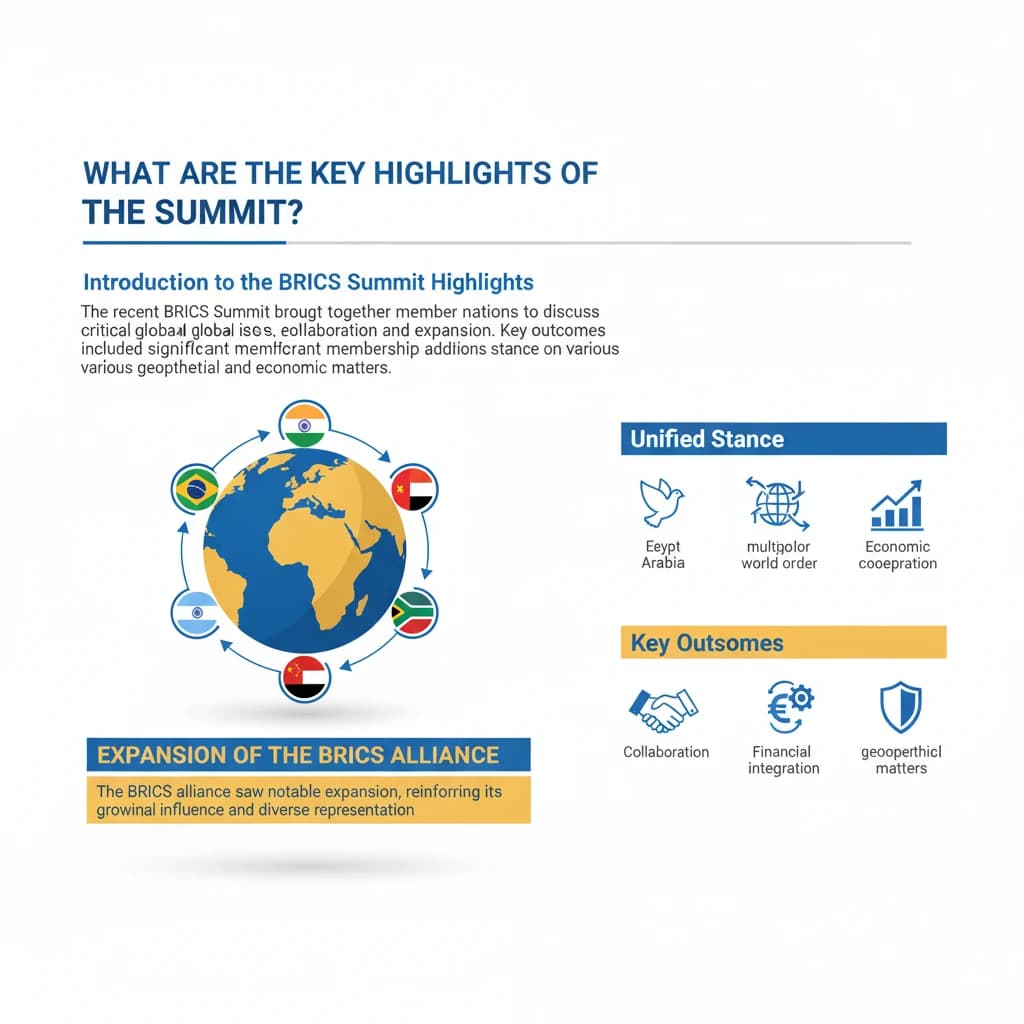
The recent BRICS Summit brought together member nations to discuss critical global issues, emphasizing collaboration and expansion. Key outcomes included significant membership additions and a unified stance on various geopolitical and economic matters.
Expansion of the BRICS Alliance
The BRICS alliance saw a notable expansion, reinforcing its growing global influence and diverse representation. This expansion marks a new phase in the group's evolution.
- In January 2024, Egypt, Ethiopia, Iran, and the UAE officially joined the alliance.
- By January 2025, Indonesia became the 10th member of the BRICS group.
- Saudi Arabia's formal membership is pending, though its foreign minister participated in the summit, indicating strong interest.
The participation of these new member countries at the summit underscored the increasing influence and geographical diversity within the expanded BRICS+ alliance.
The Kazan Declaration
The summit culminated in the adoption of the Kazan Declaration, a crucial document outlining the collective positions and commitments of the member states. This declaration addresses a range of international challenges.
BRICS Stance on Geopolitical Conflicts
The declaration articulated clear positions on ongoing global conflicts, advocating for peaceful resolutions and expressing humanitarian concerns.
- On Ukraine: Members emphasized the importance of mediating a peaceful resolution through sustained dialogue and diplomacy.
- On West Asia Crisis: Deep concern was expressed over the escalating humanitarian crisis in the Gaza Strip and West Bank.
- Condemnation of Attacks: The declaration condemned the significant loss of civilian lives and extensive infrastructure damage resulting from Israeli attacks in Southern Lebanon.
Addressing Western Sanctions
BRICS members highlighted their collective concern regarding the impact of unilateral coercive measures on the global economy.
The declaration emphasized the disruptive effects of unlawful unilateral coercive measures, including trade sanctions, on the global economy, international trade, and the achievement of Sustainable Development Goals (SDGs).
Economic Integration and Initiatives
A significant focus of the summit was on enhancing economic cooperation and reducing reliance on traditional Western-dominated financial systems.
BRICS Grain Exchange: Discussions explored the establishment of a dedicated grain trading platform within BRICS. This initiative, the BRICS Grain Exchange, has scope for future expansion to include other agricultural sectors.
The summit strongly advocated for greater financial integration among member countries, identifying several key aspects for collaboration.
- Promoting the importance of trade in local currencies to reduce dependency on the US Dollar.
- Facilitating smooth cross-border payments to streamline international transactions.
- India's UPI (Unified Payments Interface) was specifically highlighted as a successful and exemplary model for digital payment systems.
- Discussions included the potential development of a BRICS-led payment system designed to rival the existing SWIFT system.
Environmental Cooperation: Big Cats Alliance
Environmental preservation was also on the agenda, with a specific focus on protecting endangered species.
BRICS members expressed strong support for efforts to preserve rare species, particularly big cats. They acknowledged and noted India's initiative to create an international Big Cats Alliance, showcasing collaborative conservation efforts.
💡 Key Takeaways
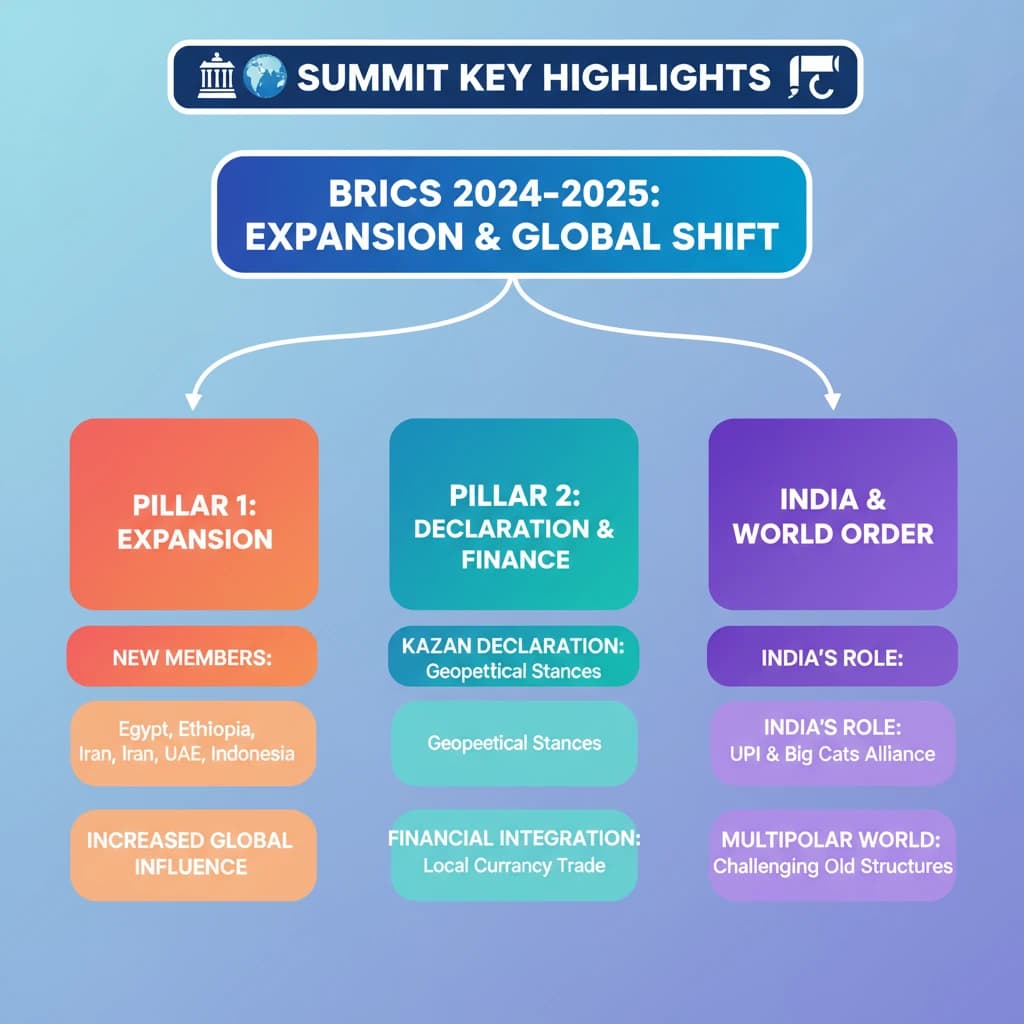
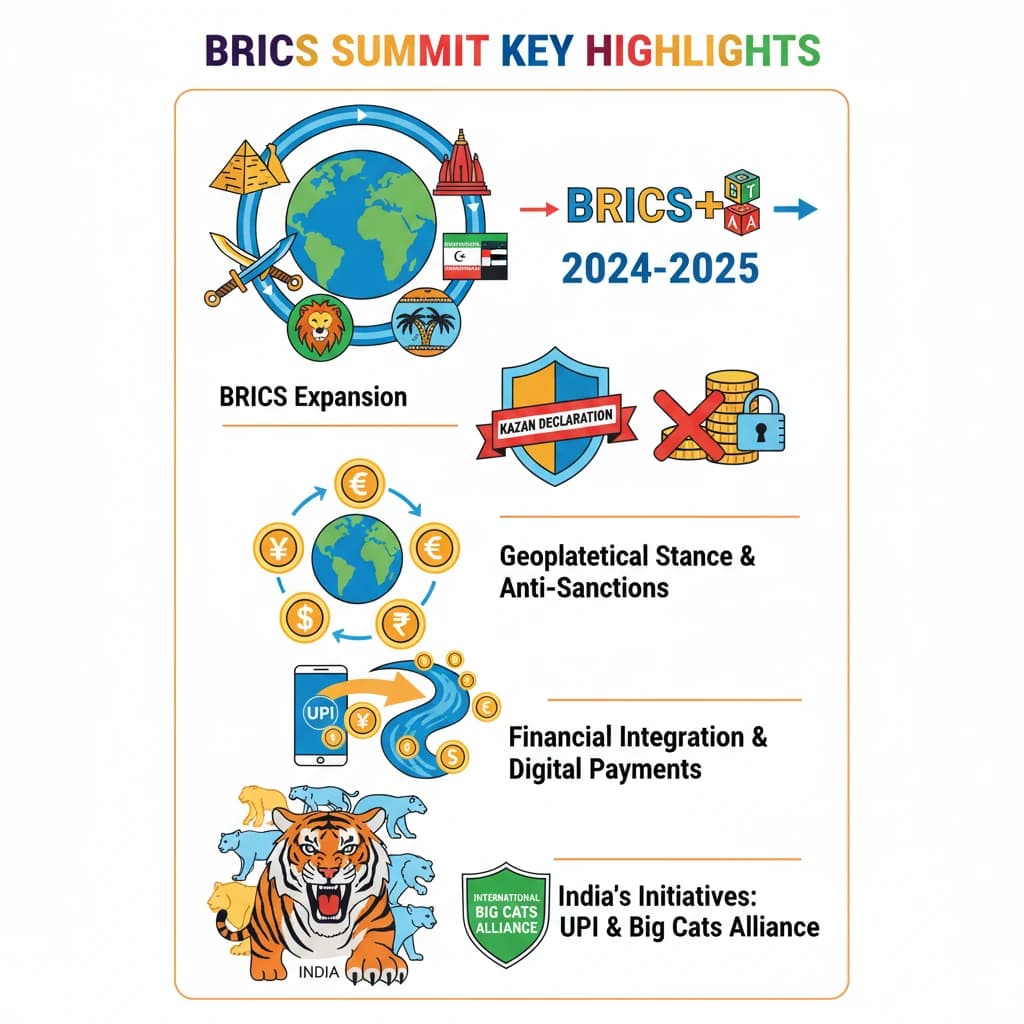
- •BRICS expanded significantly in 2024-2025, adding Egypt, Ethiopia, Iran, UAE, and Indonesia, increasing its global influence.
- •The Kazan Declaration outlined BRICS's collective positions on geopolitical conflicts (Ukraine, West Asia) and condemned unilateral sanctions.
- •Emphasis on financial integration includes promoting local currency trade, facilitating cross-border payments, and exploring a BRICS-led payment system.
- •India's UPI was highlighted as a successful model, and its International Big Cats Alliance received support.
- •The summit reinforces BRICS's role in advocating for a multipolar world order and challenging existing global financial structures.
🧠 Memory Techniques
95% Verified Content