Loading page, please wait…
What are the Key Outcomes of the Visit? - UPSC International Relations
What is What are the Key Outcomes of the Visit? in UPSC International Relations?
What are the Key Outcomes of the Visit? is a key topic under International Relations for UPSC Civil Services Examination. Key points include: India-Russia set a bilateral trade target of USD 100 billion by 2030, largely driven by crude oil imports.. Defence cooperation shifted from buyer-seller to joint R&D, co-development, and production with Russia.. Focus intensified on Eurasian connectivity via INSTC and Chennai-Vladivostok Eastern Maritime Corridor (EMC).. Understanding this topic is essential for both UPSC Prelims and Mains preparation.
Why is What are the Key Outcomes of the Visit? important for UPSC exam?
What are the Key Outcomes of the Visit? is a Medium-level topic in UPSC International Relations. It is tested in both Prelims (factual MCQs) and Mains (analytical answer writing). Previous year UPSC questions have frequently covered aspects of What are the Key Outcomes of the Visit?, making it essential for comprehensive IAS preparation.
How to prepare What are the Key Outcomes of the Visit? for UPSC?
To prepare What are the Key Outcomes of the Visit? for UPSC: (1) Study the comprehensive notes covering all key concepts on Vaidra. (2) Practice previous year questions on this topic. (3) Connect it with current affairs using daily updates. (4) Revise using key takeaways and mind maps available for International Relations. (5) Write practice answers linking What are the Key Outcomes of the Visit? to related GS Paper topics.
Key takeaways of What are the Key Outcomes of the Visit? for UPSC
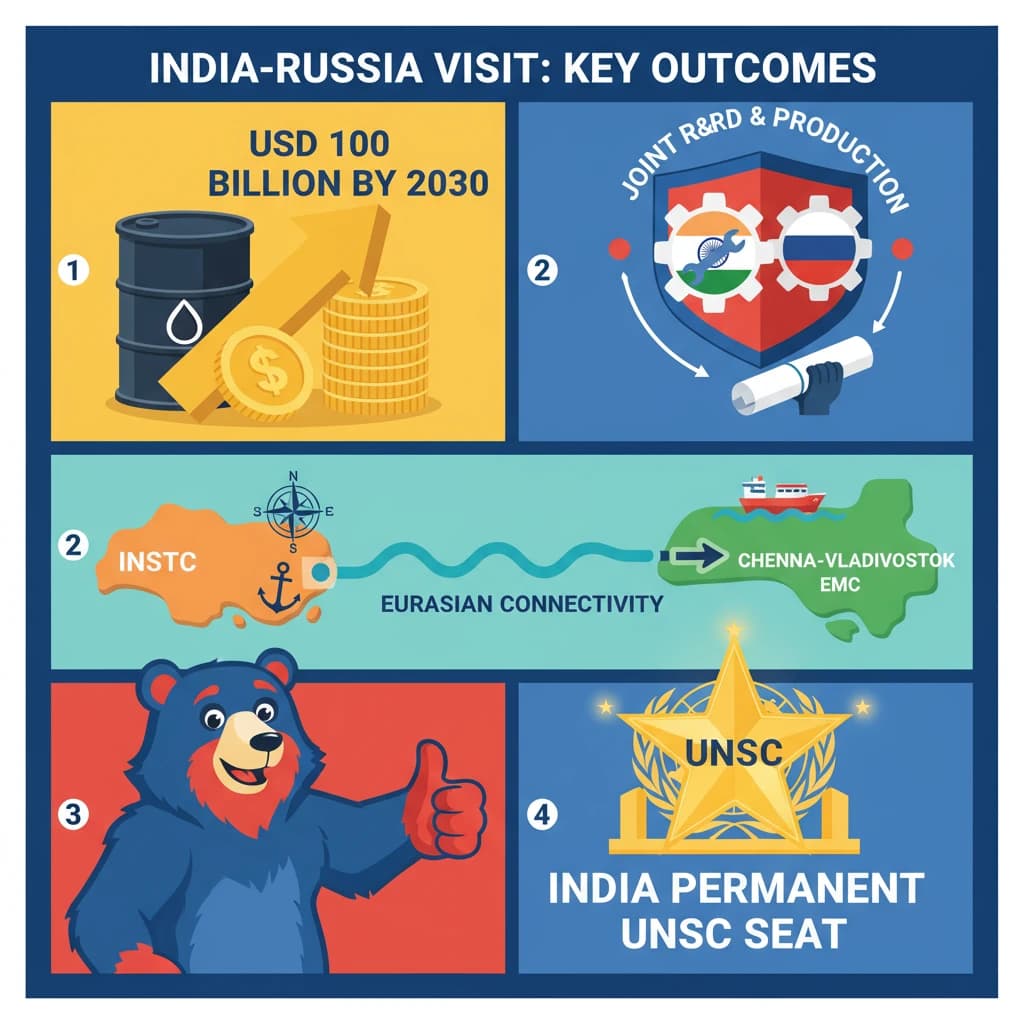
- India-Russia set a bilateral trade target of USD 100 billion by 2030, largely driven by crude oil imports.
- Defence cooperation shifted from buyer-seller to joint R&D, co-development, and production with Russia.
- Focus intensified on Eurasian connectivity via INSTC and Chennai-Vladivostok Eastern Maritime Corridor (EMC).
- Russia reiterated strong support for India's permanent membership in a reformed UN Security Council.
- Extensive development and digital cooperation with Maldives, including LoC projects, UPI launch, and capacity building.
- The long-awaited Reciprocal Exchange of Logistics Agreement (RELOS) with Russia was not signed during the visit.
What are the Key Outcomes of the Visit?
Medium⏱️ 8 min read
international relations
📖 Introduction
Economic Cooperation with Russia
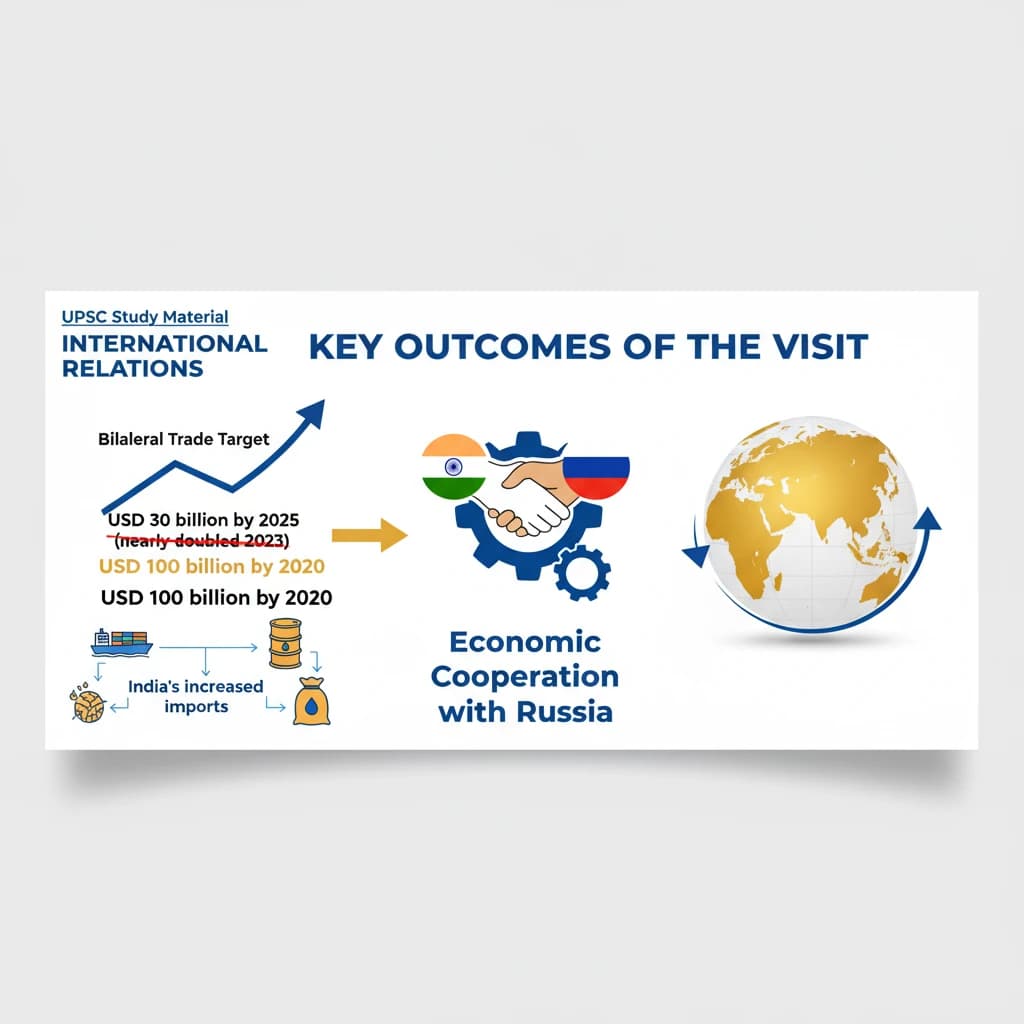
Bilateral Trade Target: India and Russia have set an ambitious new bilateral trade target, significantly increasing their economic aspirations.
The new target aims for USD 100 billion by 2030. This is a substantial leap from the previous goal of USD 30 billion by 2025, which was nearly doubled in 2023.
This surge in trade volume is primarily attributed to India’s increased imports of Russian crude oil.
These imports rose significantly after the US and European Union imposed oil sanctions on Russia following its invasion of Ukraine.
Programme-2030: An agreement was reached to prepare a comprehensive “Programme-2030”. This program is designed to develop promising areas of economic cooperation between the two nations.
The coordination of this program will be handled by the India-Russia Intergovernmental Commission on Trade, Economic, Scientific, Technical and Cultural Cooperation (IRIGC-TEC).
IRIGC-TEC serves as the apex Government-to-Government (G2G) forum for bilateral economic cooperation. It is co-chaired by the External Affairs Minister of India and the Deputy Prime Minister of Russia.
Free Trade Agreement (FTA): India and the Eurasian Economic Union (EEU) have commenced negotiations for a Free Trade Agreement (FTA) on goods.
Additionally, both sides plan to explore a bilateral free trade agreement in services and investments.
“Make in India” & “Atmanirbhar Bharat”: Leaders agreed to facilitate the participation of Russian businesses in India’s “Make in India” and “Atmanirbhar Bharat” programs.
Conversely, Indian companies will be encouraged to participate in investment projects within Russia.
Defence and Technology Cooperation
Shift in Relationship: The defence cooperation is undergoing a significant transition from a traditional buyer-seller relationship.
The new emphasis is on joint research, development, co-development, and joint production of advanced defence technology and systems.
Joint Manufacturing: Both countries aim to encourage the joint manufacturing of spare parts and components for Russian-origin arms and defence equipment in India.
This initiative is a crucial component of the broader Make-in-India program.
It includes setting up joint ventures to meet the needs of the Indian Armed Forces and for subsequent export to friendly third countries.
Working Group on Technological Cooperation: A new Working Group on Technological Cooperation is slated for establishment.
This group will discuss its provisions during the next meeting of the Intergovernmental Commission on Military and Military Technical Cooperation (IRIGC-M&MTC).
Indian Military Recruits in Russia: Russian President Vladimir Putin accepted the Prime Minister of India’s request regarding Indian military personnel.
The request sought the discharge of Indian military recruits serving in the Russian military on the Ukrainian war front who wish to return to India.
Russian law permits the recruitment of foreign soldiers after thorough screening, which includes mental and physical checks.
Reciprocal Exchange of Logistics Agreement (RELOS): The summit concluded without the signing of the long-awaited RELOS agreement.
This agreement would have provided essential logistical support for military operations between Russia and India.
The Indian Navy would have particularly benefited from RELOS, gaining access to Russian military facilities in the Arctic.
Transport and Connectivity Initiatives
Eurasian Transport Corridors: Both sides are focused on developing stable and efficient transport corridors across Eurasia.
Key initiatives include the Chennai-Vladivostok Eastern Maritime Corridor (EMC) and the International North-South Transport Corridor (INSTC).
Chennai-Vladivostok EMC: This is a vital sea link connecting ports on India's east coast with ports in Russia's far-east region.
The Chennai-Vladivostok EMC was initially proposed in 2019. Its objective is to transport various types of cargo and reduce the transportation time to Russia by 40%.
International North-South Transport Corridor (INSTC): The INSTC represents a crucial multi-modal transportation route.
Established in 2000 in St. Petersburg by Iran, Russia, and India, the INSTC aims to promote transportation cooperation among its member states.
The corridor connects the Indian Ocean and the Persian Gulf to the Caspian Sea via Iran.
From the Caspian Sea, it further connects to St. Petersburg and Northern Europe via the Russian Federation.
Northern Sea Route & Connectivity: The leaders aim to increase infrastructure capacity and utilize the potential of the Northern Sea Route.
Both nations will collaborate to reduce the time and cost of cargo transportation, thereby enhancing connectivity in the broader Eurasian space.
International Cooperation
UN Security Council (UNSC): Russia expressed appreciation for India’s non-permanent membership in the UN Security Council (2021-22).
Russia also supported India’s ongoing efforts in peacekeeping and counter-terrorism initiatives.
Permanent UNSC Membership: Russia reiterated its strong support for India’s permanent membership in a reformed and expanded UN Security Council.
India-Maldives Bilateral Outcomes
Water and Sewerage Network Project: Indian and Maldivian Foreign Ministers jointly inaugurated an India-assisted project.
This project, supported by India's Line of Credit (LoC), provides water and sewerage networks across 28 islands of Maldives.
Capacity Building: A Memorandum of Understanding (MoU) was signed focused on capacity building.
This MoU will facilitate the training of an additional 1,000 Maldivian civil servants in India.
Launch of UPI: Both countries reached an agreement for the introduction of Unified Payments Interface (UPI) in Maldives.
Community Development Projects: Six High Impact Community Development Projects (HICDPs) were jointly inaugurated.
These projects, funded by India's grant assistance, cover vital areas such as mental health, special education, speech therapy, and street lighting.
'Ek Ped Maa Ke Naam' Initiative: India's EAM planted a sapling at the Rashtrapatiy Park as part of a significant environmental initiative.
This was in support of Prime Minister Muizzu’s ‘Ek Ped Maa Ke Naam’ initiative and President Muizzu’s 5 Million Tree Project.
Greener Male’ Connectivity Project (GMCP): The EAM visited the India-assisted GMCP site.
India reaffirmed its commitment to the progress of this flagship development project, which will connect Male with the adjoining islands of Villigili, Gulhifalhu, and Thilafushi.
Addu Reclamation and Shore Protection Project: The EAM inaugurated the Addu Reclamation and Shore Protection Project.
Additionally, the Addu Detour Link Bridge Project was also inaugurated during the visit.
💡 Key Takeaways
- •India-Russia set a bilateral trade target of USD 100 billion by 2030, largely driven by crude oil imports.
- •Defence cooperation shifted from buyer-seller to joint R&D, co-development, and production with Russia.
- •Focus intensified on Eurasian connectivity via INSTC and Chennai-Vladivostok Eastern Maritime Corridor (EMC).
- •Russia reiterated strong support for India's permanent membership in a reformed UN Security Council.
- •Extensive development and digital cooperation with Maldives, including LoC projects, UPI launch, and capacity building.
- •The long-awaited Reciprocal Exchange of Logistics Agreement (RELOS) with Russia was not signed during the visit.
🧠 Memory Techniques
95% Verified Content