Loading page, please wait…
What are the Key Takeaways of Raisina Dialogue 2024? - UPSC International Relations
What is What are the Key Takeaways of Raisina Dialogue 2024? in UPSC International Relations?
What are the Key Takeaways of Raisina Dialogue 2024? is a key topic under International Relations for UPSC Civil Services Examination. Key points include: India positioned itself as a 'bridging power' and 'vishwamitra' through a 'multi-vector' foreign policy.. Significant diplomatic outreach to the Baltic-Nordic Forum aimed at strengthening trade and investment ties.. Discussions heavily focused on global conflicts, particularly the Russian war in Ukraine and managing an aggressive China.. Understanding this topic is essential for both UPSC Prelims and Mains preparation.
Why is What are the Key Takeaways of Raisina Dialogue 2024? important for UPSC exam?
What are the Key Takeaways of Raisina Dialogue 2024? is a Medium-level topic in UPSC International Relations. It is tested in both Prelims (factual MCQs) and Mains (analytical answer writing). Previous year UPSC questions have frequently covered aspects of What are the Key Takeaways of Raisina Dialogue 2024?, making it essential for comprehensive IAS preparation.
How to prepare What are the Key Takeaways of Raisina Dialogue 2024? for UPSC?
To prepare What are the Key Takeaways of Raisina Dialogue 2024? for UPSC: (1) Study the comprehensive notes covering all key concepts on Vaidra. (2) Practice previous year questions on this topic. (3) Connect it with current affairs using daily updates. (4) Revise using key takeaways and mind maps available for International Relations. (5) Write practice answers linking What are the Key Takeaways of Raisina Dialogue 2024? to related GS Paper topics.
Key takeaways of What are the Key Takeaways of Raisina Dialogue 2024? for UPSC
- India positioned itself as a 'bridging power' and 'vishwamitra' through a 'multi-vector' foreign policy.
- Significant diplomatic outreach to the Baltic-Nordic Forum aimed at strengthening trade and investment ties.
- Discussions heavily focused on global conflicts, particularly the Russian war in Ukraine and managing an aggressive China.
- European nations urged India to reconsider ties with Russia and join a Ukraine-requested 'Peace Conference'.
- Regional security concerns across Indo-Pacific, Middle East, and Eastern Europe were extensively addressed.
- Technology and innovation were recognized as key shapers of geopolitics and global governance.
What are the Key Takeaways of Raisina Dialogue 2024?
Medium⏱️ 6 min read
international relations
📖 Introduction
Introduction to Raisina Dialogue 2024
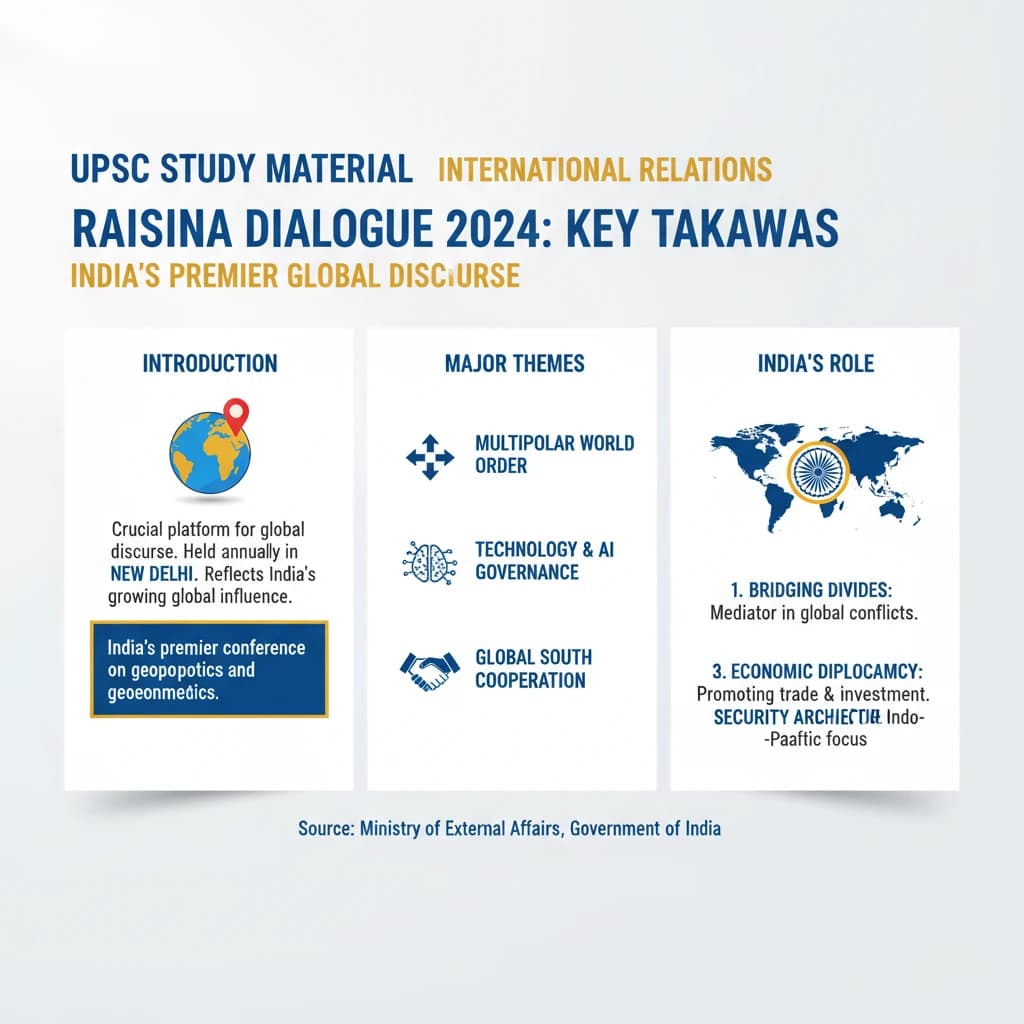
The Raisina Dialogue 2024 served as a crucial platform for global discourse, bringing together leaders, policymakers, and experts to discuss pressing geopolitical and geoeconomic issues. Held annually in New Delhi, it reflects India's growing influence in international relations.
The Raisina Dialogue is India's premier conference on geopolitics and geoeconomics, organized by the Observer Research Foundation (ORF) in partnership with the Ministry of External Affairs (MEA).
India's Role as a Bridging Power
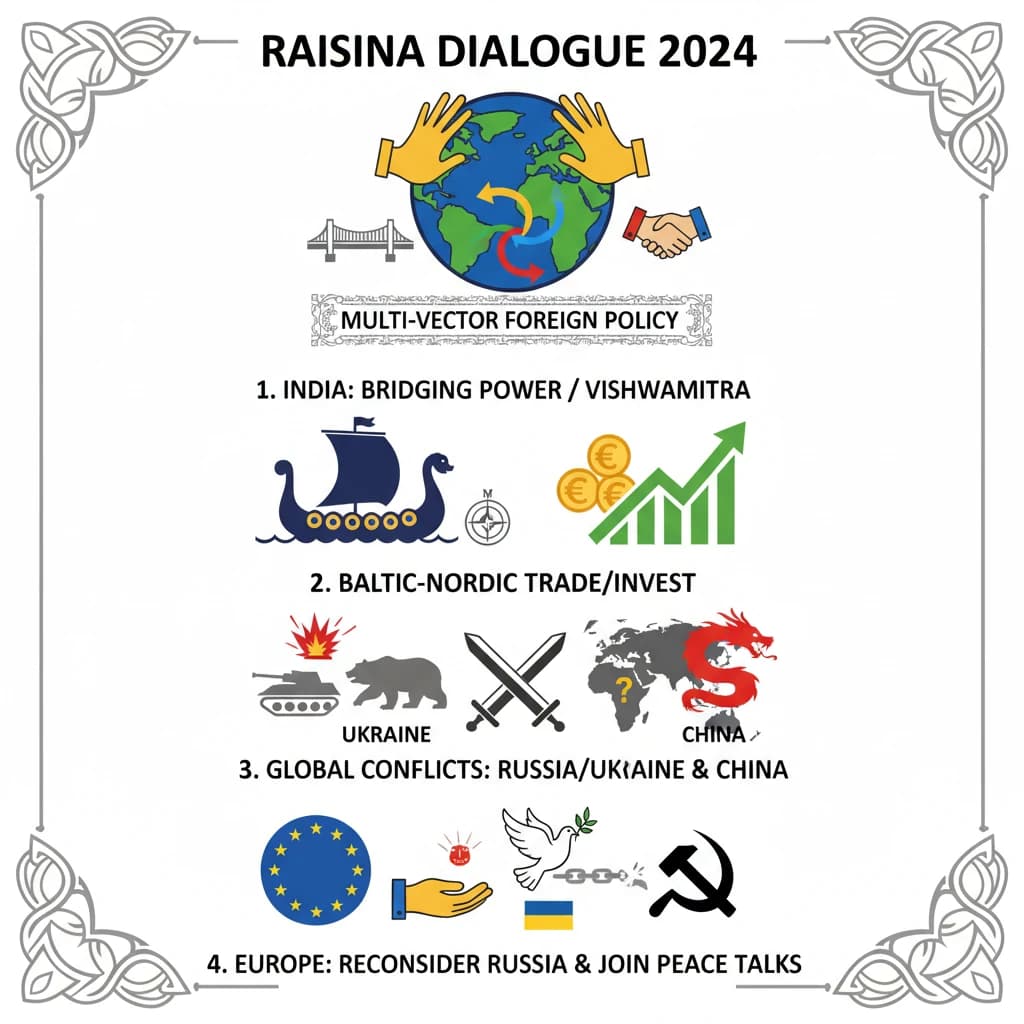
India's External Affairs Minister articulated India's position as a "bridging power". This signifies the nation's intent to seek common ground and foster cooperation amidst global divisions.
This role is underpinned by a "multi-vector policy", indicating India's strategy of engaging with multiple global partners without exclusive alignment, thereby positioning itself as a "vishwamitra" or a friend to the world.
Key Concept: A "bridging power" aims to connect disparate blocs and facilitate dialogue, rather than aligning strictly with one side, promoting stability and multilateralism.
Baltic-Nordic Forum Outreach
A significant diplomatic achievement was the substantial presence of ministerial contingents from Central and Eastern Europe, specifically including all Ministers from the Baltic-Nordic Forum.
This outreach created new avenues for the Indian government to establish stronger trade agreements and investment ties with this economically competitive, yet often overlooked, part of Europe.
The Baltic-Nordic Forum comprises countries like Estonia, Latvia, Lithuania (Baltic States) and Denmark, Finland, Iceland, Norway, Sweden (Nordic Countries), known for innovation and strong economies.
Focus on Global Conflicts
A dominant theme of the dialogue was the discussion around ongoing global conflicts. The strong European presence naturally directed significant attention towards the Russian war in Ukraine.
European Ministers actively urged India to reassess its trade and ties with Russia and to advocate for Ukraine's sovereignty, particularly ahead of the second anniversary of the invasion.
They also extended an invitation for India to participate in a forthcoming "Peace Conference" in Switzerland, initiated at the request of Ukraine President Volodymyr Zelensky.
Discussions on military and naval strategy also concentrated on the imperative to manage an increasingly assertive China, including deliberations on "grey warfare" tactics.
"Grey warfare" refers to aggressive actions below the threshold of conventional armed conflict, often involving cyberattacks, economic coercion, and propaganda.
UPSC aspirants should note India's delicate balancing act between its strategic partnership with Russia and its growing ties with Western nations, especially concerning the Ukraine conflict and China's assertiveness.
Regional Security Concerns
The conference also extensively addressed various regional security concerns across critical geopolitical zones. This included ongoing tensions in the Indo-Pacific, the volatile Middle East, and Eastern Europe.
Participants engaged in dialogues concerning effective conflict resolution strategies, fostering sustainable peace-building efforts, and managing complex regional rivalries to ensure stability.
Technology and Innovation in Geopolitics
A crucial underlying theme was the transformative influence of technology and innovation on the global geopolitical landscape and the future of global governance.
Discussions likely explored how advancements in areas like AI, cybersecurity, and space technology are reshaping power dynamics and international cooperation frameworks.
💡 Key Takeaways
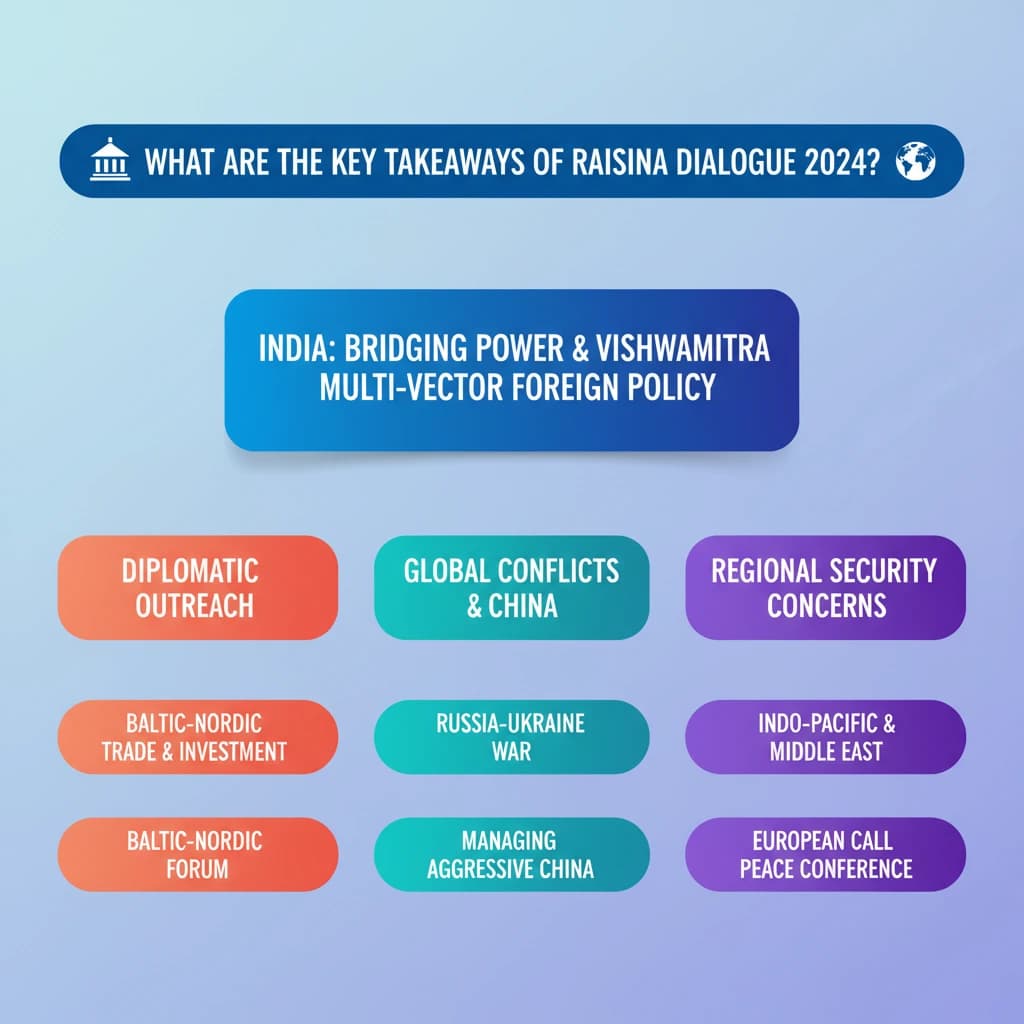
- •India positioned itself as a 'bridging power' and 'vishwamitra' through a 'multi-vector' foreign policy.
- •Significant diplomatic outreach to the Baltic-Nordic Forum aimed at strengthening trade and investment ties.
- •Discussions heavily focused on global conflicts, particularly the Russian war in Ukraine and managing an aggressive China.
- •European nations urged India to reconsider ties with Russia and join a Ukraine-requested 'Peace Conference'.
- •Regional security concerns across Indo-Pacific, Middle East, and Eastern Europe were extensively addressed.
- •Technology and innovation were recognized as key shapers of geopolitics and global governance.
🧠 Memory Techniques
95% Verified Content