Loading page, please wait…
What are the Other Major Developmental Projects along India’s Border - UPSC International Relations
What is What are the Other Major Developmental Projects along India’s Border in UPSC International Relations?
What are the Other Major Developmental Projects along India’s Border is a key topic under International Relations for UPSC Civil Services Examination. Key points include: India's border projects are multi-faceted, covering security, infrastructure, and socio-economic development.. Vibrant Villages Programme (VVP) focuses on holistic development of India-China border villages to prevent out-migration.. Border Area Development Programme (BADP) targets comprehensive development in remote international border areas.. Understanding this topic is essential for both UPSC Prelims and Mains preparation.
Why is What are the Other Major Developmental Projects along India’s Border important for UPSC exam?
What are the Other Major Developmental Projects along India’s Border is a Medium-level topic in UPSC International Relations. It is tested in both Prelims (factual MCQs) and Mains (analytical answer writing). Previous year UPSC questions have frequently covered aspects of What are the Other Major Developmental Projects along India’s Border, making it essential for comprehensive IAS preparation.
How to prepare What are the Other Major Developmental Projects along India’s Border for UPSC?
To prepare What are the Other Major Developmental Projects along India’s Border for UPSC: (1) Study the comprehensive notes covering all key concepts on Vaidra. (2) Practice previous year questions on this topic. (3) Connect it with current affairs using daily updates. (4) Revise using key takeaways and mind maps available for International Relations. (5) Write practice answers linking What are the Other Major Developmental Projects along India’s Border to related GS Paper topics.
Key takeaways of What are the Other Major Developmental Projects along India’s Border for UPSC
- India's border projects are multi-faceted, covering security, infrastructure, and socio-economic development.
- Vibrant Villages Programme (VVP) focuses on holistic development of India-China border villages to prevent out-migration.
- Border Area Development Programme (BADP) targets comprehensive development in remote international border areas.
- Smart Fencing under CIBMS uses advanced technology for enhanced security along the India-Pakistan border.
- National Board for Wildlife (NBWL) is a statutory body, chaired by the PM, advising on wildlife conservation and approving projects in protected areas.
- NBWL's Standing Committee, chaired by the Environment Minister, approves projects within 10 km of protected wildlife areas.
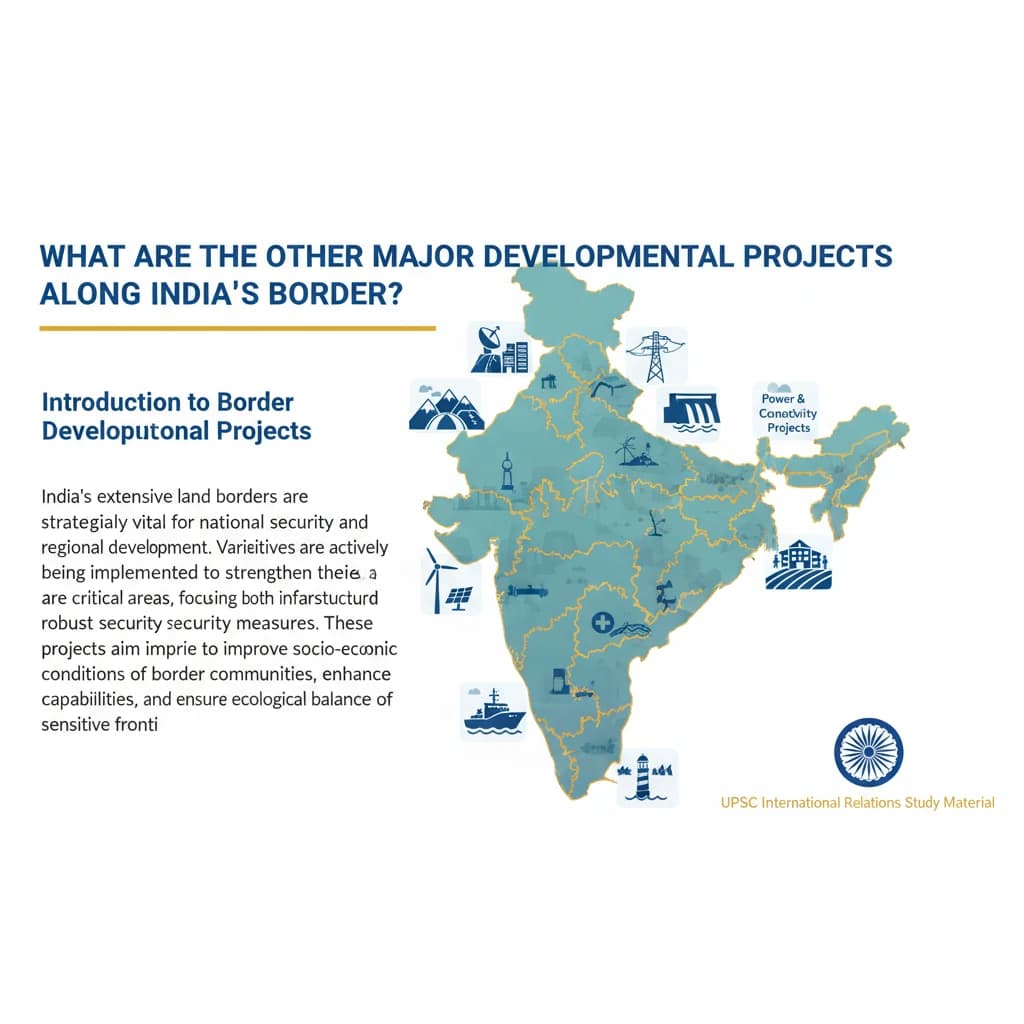
What are the Other Major Developmental Projects along India’s Border
Medium⏱️ 12 min read
international relations
📖 Introduction
Introduction to Border Developmental Projects
India's extensive land borders are strategically vital for national security and regional development. Various initiatives are actively being implemented to strengthen these critical areas, focusing on both infrastructural enhancements and robust security measures.
These projects aim to improve the socio-economic conditions of border communities, enhance surveillance capabilities, and ensure the ecological balance of sensitive frontier zones.
Development Projects along the India-China Border
The India-China border, particularly in the northern states and Union Territories, receives significant developmental focus due to its strategic importance and challenging terrain.
Key government programmes are designed to bolster infrastructure, improve connectivity, and enhance the living standards of residents in these remote and high-altitude areas.
Vibrant Villages Programme (VVP)
The Vibrant Villages Programme (VVP) is a centrally sponsored scheme specifically designed for the comprehensive development of selected villages located in blocks bordering the India-China border.
This programme prioritizes improving essential infrastructure, enhancing digital and physical connectivity, creating sustainable livelihood opportunities, and upgrading social amenities. Its objective is to prevent out-migration from these crucial border areas and thereby strengthen overall border security.
- Objective: Holistic development of strategically important border villages.
- Focus Areas: Infrastructure, connectivity, livelihood generation, and social development.
- Strategic Impact: Contributes to national security by ensuring population retention in frontier regions.
Border Area Development Programme (BADP)
The Border Area Development Programme (BADP) is another crucial initiative aimed at addressing the unique developmental needs of people residing in remote and often inaccessible areas situated near India's international borders.
It encompasses a wide array of projects, including the construction of vital roads and bridges, and the provision of essential services such as health, education, and sanitation, particularly in villages located within 0-10 km of the border.
- Scope: Comprehensive development across border districts.
- Funding: A centrally sponsored scheme.
- Typical Projects: Focuses on infrastructure, basic amenities, and economic upliftment.
Development Projects along the India-Pakistan Border
Along the India-Pakistan border, the primary emphasis of developmental projects often shifts towards enhancing security infrastructure and advanced surveillance capabilities. This is largely due to the historical context of cross-border infiltration and security challenges.
Smart Fencing in India (Comprehensive Integrated Border Management System – CIBMS)
Smart Fencing, implemented as a core component of the Comprehensive Integrated Border Management System (CIBMS), represents a significant technological advancement in border security along the India-Pakistan border.
This system integrates various cutting-edge surveillance and communication technologies to establish a multi-layered, robust, and all-weather electronic surveillance network. It aims to provide real-time situational awareness to border guarding forces.
- System Name: CIBMS (Comprehensive Integrated Border Management System).
- Key Components: Advanced sensors, high-resolution cameras, radars, underground optical fibre networks, and sophisticated data analytics.
- Benefit: Provides enhanced real-time situational awareness and facilitates rapid response capabilities for border forces.
National Board for Wildlife (NBWL)
Beyond direct infrastructure, the protection of natural ecosystems and biodiversity along border areas is also critically important. This crucial aspect is often managed and regulated by specialized bodies such as the National Board for Wildlife (NBWL).
The NBWL plays a pivotal role in national conservation efforts, particularly in scrutinizing and approving developmental projects that may impact wildlife habitats, including those in sensitive border regions.
Establishment and Legal Basis
The National Board for Wildlife (NBWL) is a statutory body that was officially constituted in 2003.
Its establishment was mandated under the provisions of the comprehensive Wild Life (Protection) Act, 1972. The NBWL succeeded and replaced its predecessor, the Indian Board for Wildlife, which had been set up earlier in 1952.
- Status: A Statutory Board.
- Year of Constitution: 2003.
- Legal Foundation: Derived from the Wild Life (Protection) Act, 1972.
- Predecessor: The Indian Board for Wildlife (established in 1952).
Composition and Leadership
The NBWL is notably chaired by the Prime Minister of India. This high-level leadership underscores the significant national importance and commitment accorded to wildlife conservation in the country.
The composition ensures that wildlife protection remains a top national priority and receives appropriate policy attention and strategic direction.
Roles and Responsibilities
The primary responsibility of the NBWL is the active promotion of conservation and sustainable development of wildlife and forests across the entire nation.
It functions as an apex body, responsible for reviewing all matters pertaining to wildlife and for approving various developmental projects that could potentially affect wildlife habitats.
Crucially, the board is advisory in nature. This means it primarily provides recommendations and guidance to the Government on policy-making for wildlife conservation, rather than directly implementing policies itself.
- Core Function: Promotes conservation and development of wildlife and forests.
- Nature of Role: An advisory body to the Government on policy matters.
- Key Role: Serves as the apex body for the review and approval of wildlife-related projects.
The Standing Committee of NBWL
The Standing Committee of the NBWL is a vital operational arm of the main board, designed to facilitate more agile and quicker decision-making processes.
This important committee is chaired by the Minister of Environment, Forest and Climate Change.
It holds the authority to approve all projects that are proposed to fall either within protected wildlife areas or within a 10 km radius surrounding such protected zones.
- Chairperson: The Minister of Environment, Forest and Climate Change.
- Approval Authority: Responsible for approving projects within protected wildlife areas or their 10 km vicinity.
UPSC Insight: A thorough understanding of the statutory nature, composition (especially the chairperson), and advisory role of NBWL is fundamental for GS-III Environment & Ecology. Its function in project approval, particularly concerning protected areas, is a frequent topic for questions on environmental governance and sustainable development.
💡 Key Takeaways
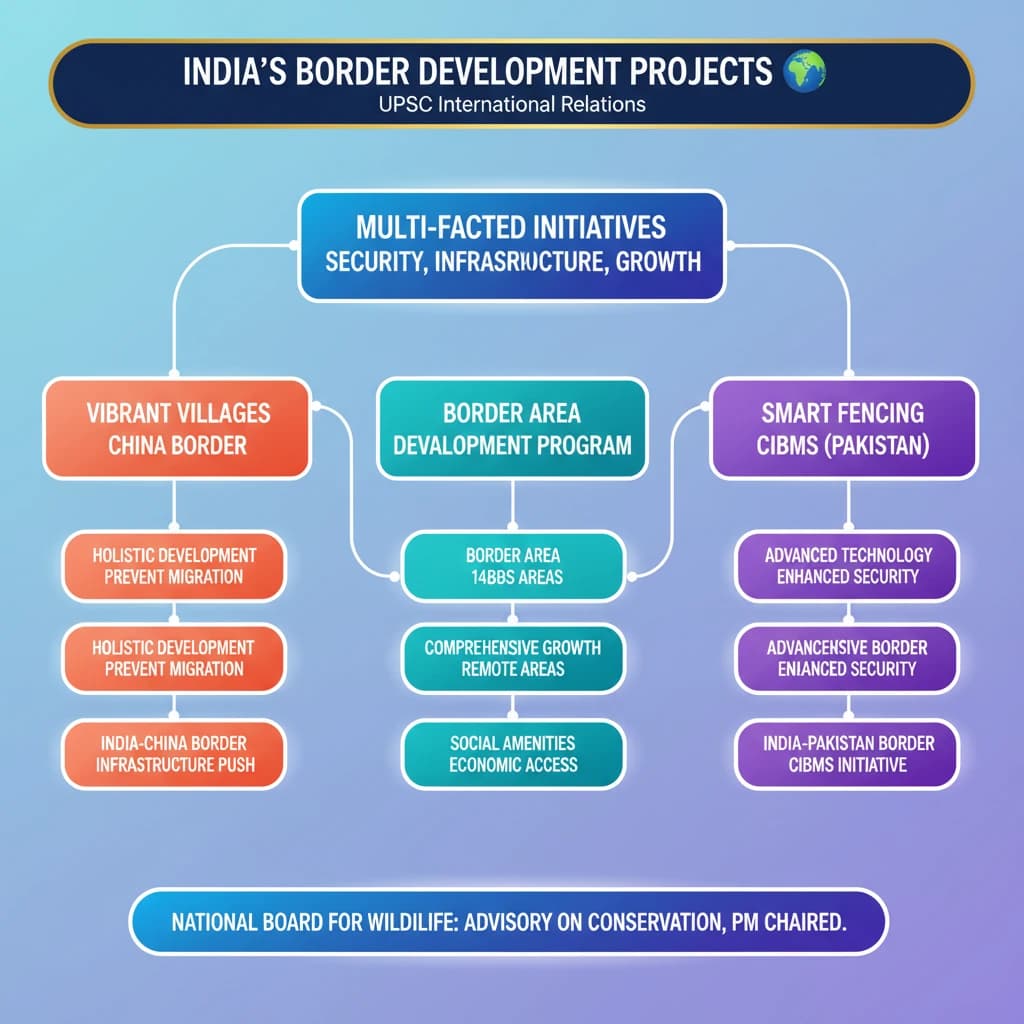
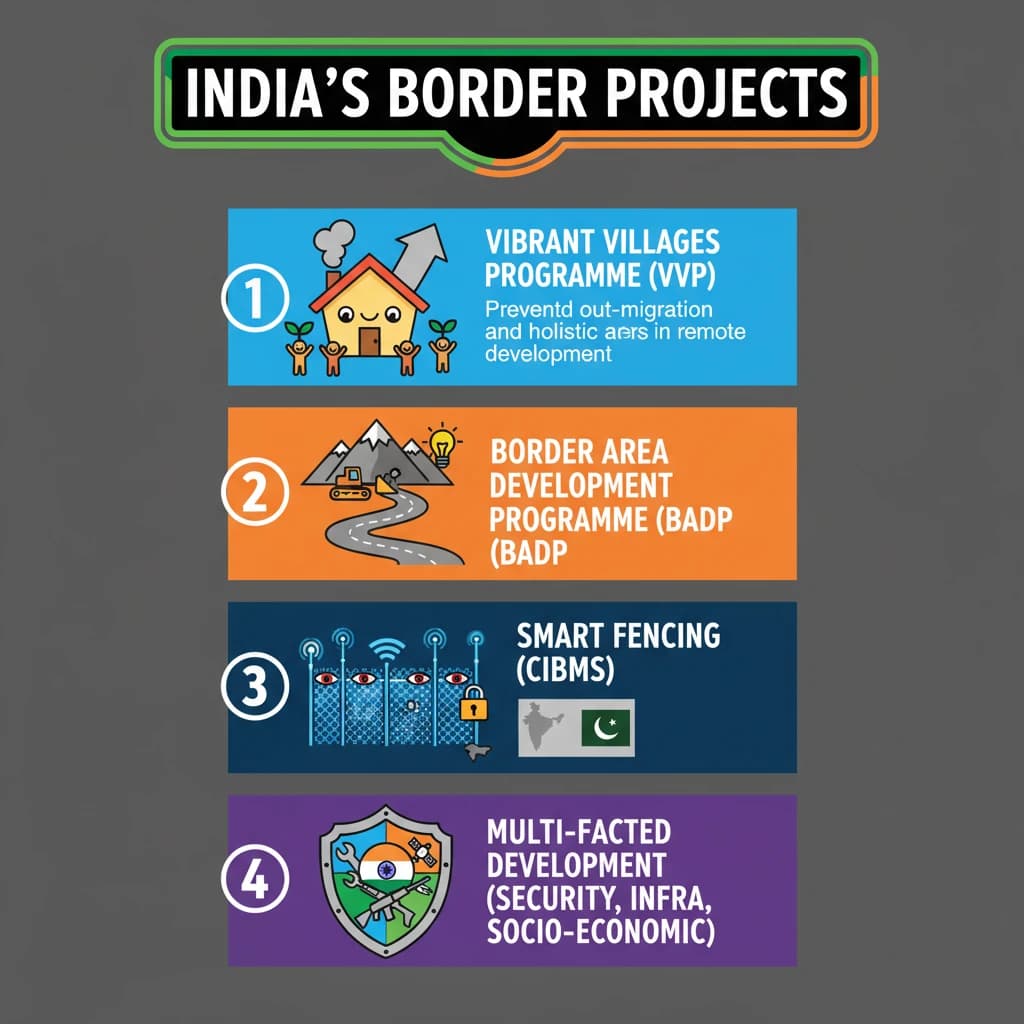
- •India's border projects are multi-faceted, covering security, infrastructure, and socio-economic development.
- •Vibrant Villages Programme (VVP) focuses on holistic development of India-China border villages to prevent out-migration.
- •Border Area Development Programme (BADP) targets comprehensive development in remote international border areas.
- •Smart Fencing under CIBMS uses advanced technology for enhanced security along the India-Pakistan border.
- •National Board for Wildlife (NBWL) is a statutory body, chaired by the PM, advising on wildlife conservation and approving projects in protected areas.
- •NBWL's Standing Committee, chaired by the Environment Minister, approves projects within 10 km of protected wildlife areas.
🧠 Memory Techniques
95% Verified Content
📚 Reference Sources
•Press Information Bureau (PIB) releases on Vibrant Villages Programme and CIBMS
•Ministry of Environment, Forest and Climate Change (MoEFCC) documents on NBWL