Loading page, please wait…
What is Act East Policy? - UPSC International Relations
What is What is Act East Policy? in UPSC International Relations?
What is Act East Policy? is a key topic under International Relations for UPSC Civil Services Examination. Key points include: Act East Policy (AEP) was launched in November 2014, upgrading the Look East Policy (LEP).. It's a diplomatic initiative for economic, strategic, and cultural ties with the Indo-Pacific region.. Key engagement areas: connectivity, trade, culture, defence, and people-to-people contact.. Understanding this topic is essential for both UPSC Prelims and Mains preparation.
Why is What is Act East Policy? important for UPSC exam?
What is Act East Policy? is a Medium-level topic in UPSC International Relations. It is tested in both Prelims (factual MCQs) and Mains (analytical answer writing). Previous year UPSC questions have frequently covered aspects of What is Act East Policy?, making it essential for comprehensive IAS preparation.
How to prepare What is Act East Policy? for UPSC?
To prepare What is Act East Policy? for UPSC: (1) Study the comprehensive notes covering all key concepts on Vaidra. (2) Practice previous year questions on this topic. (3) Connect it with current affairs using daily updates. (4) Revise using key takeaways and mind maps available for International Relations. (5) Write practice answers linking What is Act East Policy? to related GS Paper topics.
Key takeaways of What is Act East Policy? for UPSC
- Act East Policy (AEP) was launched in November 2014, upgrading the Look East Policy (LEP).
- It's a diplomatic initiative for economic, strategic, and cultural ties with the Indo-Pacific region.
- Key engagement areas: connectivity, trade, culture, defence, and people-to-people contact.
- AEP aims for proactive, pragmatic engagement at bilateral, regional, and multilateral levels.
- A primary objective is the economic development of India's North Eastern Region (NER) as a gateway to Southeast Asia.
What is Act East Policy?
Medium⏱️ 8 min read
international relations
📖 Introduction
What is India's Act East Policy?
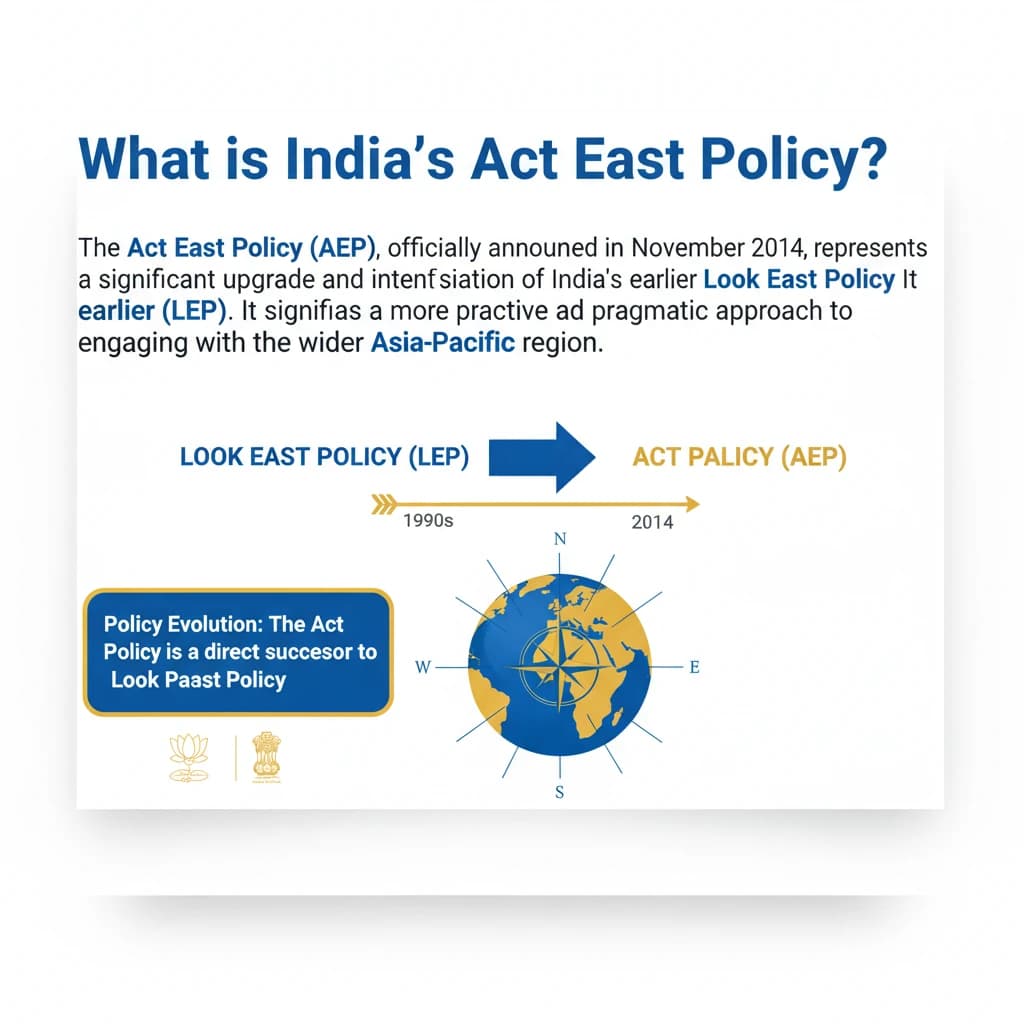
The Act East Policy (AEP), officially announced in November 2014, represents a significant upgrade and intensification of India's earlier Look East Policy (LEP). It signifies a more proactive and pragmatic approach to engaging with the wider Asia-Pacific region.
Policy Evolution: The Act East Policy is a direct successor to the Look East Policy, which was initiated in the early 1990s. AEP aims for deeper, more comprehensive engagement.
Diplomatic Initiative and Scope
The Act East Policy is a comprehensive diplomatic initiative designed to foster robust economic, strategic, and cultural relations. It targets the vast Indo-Pacific region, engaging countries at bilateral, regional, and multilateral levels.
Its scope involves intensive and continuous engagement across various critical sectors. This multi-faceted approach ensures a holistic development of ties with partner nations.
Key Pillars of Engagement
- Connectivity: Enhancing physical and digital links, including infrastructure projects.
- Trade: Promoting economic cooperation and boosting bilateral and regional commerce.
- Culture: Strengthening people-to-people contact and cultural exchanges.
- Defence: Fostering security cooperation and joint exercises.
- People-to-People Contact: Encouraging tourism, educational exchanges, and cultural understanding.
Focus Region: While primarily focused on Southeast Asian countries (ASEAN), the policy's ambit extends to the broader Indo-Pacific region, including East Asia and Oceania.
Primary Objectives of Act East Policy
The overarching aim of the Act East Policy is to achieve multifaceted development. It seeks to promote economic cooperation, strengthen cultural ties, and develop a robust strategic relationship with countries across the Indo-Pacific region.
A critical component of the policy is the focus on the North Eastern Region (NER) of India. The NER is envisioned as the 'gateway' to Southeast Asia, and its economic development is a key strategic objective, leveraging its geographical proximity.
UPSC Insight: When discussing Act East Policy, always highlight its distinction from Look East Policy (more proactive, broader scope) and emphasize the strategic importance of the North Eastern Region as a land bridge to ASEAN.
💡 Key Takeaways
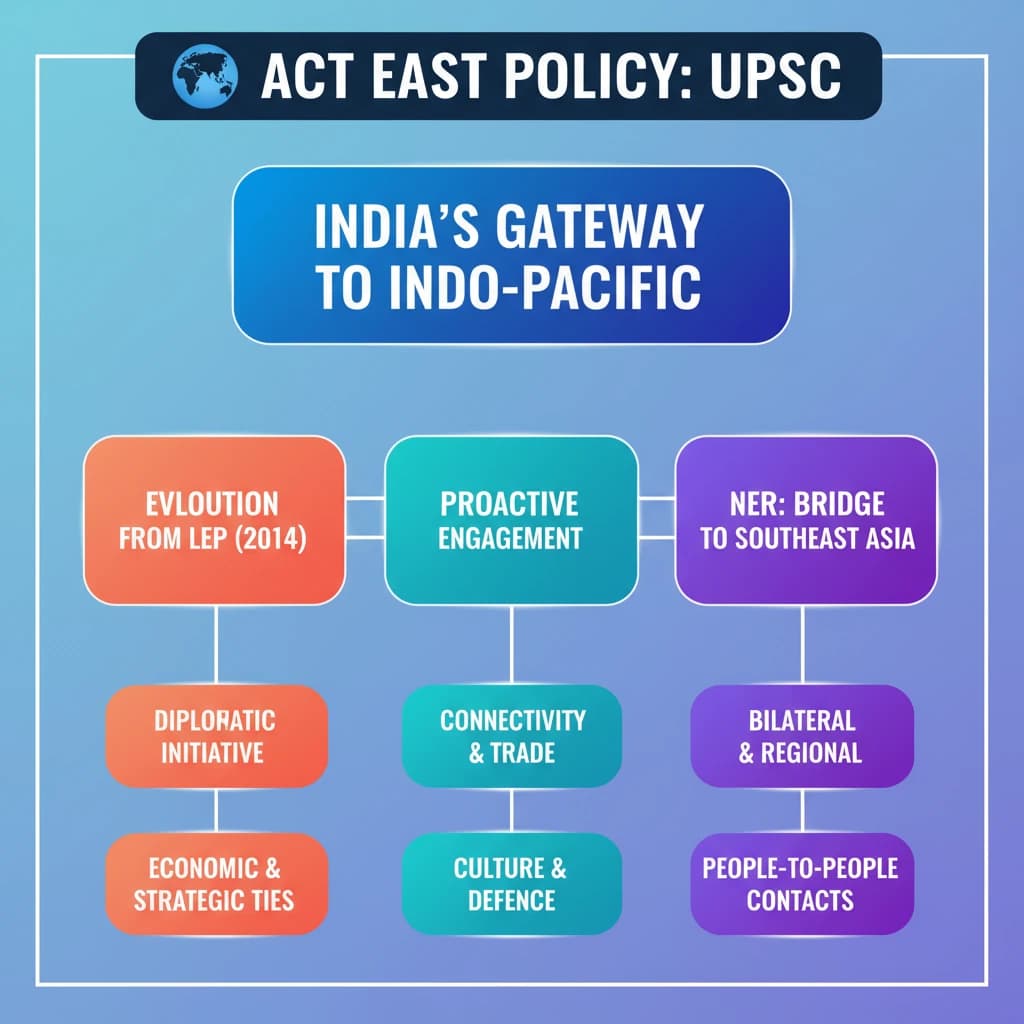
- •Act East Policy (AEP) was launched in November 2014, upgrading the Look East Policy (LEP).
- •It's a diplomatic initiative for economic, strategic, and cultural ties with the Indo-Pacific region.
- •Key engagement areas: connectivity, trade, culture, defence, and people-to-people contact.
- •AEP aims for proactive, pragmatic engagement at bilateral, regional, and multilateral levels.
- •A primary objective is the economic development of India's North Eastern Region (NER) as a gateway to Southeast Asia.
🧠 Memory Techniques

95% Verified Content