Loading page, please wait…
What is the Caribbean Community (CARICOM) - UPSC International Relations
What is What is the Caribbean Community (CARICOM) in UPSC International Relations?
What is the Caribbean Community (CARICOM) is a key topic under International Relations for UPSC Civil Services Examination. Key points include: CARICOM is a regional grouping of 21 countries (15 Member States, 6 Associate Members) in the Caribbean.. It was founded in 1973 with the signing of the Treaty of Chaguaramas by Barbados, Guyana, Jamaica, and Trinidad and Tobago.. Its core objectives include economic integration (Caribbean Single Market and Economy - CSME), functional cooperation, and foreign policy coordination.. Understanding this topic is essential for both UPSC Prelims and Mains preparation.
Why is What is the Caribbean Community (CARICOM) important for UPSC exam?
What is the Caribbean Community (CARICOM) is a Easy-level topic in UPSC International Relations. It is tested in both Prelims (factual MCQs) and Mains (analytical answer writing). Previous year UPSC questions have frequently covered aspects of What is the Caribbean Community (CARICOM), making it essential for comprehensive IAS preparation.
How to prepare What is the Caribbean Community (CARICOM) for UPSC?
To prepare What is the Caribbean Community (CARICOM) for UPSC: (1) Study the comprehensive notes covering all key concepts on Vaidra. (2) Practice previous year questions on this topic. (3) Connect it with current affairs using daily updates. (4) Revise using key takeaways and mind maps available for International Relations. (5) Write practice answers linking What is the Caribbean Community (CARICOM) to related GS Paper topics.
Key takeaways of What is the Caribbean Community (CARICOM) for UPSC
- CARICOM is a regional grouping of 21 countries (15 Member States, 6 Associate Members) in the Caribbean.
- It was founded in 1973 with the signing of the Treaty of Chaguaramas by Barbados, Guyana, Jamaica, and Trinidad and Tobago.
- Its core objectives include economic integration (Caribbean Single Market and Economy - CSME), functional cooperation, and foreign policy coordination.
- The community is characterized by significant ethnic and linguistic diversity, with a young demographic (60% under 30).
- CARICOM plays a crucial role in disaster management, climate change advocacy, and promoting regional stability for its member SIDS.
What is the Caribbean Community (CARICOM)
Easy⏱️ 7 min read
international relations
📖 Introduction
Introduction to CARICOM
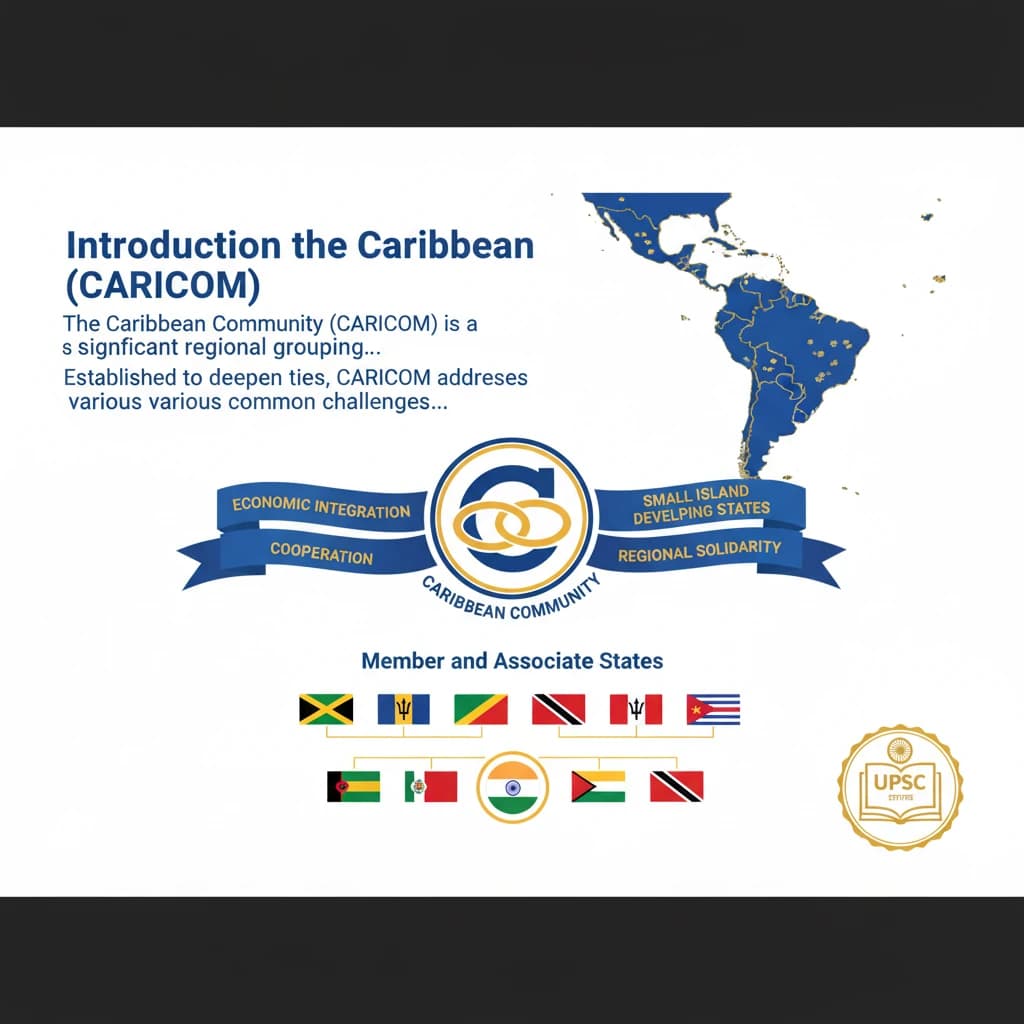
The Caribbean Community (CARICOM) is a significant regional grouping comprising countries primarily from the Caribbean Sea. It plays a crucial role in fostering economic integration and cooperation among its members.
Established to deepen ties, CARICOM addresses various common challenges faced by small island developing states and mainland territories in the region.
Member and Associate States
CARICOM is composed of a diverse set of nations, including both island states and mainland territories. This blend contributes to its unique geopolitical and economic character.
Total Countries: 21
- Member States: 15
- Associate Members: 6
Notable mainland territories include Suriname and Guyana.
Founding and Establishment
The genesis of CARICOM dates back to 1973, marking a pivotal moment in Caribbean regionalism. Its formation was a step towards stronger collective action.
Founding Date: 1973
Founding Document: Treaty of Chaguaramas
Founding Members:
- Barbados
- Guyana
- Jamaica
- Trinidad and Tobago
The Treaty of Chaguaramas is the foundational agreement that established the Caribbean Community and Common Market, setting the framework for regional integration.
Demographics and Diversity
CARICOM is characterized by its rich cultural and ethnic diversity, reflecting centuries of historical interactions. This multicultural fabric is a defining feature of the community.
Population: Approximately 16 million
Demographic Profile: Young, with 60% of the population under the age of 30.
Ethnic Backgrounds: People of African, Indian, European, Chinese, Portuguese, and Indigenous descent.
The region is also remarkably multilingual, showcasing a blend of colonial legacies and indigenous cultures. This linguistic variety adds to its unique identity.
Primary Language: English
Other Major Languages: French, Dutch
Additional Languages: Various African and Asian languages spoken by diverse communities.
Understanding CARICOM's diversity and demographics is crucial for UPSC Mains answers on regional groupings, cultural diplomacy, and challenges faced by developing nations.
💡 Key Takeaways
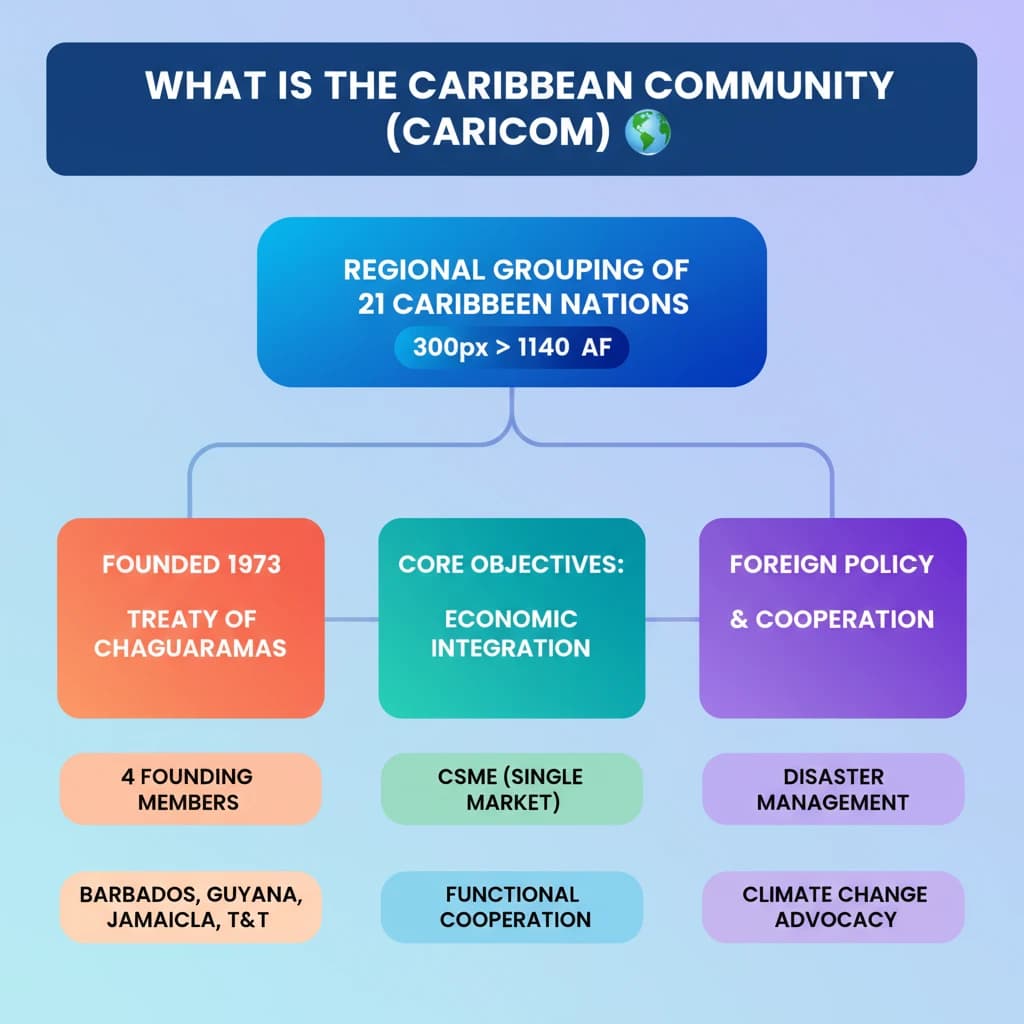
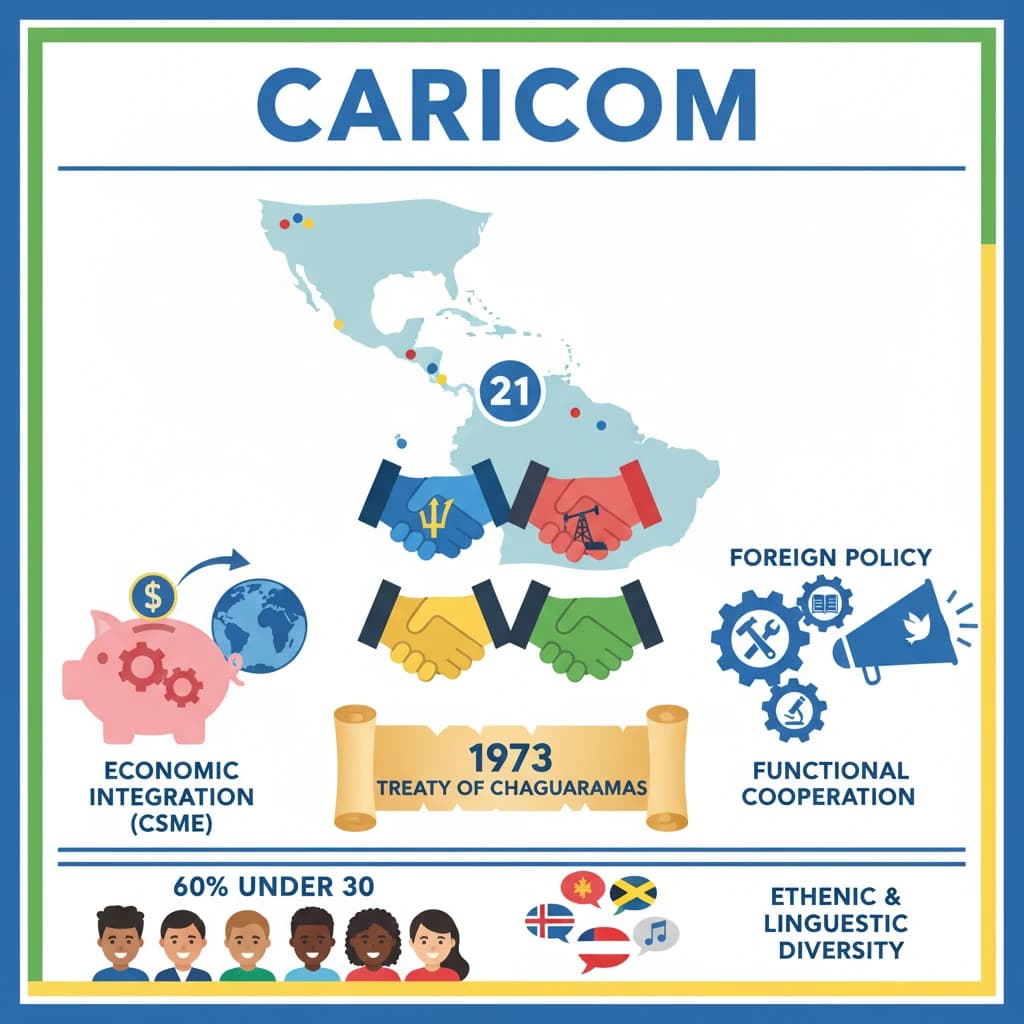
- •CARICOM is a regional grouping of 21 countries (15 Member States, 6 Associate Members) in the Caribbean.
- •It was founded in 1973 with the signing of the Treaty of Chaguaramas by Barbados, Guyana, Jamaica, and Trinidad and Tobago.
- •Its core objectives include economic integration (Caribbean Single Market and Economy - CSME), functional cooperation, and foreign policy coordination.
- •The community is characterized by significant ethnic and linguistic diversity, with a young demographic (60% under 30).
- •CARICOM plays a crucial role in disaster management, climate change advocacy, and promoting regional stability for its member SIDS.
🧠 Memory Techniques
95% Verified Content