Loading page, please wait…
What is the Difference Between Look East Policy and Act East Policy? - UPSC International Relations
What is What is the Difference Between Look East Policy and Act East Policy? in UPSC International Relations?
What is the Difference Between Look East Policy and Act East Policy? is a key topic under International Relations for UPSC Civil Services Examination. Key points include: Look East Policy (1992) focused on economic integration with ASEAN.. Act East Policy (2014) expanded scope to include East Asia and security cooperation.. LEP's success: Trade with ASEAN grew from $2B to $72B (1992-2017).. Understanding this topic is essential for both UPSC Prelims and Mains preparation.
Why is What is the Difference Between Look East Policy and Act East Policy? important for UPSC exam?
What is the Difference Between Look East Policy and Act East Policy? is a Medium-level topic in UPSC International Relations. It is tested in both Prelims (factual MCQs) and Mains (analytical answer writing). Previous year UPSC questions have frequently covered aspects of What is the Difference Between Look East Policy and Act East Policy?, making it essential for comprehensive IAS preparation.
How to prepare What is the Difference Between Look East Policy and Act East Policy? for UPSC?
To prepare What is the Difference Between Look East Policy and Act East Policy? for UPSC: (1) Study the comprehensive notes covering all key concepts on Vaidra. (2) Practice previous year questions on this topic. (3) Connect it with current affairs using daily updates. (4) Revise using key takeaways and mind maps available for International Relations. (5) Write practice answers linking What is the Difference Between Look East Policy and Act East Policy? to related GS Paper topics.
Key takeaways of What is the Difference Between Look East Policy and Act East Policy? for UPSC
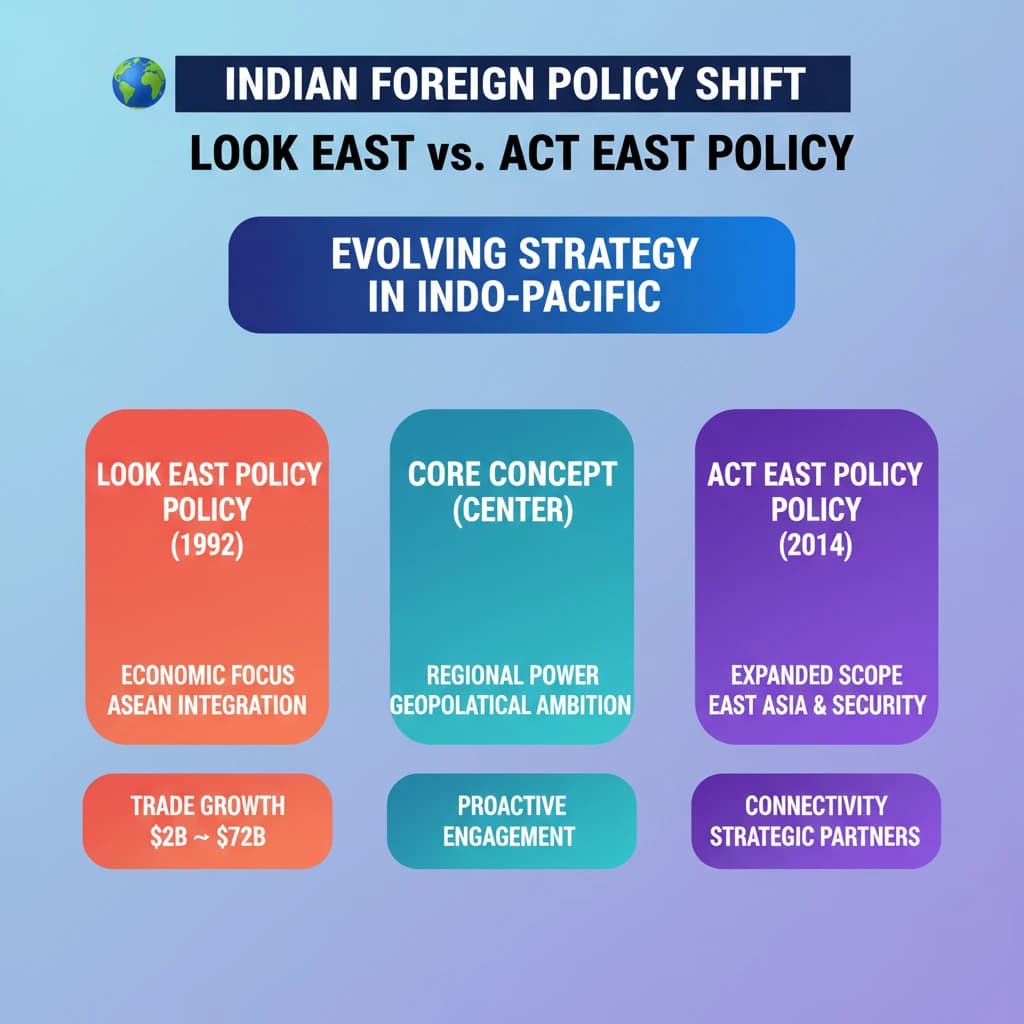
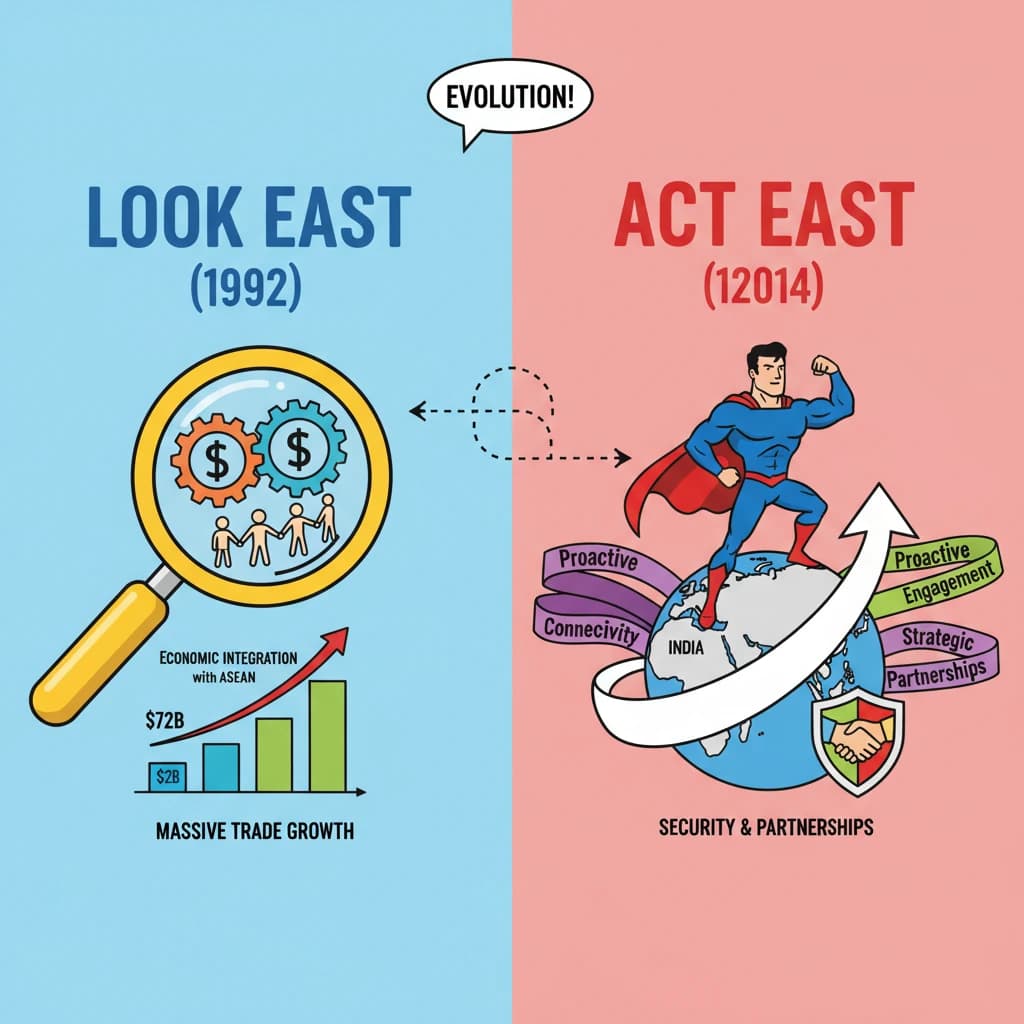
- Look East Policy (1992) focused on economic integration with ASEAN.
- Act East Policy (2014) expanded scope to include East Asia and security cooperation.
- LEP's success: Trade with ASEAN grew from $2B to $72B (1992-2017).
- AEP emphasizes proactive engagement, connectivity, and strategic partnerships in the Indo-Pacific.
- The shift reflects India's evolving geopolitical ambitions and role as a regional power.
What is the Difference Between Look East Policy and Act East Policy?
Medium⏱️ 9 min read
international relations
📖 Introduction
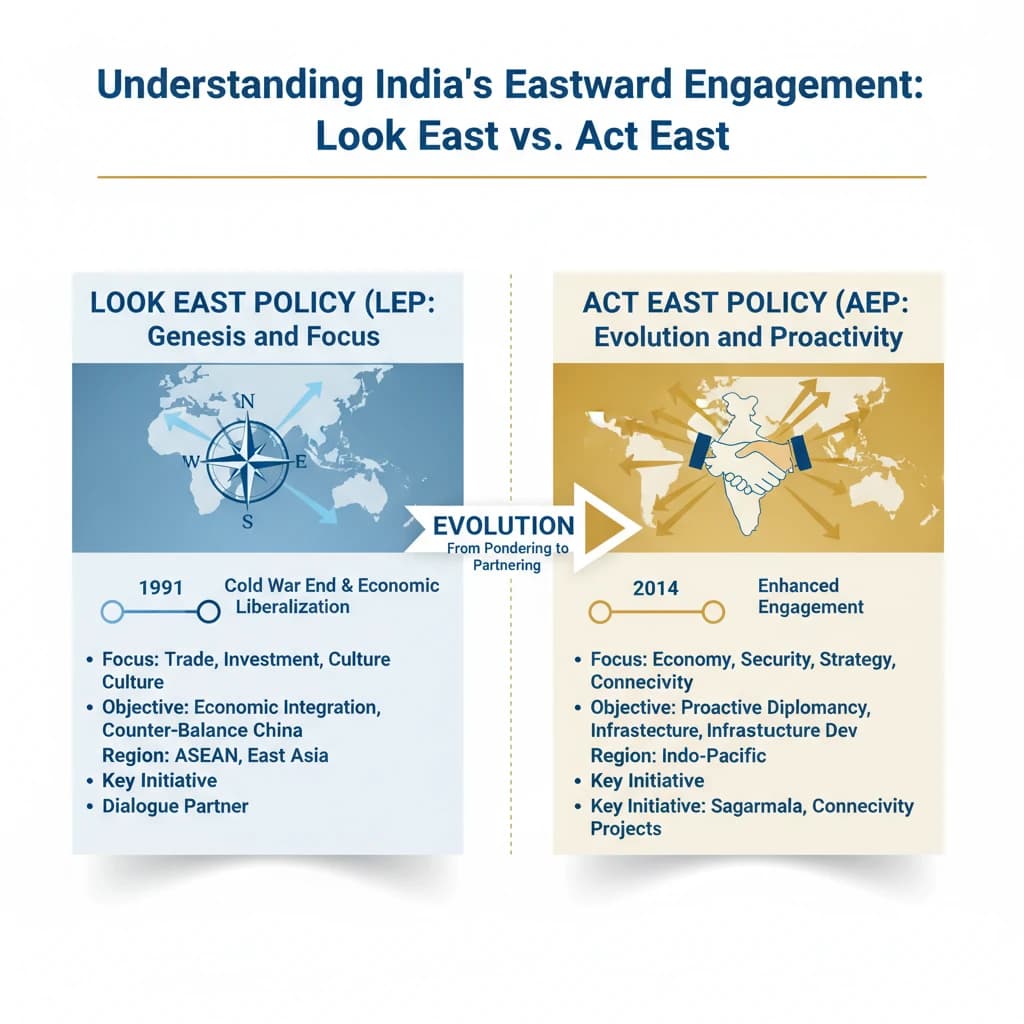
Understanding India's Eastward Engagement: Look East vs. Act East
India's foreign policy towards its eastern neighbours has undergone a significant evolution, moving from the Look East Policy to the more proactive Act East Policy. Both policies aim to strengthen India's ties with the vibrant economies and strategic regions of Southeast and East Asia.
The Look East Policy (LEP): Genesis and Focus
The Look East Policy (LEP) was initiated by India in 1992. Its primary objective was to forge stronger economic and strategic relations with the countries of Southeast Asia, particularly the Association of Southeast Asian Nations (ASEAN).
The policy emerged in the post-Cold War era, driven by India's economic liberalisation and a desire to diversify its foreign relations beyond traditional partners. It marked a strategic shift towards greater engagement with dynamic Asian economies.
Core Focus of Look East Policy: Primarily centred on economic integration with ASEAN countries.
Key Milestones of Look East Policy
- 1996: India became a Dialogue Partner of ASEAN, signifying a formal step towards deeper engagement.
- 2002: The relationship was upgraded to a Summit Level Partner, allowing for greater high-level interactions.
- 2012: India's engagement with ASEAN was further elevated to a Strategic Partnership, reflecting growing convergence of interests.
Economic Impact: India's trade with ASEAN grew from USD 2 billion in 1992 to USD 72 billion by 2017-18, significantly boosted by the Free Trade Agreement (FTA) signed in 2010.
India also actively participated in various regional forums under the LEP, such as the East Asia Summit (EAS) and the ASEAN Regional Forum (ARF), solidifying its presence in the regional security and economic architecture.
The Act East Policy (AEP): Evolution and Expansion
The Act East Policy (AEP) was launched in November 2014 by the Narendra Modi government, building upon the foundations laid by the Look East Policy. It represents a more dynamic and action-oriented approach to India's engagement with the Indo-Pacific region.
Expanded Focus of Act East Policy: Encompasses ASEAN countries, East Asian countries (e.g., Japan, South Korea), and extends beyond mere economic integration to include robust security cooperation.
The AEP aims to promote economic cooperation, cultural ties, and develop strategic relationships with countries in the Indo-Pacific region, providing enhanced connectivity, trade, and defence partnerships.
Key Differences: Look East vs. Act East
While both policies share the common goal of enhancing India's engagement with the East, the Act East Policy is distinguished by its broader geographical scope, deeper sectoral engagement, and more proactive strategic dimension.
| Feature | Look East Policy (LEP) | Act East Policy (AEP) |
|---|---|---|
| Initiation | 1992 | 2014 |
| Primary Focus | Mainly economic integration | Economic integration, strategic cooperation, security cooperation |
| Geographical Scope | Primarily ASEAN countries | ASEAN countries + broader East Asian countries (e.g., Japan, South Korea) + Pacific Island Countries |
| Nature of Engagement | Reactive, largely economic | Proactive, multi-faceted (economic, strategic, security, cultural, people-to-people) |
| Key Driver | Economic liberalisation, post-Cold War reorientation | Indo-Pacific strategy, regional security, connectivity initiatives |
Understanding the evolution from Look East to Act East is crucial for Mains Paper 2 (International Relations). Focus on the 'why' behind the shift and the expanded dimensions of the AEP.
💡 Key Takeaways
- •Look East Policy (1992) focused on economic integration with ASEAN.
- •Act East Policy (2014) expanded scope to include East Asia and security cooperation.
- •LEP's success: Trade with ASEAN grew from $2B to $72B (1992-2017).
- •AEP emphasizes proactive engagement, connectivity, and strategic partnerships in the Indo-Pacific.
- •The shift reflects India's evolving geopolitical ambitions and role as a regional power.
🧠 Memory Techniques
95% Verified Content
📚 Reference Sources
•Ministry of External Affairs (MEA), Government of India official website
•ASEAN official website
•Academic articles on India's foreign policy and Act East Policy