Loading page, please wait…
What is the Line of Actual Control (LAC)? - UPSC International Relations
What is What is the Line of Actual Control (LAC)? in UPSC International Relations?
What is the Line of Actual Control (LAC)? is a key topic under International Relations for UPSC Civil Services Examination. Key points include: The LAC is the de facto boundary separating Indian and Chinese controlled territories.. India claims LAC is 3,488 km, China claims 2,000 km, highlighting a key dispute.. It is divided into three sectors: Eastern (Arunachal, Sikkim), Middle (Uttarakhand, Himachal), and Western (Ladakh), with major disagreements in the Western sector.. Understanding this topic is essential for both UPSC Prelims and Mains preparation.
Why is What is the Line of Actual Control (LAC)? important for UPSC exam?
What is the Line of Actual Control (LAC)? is a Medium-level topic in UPSC International Relations. It is tested in both Prelims (factual MCQs) and Mains (analytical answer writing). Previous year UPSC questions have frequently covered aspects of What is the Line of Actual Control (LAC)?, making it essential for comprehensive IAS preparation.
How to prepare What is the Line of Actual Control (LAC)? for UPSC?
To prepare What is the Line of Actual Control (LAC)? for UPSC: (1) Study the comprehensive notes covering all key concepts on Vaidra. (2) Practice previous year questions on this topic. (3) Connect it with current affairs using daily updates. (4) Revise using key takeaways and mind maps available for International Relations. (5) Write practice answers linking What is the Line of Actual Control (LAC)? to related GS Paper topics.
Key takeaways of What is the Line of Actual Control (LAC)? for UPSC
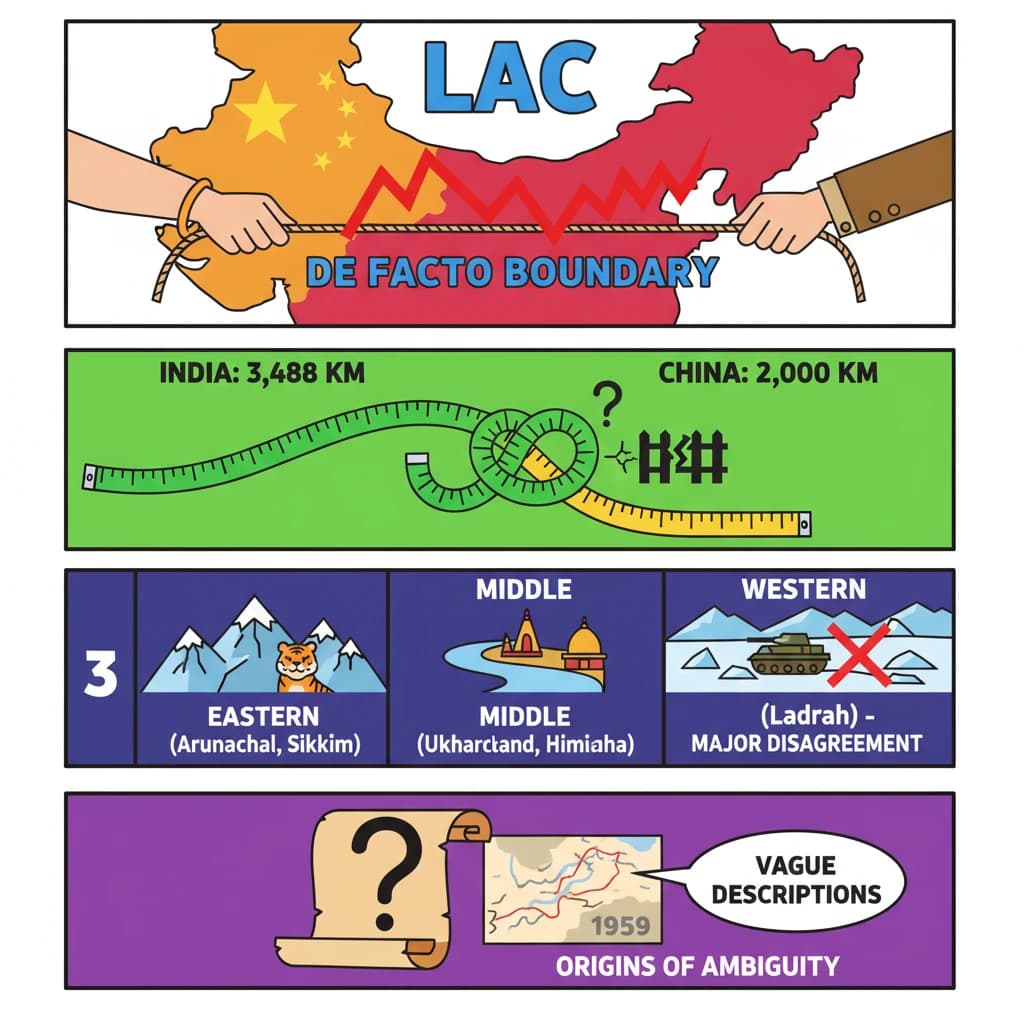
- The LAC is the de facto boundary separating Indian and Chinese controlled territories.
- India claims LAC is 3,488 km, China claims 2,000 km, highlighting a key dispute.
- It is divided into three sectors: Eastern (Arunachal, Sikkim), Middle (Uttarakhand, Himachal), and Western (Ladakh), with major disagreements in the Western sector.
- The LAC's ambiguity originates from vague Chinese descriptions in 1959, using non-scale maps.
- India initially rejected the LAC (1959, 1962) due to its undefined nature, but shifted its approach in the mid-1980s for pragmatic border management.
- Incidents like Doklam (2017) and Galwan (2020) exemplify the persistent tensions and differing perceptions along the LAC.
What is the Line of Actual Control (LAC)?
Medium⏱️ 7 min read
international relations
📖 Introduction
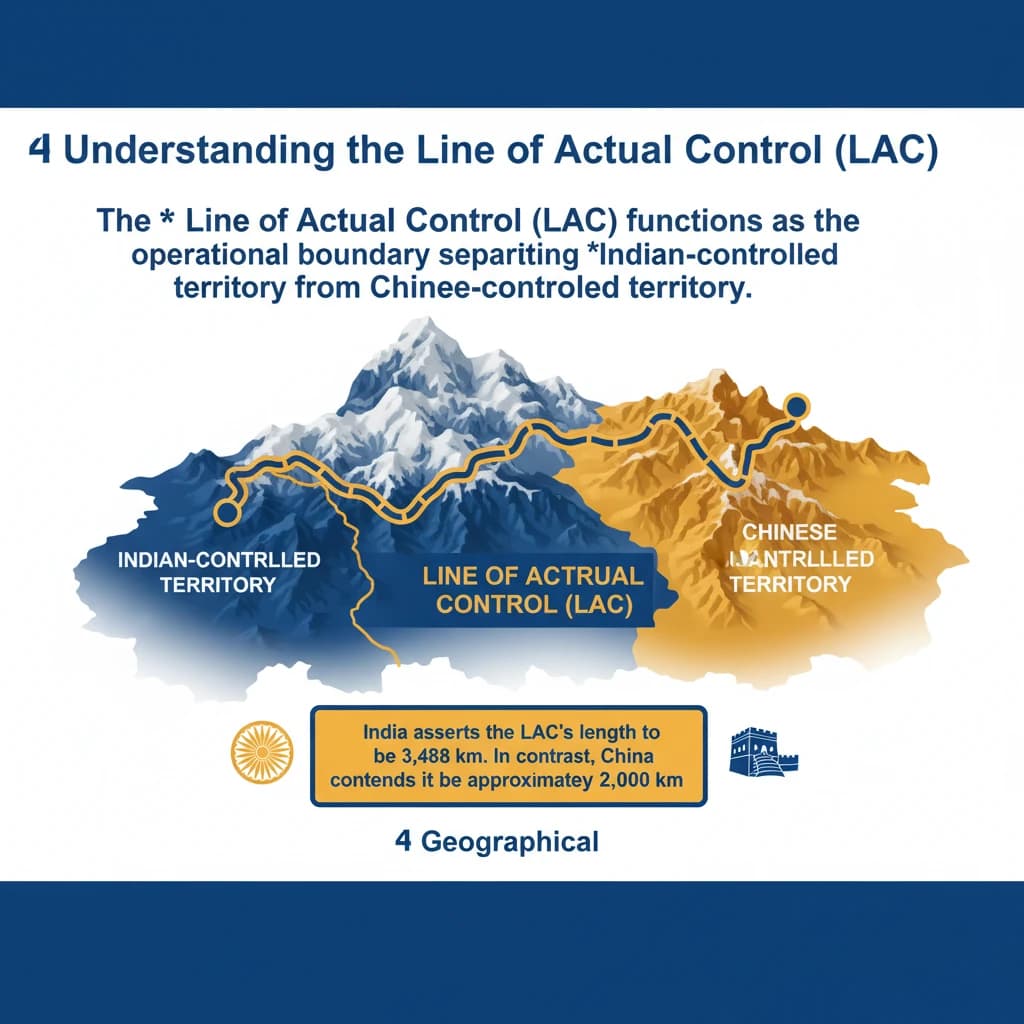
Understanding the Line of Actual Control (LAC)
The Line of Actual Control (LAC) functions as the operational boundary separating Indian-controlled territory from Chinese-controlled territory.
India asserts the LAC's length to be 3,488 km. In contrast, China contends it to be approximately 2,000 km.
Geographical Demarcation of the LAC
This demarcation is traditionally categorized into three distinct sectors, each with its unique geographical and historical context.
- Eastern sector: Encompasses the regions of Arunachal Pradesh and Sikkim.
- Middle sector: Spans across Uttarakhand and Himachal Pradesh.
- Western sector: Primarily located in the strategically crucial region of Ladakh.
Core Disagreements Regarding the LAC
The fundamental dispute surrounding the LAC stems from differing perceptions of its precise alignment across these various sectors.
In the eastern sector, the LAC generally follows the historically significant 1914 McMahon Line, with only minor disagreements concerning specific ground positions.
However, major disagreements are concentrated in the Western sector. These disputes trace their origins back to letters exchanged between Chinese Prime Minister Zhou Enlai and Indian Prime Minister Jawahar Nehru in 1959.
The Chinese initially described the LAC only in general terms on maps that were not to scale, contributing significantly to its inherent ambiguity.
Following the 1962 War, China claimed to have withdrawn its forces 20 km behind the LAC in November 1959, a claim that further complicated the understanding of its actual position.
During the Doklam crisis in 2017, the Chinese Foreign Ministry spokesperson urged India to abide by the “1959 LAC”, further highlighting the persistent ambiguity.
Despite subsequent clarifications, this ambiguity has persisted, leading to contrasting interpretations by both nations regarding the LAC's true alignment.
India's Evolving Stance on the LAC
Initially, India rejected the concept of the LAC in both 1959 and 1962.
This rejection was primarily due to concerns over its vague definition and the potential for China to exploit this ambiguity to alter ground realities through military force.
A significant shift in India's approach to the LAC began in the mid-1980s. This change was prompted by an increase in border encounters, necessitating a review of patrolling boundaries and a more pragmatic engagement with the concept.
Understanding the historical evolution of India's stance on the LAC is crucial for analyzing current India-China relations in UPSC Mains GS-2 (International Relations).
💡 Key Takeaways
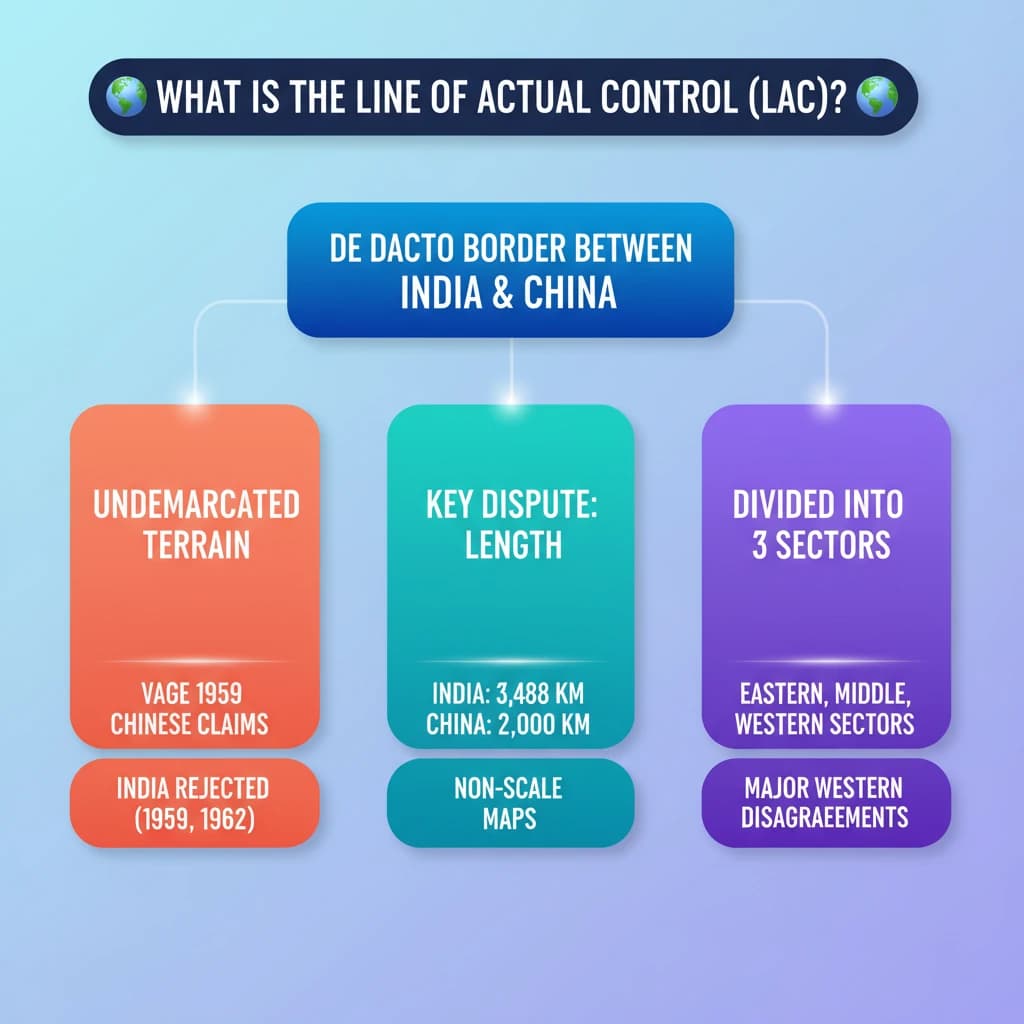
- •The LAC is the de facto boundary separating Indian and Chinese controlled territories.
- •India claims LAC is 3,488 km, China claims 2,000 km, highlighting a key dispute.
- •It is divided into three sectors: Eastern (Arunachal, Sikkim), Middle (Uttarakhand, Himachal), and Western (Ladakh), with major disagreements in the Western sector.
- •The LAC's ambiguity originates from vague Chinese descriptions in 1959, using non-scale maps.
- •India initially rejected the LAC (1959, 1962) due to its undefined nature, but shifted its approach in the mid-1980s for pragmatic border management.
- •Incidents like Doklam (2017) and Galwan (2020) exemplify the persistent tensions and differing perceptions along the LAC.
🧠 Memory Techniques
95% Verified Content
📚 Reference Sources
•General knowledge on India-China border disputes