Loading page, please wait…
What were the Key Outcomes of PM’s Visit to Brunei Darussalam? - UPSC International Relations
What is What were the Key Outcomes of PM’s Visit to Brunei Darussalam? in UPSC International Relations?
What were the Key Outcomes of PM’s Visit to Brunei Darussalam? is a key topic under International Relations for UPSC Civil Services Examination. Key points include: PM's visit to Brunei reaffirmed ISRO's TTC Station cooperation and cultural ties.. Singapore visit elevated relationship to 'Comprehensive Strategic Partnership'.. Landmark MoU signed with Singapore for resilient semiconductor supply chain.. Understanding this topic is essential for both UPSC Prelims and Mains preparation.
Why is What were the Key Outcomes of PM’s Visit to Brunei Darussalam? important for UPSC exam?
What were the Key Outcomes of PM’s Visit to Brunei Darussalam? is a Medium-level topic in UPSC International Relations. It is tested in both Prelims (factual MCQs) and Mains (analytical answer writing). Previous year UPSC questions have frequently covered aspects of What were the Key Outcomes of PM’s Visit to Brunei Darussalam?, making it essential for comprehensive IAS preparation.
How to prepare What were the Key Outcomes of PM’s Visit to Brunei Darussalam? for UPSC?
To prepare What were the Key Outcomes of PM’s Visit to Brunei Darussalam? for UPSC: (1) Study the comprehensive notes covering all key concepts on Vaidra. (2) Practice previous year questions on this topic. (3) Connect it with current affairs using daily updates. (4) Revise using key takeaways and mind maps available for International Relations. (5) Write practice answers linking What were the Key Outcomes of PM’s Visit to Brunei Darussalam? to related GS Paper topics.
Key takeaways of What were the Key Outcomes of PM’s Visit to Brunei Darussalam? for UPSC
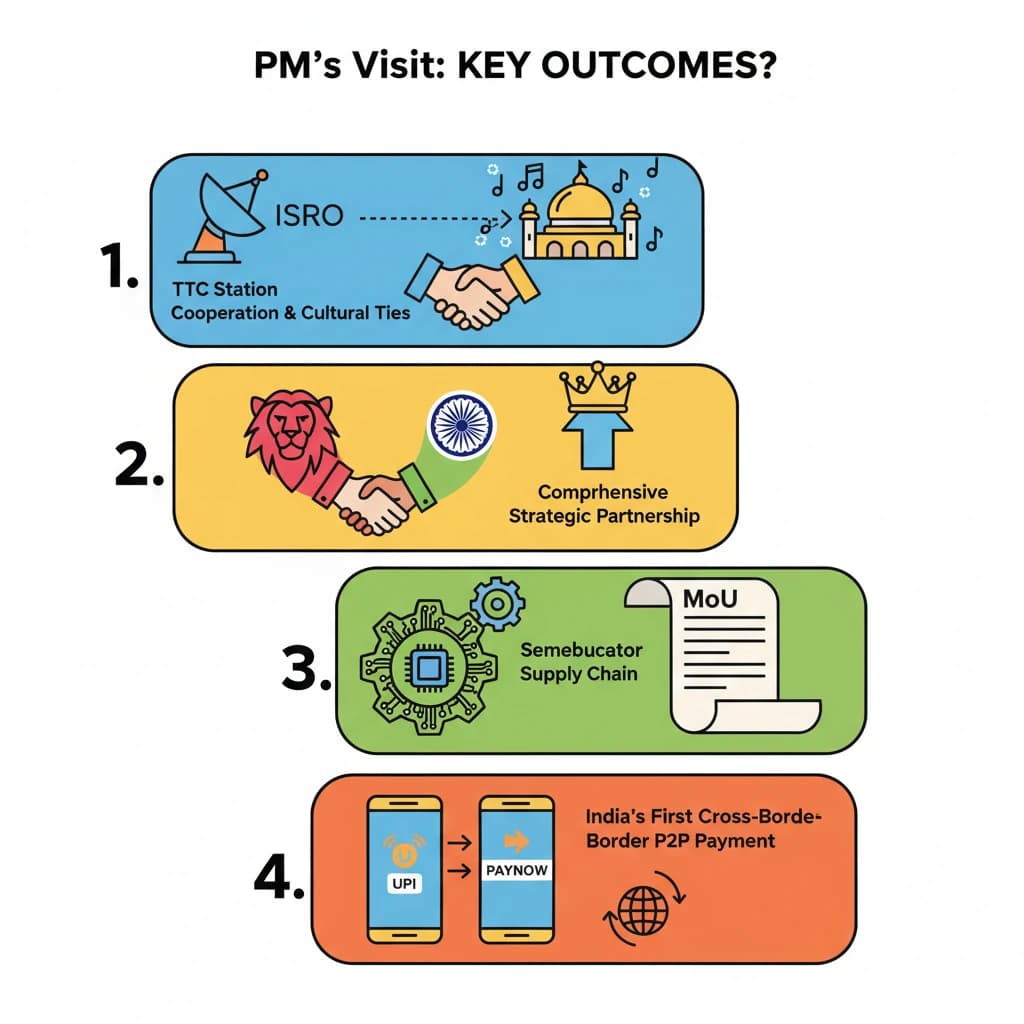
- PM's visit to Brunei reaffirmed ISRO's TTC Station cooperation and cultural ties.
- Singapore visit elevated relationship to 'Comprehensive Strategic Partnership'.
- Landmark MoU signed with Singapore for resilient semiconductor supply chain.
- UPI-PayNow linkage with Singapore is India's first cross-border P2P payment facility.
- India and Singapore share deep historical, economic (6th largest trade partner, top FDI source), and cultural ties.
- Both nations collaborate on multilateral forums like ISA, CDRI, and IORA.
What were the Key Outcomes of PM’s Visit to Brunei Darussalam?
Medium⏱️ 10 min read
international relations
📖 Introduction
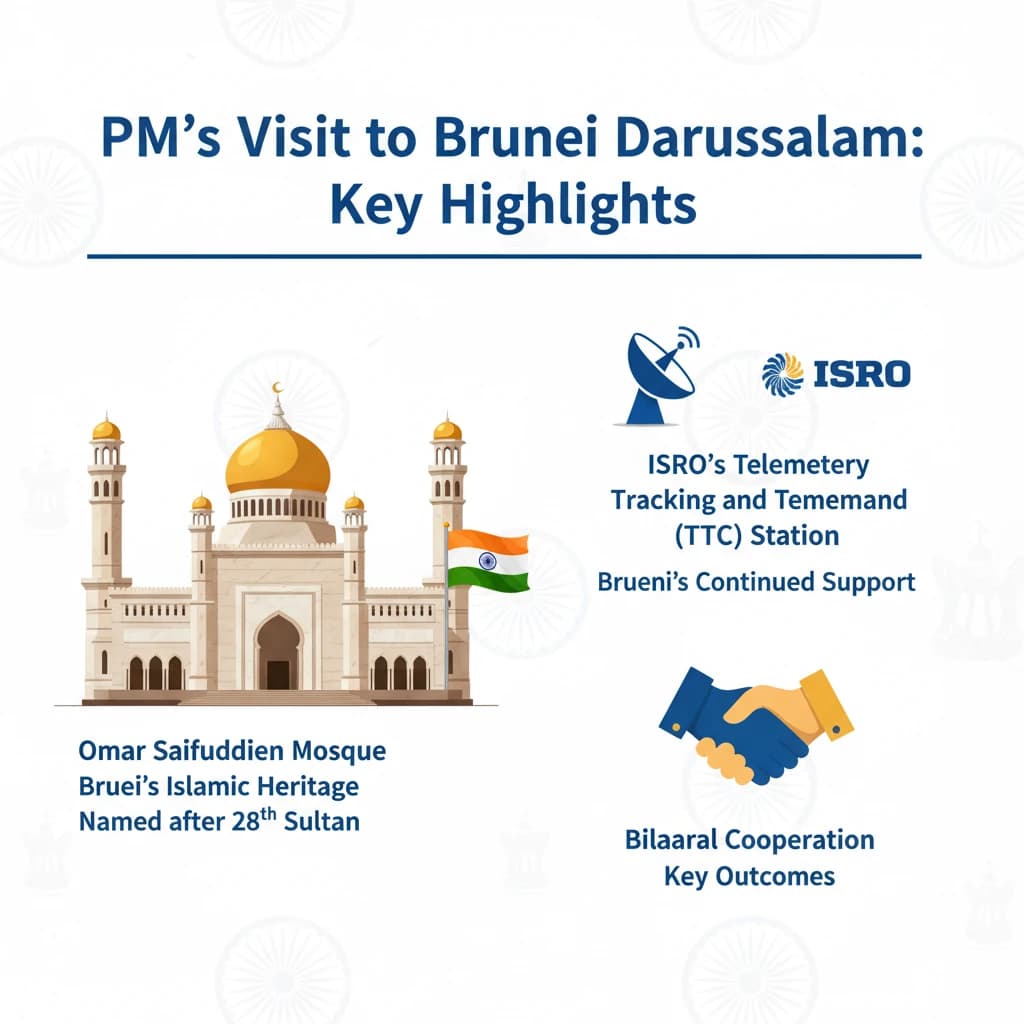
PM's Visit to Brunei Darussalam: Key Highlights
During the visit, the Prime Minister visited the iconic Omar Ali Saifuddien Mosque in Bandar Seri Begawan. This mosque is a significant symbol of Brunei's Islamic heritage and is named after the 28th Sultan of Brunei.
India expressed appreciation for Brunei's continued support in hosting ISRO's Telemetry Tracking and Telecommand (TTC) Station. Discussions were held to further cooperation under the recently reviewed Memorandum of Understanding (MoU), highlighting ongoing space collaboration.
The ISRO Telemetry Tracking and Telecommand (TTC) Station in Brunei is crucial for India's space missions, providing vital communication and tracking support for satellites and spacecraft.
PM's Visit to Singapore: Major Outcomes
The Prime Minister's visit to Singapore yielded several significant outcomes, deepening the existing strong bilateral ties. A key focus was on enhancing economic and strategic partnerships across various sectors.
The visit underscored the growing importance of Southeast Asia in India's Act East Policy and its commitment to fostering robust relationships with key regional partners like Singapore.
Semiconductor Ecosystem Partnership
A landmark Memorandum of Understanding (MoU) was signed between India and Singapore aimed at developing a resilient semiconductor supply chain. This agreement marks a crucial new area of bilateral cooperation, vital for future technological advancements.
This MoU holds immense geo-strategic significance. Semiconductor chips are globally critical components across various technologies, making a secure supply chain essential for national and economic security.
Singapore has a well-established and thriving semiconductor industry since the 1970s. It accounts for approximately 10% of global semiconductor output and 20% of semiconductor equipment production, making it a key player.
Elevation to Comprehensive Strategic Partnership
India and Singapore mutually agreed to elevate their bilateral relationship to a 'Comprehensive Strategic Partnership'. This upgrade signifies a broader and deeper level of cooperation across diverse sectors, from defense to economy and culture.
Strengthening Cultural Linkages
India announced the upcoming inauguration of the Thiruvalluvar Cultural Centre in Singapore. This centre will celebrate the rich legacy of the revered Tamil saint Thiruvalluvar, further enhancing people-to-people connections and cultural exchange.
India-Singapore Bilateral Relations: A Deeper Dive
Beyond the immediate visit outcomes, the existing India-Singapore relationship provides a strong foundation for future collaborations.
Historical Connect
India and Singapore share profound historical ties that span over a millennium, encompassing extensive commerce, vibrant cultural exchanges, and deep people-to-people connections.
The modern relationship traces back to 1819 when Stamford Raffles, a British East India administrator, established a trading post in Singapore. This post later became a British colony, governed from Kolkata until 1867.
Significantly, India was among the first countries to officially recognise Singapore's independence in 1965, underscoring the enduring bond between the two nations.
Trade and Economic Cooperation
Trade relations are a cornerstone of the bilateral partnership. Singapore is a vital economic partner for India.
Singapore stands as India's 6th largest trade partner, contributing a significant 3.2% to India's overall trade volume.
Investment flows are equally robust, with Singapore being a top source of Foreign Direct Investment (FDI) into India.
Since 2018-19, Singapore has consistently been the largest contributor of FDI into India. Key sectors attracting this investment include Services, Computer Software & Hardware, Trading, Telecommunications, and Drugs & Pharmaceuticals.
Fintech Advancements
Significant strides have been made in fintech cooperation, facilitating easier cross-border transactions.
Commercial and technical arrangements have been successfully implemented for the acceptance of RuPay cards in Singapore. This enhances convenience for Indian tourists and businesses.
The UPI-PayNow linkage represents a landmark development in cross-border fintech. It enables instant, low-cost fund transfers between the two countries' fast payment systems.
Singapore is the first nation with which India has launched this cross-border Person-to-Person (P2P) payment facility, marking a significant milestone in digital payment integration.
Science and Technology Cooperation
Cooperation in science and technology, particularly in space, has been a strong area of collaboration.
ISRO (Indian Space Research Organisation) has successfully launched several Singaporean satellites. This includes Singapore's first indigenous built micro-satellite in 2011, demonstrating robust partnership in space technology.
Multilateral Cooperation
Both nations actively participate in various multilateral forums, contributing to regional and global stability and development.
Singapore has joined key Indian initiatives such as the International Solar Alliance (ISA) and the Coalition for Disaster Resilient Infrastructure (CDRI). India and Singapore are also active members of regional groups like the Indian Ocean Rim Association (IORA).
Indian Community and Cultural Ties
The presence of a significant Indian diaspora further strengthens the cultural and social fabric connecting the two countries.
Ethnic Indians constitute approximately 9.1% of Singapore's 3.9 million residents. Reflecting this cultural diversity, Tamil is one of the four official languages of Singapore.
💡 Key Takeaways
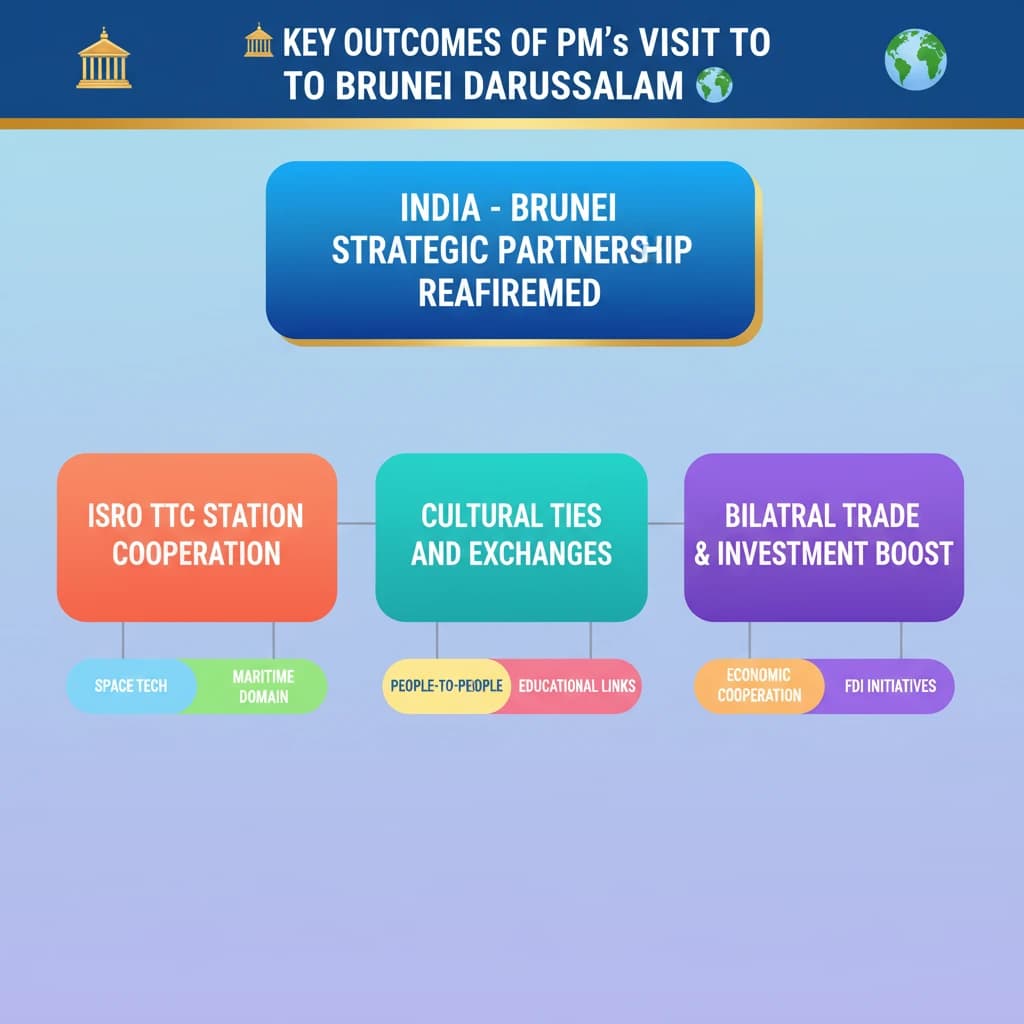
- •PM's visit to Brunei reaffirmed ISRO's TTC Station cooperation and cultural ties.
- •Singapore visit elevated relationship to 'Comprehensive Strategic Partnership'.
- •Landmark MoU signed with Singapore for resilient semiconductor supply chain.
- •UPI-PayNow linkage with Singapore is India's first cross-border P2P payment facility.
- •India and Singapore share deep historical, economic (6th largest trade partner, top FDI source), and cultural ties.
- •Both nations collaborate on multilateral forums like ISA, CDRI, and IORA.
🧠 Memory Techniques
95% Verified Content