Loading page, please wait…
Vaidra Logo
Vaidra

Top 4 items + smart groups

UPSC GPT
New
Current Affairs
Daily Solutions
Daily Puzzle
Mains Evaluator

Version 2.0.0 • Built with ❤️ for UPSC aspirants

Loading...
Loading...
Loading...
Loading...
Loading...
Loading...
Loading...
Loading...
Loading...
Loading...
Loading...
Loading...
Loading...
PRITHVI Vigyan Scheme - UPSC Polity And Governance
Back
All Subjects

Topics

0 topics • 0 completed

Loading topics...
Loading...
Loading...
Loading...
Loading...
Loading...
Overall Progress0%

PRITHVI Vigyan Scheme - UPSC Polity And Governance

What is PRITHVI Vigyan Scheme in UPSC Polity And Governance?

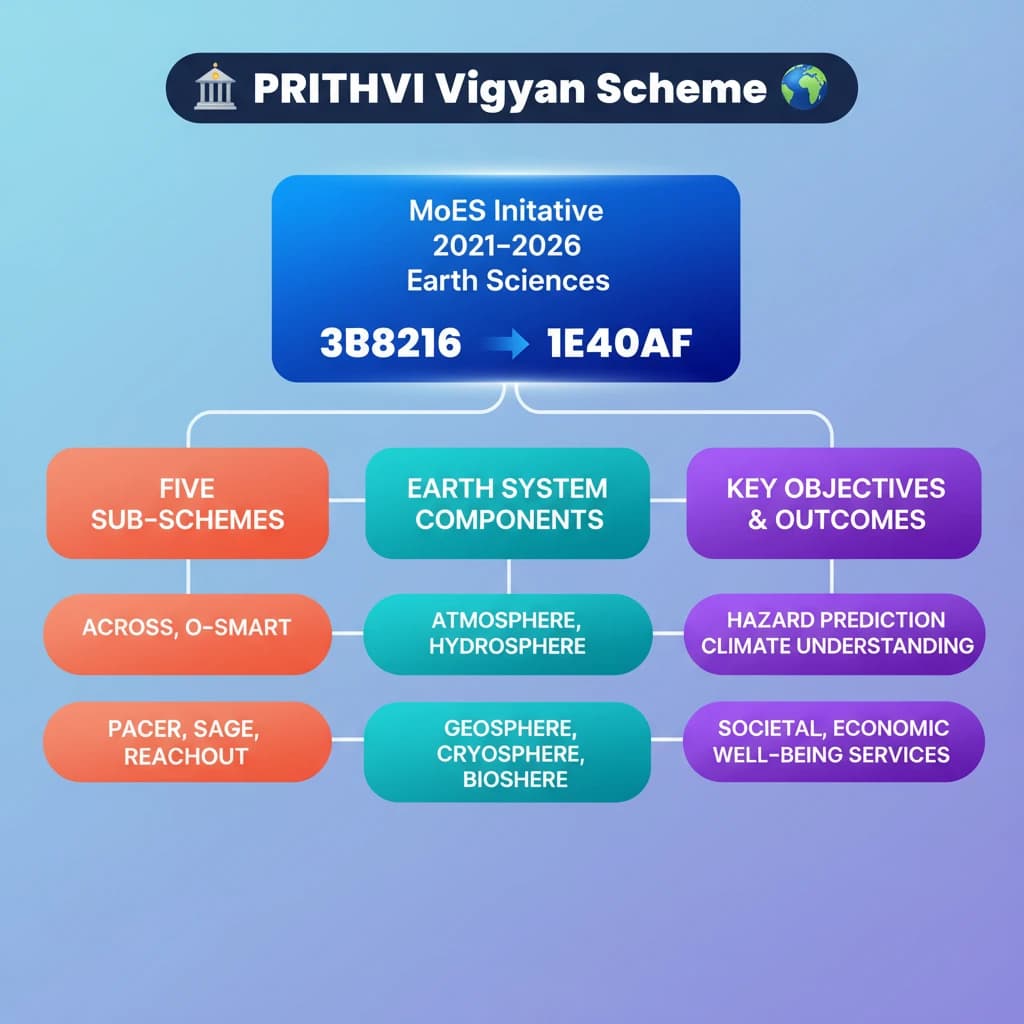
PRITHVI Vigyan Scheme is a key topic under Polity And Governance for UPSC Civil Services Examination. Key points include: PRITHVI Vigyan is a comprehensive scheme by the Ministry of Earth Sciences (MoES) for 2021-2026.. It consolidates five sub-schemes: ACROSS, O-SMART, PACER, SAGE, and REACHOUT.. The scheme addresses five Earth System components: atmosphere, hydrosphere, geosphere, cryosphere, and biosphere.. Understanding this topic is essential for both UPSC Prelims and Mains preparation.

Why is PRITHVI Vigyan Scheme important for UPSC exam?

PRITHVI Vigyan Scheme is a Medium-level topic in UPSC Polity And Governance. It is tested in both Prelims (factual MCQs) and Mains (analytical answer writing). Previous year UPSC questions have frequently covered aspects of PRITHVI Vigyan Scheme, making it essential for comprehensive IAS preparation.

How to prepare PRITHVI Vigyan Scheme for UPSC?

To prepare PRITHVI Vigyan Scheme for UPSC: (1) Study the comprehensive notes covering all key concepts on Vaidra. (2) Practice previous year questions on this topic. (3) Connect it with current affairs using daily updates. (4) Revise using key takeaways and mind maps available for Polity And Governance. (5) Write practice answers linking PRITHVI Vigyan Scheme to related GS Paper topics.

Key takeaways of PRITHVI Vigyan Scheme for UPSC

  • PRITHVI Vigyan is a comprehensive scheme by the Ministry of Earth Sciences (MoES) for 2021-2026.
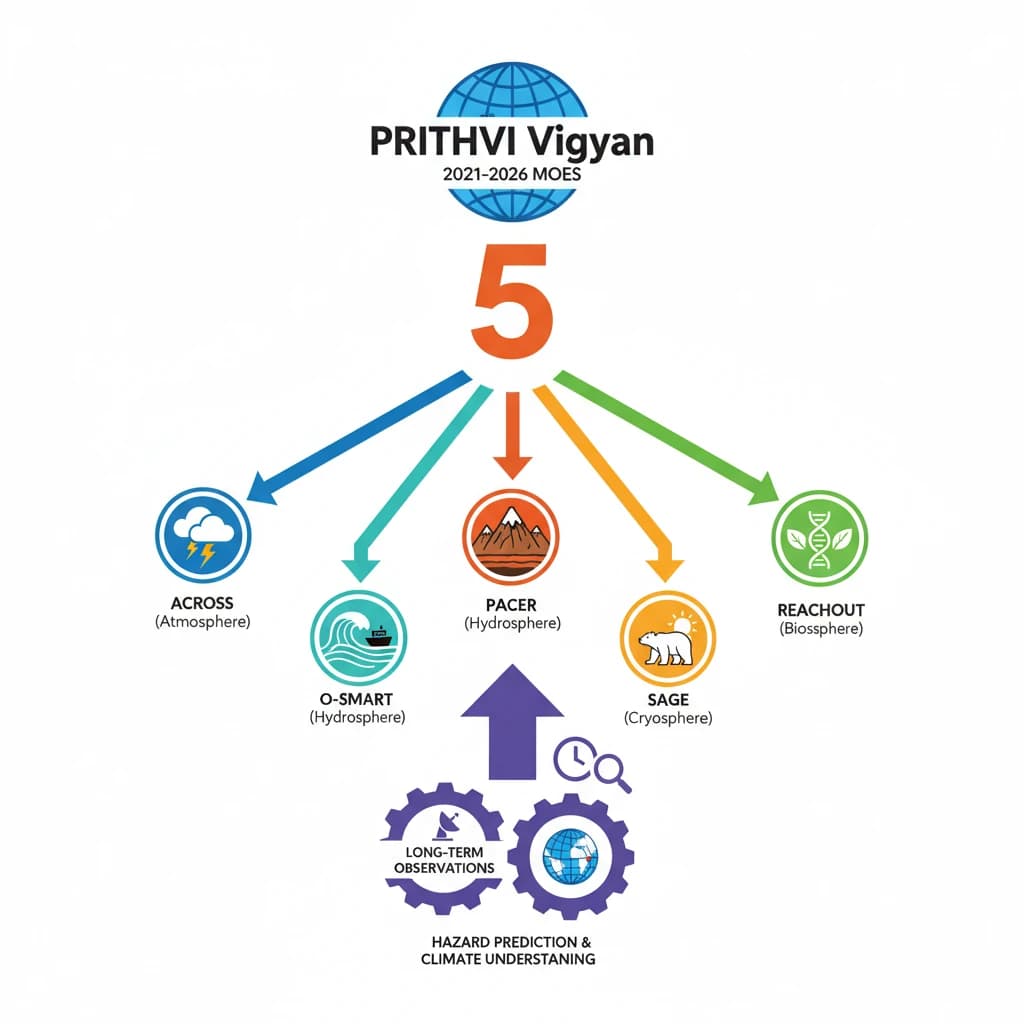
  • It consolidates five sub-schemes: ACROSS, O-SMART, PACER, SAGE, and REACHOUT.
  • The scheme addresses five Earth System components: atmosphere, hydrosphere, geosphere, cryosphere, and biosphere.
  • Key objectives include long-term observations and developing modelling systems for hazard prediction and climate change understanding.
  • It aims to enhance services for societal, environmental, and economic well-being.
  • A recent Cabinet approval also includes an ISRO-Mauritius agreement for joint small satellite development, building on historical cooperation.
PRITHVI Vigyan Scheme

PRITHVI Vigyan Scheme

Medium⏱️ 6 min read✓ 95% Verified
polity and governance

📖 Introduction

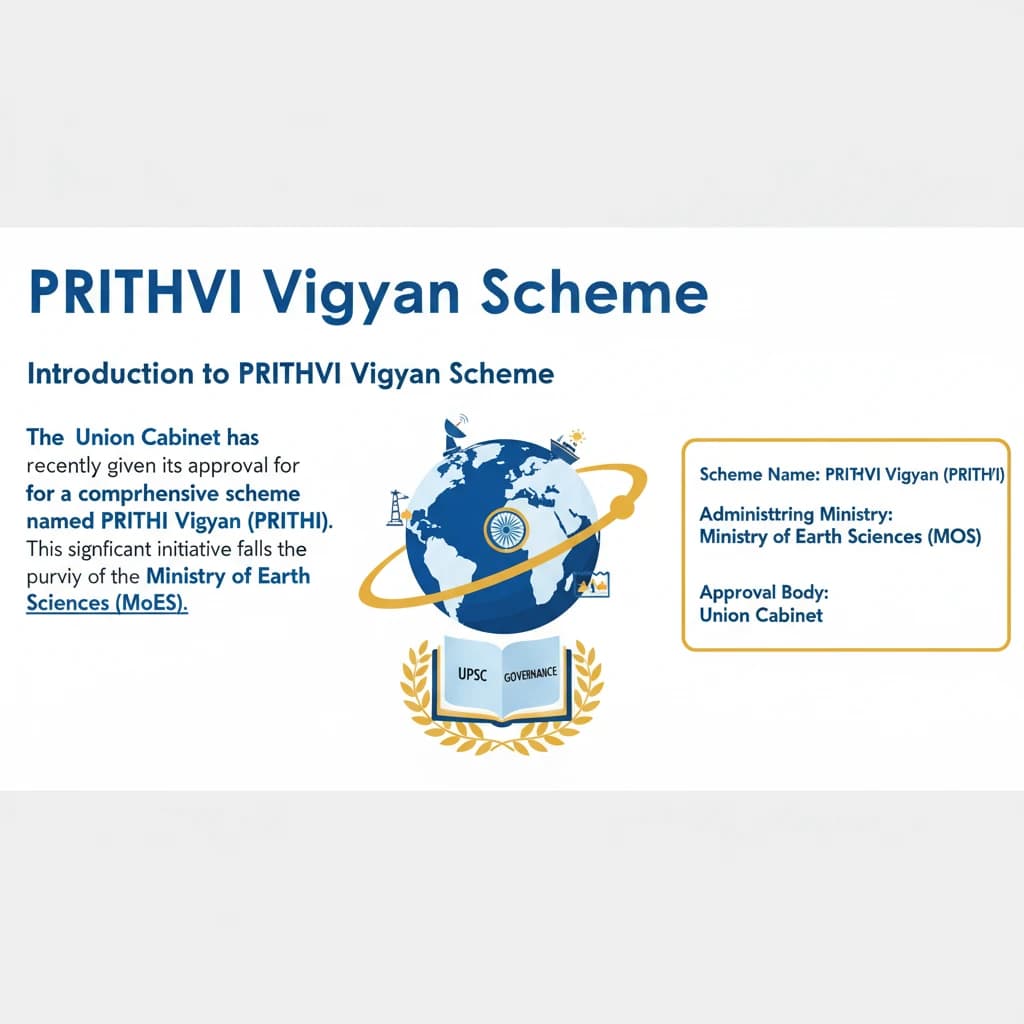
<h4>Introduction to PRITHVI Vigyan Scheme</h4><p>The <strong>Union Cabinet</strong> has recently given its approval for the comprehensive scheme named <strong>PRITHVI Vigyan (PRITHVI)</strong>. This significant initiative falls under the purview of the <strong>Ministry of Earth Sciences (MoES)</strong>.</p><div class='info-box'><p><strong>Scheme Name:</strong> PRITHVI Vigyan (PRITHVI)</p><p><strong>Administering Ministry:</strong> Ministry of Earth Sciences (MoES)</p><p><strong>Approval Body:</strong> Union Cabinet</p></div><h4>Purpose and Scope of PRITHVI</h4><p>The <strong>PRITHVI scheme</strong> is designed to enhance <strong>Earth System Sciences</strong> across various domains. Its primary goal is to provide crucial services that contribute to societal, environmental, and economic well-being.</p><div class='key-point-box'><p><strong>Holistic Approach:</strong> PRITHVI comprehensively addresses five key components of <strong>Earth System Sciences</strong>: <strong>atmosphere</strong>, <strong>hydrosphere</strong>, <strong>geosphere</strong>, <strong>cryosphere</strong>, and <strong>biosphere</strong>.</p></div><h4>Scheme Duration and Structure</h4><p>This overarching scheme by the <strong>MoES</strong> is slated for the period from <strong>2021 to 2026</strong>. It consolidates and encompasses five existing sub-schemes under its umbrella.</p><h4>The Five Sub-Schemes of PRITHVI</h4><ul><li><strong>ACROSS:</strong> This stands for <strong>Atmosphere and Climate Research-Modelling Observing Systems & Services</strong>. It focuses on atmospheric and climate-related studies.</li><li><strong>O-SMART:</strong> This sub-scheme covers <strong>Ocean Services, Modelling Application, Resources and Technology</strong>, emphasizing marine research and applications.</li><li><strong>PACER:</strong> Dedicated to <strong>Polar Science and Cryosphere Research</strong>, this component addresses studies related to polar regions and ice.</li><li><strong>SAGE:</strong> Encompassing <strong>Seismology and Geosciences</strong>, SAGE aims to strengthen <strong>earthquake monitoring</strong> and research on the Earth's solid components. It includes activities like <strong>seismological monitoring</strong> and <strong>microzonation</strong>.</li><li><strong>REACHOUT:</strong> This component focuses on <strong>Research, Education, Training and Outreach</strong>, promoting capacity building and public engagement in Earth Sciences.</li></ul><h4>Key Objectives of the PRITHVI Scheme</h4><p>The scheme has clearly defined objectives to ensure its impact and effectiveness.</p><ol><li>To augment and sustain <strong>long-term observations</strong> of the <strong>atmosphere</strong>, <strong>ocean</strong>, <strong>geosphere</strong>, <strong>cryosphere</strong>, and <strong>solid earth</strong>. This is crucial for recording the vital signs of the <strong>Earth System</strong> and detecting changes.</li><li>To develop advanced <strong>modelling systems</strong> for understanding and predicting <strong>weather</strong>, <strong>ocean</strong>, and <strong>climate hazards</strong>. It also aims to deepen the scientific understanding of <strong>climate change</strong>.</li></ol><h4>ISRO-Mauritius Collaboration</h4><p>In a related development, the <strong>Cabinet</strong> also approved an agreement between the <strong>Indian Space Research Organisation (ISRO)</strong> and the <strong>Mauritius Research and Innovation Council (MRIC)</strong>. This agreement is for the joint development of a <strong>small satellite</strong>.</p><div class='exam-tip-box'><p><strong>UPSC Insight:</strong> This collaboration highlights India's growing role in <strong>space diplomacy</strong> and its commitment to assisting partner nations in space technology. It's relevant for <strong>GS-II (International Relations)</strong> and <strong>GS-III (Science & Technology)</strong>.</p></div><p>India and Mauritius share a long-standing history of cooperation in space. Since the <strong>1980s</strong>, <strong>ISRO</strong> has maintained a ground station in Mauritius, providing crucial tracking and telemetry support for its launch vehicle and satellite missions.</p>
Concept Diagram

💡 Key Takeaways

  • •PRITHVI Vigyan is a comprehensive scheme by the Ministry of Earth Sciences (MoES) for 2021-2026.
  • •It consolidates five sub-schemes: ACROSS, O-SMART, PACER, SAGE, and REACHOUT.
  • •The scheme addresses five Earth System components: atmosphere, hydrosphere, geosphere, cryosphere, and biosphere.
  • •Key objectives include long-term observations and developing modelling systems for hazard prediction and climate change understanding.
  • •It aims to enhance services for societal, environmental, and economic well-being.
  • •A recent Cabinet approval also includes an ISRO-Mauritius agreement for joint small satellite development, building on historical cooperation.

🧠 Memory Techniques
Memory Aid
95% Verified Content

Related Topics

Loading related topics...
Explore:Polity And Governance Topics·All Subjects·Daily Current Affairs·Editorial Analysis·Previous Year Questions·UPSC GPT