Loading page, please wait…
10 Years of UJALA and SLNP - UPSC Polity And Governance
What is 10 Years of UJALA and SLNP in UPSC Polity And Governance?
10 Years of UJALA and SLNP is a key topic under Polity And Governance for UPSC Civil Services Examination. Key points include: UJALA and SLNP, launched on January 5, 2015, mark 10 years of transformative energy efficiency initiatives.. UJALA made LED bulbs affordable (Rs 70) for households, distributing over 36.87 crore bulbs.. SLNP replaced conventional streetlights with LEDs, managed by EESL, recovering costs from municipalities.. Understanding this topic is essential for both UPSC Prelims and Mains preparation.
Why is 10 Years of UJALA and SLNP important for UPSC exam?
10 Years of UJALA and SLNP is a Medium-level topic in UPSC Polity And Governance. It is tested in both Prelims (factual MCQs) and Mains (analytical answer writing). Previous year UPSC questions have frequently covered aspects of 10 Years of UJALA and SLNP, making it essential for comprehensive IAS preparation.
How to prepare 10 Years of UJALA and SLNP for UPSC?
To prepare 10 Years of UJALA and SLNP for UPSC: (1) Study the comprehensive notes covering all key concepts on Vaidra. (2) Practice previous year questions on this topic. (3) Connect it with current affairs using daily updates. (4) Revise using key takeaways and mind maps available for Polity And Governance. (5) Write practice answers linking 10 Years of UJALA and SLNP to related GS Paper topics.
Key takeaways of 10 Years of UJALA and SLNP for UPSC
- UJALA and SLNP, launched on January 5, 2015, mark 10 years of transformative energy efficiency initiatives.
- UJALA made LED bulbs affordable (Rs 70) for households, distributing over 36.87 crore bulbs.
- SLNP replaced conventional streetlights with LEDs, managed by EESL, recovering costs from municipalities.
- These schemes annually save billions of kWh of electricity and avoid millions of tonnes of CO₂ emissions.
- GRAM UJALA (March 2021) extended LED affordability (Rs 10) to rural households.
- The initiatives demonstrate successful government intervention, market transformation, and a unique PPP model by EESL.
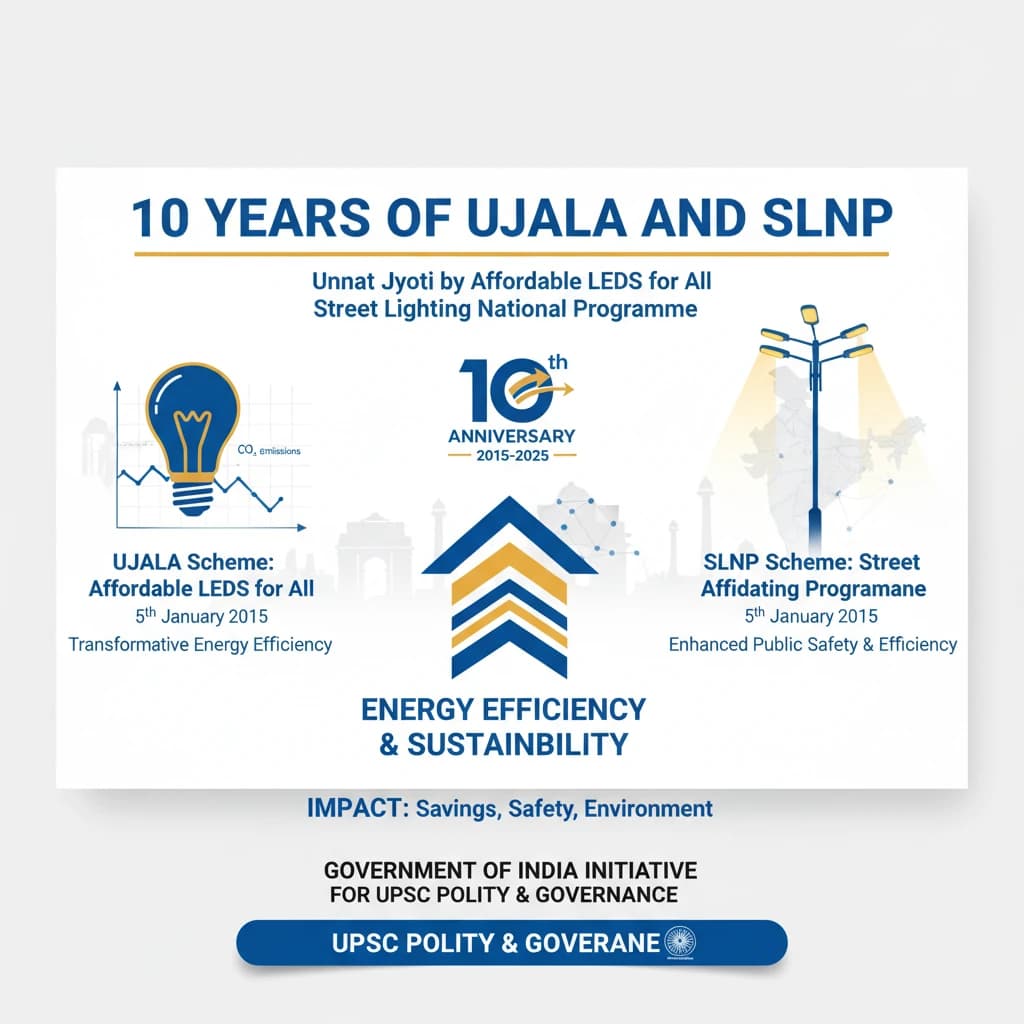
10 Years of UJALA and SLNP
Medium⏱️ 7 min read
polity and governance
📖 Introduction
Introduction to UJALA and SLNP
The Unnat Jyoti by Affordable LEDs for All (UJALA) scheme, launched on 5th January 2015, has completed its 10th anniversary. This initiative has been transformative in promoting energy efficiency across India.
Alongside UJALA, the Street Lighting National Programme (SLNP) was also launched. Both schemes have significantly contributed to revolutionizing lighting, reducing energy consumption, and advancing India’s environmental sustainability goals.
Launch Date: 5th January 2015
Key Objectives: Energy efficiency, reduced consumption, environmental sustainability.
UJALA Scheme: Key Facts
The UJALA Scheme was introduced in January 2015 to promote energy efficiency. Its primary method is replacing traditional lighting systems with energy-saving LED bulbs.
It specifically targets the replacement of incandescent lamps (ICLs) and Compact Fluorescent Lamps (CFLs), which were less efficient.
Joint Project: The scheme is a collaboration between the Government of India’s Public Sector Undertakings, the Union Ministry of Power’s Energy Efficiency Services Limited (EESL), and DISCOMs (Distribution Companies).
Objectives of UJALA
The main objective of the UJALA Scheme is ambitious: to save 85 lakh kWh of electricity annually. It also aims to reduce 15,000 tonnes of Carbon dioxide (CO₂) emissions.
This is achieved by replacing an estimated 77 crore traditional bulbs and 3.5 crore street lights with efficient LEDs.
Need for UJALA
Before UJALA, lighting constituted a significant portion of residential electricity use in India, approximately 18-27%. This highlighted a major area for potential energy savings.
In 2011, Indian households utilized about one billion lighting points. The majority relied on less efficient options: CFLs (46%) and tube lights (41%). Only a small fraction, 0.4%, used LED bulbs.
Efficiency of LEDs
LEDs offer substantial energy savings compared to older technologies. They save up to 90% energy compared to ICLs and 50% compared to CFLs.
Furthermore, LED bulbs use 75% less energy and last 25 times longer than incandescent bulbs. The high upfront cost of LEDs was a major barrier to their adoption prior to the scheme.
Key Features of UJALA
- Subsidized LED Bulbs: The scheme dramatically reduced the cost of LED bulbs. The price was brought down to Rs 70 per LED bulb, a significant drop from Rs 450 in 2014.
- Distribution Mechanism: Bulbs are distributed through a unique demand aggregation-price crash model. This involves bulk buying to achieve lower prices.
In 2015, EESL initiated open bids for large-scale procurement of LED lamps and collaborated with state governments to establish an efficient distribution network.
Progress and Achievements of UJALA
The UJALA scheme has achieved remarkable success, distributing over 36.87 crore LED bulbs across the country. This has led to substantial benefits:
- Energy Savings: An impressive 47,883 million kWh of energy is saved annually.
- Cost Savings: Households and the nation save approximately Rs. 19,153 crore annually.
- CO₂ Reduction: The scheme has helped avoid 3.88 million tonnes of CO₂ emissions annually.
- Peak Demand Avoided: A significant 9,586 MW of peak electricity demand has been avoided.
GRAM UJALA Scheme
The GRAM UJALA Scheme was launched in March 2021, specifically targeting rural households. It offers LED bulbs at a highly subsidized rate of Rs. 10 each.
This offer is provided in exchange for old incandescent bulbs. Under Phase-I, the goal was to distribute 1.5 crore LED bulbs, aiming for energy savings of 2025 million kWh/year and a CO₂ reduction of 1.65 million tonnes per year.
Street Lighting National Programme (SLNP): Key Facts
The SLNP was launched concurrently with UJALA. Its core objectives include reducing energy consumption in public lighting and lowering operational costs for municipalities.
It also aims to foster a market transformation towards more energy-efficient appliances in the public domain.
Implementing Agency: EESL was designated as the implementing agency for SLNP. It collaborates with various entities including Urban Local Bodies (ULBs), Municipal bodies, Gram Panchayats (GPs), and both Central and State Governments.
SLNP Business Model
The SLNP introduced an innovative business model. EESL covers the initial capital costs required for replacing conventional streetlights with LEDs.
The investment is then recovered through monthly or quarterly payments from the participating municipalities. This model ensures that local budgets are not strained by upfront expenses.
Performance Guarantee: EESL also guarantees a 95% uptime for the installed LED streetlights. This commitment enhances public safety and ensures reliable services for citizens.

💡 Key Takeaways
- •UJALA and SLNP, launched on January 5, 2015, mark 10 years of transformative energy efficiency initiatives.
- •UJALA made LED bulbs affordable (Rs 70) for households, distributing over 36.87 crore bulbs.
- •SLNP replaced conventional streetlights with LEDs, managed by EESL, recovering costs from municipalities.
- •These schemes annually save billions of kWh of electricity and avoid millions of tonnes of CO₂ emissions.
- •GRAM UJALA (March 2021) extended LED affordability (Rs 10) to rural households.
- •The initiatives demonstrate successful government intervention, market transformation, and a unique PPP model by EESL.
🧠 Memory Techniques

95% Verified Content
📚 Reference Sources
•Ministry of Power, Government of India official reports
•Energy Efficiency Services Limited (EESL) official website and annual reports