Loading page, please wait…
Vaidra Logo
Vaidra

Top 4 items + smart groups

UPSC GPT
New
Current Affairs
Daily Solutions
Daily Puzzle
Mains Evaluator

Version 2.0.0 • Built with ❤️ for UPSC aspirants

Loading...
Loading...
Loading...
Loading...
Loading...
Loading...
Loading...
Loading...
Loading...
Loading...
Loading...
Loading...
Loading...
Back
All Subjects

Topics

0 topics • 0 completed

Loading topics...
Loading...
Loading...
Loading...
Loading...
Loading...
Overall Progress0%

Spices Board of India - UPSC Polity And Governance

What is Spices Board of India in UPSC Polity And Governance?

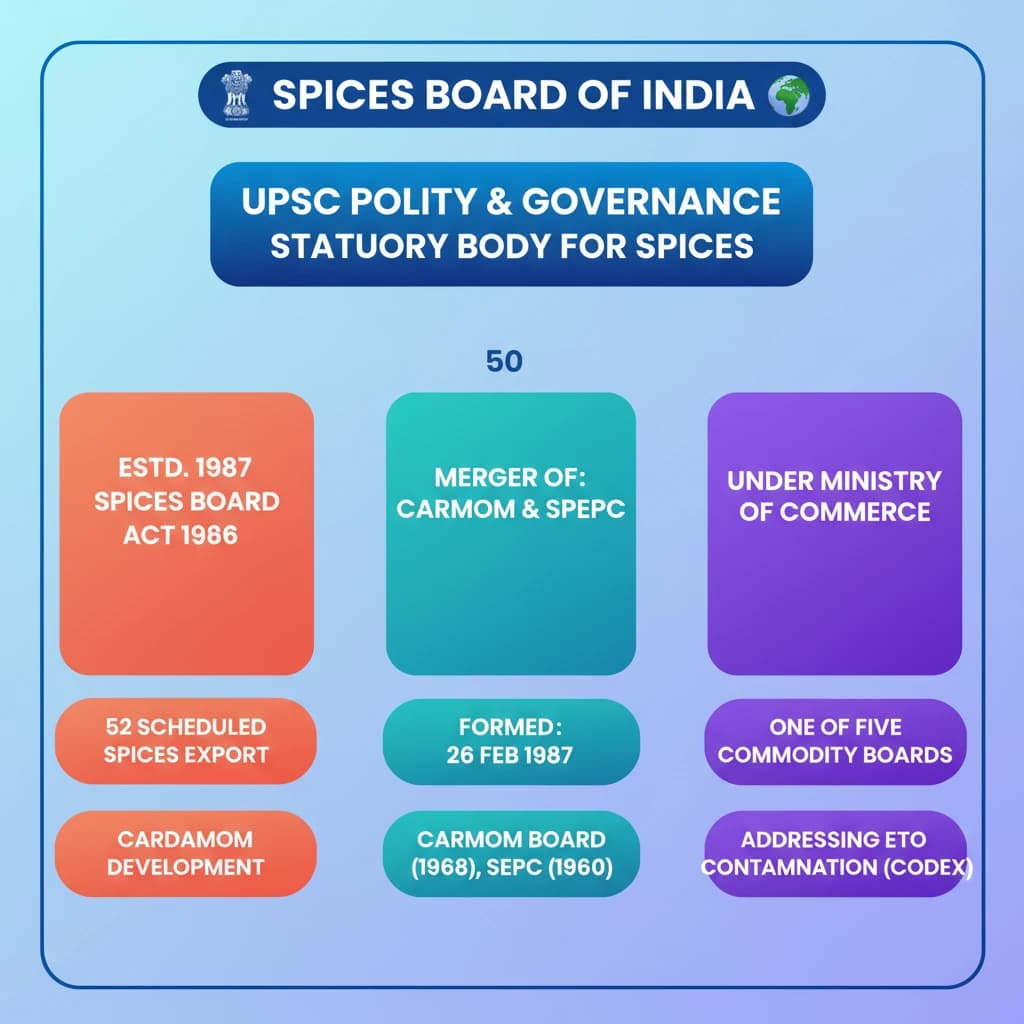
Spices Board of India is a key topic under Polity And Governance for UPSC Civil Services Examination. Key points include: Spices Board of India was constituted on February 26, 1987, under the Spices Board Act, 1986.. It resulted from the merger of the Cardamom Board (1968) and Spices Export Promotion Council (1960).. It is one of five statutory Commodity Boards under the Department of Commerce.. Understanding this topic is essential for both UPSC Prelims and Mains preparation.

Why is Spices Board of India important for UPSC exam?

Spices Board of India is a Medium-level topic in UPSC Polity And Governance. It is tested in both Prelims (factual MCQs) and Mains (analytical answer writing). Previous year UPSC questions have frequently covered aspects of Spices Board of India, making it essential for comprehensive IAS preparation.

How to prepare Spices Board of India for UPSC?

To prepare Spices Board of India for UPSC: (1) Study the comprehensive notes covering all key concepts on Vaidra. (2) Practice previous year questions on this topic. (3) Connect it with current affairs using daily updates. (4) Revise using key takeaways and mind maps available for Polity And Governance. (5) Write practice answers linking Spices Board of India to related GS Paper topics.

Key takeaways of Spices Board of India for UPSC

  • Spices Board of India was constituted on February 26, 1987, under the Spices Board Act, 1986.
  • It resulted from the merger of the Cardamom Board (1968) and Spices Export Promotion Council (1960).
  • It is one of five statutory Commodity Boards under the Department of Commerce.
  • Its primary responsibilities include export promotion of 52 Scheduled spices and development of Cardamom.
  • Currently, it is addressing the issue of Ethylene Oxide (ETO) contamination in spices with CODEX.
  • Plays a crucial role in maintaining India's reputation and competitiveness in the global spice market.
Spices Board of India

Spices Board of India

Medium⏱️ 5 min read✓ 95% Verified
polity and governance

📖 Introduction

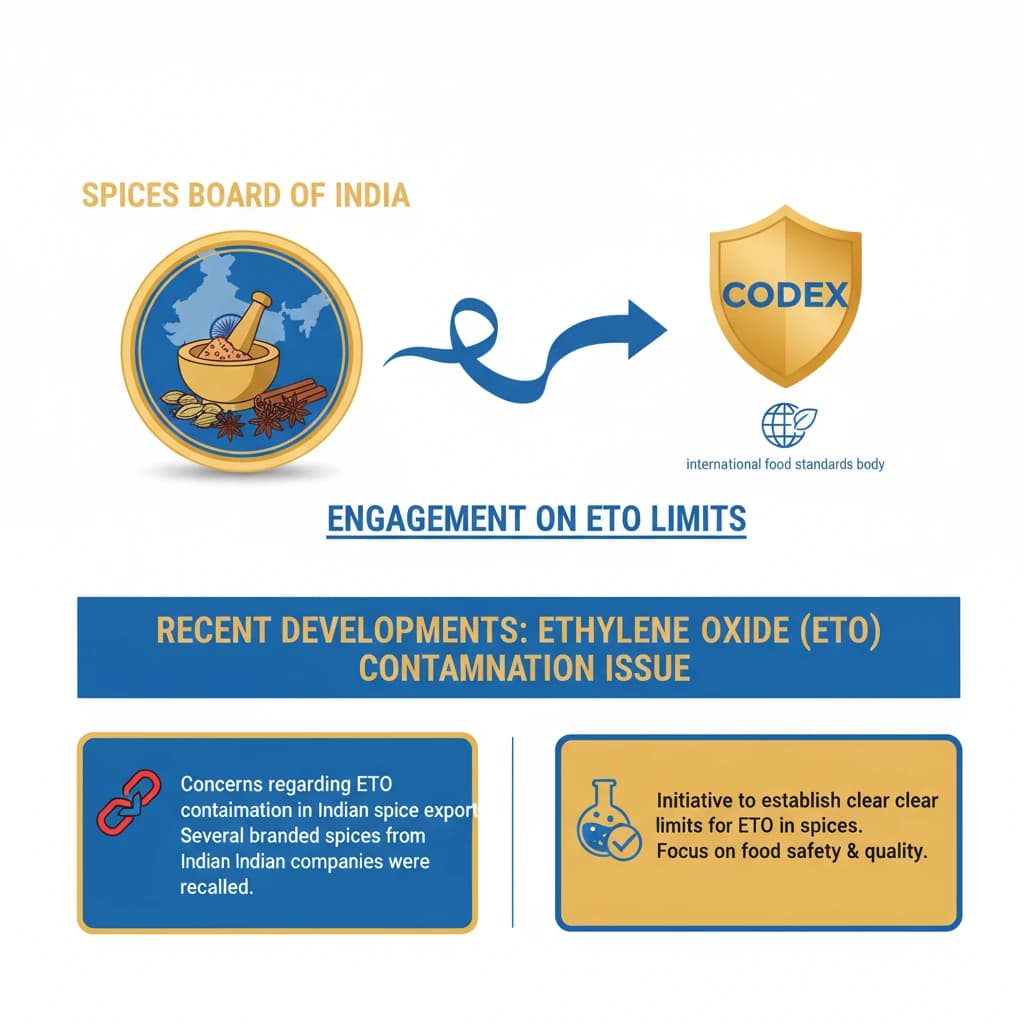
<h4>Recent Developments: Ethylene Oxide (ETO) Contamination Issue</h4><p>The <strong>Spices Board of India</strong> has recently engaged with <strong>CODEX</strong>, the international food standards body. This engagement focuses on establishing clear limits for the use of <strong>Ethylene Oxide (ETO)</strong> in spices.</p><p>This initiative follows significant concerns regarding <strong>ETO contamination</strong> in Indian spice exports. Several branded spices from Indian companies were recalled in <strong>Hong Kong</strong> and <strong>Singapore</strong> due to these issues.</p><div class='info-box'><p>Following the international recalls, <strong>Nepal</strong> also imposed a ban on the sale and import of certain spice-mix products. This ban was enacted due to similar concerns about potential <strong>ETO contamination</strong>, highlighting the global impact of such quality control issues.</p></div><h4>Understanding the Spices Board of India</h4><p>The <strong>Spices Board of India</strong> was formally constituted on <strong>February 26, 1987</strong>. Its establishment was mandated under the <strong>Spices Board Act, 1986</strong>, signifying its status as a statutory body.</p><p>This formation involved the merger of two existing entities: the erstwhile <strong>Cardamom Board (1968)</strong> and the <strong>Spices Export Promotion Council (1960)</strong>. This consolidation aimed to create a unified authority for spice development and promotion.</p><div class='info-box'><p>The <strong>Spices Board</strong> is one of <strong>five statutory Commodity Boards</strong> operating under the administrative control of the <strong>Department of Commerce</strong>. These boards play a crucial role in overseeing specific agricultural commodities.</p></div><div class='key-point-box'><p>These <strong>Commodity Boards</strong> are collectively responsible for the <strong>production, development, and export</strong> of key agricultural products. The five commodities they cover are <strong>tea, coffee, rubber, spices, and tobacco</strong>.</p></div><p>Specifically, the <strong>Spices Board</strong> holds a dual mandate. It is responsible for the comprehensive <strong>export promotion</strong> of <strong>52 Scheduled spices</strong> listed under its purview.</p><p>Additionally, it has a dedicated role in the <strong>development</strong> and cultivation of <strong>Cardamom</strong>. This includes initiatives for improving quality, productivity, and market access for this specific spice.</p>
Concept Diagram

💡 Key Takeaways

  • •Spices Board of India was constituted on February 26, 1987, under the Spices Board Act, 1986.
  • •It resulted from the merger of the Cardamom Board (1968) and Spices Export Promotion Council (1960).
  • •It is one of five statutory Commodity Boards under the Department of Commerce.
  • •Its primary responsibilities include export promotion of 52 Scheduled spices and development of Cardamom.
  • •Currently, it is addressing the issue of Ethylene Oxide (ETO) contamination in spices with CODEX.
  • •Plays a crucial role in maintaining India's reputation and competitiveness in the global spice market.

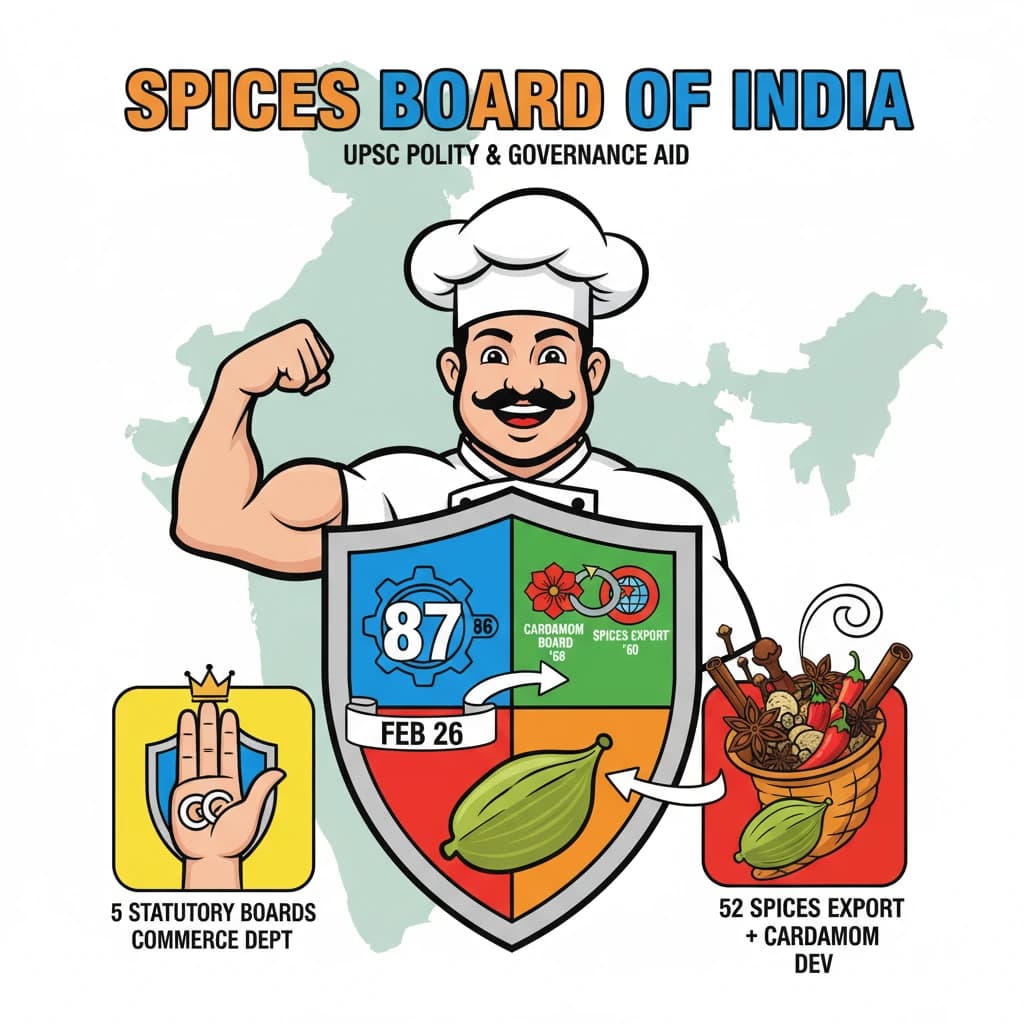
🧠 Memory Techniques
Memory Aid
95% Verified Content

Related Topics

Loading related topics...
Explore:Polity And Governance Topics·All Subjects·Daily Current Affairs·Editorial Analysis·Previous Year Questions·UPSC GPT
Spices Board of India - UPSC Polity And Governance