📖 Introduction
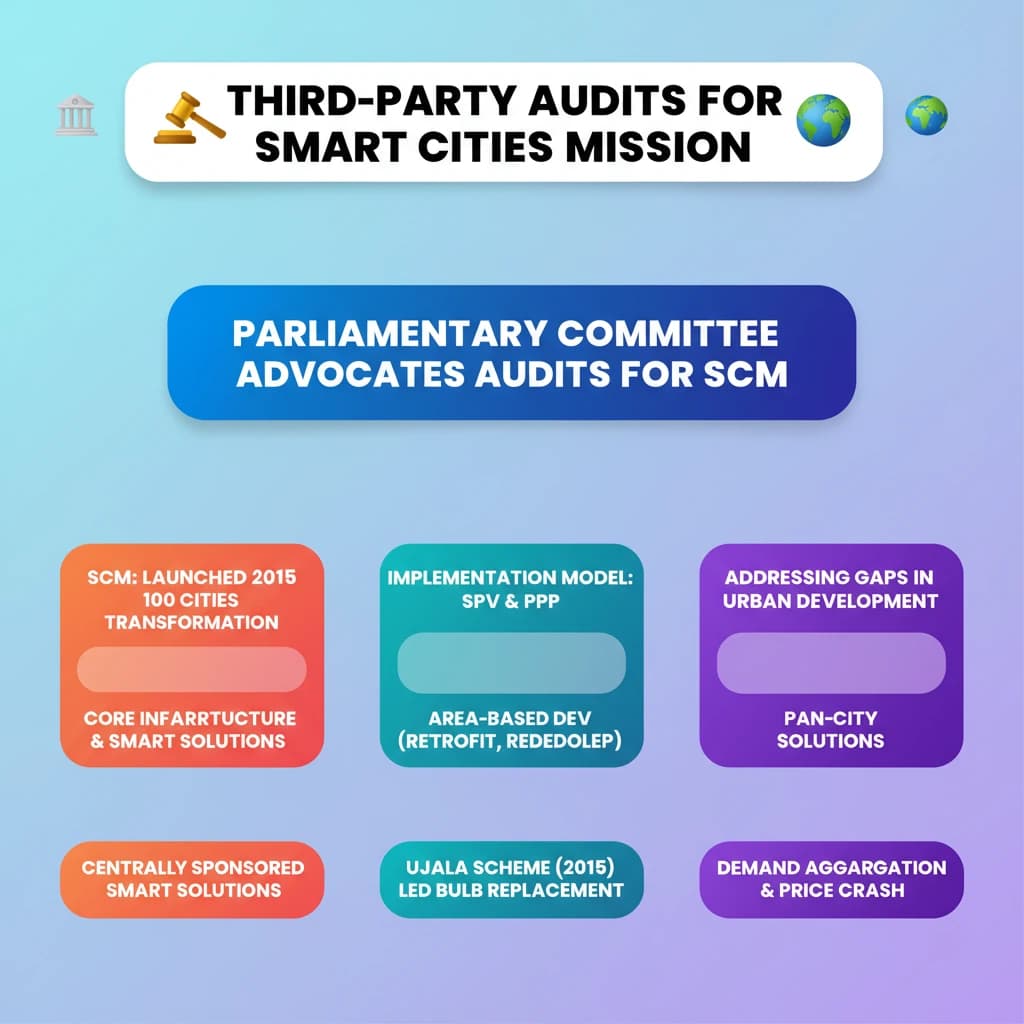
<h4>Context: Third-Party Audits for Smart Cities Mission</h4><p>A <strong>Parliamentary Standing Committee</strong> on housing and urban affairs recently called for <strong>third-party assessments</strong> of projects under the <strong>Smart Cities Mission (SCM)</strong>.</p><p>This initiative aims to address existing <strong>gaps in implementation</strong>, particularly within <strong>smaller cities</strong>. The recommendation highlights the need for enhanced <strong>accountability</strong> and <strong>efficiency</strong> in urban development projects.</p><h4>About the Smart Cities Mission (SCM)</h4><p>The <strong>Smart Cities Mission (SCM)</strong> is a <strong>Centrally Sponsored Scheme</strong> launched in <strong>June 2015</strong>.</p><p>Its primary goal is to transform <strong>100 cities</strong> across India by providing them with essential <strong>core infrastructure</strong>. The mission also seeks to foster a <strong>clean and sustainable environment</strong> in cities, ensuring a decent <strong>quality of life</strong> for citizens through <strong>"Smart Solutions."</strong></p><div class='info-box'><p><strong>Centrally Sponsored Scheme:</strong> A scheme where a certain percentage of funding is provided by the Central Government, and the remaining by State Governments.</p></div><h4>Objectives of SCM</h4><p>The SCM is designed with multiple key objectives to enhance urban living and governance.</p><p>It promotes the <strong>efficient use of resources</strong>, development of <strong>green spaces</strong>, and overall <strong>environmental sustainability</strong>. The mission ensures access to fundamental services like <strong>clean water, electricity, sanitation, healthcare</strong>, and various <strong>public amenities</strong>.</p><p>Governance is enhanced through the application of <strong>digital platforms, e-governance</strong>, and active <strong>citizen participation</strong>. It also focuses on providing <strong>affordable housing solutions</strong>, specifically catering to <strong>economically weaker sections</strong>.</p><p>Improvements in <strong>public transport systems</strong> and reduction of <strong>congestion</strong> are targeted through <strong>smart traffic management</strong>. Citizen safety, especially for <strong>vulnerable groups</strong>, is prioritized via <strong>surveillance</strong> and robust <strong>emergency services</strong>.</p><p>The mission aims to create a strong <strong>IT infrastructure</strong> for seamless access to services and information. Ultimately, SCM seeks to develop <strong>model cities</strong> that can showcase <strong>best practices</strong> for other urban centers to emulate.</p><h4>Key Components of SCM</h4><p>The Smart Cities Mission employs a dual approach for urban development. It includes <strong>Area-Based Development</strong> and <strong>Pan-City Solutions</strong>.</p><div class='key-point-box'><p><strong>Area-Based Development:</strong> Focuses on specific geographic areas within cities for comprehensive transformation.</p></div><p><strong>Types of Area-Based Development:</strong></p><ul><li><strong>Redevelopment:</strong> Involves upgrading and transforming existing urban areas with enhanced infrastructure. An example is the <strong>Bhendi Bazaar</strong> project in <strong>Mumbai</strong>.</li><li><strong>Retrofitting:</strong> Modernizing and improving infrastructure in existing localities to make them 'smart'. <strong>Ahmedabad's Local Area Development</strong> serves as a key example.</li><li><strong>Greenfield Development:</strong> Entails building entirely new, sustainable urban spaces from scratch. <strong>New Town Kolkata</strong> and <strong>GIFT City</strong> are prominent examples.</li></ul><div class='key-point-box'><p><strong>Pan-City Solutions:</strong> Involves the adoption of <strong>Information and Communication Technology (ICT)</strong> solutions across various city-wide sectors.</p></div><p>These solutions cover areas such as <strong>e-governance, waste and water management, urban mobility</strong>, and <strong>energy efficiency</strong>.</p><h4>Governance Structure of SCM</h4><p>The implementation of SCM projects is carried out through <strong>Special Purpose Vehicles (SPVs)</strong>.</p><p>These <strong>SPVs</strong> are established under the <strong>Companies Act, 2013</strong>, and are typically led by <strong>bureaucrats</strong> or <strong>industry representatives</strong>. There is a strong emphasis on a <strong>Public-Private Partnership (PPP) model</strong> for funding and execution of projects.</p><h4>Connection to Street Lighting National Programme (SLNP)</h4><p>The <strong>Street Lighting National Programme (SLNP)</strong> was launched in conjunction with the <strong>UJALA scheme</strong>.</p><p>Its objective is to replace conventional streetlights with <strong>energy-efficient Light Emitting Diodes (LEDs)</strong>. This initiative contributes to the broader goal of <strong>energy conservation</strong> and <strong>sustainability</strong> within urban areas.</p><h4>About the UJALA Scheme</h4><p>The <strong>UJALA Scheme</strong> was launched in <strong>January 2015</strong>.</p><p>It aims to promote <strong>energy efficiency</strong> by replacing traditional lighting systems, such as <strong>incandescent lamps (ICLs)</strong> and <strong>Compact Fluorescent Lamps (CFLs)</strong>, with <strong>energy-saving LED bulbs</strong>. The scheme is a collaborative project involving the <strong>Government of India's Public Sector Undertakings</strong>, the <strong>Union Ministry of Power's Energy Efficiency Services Limited (EESL)</strong>, and various <strong>DISCOMs (Distribution Companies)</strong>.</p><h4>Objectives of UJALA</h4><p>The <strong>UJALA Scheme</strong> targets significant energy savings and emission reductions.</p><p>It aims to save <strong>85 lakh kWh of electricity</strong> and reduce <strong>15,000 tonnes of Carbon dioxide (CO₂)</strong>. This is achieved by replacing <strong>77 crore traditional bulbs</strong> and <strong>3.5 crore street lights</strong> with <strong>LEDs</strong>.</p><h4>Need for UJALA</h4><p>Lighting constitutes a substantial portion of residential electricity consumption in India, approximately <strong>18-27%</strong>.</p><p>In <strong>2011</strong>, Indian households utilized about <strong>one billion lighting points</strong>. At that time, the majority relied on <strong>CFLs (46%)</strong> and <strong>tube lights (41%)</strong>, with only <strong>0.4%</strong> using <strong>LED bulbs</strong>. This highlighted a significant opportunity for energy efficiency improvements.</p><h4>Efficiency of LEDs</h4><p><strong>LEDs</strong> offer superior energy savings compared to conventional lighting.</p><p>They save up to <strong>90% energy</strong> compared to <strong>incandescent lamps (ICLs)</strong> and <strong>50%</strong> compared to <strong>Compact Fluorescent Lamps (CFLs)</strong>. <strong>LED bulbs</strong> consume <strong>75% less energy</strong> and last <strong>25 times longer</strong> than incandescent bulbs. The main barrier to their widespread adoption was their <strong>high upfront cost</strong>.</p><h4>Key Features of UJALA</h4><p><strong>Subsidized LED Bulbs:</strong> The scheme dramatically reduced the cost of <strong>LED bulbs</strong>.</p><p>The price was brought down to <strong>Rs 70 per LED bulb</strong>, a significant decrease from <strong>Rs 450 in 2014</strong>. <strong>Distribution Mechanism:</strong> UJALA utilized a <strong>demand aggregation-price crash model</strong>. This involved <strong>bulk buying</strong> to significantly reduce procurement prices.</p><p>In <strong>2015</strong>, <strong>EESL</strong> invited open bids for large-scale <strong>LED lamp procurement</strong> and partnered with <strong>state governments</strong> to establish an effective distribution network.</p>