📖 Introduction
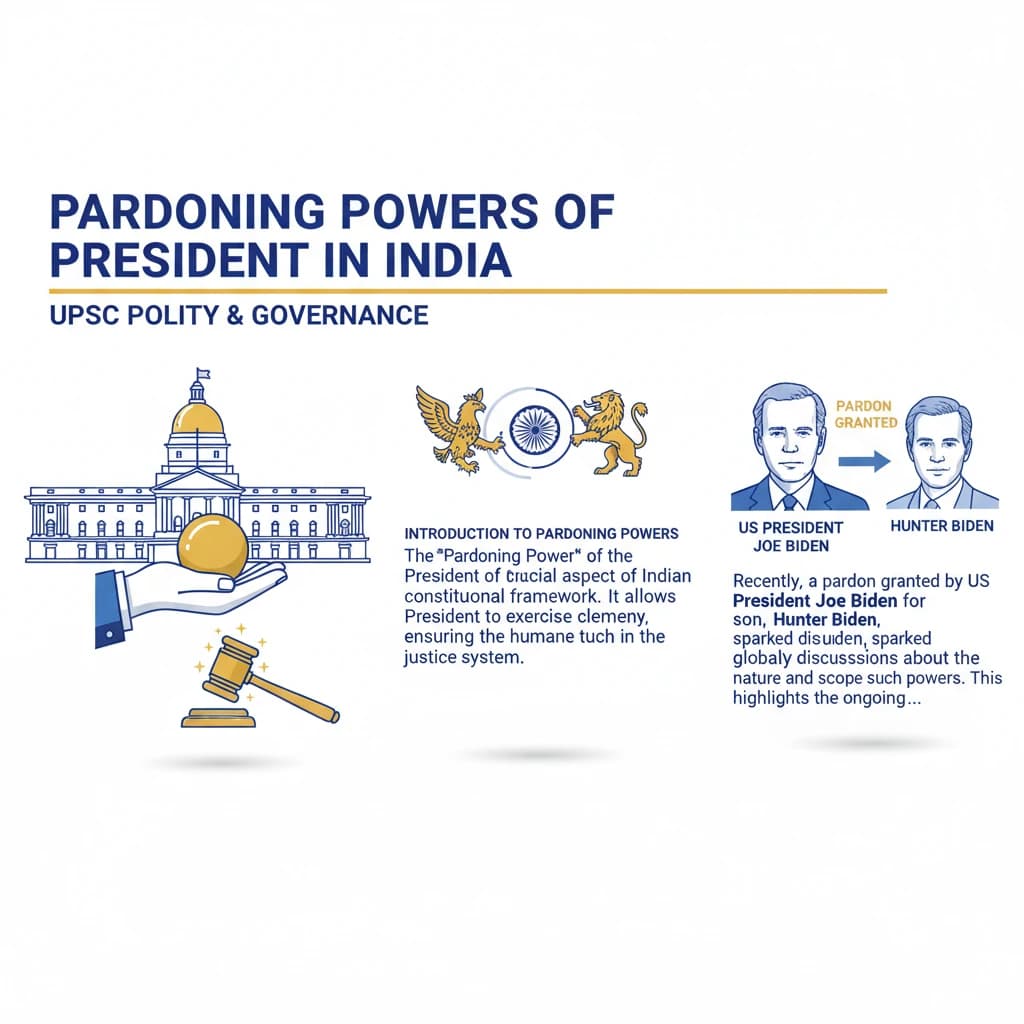
<h4>Introduction to Pardoning Powers</h4><p>The <strong>Pardoning Power</strong> of the <strong>President of India</strong> is a crucial aspect of the Indian constitutional framework. It allows the President to exercise clemency, ensuring a humane touch in the justice system.</p><p>Recently, a pardon granted by the <strong>US President Joe Biden</strong> for his son, <strong>Hunter Biden</strong>, sparked discussions globally about the nature and scope of such powers. This highlights the ongoing relevance of executive clemency.</p><h4>Constitutional Basis: Article 72</h4><p><strong>Article 72</strong> of the <strong>Indian Constitution</strong> vests the President of India with the power to grant <strong>pardons</strong>, <strong>remit</strong> or <strong>commute sentences</strong>, grant <strong>respites</strong> or <strong>remissions</strong> of punishment, or <strong>reprieve</strong> the sentence of any person convicted of an offense.</p><div class='info-box'><p>This power is applicable in specific scenarios:</p><ul><li>When the punishment is by a <strong>Court Martial</strong>.</li><li>When the sentence involves <strong>capital punishment</strong> (death sentence).</li><li>When the conviction is for offenses under <strong>Union laws</strong>.</li></ul></div><h4>Significance of Pardoning Powers</h4><p>The President's pardoning power serves a vital role in the justice delivery system. It acts as a safety valve against potential miscarriages of justice.</p><div class='key-point-box'><p><strong>Key Significance:</strong></p><ul><li><strong>Rectifying Judicial Errors:</strong> It provides an avenue to remedy potential errors that may have occurred in judicial proceedings.</li><li><strong>Humanitarian Considerations:</strong> It allows for the exercise of clemency in situations demanding humanitarian considerations, such as the convict's health or family circumstances.</li></ul></div><h4>Limitations on Presidential Pardoning Power</h4><p>While extensive, the President's pardoning power is not absolute and is subject to certain constitutional limitations. The President cannot exercise this power independently or arbitrarily.</p><p>Decisions regarding pardons must always align with the <strong>advice of the Council of Ministers</strong>. This principle ensures that the power is exercised responsibly and democratically.</p><h4>Landmark Supreme Court Judgments</h4><p>The <strong>Supreme Court of India</strong> has clarified the scope and limitations of the President's pardoning power through several landmark judgments.</p><div class='info-box'><ul><li><strong>Maru Ram vs Union of India, 1980:</strong> The SC held that the power to grant pardons must be exercised <strong>fairly, reasonably, and without arbitrariness</strong>. It emphasized the need for justice and balance in its application.</li><li><strong>Kehar Singh v. Union of India, 1988:</strong> The SC affirmed that the President's pardoning power is <strong>independent of the judiciary</strong>. However, it can be <strong>reviewed to ensure procedural fairness</strong>, focusing on adherence to constitutional principles and procedural requirements, not the merits of the decision itself.</li></ul></div><div class='exam-tip-box'><p><strong>UPSC Insight:</strong> Remember these landmark cases (<strong>Maru Ram</strong> and <strong>Kehar Singh</strong>) as they are frequently asked in both Prelims and Mains to discuss the scope and judicial review of pardoning powers. Highlight the balance between executive clemency and judicial oversight.</p></div><h4>Types of Clemency Powers</h4><p><strong>Article 72</strong> outlines various forms of clemency that the President can grant. Each type has a distinct effect on the sentence and conviction.</p><div class='info-box'><table class='info-table'><tr><th>Clemency Type</th><th>Definition</th></tr><tr><td><strong>Pardon</strong></td><td>Removes both the <strong>sentence and the conviction</strong>, absolving the convict from all punishments and disqualifications.</td></tr><tr><td><strong>Commutation</strong></td><td>Substitutes one form of punishment for a <strong>lighter one</strong> (e.g., death sentence to rigorous imprisonment).</td></tr><tr><td><strong>Remission</strong></td><td>Reduces the <strong>period of a sentence</strong> without changing its nature (e.g., 10 years rigorous imprisonment to 5 years rigorous imprisonment).</td></tr><tr><td><strong>Respite</strong></td><td>Awards a <strong>lesser sentence</strong> due to special circumstances like <strong>physical disability</strong> or <strong>pregnancy</strong> of the convict.</td></tr><tr><td><strong>Reprieve</strong></td><td>Temporarily <strong>stays the execution of a sentence</strong> (especially death sentence) to allow time to seek pardon or commutation.</td></tr></table></div><h4>Pardoning Power of the US President</h4><p>The <strong>US Constitution</strong> also grants its President significant pardoning powers. This power is explicitly stated in their constitution.</p><div class='info-box'><p>The US President can "grant <strong>Reprieves and Pardons for Offences against the United States</strong>, except in Cases of Impeachment."</p><ul><li>This executive power applies exclusively to <strong>federal crimes</strong>.</li><li>It does not extend to <strong>state-level offenses</strong> or <strong>impeachment cases</strong>.</li></ul></div><h4>Comparison: President vs. Governor's Pardoning Powers</h4><p>Similar to the President, the <strong>Governor of a state</strong> also exercises pardoning powers under <strong>Article 161</strong> of the Indian Constitution. However, there are significant limitations compared to the President's power.</p><div class='info-box'><table class='info-table'><tr><th>Aspect</th><th>President (Article 72)</th><th>Governor (Article 161)</th></tr><tr><td><strong>Applicability</strong></td><td>Offenses against <strong>Union laws</strong>.</td><td>Offenses against <strong>State laws</strong>.</td></tr><tr><td><strong>Death Sentence</strong></td><td>Can <strong>pardon</strong>, reprieve, respite, remit, suspend, or commute a death sentence. Is the <strong>only authority to pardon a death sentence</strong>.</td><td>Cannot <strong>pardon a death sentence</strong>. Can only suspend, remit, or commute a death sentence.</td></tr><tr><td><strong>Court Martial</strong></td><td>Can grant pardon, reprieve, respite, suspension, remission, or commutation in respect to punishment or sentence by a <strong>court-martial</strong> (military court).</td><td>Does <strong>not possess any such power</strong> regarding court-martial sentences.</td></tr></table></div><div class='key-point-box'><p><strong>Crucial Distinction:</strong> Even if a state law provides for a death sentence, the ultimate power to grant a <strong>pardon</strong> for it lies solely with the <strong>President</strong>, not the Governor.</p></div>