Loading page, please wait…
Vaidra Logo
Vaidra

Top 4 items + smart groups

UPSC GPT
New
Current Affairs
Daily Solutions
Daily Puzzle
Mains Evaluator

Version 2.0.0 • Built with ❤️ for UPSC aspirants

Loading...
Loading...
Loading...
Loading...
Loading...
Loading...
Loading...
Loading...
Loading...
Loading...
Loading...
Loading...
Loading...
S. R. Bommai v. Union of India Case 1994 - UPSC Polity And Governance

S. R. Bommai v. Union of India Case 1994 - UPSC Polity And Governance

What is S. R. Bommai v. Union of India Case 1994 in UPSC Polity And Governance?

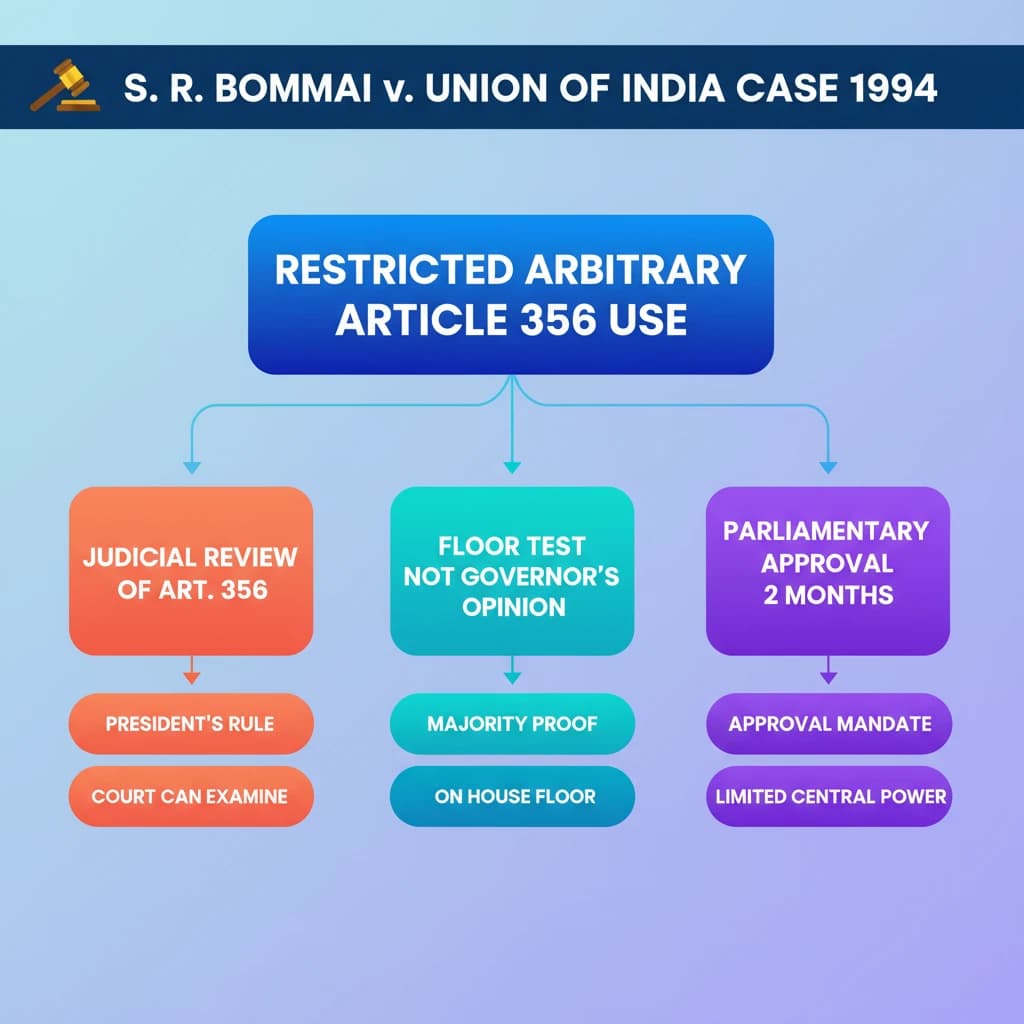
S. R. Bommai v. Union of India Case 1994 is a key topic under Polity And Governance for UPSC Civil Services Examination. Key points include: S. R. Bommai v. Union of India (1994) restricted arbitrary use of Article 356.. President's Rule under Article 356 is subject to judicial review.. A state government's majority must be tested on the floor of the House, not by the Governor's subjective assessment.. Understanding this topic is essential for both UPSC Prelims and Mains preparation.

Why is S. R. Bommai v. Union of India Case 1994 important for UPSC exam?

S. R. Bommai v. Union of India Case 1994 is a Medium-level topic in UPSC Polity And Governance. It is tested in both Prelims (factual MCQs) and Mains (analytical answer writing). Previous year UPSC questions have frequently covered aspects of S. R. Bommai v. Union of India Case 1994, making it essential for comprehensive IAS preparation.

How to prepare S. R. Bommai v. Union of India Case 1994 for UPSC?

To prepare S. R. Bommai v. Union of India Case 1994 for UPSC: (1) Study the comprehensive notes covering all key concepts on Vaidra. (2) Practice previous year questions on this topic. (3) Connect it with current affairs using daily updates. (4) Revise using key takeaways and mind maps available for Polity And Governance. (5) Write practice answers linking S. R. Bommai v. Union of India Case 1994 to related GS Paper topics.

Key takeaways of S. R. Bommai v. Union of India Case 1994 for UPSC

  • S. R. Bommai v. Union of India (1994) restricted arbitrary use of Article 356.
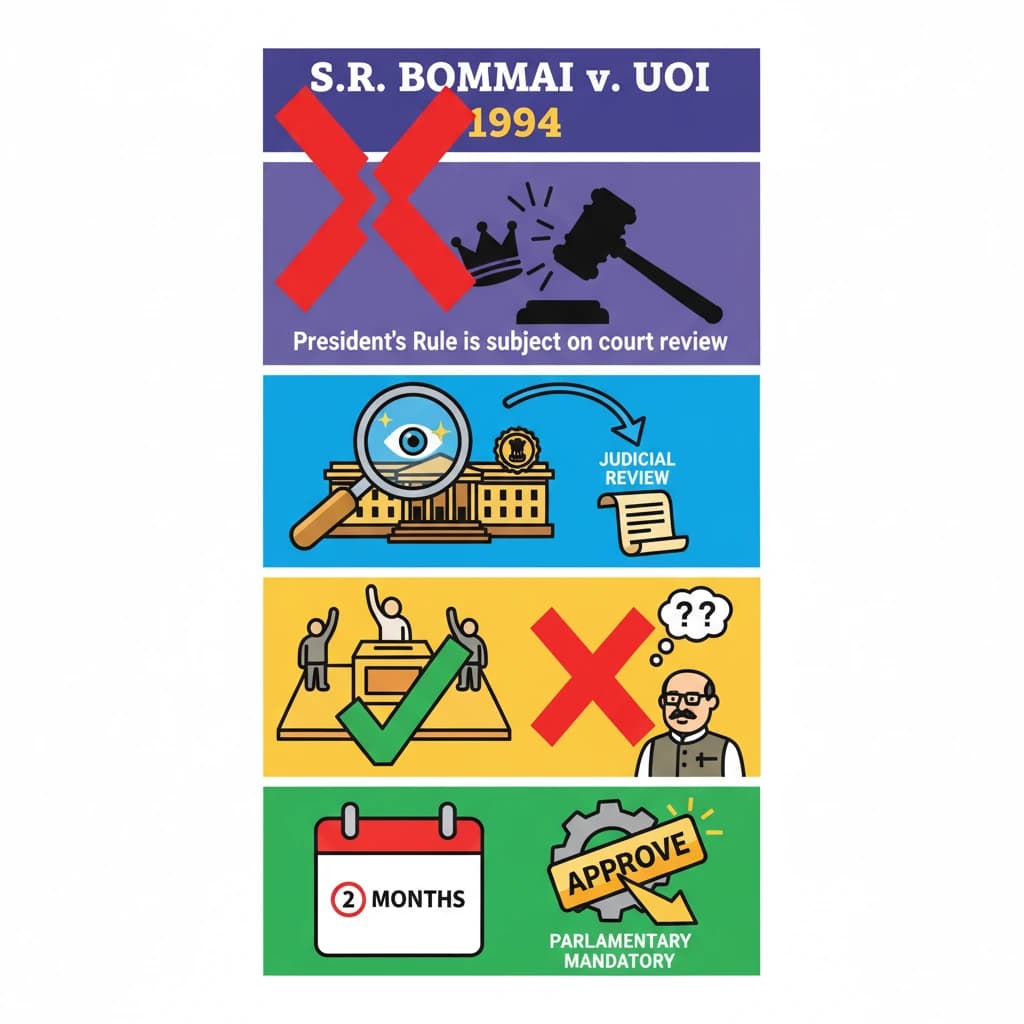
  • President's Rule under Article 356 is subject to judicial review.
  • A state government's majority must be tested on the floor of the House, not by the Governor's subjective assessment.
  • Parliamentary approval within two months is mandatory for President's Rule to continue.
  • The judgment strengthened cooperative federalism and limited central intervention in state affairs.
S. R. Bommai v. Union of India Case 1994

S. R. Bommai v. Union of India Case 1994

Medium⏱️ 7 min read✓ 98% Verified
polity and governance

📖 Introduction

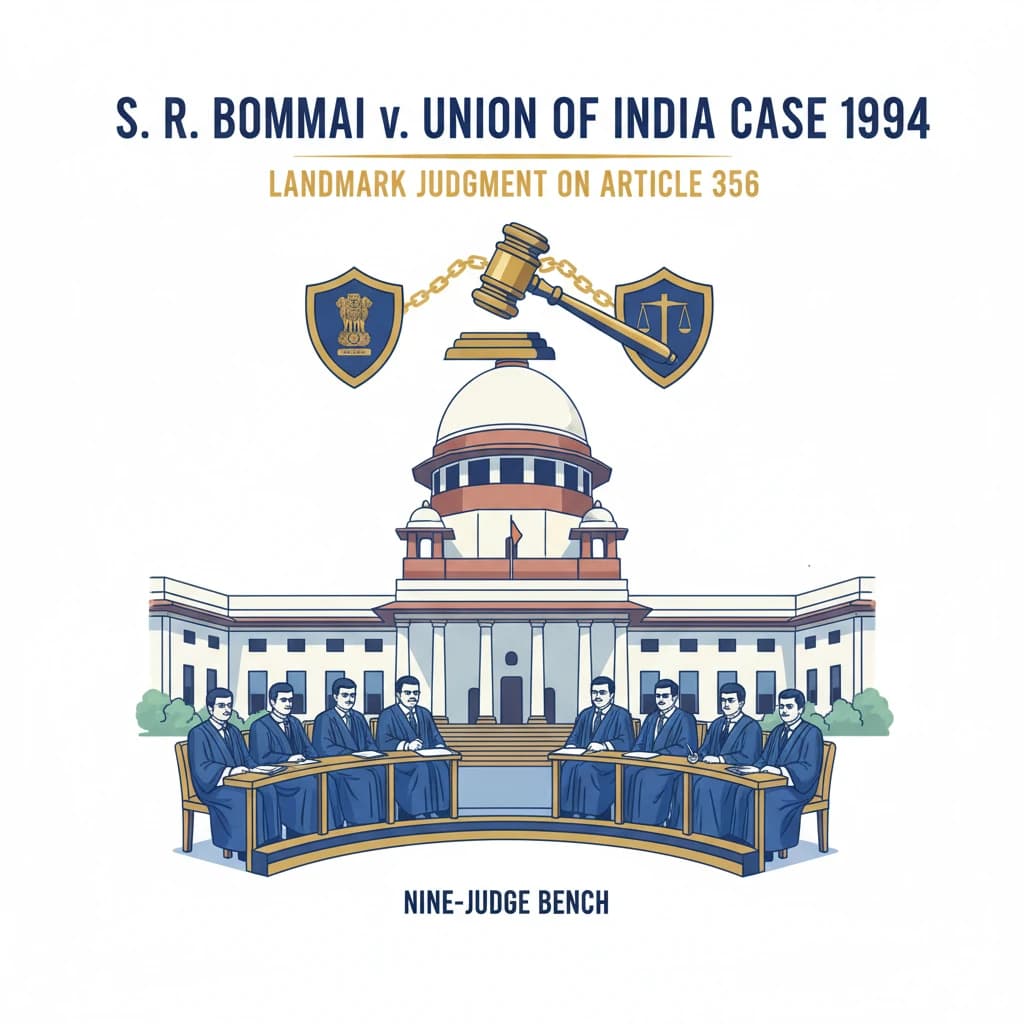
<h4>Introduction to S. R. Bommai v. Union of India Case</h4><p>The landmark judgment in <strong>S. R. Bommai v. Union of India (1994)</strong> was delivered by a <strong>nine-judge bench</strong> of the <strong>Supreme Court of India</strong>. This case significantly curtailed the arbitrary use of <strong>Article 356</strong> of the Constitution, which allows for the dismissal of state governments.</p><p>Its impact on India's <strong>constitutional framework</strong> and <strong>Centre-State relations</strong> has been profound and continues to shape governance, celebrating its <strong>30th anniversary</strong> in 2024.</p><div class='info-box'><p><strong>Case Name:</strong> S. R. Bommai v. Union of India</p><p><strong>Year:</strong> 1994</p><p><strong>Bench Strength:</strong> Nine Judges</p><p><strong>Key Article:</strong> Article 356 (President's Rule)</p></div><h4>Background of the S. R. Bommai Case</h4><p>The case originated from the dismissal of the <strong>Janata Dal government</strong> in <strong>Karnataka</strong> in 1989, led by <strong>Chief Minister S. R. Bommai</strong>. This dismissal was carried out under <strong>Article 356</strong>.</p><p>In <strong>September 1988</strong>, a legislator from the <strong>Janata Dal</strong>, along with <strong>19 other Members of the Legislative Assembly (MLAs)</strong>, defected from the party, withdrawing support from the <strong>Bommai government</strong>. This led to the Governor's recommendation for President's Rule.</p><p><strong>S. R. Bommai's</strong> request to test his government's majority on the floor of the Assembly was denied by the <strong>Governor</strong>. The state government was subsequently dismissed, prompting <strong>Bommai</strong> to seek legal recourse.</p><h4>Supreme Court Judgment: Key Principles</h4><p>The <strong>Supreme Court's</strong> judgment emphasized that the <strong>Presidential Proclamation</strong> under <strong>Article 356</strong> must be exercised with extreme <strong>caution</strong>. This aligns with the views of <strong>Dr. B.R. Ambedkar</strong> and recommendations by the <strong>Sarkaria Commission</strong>.</p><div class='key-point-box'><p><strong>Key Principle:</strong> The power to dismiss a state government under <strong>Article 356</strong> is <strong>not absolute</strong> but subject to significant limitations and safeguards.</p></div><p>The Court mandated that any proclamation under <strong>Article 356(3)</strong> must be thoroughly analyzed by <strong>both Houses of Parliament</strong>. If Parliament does not approve it within <strong>two months</strong>, the proclamation lapses, and the state assembly resumes its functions.</p><h4>Judicial Review of Article 356</h4><p>A pivotal aspect of the judgment was the clarification that the <strong>President's Proclamation</strong> under <strong>Article 356</strong> is subject to <strong>judicial review</strong>. The Supreme Court can entertain <strong>writ petitions</strong> challenging its legality if arguable questions are raised.</p><div class='exam-tip-box'><p>This aspect is crucial for <strong>UPSC Mains GS-II</strong>, demonstrating the judiciary's role in upholding <strong>constitutionalism</strong> and <strong>federal principles</strong>. Always mention <strong>judicial review</strong> in relation to <strong>Article 356</strong> post-Bommai.</p></div><p>The Court inferred the power to dissolve the legislature from <strong>Article 174(2)</strong>, which allows the <strong>Governor</strong> to dissolve the Legislative Assembly, and <strong>Article 356(1)(a)</strong>, which enables the <strong>President</strong> to assume the Governor's powers.</p><h4>Implications for Federalism</h4><p>The <strong>S. R. Bommai judgment</strong> significantly strengthened <strong>cooperative federalism</strong> by protecting states from arbitrary central intervention. It ensures that the Centre and states maintain a horizontal relationship of cooperation.</p><p>The ruling indirectly promotes <strong>competitive federalism</strong> by ensuring stable state governments, allowing them to compete for development and investment without fear of unconstitutional dismissal.</p>
Concept Diagram

💡 Key Takeaways

  • •S. R. Bommai v. Union of India (1994) restricted arbitrary use of Article 356.
  • •President's Rule under Article 356 is subject to judicial review.
  • •A state government's majority must be tested on the floor of the House, not by the Governor's subjective assessment.
  • •Parliamentary approval within two months is mandatory for President's Rule to continue.
  • •The judgment strengthened cooperative federalism and limited central intervention in state affairs.

🧠 Memory Techniques
Memory Aid
98% Verified Content

📚 Reference Sources

•Supreme Court of India Judgment: S. R. Bommai v. Union of India (1994)
•The Constitution of India (Article 356, Article 174(2))
•Sarkaria Commission Report on Centre-State Relations (1987)

Related Topics

Loading related topics...
Explore:Polity And Governance Topics·All Subjects·Daily Current Affairs·Editorial Analysis·Previous Year Questions·UPSC GPT
Back
All Subjects

Topics

0 topics • 0 completed

Loading topics...
Loading...
Loading...
Loading...
Loading...
Loading...
Overall Progress0%