Loading page, please wait…
Vaidra Logo
Vaidra

Top 4 items + smart groups

UPSC GPT
New
Current Affairs
Daily Solutions
Daily Puzzle
Mains Evaluator

Version 2.0.0 • Built with ❤️ for UPSC aspirants

Loading...
Loading...
Loading...
Loading...
Loading...
Loading...
Loading...
Loading...
Loading...
Loading...
Loading...
Loading...
Loading...
PM-Surya Ghar: Muft Bijli Yojana - UPSC Polity And Governance
Back
All Subjects

Topics

0 topics • 0 completed

Loading topics...
Loading...
Loading...
Loading...
Loading...
Loading...
Overall Progress0%

PM-Surya Ghar: Muft Bijli Yojana - UPSC Polity And Governance

What is PM-Surya Ghar: Muft Bijli Yojana in UPSC Polity And Governance?

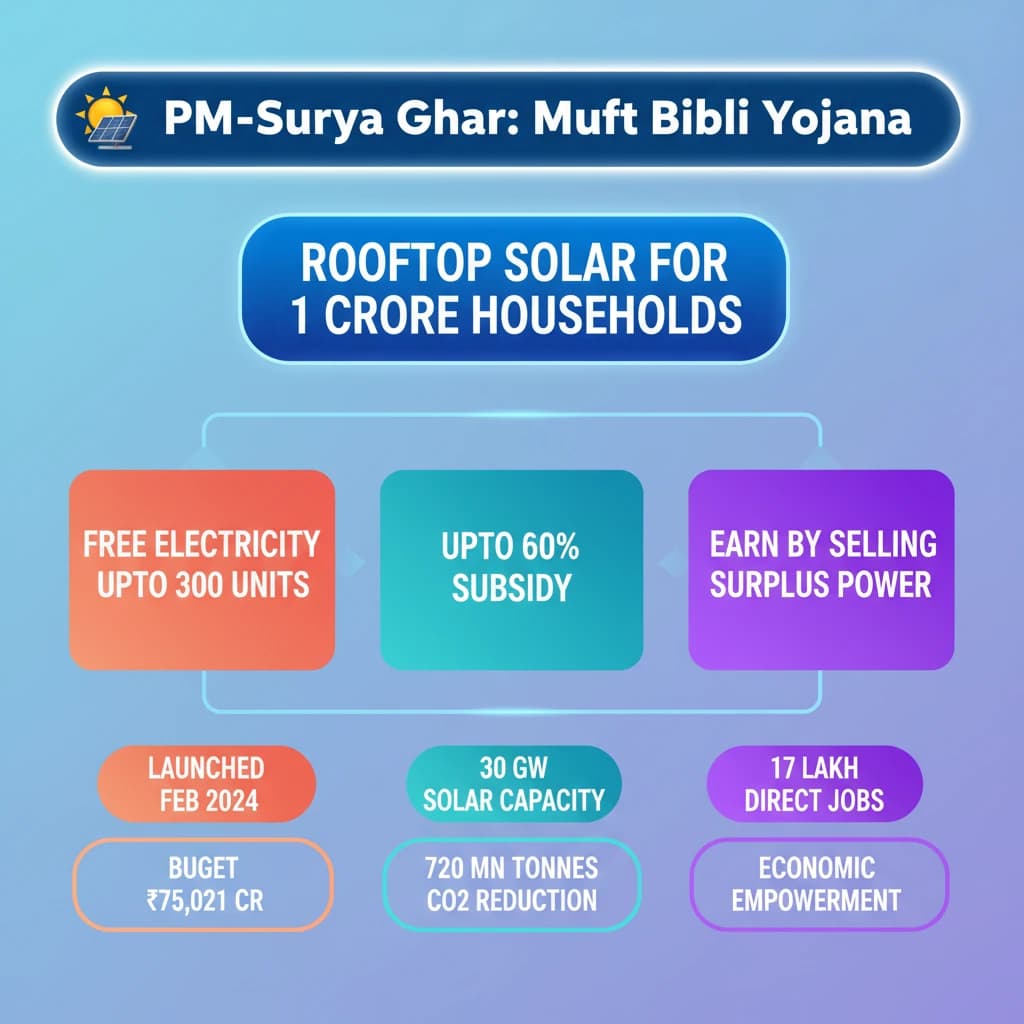
PM-Surya Ghar: Muft Bijli Yojana is a key topic under Polity And Governance for UPSC Civil Services Examination. Key points include: PM-Surya Ghar: Muft Bijli Yojana, launched Feb 2024 by MNRE, targets 1 crore households for rooftop solar.. Budget of Rs 75,021 crore, aims for 300 units free electricity and up to 60% subsidy.. Key implementation models include RESCO, Utility-Led Aggregation, and consumer-driven via National Portal.. Understanding this topic is essential for both UPSC Prelims and Mains preparation.

Why is PM-Surya Ghar: Muft Bijli Yojana important for UPSC exam?

PM-Surya Ghar: Muft Bijli Yojana is a Medium-level topic in UPSC Polity And Governance. It is tested in both Prelims (factual MCQs) and Mains (analytical answer writing). Previous year UPSC questions have frequently covered aspects of PM-Surya Ghar: Muft Bijli Yojana, making it essential for comprehensive IAS preparation.

How to prepare PM-Surya Ghar: Muft Bijli Yojana for UPSC?

To prepare PM-Surya Ghar: Muft Bijli Yojana for UPSC: (1) Study the comprehensive notes covering all key concepts on Vaidra. (2) Practice previous year questions on this topic. (3) Connect it with current affairs using daily updates. (4) Revise using key takeaways and mind maps available for Polity And Governance. (5) Write practice answers linking PM-Surya Ghar: Muft Bijli Yojana to related GS Paper topics.

Key takeaways of PM-Surya Ghar: Muft Bijli Yojana for UPSC

  • PM-Surya Ghar: Muft Bijli Yojana, launched Feb 2024 by MNRE, targets 1 crore households for rooftop solar.
  • Budget of Rs 75,021 crore, aims for 300 units free electricity and up to 60% subsidy.
  • Key implementation models include RESCO, Utility-Led Aggregation, and consumer-driven via National Portal.
  • Expected outcomes: 720 million tonnes carbon reduction, 17 lakh direct jobs, 30 GW additional solar capacity.
  • Households can earn income by selling surplus electricity to DISCOMs, enhancing economic empowerment.
PM-Surya Ghar: Muft Bijli Yojana

PM-Surya Ghar: Muft Bijli Yojana

Medium⏱️ 6 min read✓ 98% Verified
polity and governance

📖 Introduction

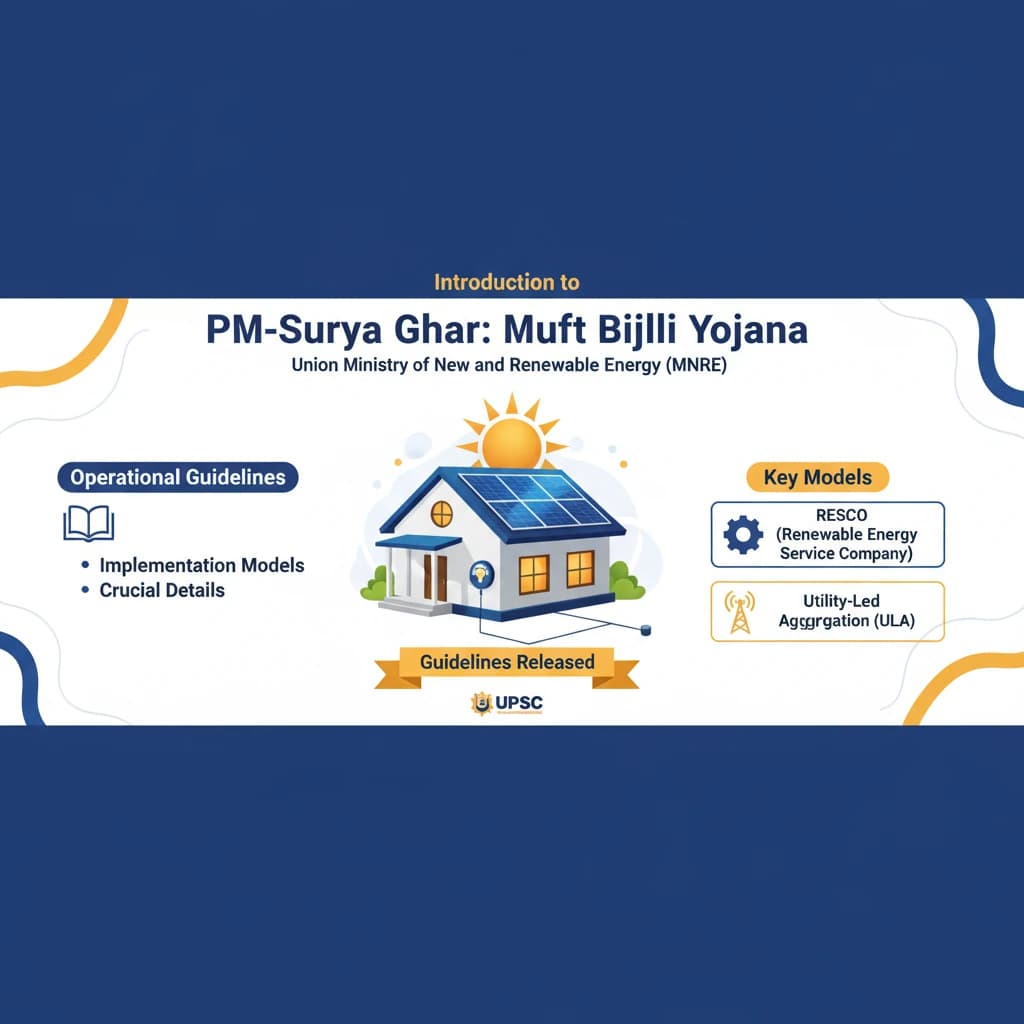
<h4>Introduction to PM-Surya Ghar: Muft Bijli Yojana</h4><p>The <strong>Union Ministry of New and Renewable Energy (MNRE)</strong> recently released the <strong>operational guidelines</strong> for the <strong>PM-Surya Ghar: Muft Bijli Yojana</strong>. These guidelines provide crucial details on the implementation models for this ambitious scheme.</p><p>Specifically, the guidelines elaborate on the <strong>RESCO (Renewable Energy Service Company)</strong> and <strong>Utility-Led Aggregation (ULA)</strong> models. These new frameworks are designed to complement the existing <strong>consumer-driven implementation</strong> of rooftop solar installations.</p><div class='exam-tip-box'><p><strong>UPSC Insight:</strong> Understanding the different implementation models (RESCO, ULA, consumer-driven) is key for Mains answers on governance and energy policy. Note the responsible ministry: <strong>MNRE</strong>.</p></div><h4>About PM-Surya Ghar: Muft Bijli Yojana</h4><p>The <strong>PM Surya Ghar: Muft Bijli Yojana</strong> was officially launched in <strong>February 2024</strong>. It is a flagship initiative by the <strong>Ministry of New and Renewable Energy (MNRE)</strong>.</p><p>The primary goal of the scheme is to provide <strong>free electricity</strong> to <strong>one crore households</strong> across India. This will be achieved through the installation of <strong>rooftop solar panels</strong> on residential buildings.</p><div class='info-box'><p><strong>Scheme Details:</strong></p><ul><li><strong>Launch Date:</strong> February 2024</li><li><strong>Responsible Ministry:</strong> MNRE</li><li><strong>Budget:</strong> <strong>Rs 75,021 crore</strong></li><li><strong>Implementation Period:</strong> Planned until <strong>FY 2026-27</strong></li><li><strong>Target:</strong> <strong>One crore households</strong></li></ul></div><p>The scheme offers significant benefits to eligible households. It provides up to <strong>300 units of free electricity per month</strong>. Additionally, it offers a substantial <strong>subsidy</strong> covering up to <strong>60% of the installation cost</strong> of the rooftop solar panels.</p><h4>Eligibility Criteria</h4><p>To qualify for the <strong>PM Surya Ghar: Muft Bijli Yojana</strong>, applicants must meet specific criteria. These ensure that the benefits reach the intended beneficiaries effectively.</p><ul><li>Applicant must be an <strong>Indian citizen</strong>.</li><li>Applicant must be a <strong>homeowner</strong>.</li><li>The household must possess a <strong>valid electricity connection</strong>.</li><li>The household should <strong>not have availed a prior solar subsidy</strong> for rooftop solar installations.</li></ul><h4>Implementation Structure</h4><p>The execution of the <strong>PM Surya Ghar: Muft Bijli Yojana</strong> is structured at both national and state levels to ensure efficient rollout and monitoring.</p><p>At the national level, the scheme will be implemented by the <strong>National Programme Implementation Agency (NPIA)</strong>. This agency is responsible for overall coordination and strategic direction.</p><p>At the state level, the implementation is carried out by <strong>State Implementation Agencies (SIA)</strong>. These agencies manage the on-ground execution and beneficiary engagement within their respective states.</p><h4>Key Components of the Scheme</h4><p>The scheme incorporates several key components designed to facilitate widespread adoption and demonstrate the benefits of solar energy.</p><ul><li><strong>Central Financial Assistance (CFA):</strong> This component provides direct <strong>financial support</strong> to residential consumers. The assistance is facilitated for installing rooftop solar panels through a dedicated <strong>National Portal</strong>.</li><li><strong>Model Solar Village:</strong> The scheme aims to establish <strong>one Model Solar Village per district</strong> across the country. These villages will serve as exemplars, actively promoting the adoption of solar energy and showcasing its benefits.</li></ul><h4>Expected Outcomes and Impact</h4><p>The <strong>PM Surya Ghar: Muft Bijli Yojana</strong> is projected to deliver substantial environmental, economic, and social benefits.</p><ul><li><strong>Carbon Emission Reduction:</strong> The scheme is expected to reduce <strong>carbon emissions by 720 million tonnes</strong> over the lifetime of the installed rooftop solar systems. This significantly contributes to India's climate goals.</li><li><strong>Job Creation:</strong> An estimated <strong>17 lakh direct jobs</strong> are projected to be generated. These jobs will span various sectors, including manufacturing, logistics, installation, and operations and maintenance of solar systems.</li><li><strong>Increased Solar Capacity:</strong> The scheme will contribute an additional <strong>30 GW</strong> to India's total solar energy capacity. This substantial increase will come specifically from residential rooftop systems.</li><li><strong>Household Income Generation:</strong> Households can earn income by selling <strong>surplus electricity</strong> generated from their solar panels back to <strong>DISCOMs (Distribution Companies)</strong>. For example, a <strong>3 kW rooftop setup</strong> can generate over <strong>300 units per month</strong>, often exceeding a household's consumption.</li></ul>
Concept Diagram

💡 Key Takeaways

  • •PM-Surya Ghar: Muft Bijli Yojana, launched Feb 2024 by MNRE, targets 1 crore households for rooftop solar.
  • •Budget of Rs 75,021 crore, aims for 300 units free electricity and up to 60% subsidy.
  • •Key implementation models include RESCO, Utility-Led Aggregation, and consumer-driven via National Portal.
  • •Expected outcomes: 720 million tonnes carbon reduction, 17 lakh direct jobs, 30 GW additional solar capacity.
  • •Households can earn income by selling surplus electricity to DISCOMs, enhancing economic empowerment.

🧠 Memory Techniques
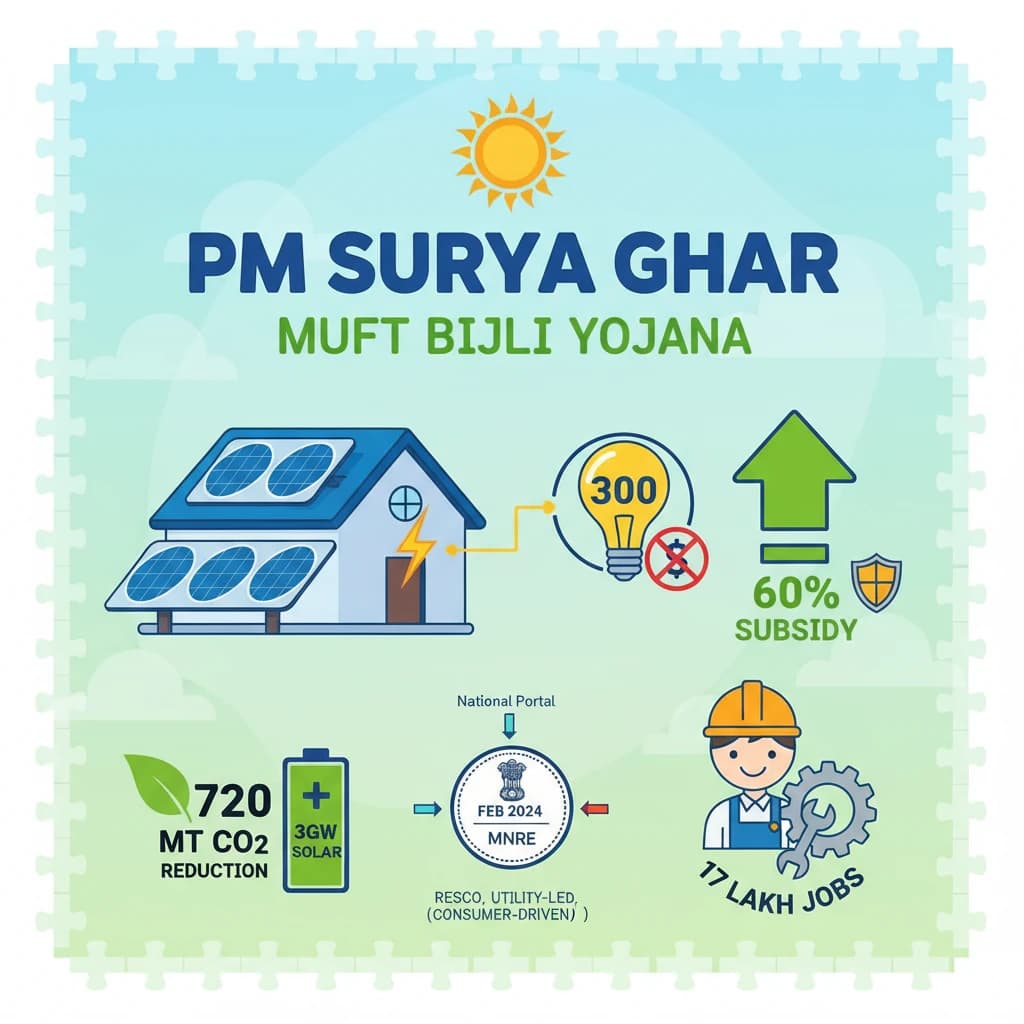
Memory Aid
98% Verified Content

📚 Reference Sources

•Ministry of New and Renewable Energy (MNRE) official announcements and guidelines (implied from source)

Related Topics

Loading related topics...
Explore:Polity And Governance Topics·All Subjects·Daily Current Affairs·Editorial Analysis·Previous Year Questions·UPSC GPT