Loading page, please wait…
Vaidra Logo
Vaidra

Top 4 items + smart groups

UPSC GPT
New
Current Affairs
Daily Solutions
Daily Puzzle
Mains Evaluator

Version 2.0.0 • Built with ❤️ for UPSC aspirants

Loading...
Loading...
Loading...
Loading...
Loading...
Loading...
Loading...
Loading...
Loading...
Loading...
Loading...
Loading...
Loading...

23rd Law Commission Set Up and History - UPSC Polity And Governance

What is 23rd Law Commission Set Up and History in UPSC Polity And Governance?

23rd Law Commission Set Up and History is a key topic under Polity And Governance for UPSC Civil Services Examination. Key points include: The 23rd Law Commission is a non-statutory, advisory body set for a 3-year term (2024-2027) by the Ministry of Law and Justice.. Its primary role is legal research, recommending repeal of obsolete laws, proposing new legislation, and advising on judicial administration.. The first Law Commission was established in 1834 under Lord Macaulay, leading to codification of IPC and CrPC.. Understanding this topic is essential for both UPSC Prelims and Mains preparation.

Why is 23rd Law Commission Set Up and History important for UPSC exam?

23rd Law Commission Set Up and History is a Medium-level topic in UPSC Polity And Governance. It is tested in both Prelims (factual MCQs) and Mains (analytical answer writing). Previous year UPSC questions have frequently covered aspects of 23rd Law Commission Set Up and History, making it essential for comprehensive IAS preparation.

How to prepare 23rd Law Commission Set Up and History for UPSC?

To prepare 23rd Law Commission Set Up and History for UPSC: (1) Study the comprehensive notes covering all key concepts on Vaidra. (2) Practice previous year questions on this topic. (3) Connect it with current affairs using daily updates. (4) Revise using key takeaways and mind maps available for Polity And Governance. (5) Write practice answers linking 23rd Law Commission Set Up and History to related GS Paper topics.

Key takeaways of 23rd Law Commission Set Up and History for UPSC

  • The 23rd Law Commission is a non-statutory, advisory body set for a 3-year term (2024-2027) by the Ministry of Law and Justice.
  • Its primary role is legal research, recommending repeal of obsolete laws, proposing new legislation, and advising on judicial administration.
  • The first Law Commission was established in 1834 under Lord Macaulay, leading to codification of IPC and CrPC.
  • Post-independence, the first Law Commission was set up in 1955 with M.C. Setalvad as Chairman.
  • The Commission's reports, like those on POCSO's age of consent or DNA profiling, significantly influence legal reforms and policy-making.
23rd Law Commission Set Up and History

23rd Law Commission Set Up and History

Medium⏱️ 8 min read✓ 95% Verified
polity and governance

📖 Introduction

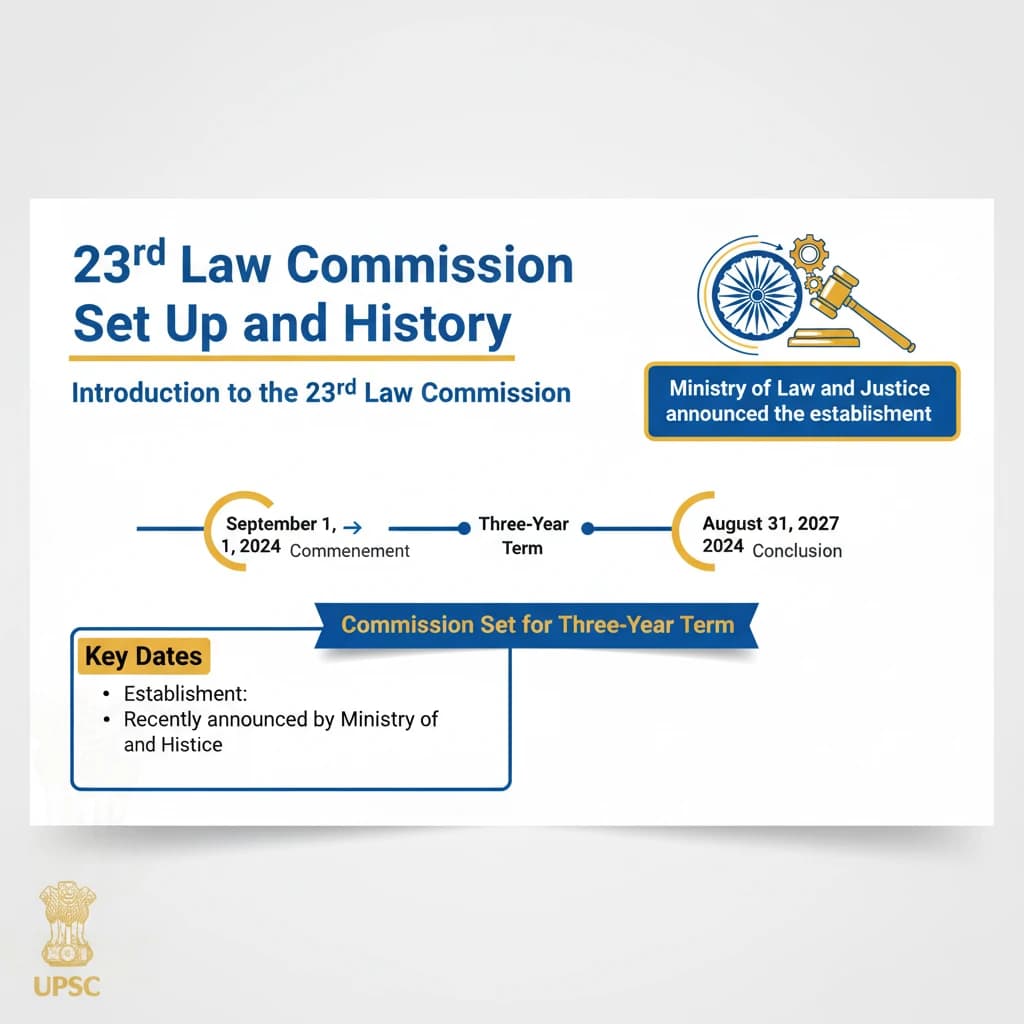
<h4>Introduction to the 23rd Law Commission</h4><p>The <strong>Ministry of Law and Justice</strong> recently announced the establishment of the <strong>23rd Law Commission</strong>. This commission is set for a <strong>three-year term</strong>, commencing from <strong>September 1, 2024</strong>, and concluding on <strong>August 31, 2027</strong>.</p><div class='info-box'><p><strong>Key Dates:</strong></p><ul><li><strong>Establishment:</strong> Recently announced by Ministry of Law and Justice</li><li><strong>Term Duration:</strong> 3 years</li><li><strong>Start Date:</strong> September 1, 2024</li><li><strong>End Date:</strong> August 31, 2027</li></ul></div><h4>Understanding the Law Commission of India</h4><p>The <strong>Law Commission of India</strong> is a significant body responsible for legal reforms. It operates as a <strong>non-statutory body</strong>, meaning it is not created by an Act of Parliament but rather through a <strong>notification</strong> from the Government of India.</p><div class='key-point-box'><p><strong>Nature of the Body:</strong></p><ul><li><strong>Non-statutory:</strong> Established by government notification, not by law.</li><li><strong>Advisory:</strong> Its recommendations are not binding on the government.</li><li><strong>Fixed Tenure:</strong> Appointed for a specific period, typically three years.</li></ul></div><h4>Core Functions of the Law Commission</h4><p>The primary role of the Law Commission is to undertake <strong>research in the field of law</strong> to facilitate legal reforms. This involves a wide array of responsibilities aimed at modernizing and improving the Indian legal system.</p><ul><li><strong>Review and Repeal of Obsolete Laws:</strong> It identifies and recommends the repeal of laws that are outdated, irrelevant, or have lost their utility in the current societal context.</li><li><strong>Law and Poverty:</strong> The Commission examines laws that have a significant impact on the poor and conducts post-audits of socio-economic legislation to assess their effectiveness and implications.</li><li><strong>Propose New Laws:</strong> It proposes new legislative frameworks to implement the <strong>Directive Principles of State Policy (DPSP)</strong> and achieve the objectives outlined in the <strong>Preamble to the Constitution of India</strong>.</li><li><strong>Judicial Administration:</strong> The Commission reviews and provides recommendations on various issues related to law and judicial administration, particularly those referred to it by the Government of India.</li></ul><div class='exam-tip-box'><p><strong>UPSC Insight:</strong> Understanding the <strong>non-statutory</strong> and <strong>advisory</strong> nature of the Law Commission is crucial. While its recommendations are not binding, they carry significant weight in legal policy-making and often influence legislative action. Mentioning specific functions can enhance your answers in <strong>GS Paper II (Polity and Governance)</strong>.</p></div><h4>Important Reports Submitted by the Law Commission</h4><p>Over its tenure, the Law Commission has submitted numerous reports addressing diverse legal issues. These reports often serve as foundational documents for legislative changes and policy reforms.</p><p>So far, the Law Commission of India has submitted <strong>289 reports</strong> on various critical issues. Some notable recent reports include:</p><ul><li><strong>Report No. 283 (September 2023):</strong> Focused on the <strong>Age of Consent</strong> under <strong>The Protection of Children From Sexual Offences Act, 2012 (POCSO Act)</strong>.</li><li><strong>Report No. 271 (July 2017):</strong> Dealt with the intricacies of <strong>Human DNA Profiling</strong>.</li><li><strong>Report No. 273 (October 2017):</strong> Addressed the <strong>Implementation of the United Nations Convention against Torture</strong> in India.</li><li><strong>Report No. 274 (April 2018):</strong> Provided a comprehensive <strong>Review of the Contempt of Courts Act, 1971</strong>.</li></ul>
Concept Diagram

💡 Key Takeaways

  • •The 23rd Law Commission is a non-statutory, advisory body set for a 3-year term (2024-2027) by the Ministry of Law and Justice.
  • •Its primary role is legal research, recommending repeal of obsolete laws, proposing new legislation, and advising on judicial administration.
  • •The first Law Commission was established in 1834 under Lord Macaulay, leading to codification of IPC and CrPC.
  • •Post-independence, the first Law Commission was set up in 1955 with M.C. Setalvad as Chairman.
  • •The Commission's reports, like those on POCSO's age of consent or DNA profiling, significantly influence legal reforms and policy-making.

🧠 Memory Techniques

Memory Aid
95% Verified Content

📚 Reference Sources

•Official website of the Law Commission of India (for cross-referencing report numbers and dates)

Related Topics

Loading related topics...
Explore:Polity And Governance Topics·All Subjects·Daily Current Affairs·Editorial Analysis·Previous Year Questions·UPSC GPT
Back
All Subjects

Topics

0 topics • 0 completed

Loading topics...
Loading...
Loading...
Loading...
Loading...
Loading...
Overall Progress0%
23rd Law Commission Set Up and History - UPSC Polity And Governance