Loading page, please wait…
Vaidra Logo
Vaidra

Top 4 items + smart groups

UPSC GPT
New
Current Affairs
Daily Solutions
Daily Puzzle
Mains Evaluator

Version 2.0.0 • Built with ❤️ for UPSC aspirants

Loading...
Loading...
Loading...
Loading...
Loading...
Loading...
Loading...
Loading...
Loading...
Loading...
Loading...
Loading...
Loading...
Atal Innovation Mission 2.0 - UPSC Polity And Governance
Back
All Subjects

Topics

0 topics • 0 completed

Loading topics...
Loading...
Loading...
Loading...
Loading...
Loading...
Overall Progress0%

Atal Innovation Mission 2.0 - UPSC Polity And Governance

What is Atal Innovation Mission 2.0 in UPSC Polity And Governance?

Atal Innovation Mission 2.0 is a key topic under Polity And Governance for UPSC Civil Services Examination. Key points include: AIM 2.0, with an enhanced budget of Rs. 2,750 crore, continues NITI Aayog's mission to strengthen India's innovation ecosystem until 2028.. It aims to scale successful programs like ATLs and AICs while introducing new initiatives.. Key programs include LIPI (vernacular innovation), Frontier Program (2500 new ATLs in underserved areas), and strategies for ecosystem improvement and output quality.. Understanding this topic is essential for both UPSC Prelims and Mains preparation.

Why is Atal Innovation Mission 2.0 important for UPSC exam?

Atal Innovation Mission 2.0 is a Medium-level topic in UPSC Polity And Governance. It is tested in both Prelims (factual MCQs) and Mains (analytical answer writing). Previous year UPSC questions have frequently covered aspects of Atal Innovation Mission 2.0, making it essential for comprehensive IAS preparation.

How to prepare Atal Innovation Mission 2.0 for UPSC?

To prepare Atal Innovation Mission 2.0 for UPSC: (1) Study the comprehensive notes covering all key concepts on Vaidra. (2) Practice previous year questions on this topic. (3) Connect it with current affairs using daily updates. (4) Revise using key takeaways and mind maps available for Polity And Governance. (5) Write practice answers linking Atal Innovation Mission 2.0 to related GS Paper topics.

Key takeaways of Atal Innovation Mission 2.0 for UPSC

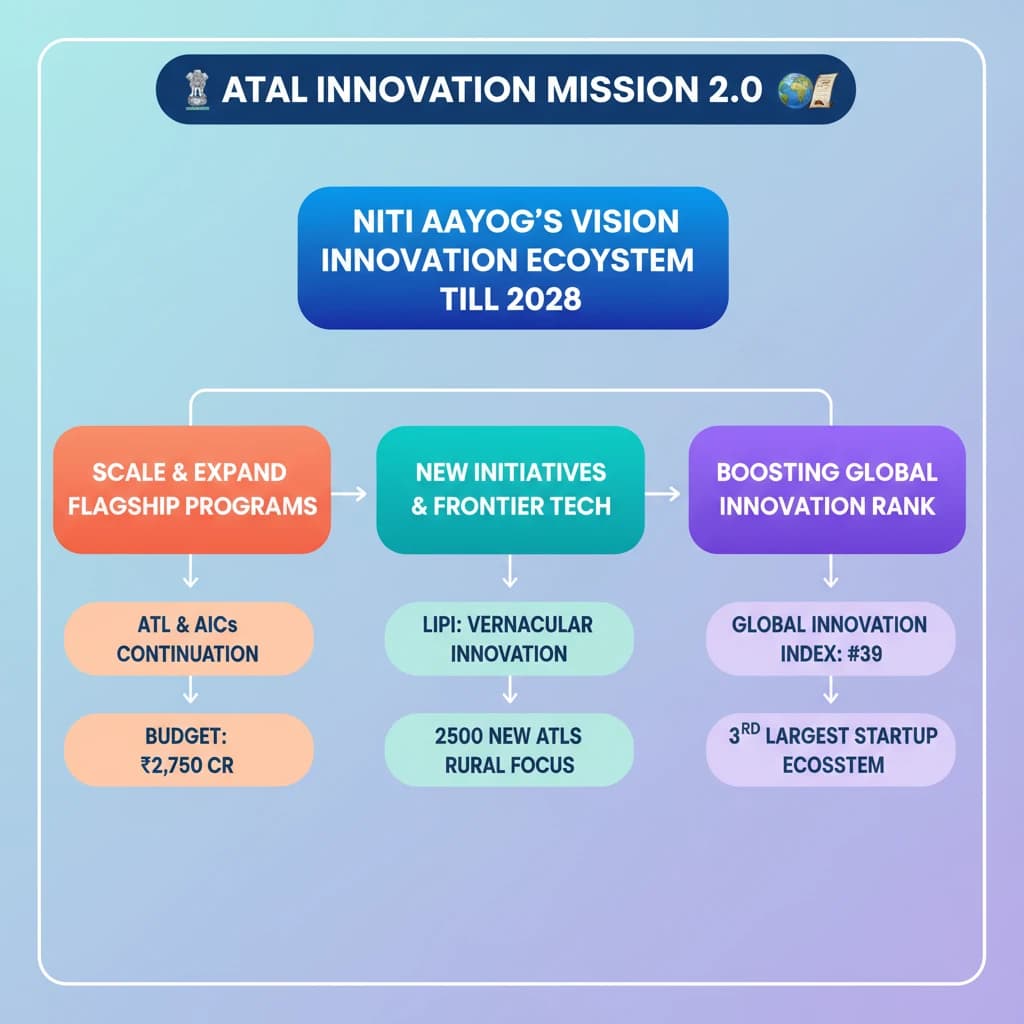
  • AIM 2.0, with an enhanced budget of Rs. 2,750 crore, continues NITI Aayog's mission to strengthen India's innovation ecosystem until 2028.
  • It aims to scale successful programs like ATLs and AICs while introducing new initiatives.
  • Key programs include LIPI (vernacular innovation), Frontier Program (2500 new ATLs in underserved areas), and strategies for ecosystem improvement and output quality.
  • India ranks 39th on the Global Innovation Index and boasts the world's third-largest startup ecosystem.
  • AIM, launched in 2016, fosters a problem-solving mindset in students and strengthens entrepreneurial support in institutions.
Atal Innovation Mission 2.0

Atal Innovation Mission 2.0

Medium⏱️ 10 min read✓ 95% Verified
polity and governance

📖 Introduction

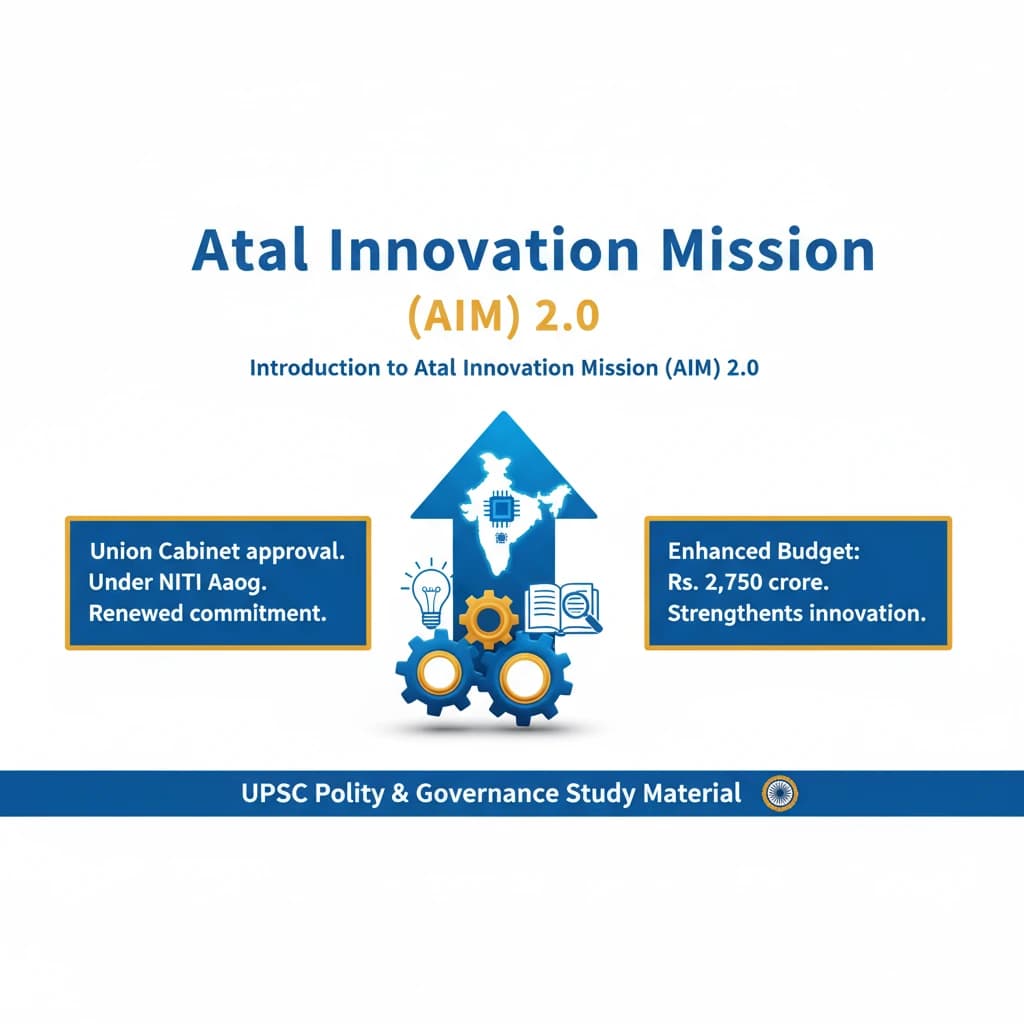
<h4>Introduction to Atal Innovation Mission (AIM) 2.0</h4><p>The <strong>Union Cabinet</strong> has recently approved the continuation of the <strong>Atal Innovation Mission (AIM)</strong> under <strong>NITI Aayog</strong>. This approval marks the launch of <strong>AIM 2.0</strong>, signifying a renewed commitment to fostering innovation.</p><p>An enhanced budget of <strong>Rs. 2,750 crore</strong> has been allocated for <strong>AIM 2.0</strong>. This substantial investment is designed to strengthen <strong>India's innovation ecosystem</strong> until <strong>2028</strong>, ensuring long-term growth and development.</p><h4>What is AIM 2.0?</h4><p><strong>AIM 2.0</strong> builds upon the significant successes of the original <strong>AIM</strong>, which established programs like <strong>Atal Tinkering Labs (ATLs)</strong> and <strong>Atal Incubation Centers (AICs)</strong> across the country.</p><p>The primary goal of <strong>AIM 2.0</strong> is to scale up existing initiatives and pilot new programs. It aims to expand and deepen <strong>India's innovation and entrepreneurship ecosystem</strong>, reaching more individuals and sectors.</p><div class='info-box'><p><strong>India's Innovation Landscape:</strong></p><ul><li>Ranked <strong>39th</strong> on the <strong>Global Innovation Index</strong>.</li><li>Home to the world's <strong>third-largest start-up ecosystem</strong>.</li></ul></div><h4>Key Programs Under AIM 2.0</h4><p><strong>AIM 2.0</strong> introduces several strategic programs designed to address various aspects of the innovation lifecycle, from grassroots creativity to advanced startup scaling.</p><h5>Language Inclusive Program of Innovation (LIPI)</h5><p>The <strong>LIPI</strong> initiative aims to establish <strong>vernacular innovation centers</strong> across the nation. These centers will operate in <strong>22 scheduled languages</strong>.</p><p>The program's objective is to support and empower <strong>non-English-speaking innovators</strong>, ensuring that language is not a barrier to participation in the innovation ecosystem.</p><h5>Frontier Program</h5><p>The <strong>Frontier Program</strong> focuses on expanding the reach of <strong>Atal Tinkering Labs (ATLs)</strong>. It plans to create <strong>2500 new ATLs</strong> in underserved regions.</p><p>Key target areas include <strong>Jammu and Kashmir</strong>, the <strong>North Eastern states</strong>, and various <strong>Aspirational Districts</strong>, promoting innovation where it is most needed.</p><h5>Programs Targeting Improving Ecosystem</h5><p>This category includes initiatives aimed at strengthening the foundational elements of the innovation ecosystem.</p><ul><li><strong>Professional Training:</strong> It involves training professionals such as managers, teachers, and trainers essential for supporting the innovation ecosystem.</li><li><strong>Research Sandbox:</strong> Creation of a dedicated <strong>research sandbox</strong> for commercializing <strong>deep tech startups</strong>, which often require longer investment cycles.</li><li><strong>State-Level Support:</strong> Strengthening state-level innovation ecosystems through <strong>NITI Aayog's State Support Mission</strong>.</li><li><strong>Global Expansion:</strong> Expanding <strong>India's innovation ecosystem globally</strong> through engagements with advanced nations, the <strong>Global Tinkering Olympiad</strong>, and partnerships with <strong>United Nations World Intellectual Property Organization (WIPO)</strong> and <strong>G20</strong>.</li></ul><h5>Programs Targeting Improved Output Quality</h5><p>These programs are designed to enhance the quality and impact of innovative outputs, particularly from startups.</p><ul><li><strong>Industrial Accelerator Program:</strong> Aims to scale up advanced startups by creating <strong>10 accelerators</strong> in critical sectors through <strong>Public-Private Partnerships (PPP)</strong>.</li><li><strong>Atal Sectoral Innovation Launchpads (ASIL):</strong> Will establish <strong>10 IDEX-like platforms</strong> across central ministries. These platforms will integrate and procure from startups in key industry sectors, fostering direct government support and market access.</li></ul><div class='exam-tip-box'><p><strong>UPSC Insight:</strong> Understanding the specific programs under <strong>AIM 2.0</strong> and their target beneficiaries is crucial for Mains answers (<strong>GS-II, GS-III</strong>). Focus on the 'why' and 'how' each program contributes to national development.</p></div>
Concept Diagram

💡 Key Takeaways

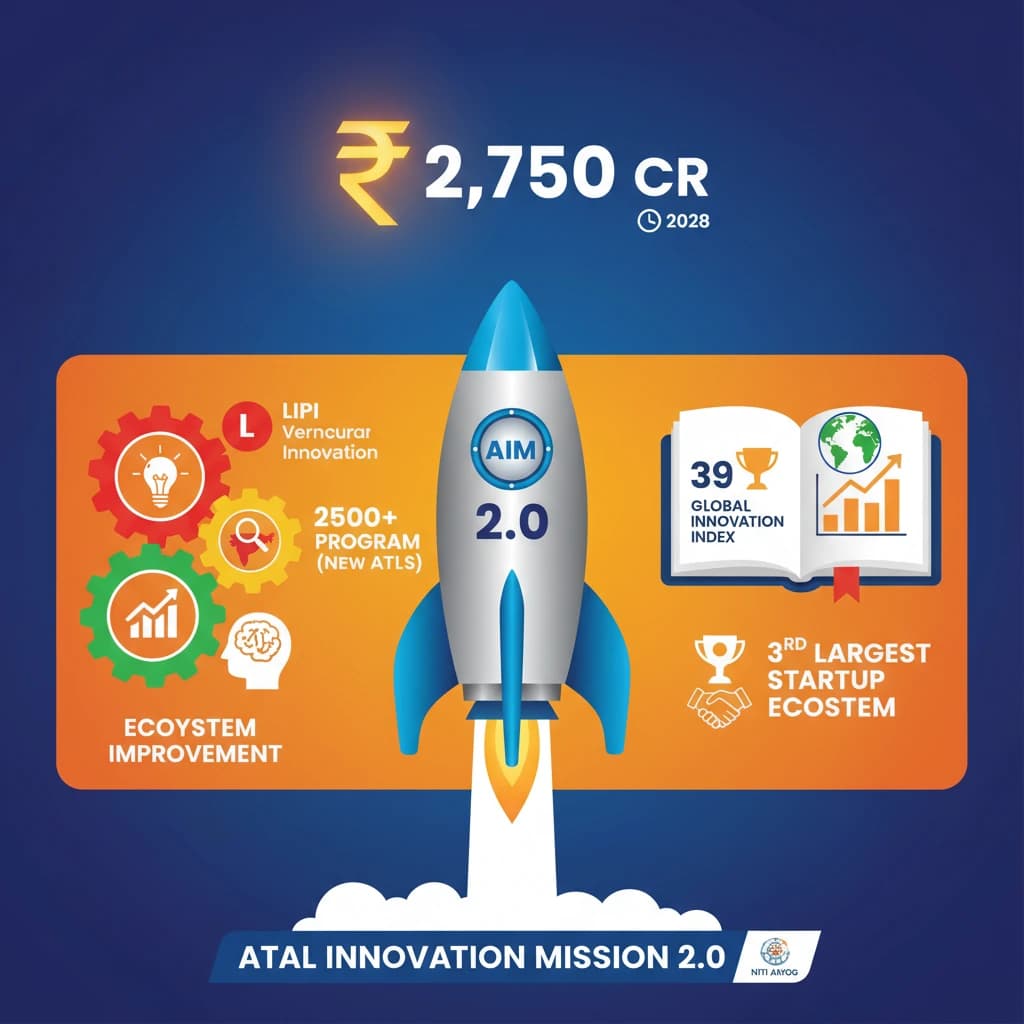
  • •AIM 2.0, with an enhanced budget of Rs. 2,750 crore, continues NITI Aayog's mission to strengthen India's innovation ecosystem until 2028.
  • •It aims to scale successful programs like ATLs and AICs while introducing new initiatives.
  • •Key programs include LIPI (vernacular innovation), Frontier Program (2500 new ATLs in underserved areas), and strategies for ecosystem improvement and output quality.
  • •India ranks 39th on the Global Innovation Index and boasts the world's third-largest startup ecosystem.
  • •AIM, launched in 2016, fosters a problem-solving mindset in students and strengthens entrepreneurial support in institutions.

🧠 Memory Techniques
Memory Aid
95% Verified Content

Related Topics

Loading related topics...
Explore:Polity And Governance Topics·All Subjects·Daily Current Affairs·Editorial Analysis·Previous Year Questions·UPSC GPT