Loading page, please wait…
Vaidra Logo
Vaidra

Top 4 items + smart groups

UPSC GPT
New
Current Affairs
Daily Solutions
Daily Puzzle
Mains Evaluator

Version 2.0.0 • Built with ❤️ for UPSC aspirants

Loading...
Loading...
Loading...
Loading...
Loading...
Loading...
Loading...
Loading...
Loading...
Loading...
Loading...
Loading...
Loading...
Supreme Court Unveils New Justice Statue - UPSC Polity And Governance
Back
All Subjects

Topics

0 topics • 0 completed

Loading topics...
Loading...
Loading...
Loading...
Loading...
Loading...
Overall Progress0%

Supreme Court Unveils New Justice Statue - UPSC Polity And Governance

What is Supreme Court Unveils New Justice Statue in UPSC Polity And Governance?

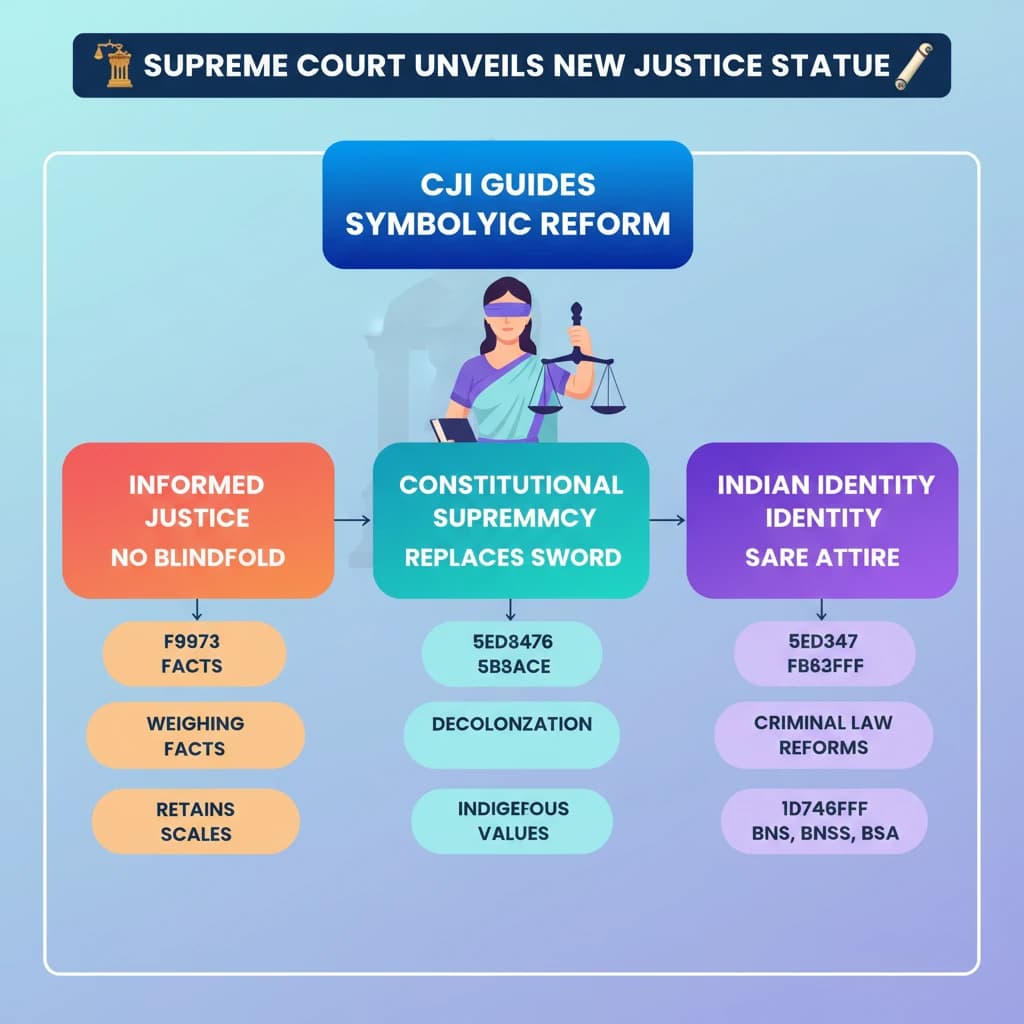
Supreme Court Unveils New Justice Statue is a key topic under Polity And Governance for UPSC Civil Services Examination. Key points include: Supreme Court unveiled a new Lady Justice statue, directed by the CJI.. Key changes: No blindfold (informed justice), Constitution replaces sword (constitutional supremacy), saree attire (Indian identity).. Scales of justice retained, symbolizing balance and weighing facts.. Understanding this topic is essential for both UPSC Prelims and Mains preparation.

Why is Supreme Court Unveils New Justice Statue important for UPSC exam?

Supreme Court Unveils New Justice Statue is a Medium-level topic in UPSC Polity And Governance. It is tested in both Prelims (factual MCQs) and Mains (analytical answer writing). Previous year UPSC questions have frequently covered aspects of Supreme Court Unveils New Justice Statue, making it essential for comprehensive IAS preparation.

How to prepare Supreme Court Unveils New Justice Statue for UPSC?

To prepare Supreme Court Unveils New Justice Statue for UPSC: (1) Study the comprehensive notes covering all key concepts on Vaidra. (2) Practice previous year questions on this topic. (3) Connect it with current affairs using daily updates. (4) Revise using key takeaways and mind maps available for Polity And Governance. (5) Write practice answers linking Supreme Court Unveils New Justice Statue to related GS Paper topics.

Key takeaways of Supreme Court Unveils New Justice Statue for UPSC

  • Supreme Court unveiled a new Lady Justice statue, directed by the CJI.
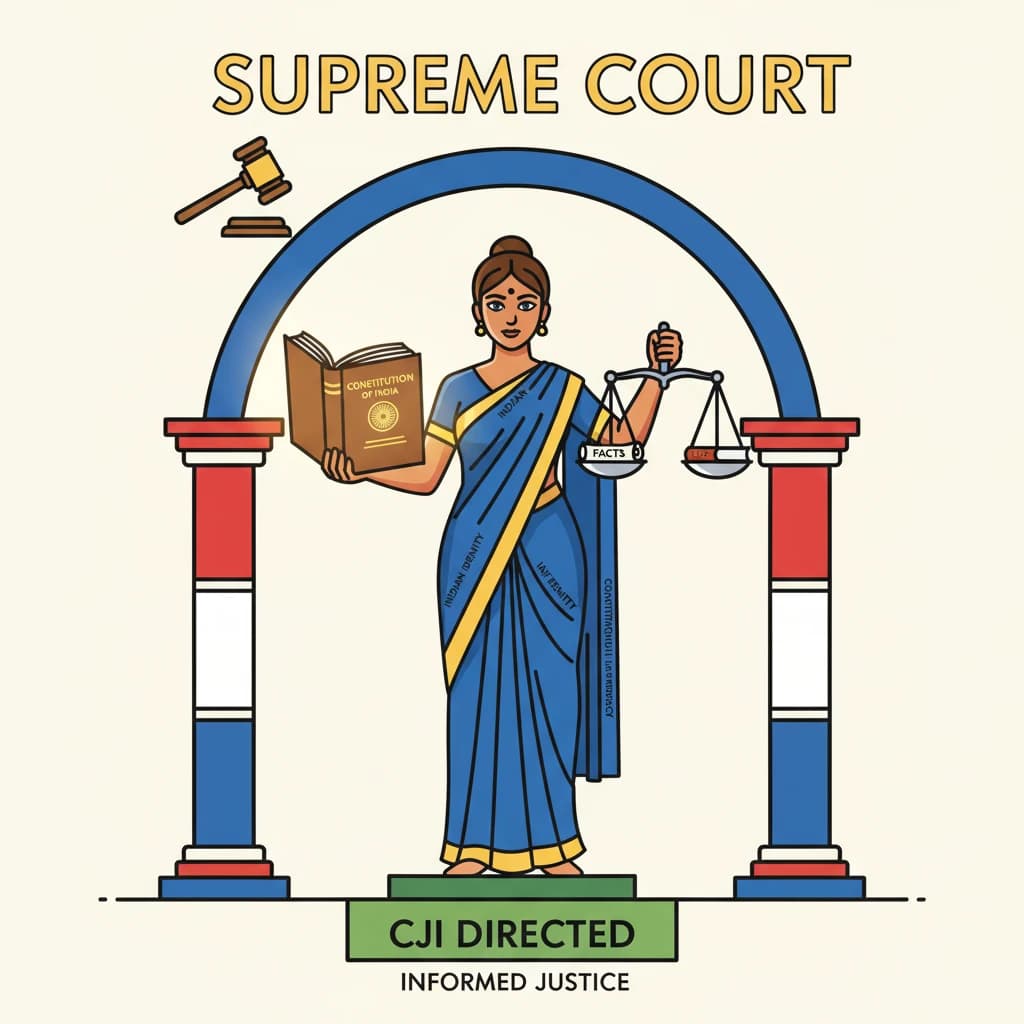
  • Key changes: No blindfold (informed justice), Constitution replaces sword (constitutional supremacy), saree attire (Indian identity).
  • Scales of justice retained, symbolizing balance and weighing facts.
  • The changes reflect a move away from colonial influences towards indigenous, constitutional values.
  • This symbolic reform aligns with broader legislative changes like the new criminal laws (BNS, BNSS, BSA).
Supreme Court Unveils New Justice Statue

Supreme Court Unveils New Justice Statue

Medium⏱️ 5 min read✓ 95% Verified
polity and governance

📖 Introduction

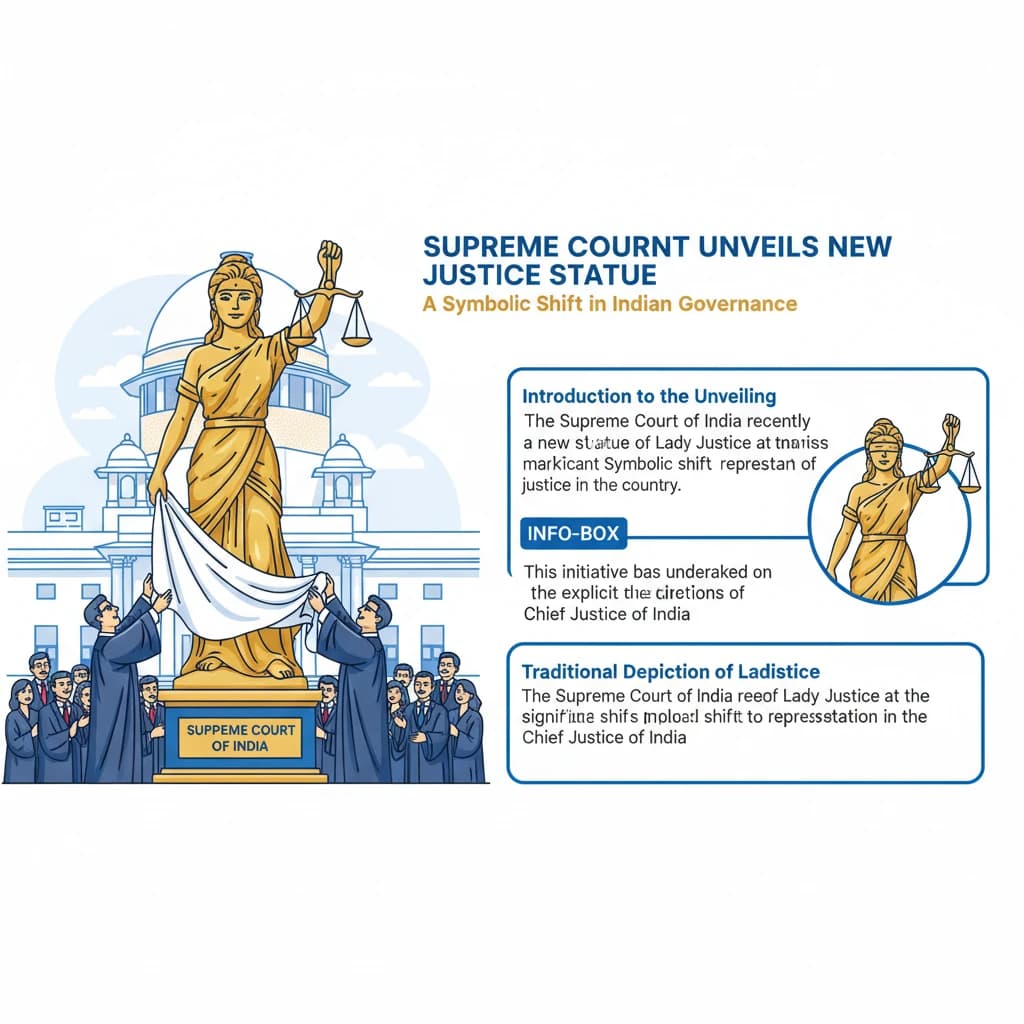
<h4>Introduction to the Unveiling</h4><p>The <strong>Supreme Court of India</strong> recently unveiled a new statue of <strong>Lady Justice</strong> at its premises, marking a significant symbolic shift in the representation of justice in the country.</p><div class="info-box"><p>This initiative was undertaken on the explicit <strong>directions of the Chief Justice of India</strong>, highlighting its institutional importance.</p></div><h4>Traditional Depiction of Lady Justice</h4><p><strong>Lady Justice</strong> is an internationally recognized <strong>allegorical figure</strong> representing the <strong>moral authority</strong> within judicial systems.</p><p>She is often depicted alongside <strong>Prudentia</strong>, another allegorical figure embodying <strong>wisdom</strong> and <strong>prudence</strong>, signifying the thoughtful application of law.</p><ul><li><strong>Blindfold:</strong> Traditionally, the blindfold symbolized <strong>equality before the law</strong>, ensuring justice is delivered impartially, irrespective of wealth, power, or status.</li><li><strong>Sword:</strong> Historically, the sword represented the <strong>authority of the law</strong> and its inherent power to punish wrongdoing and enforce decisions.</li></ul><h4>Key Changes in the New Statue</h4><p>The newly unveiled statue at the <strong>Supreme Court</strong> introduces several profound departures from the conventional portrayal of Lady Justice.</p><ul><li><strong>Absence of Blindfold:</strong> This significant change signifies that <strong>law in India is informed</strong>. It implies that justice should consider context and not be applied blindly, emphasizing a nuanced understanding.</li><li><strong>Constitution in Place of Sword:</strong> Instead of a sword, the statue holds the <strong>Constitution of India</strong>. This symbolizes that justice is guided by the nation's foundational legal document and is <strong>not driven by retribution</strong> alone.</li><li><strong>Dressed in a Saree:</strong> The statue is draped in a <strong>saree</strong>, reflecting a conscious departure from colonial influences and embracing an indigenous cultural identity.</li></ul><h4>Retained Symbolism: The Scales of Justice</h4><p>Despite the notable modifications, one crucial element of the traditional depiction has been retained: the <strong>scales of justice</strong>.</p><div class="key-point-box"><p>The scales, held in <strong>Lady Justice's right hand</strong>, continue to represent <strong>societal balance</strong> and the critical importance of carefully weighing all facts and arguments from opposing sides before reaching a verdict.</p></div><h4>Symbolic Significance and Decolonization</h4><p>The changes in the statue are deeply symbolic of a broader national effort to decolonize India's legal and institutional framework.</p><div class="exam-tip-box"><p>This move parallels the recent replacement of <strong>colonial-era laws</strong> such as the <strong>Indian Penal Code (IPC)</strong> and the <strong>Code of Criminal Procedure (CrPC)</strong> with new, indigenously named criminal laws. It highlights a shift towards a legal identity rooted in Indian values. <strong>(UPSC GS Paper II: Polity & Governance)</strong></p></div>
Concept Diagram

💡 Key Takeaways

  • •Supreme Court unveiled a new Lady Justice statue, directed by the CJI.
  • •Key changes: No blindfold (informed justice), Constitution replaces sword (constitutional supremacy), saree attire (Indian identity).
  • •Scales of justice retained, symbolizing balance and weighing facts.
  • •The changes reflect a move away from colonial influences towards indigenous, constitutional values.
  • •This symbolic reform aligns with broader legislative changes like the new criminal laws (BNS, BNSS, BSA).

🧠 Memory Techniques
Memory Aid
95% Verified Content

📚 Reference Sources

•Reports from leading Indian news agencies on the unveiling (e.g., PTI, The Hindu, Indian Express)
•Official notifications/press releases from the Ministry of Law and Justice regarding new criminal laws (BNS, BNSS, BSA)

Related Topics

Loading related topics...
Explore:Polity And Governance Topics·All Subjects·Daily Current Affairs·Editorial Analysis·Previous Year Questions·UPSC GPT