Loading page, please wait…
Vaidra Logo
Vaidra

Top 4 items + smart groups

UPSC GPT
New
Current Affairs
Daily Solutions
Daily Puzzle
Mains Evaluator

Version 2.0.0 • Built with ❤️ for UPSC aspirants

Loading...
Loading...
Loading...
Loading...
Loading...
Loading...
Loading...
Loading...
Loading...
Loading...
Loading...
Loading...
Loading...
Back
All Subjects

Topics

0 topics • 0 completed

Loading topics...
Loading...
Loading...
Loading...
Loading...
Loading...
Overall Progress0%

CIC Jurisdiction over MPLADS Funds - UPSC Polity And Governance

What is CIC Jurisdiction over MPLADS Funds in UPSC Polity And Governance?

CIC Jurisdiction over MPLADS Funds is a key topic under Polity And Governance for UPSC Civil Services Examination. Key points include: Delhi High Court ruled that CIC has no jurisdiction over MPLADS fund utilization.. MPLADS is a Central Sector Scheme, launched in 1993, for local asset creation.. MPs recommend developmental works in areas like water, education, health, and roads.. Understanding this topic is essential for both UPSC Prelims and Mains preparation.

Why is CIC Jurisdiction over MPLADS Funds important for UPSC exam?

CIC Jurisdiction over MPLADS Funds is a Medium-level topic in UPSC Polity And Governance. It is tested in both Prelims (factual MCQs) and Mains (analytical answer writing). Previous year UPSC questions have frequently covered aspects of CIC Jurisdiction over MPLADS Funds, making it essential for comprehensive IAS preparation.

How to prepare CIC Jurisdiction over MPLADS Funds for UPSC?

To prepare CIC Jurisdiction over MPLADS Funds for UPSC: (1) Study the comprehensive notes covering all key concepts on Vaidra. (2) Practice previous year questions on this topic. (3) Connect it with current affairs using daily updates. (4) Revise using key takeaways and mind maps available for Polity And Governance. (5) Write practice answers linking CIC Jurisdiction over MPLADS Funds to related GS Paper topics.

Key takeaways of CIC Jurisdiction over MPLADS Funds for UPSC

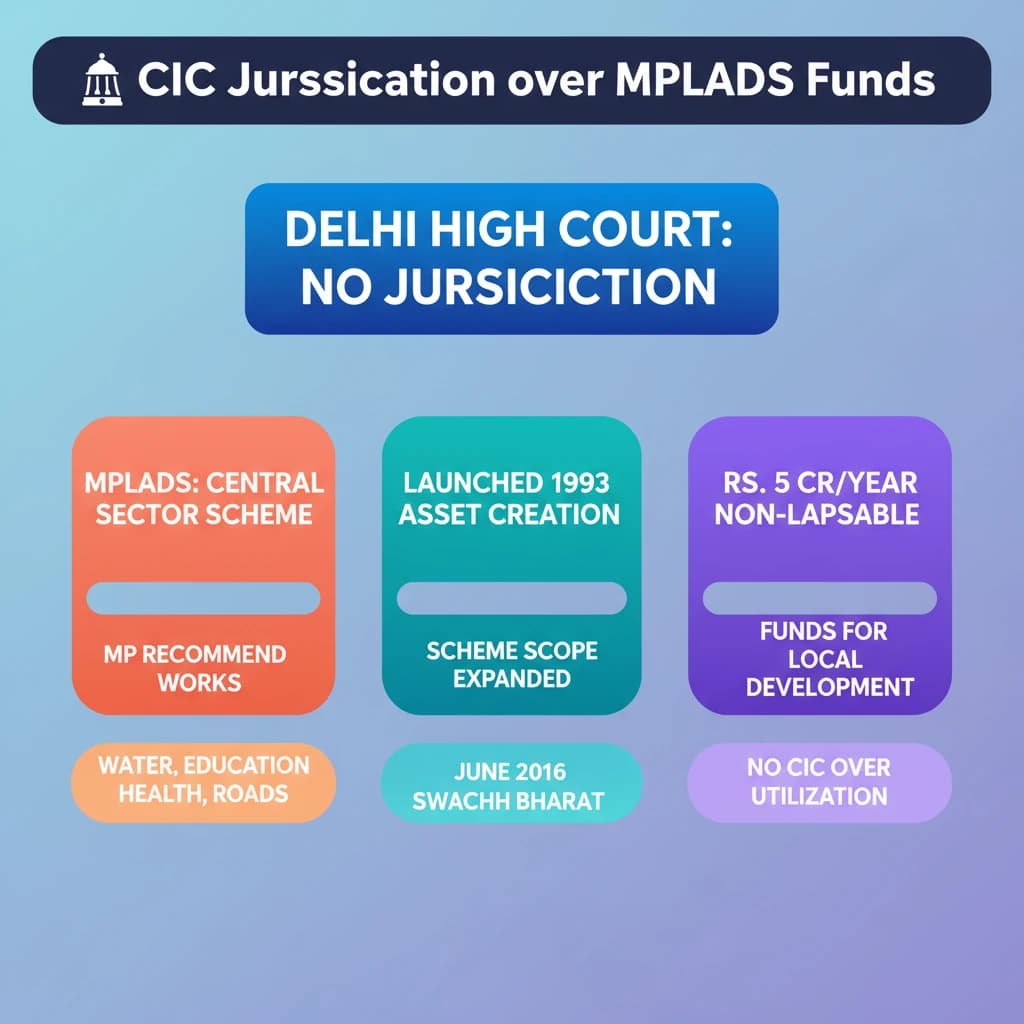
  • Delhi High Court ruled that CIC has no jurisdiction over MPLADS fund utilization.
  • MPLADS is a Central Sector Scheme, launched in 1993, for local asset creation.
  • MPs recommend developmental works in areas like water, education, health, and roads.
  • Scheme scope expanded in June 2016 to include national campaigns like Swachh Bharat Abhiyan.
  • Each MP receives Rs. 5 crore annually (non-lapsable funds).
  • The scheme lacks statutory backing, making it susceptible to arbitrary changes.
  • Criticized by NCRWC (2002) and 2nd ARC (2007) for violating division of powers and encroaching on local bodies.
CIC Jurisdiction over MPLADS Funds

CIC Jurisdiction over MPLADS Funds

Medium⏱️ 7 min read✓ 98% Verified
polity and governance

📖 Introduction

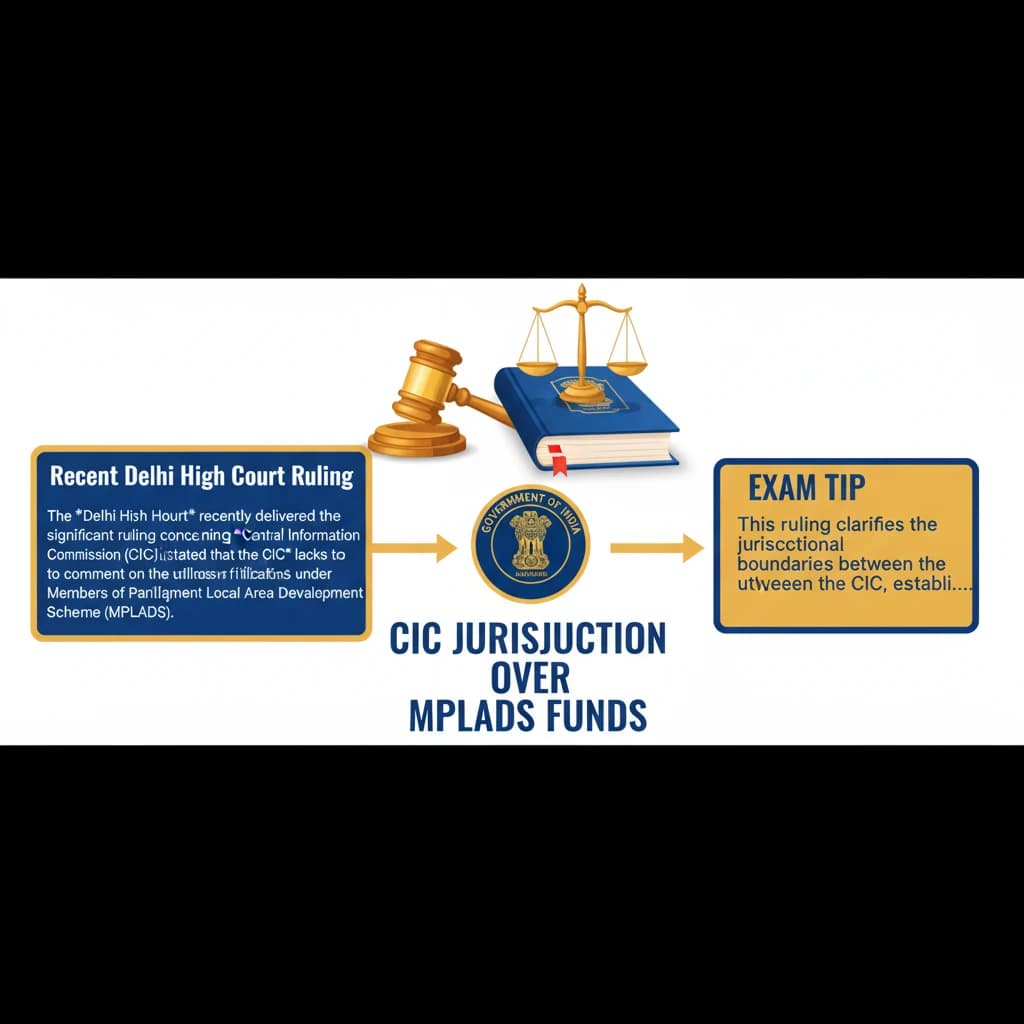
<h4>Recent Delhi High Court Ruling</h4><p>The <strong>Delhi High Court</strong> recently delivered a significant ruling concerning the <strong>Central Information Commission (CIC)</strong>. It stated that the <strong>CIC</strong> lacks the authority to comment on the utilization of funds under the <strong>Members of Parliament Local Area Development Scheme (MPLADS)</strong>.</p><div class='exam-tip-box'>This ruling clarifies the jurisdictional boundaries between the <strong>CIC</strong>, established under the <strong>Right to Information (RTI) Act</strong>, and the executive functions related to <strong>MPLADS funds</strong>. Understanding this distinction is crucial for <strong>UPSC Mains GS-II</strong>.</div><h4>What is MPLADS?</h4><p>The <strong>Members of Parliament Local Area Development Scheme (MPLADS)</strong> is a <strong>Central Sector Scheme</strong>. It was officially announced in <strong>1993</strong> with the aim of enabling Members of Parliament to initiate developmental works in their constituencies.</p><div class='info-box'><strong>Central Sector Scheme:</strong> A scheme fully funded and implemented by the <strong>Central Government</strong> agencies.</div><h4>Objectives of MPLADS</h4><p>The primary objective of <strong>MPLADS</strong> is to empower <strong>MPs</strong> to recommend works that are developmental in nature. These works focus on creating <strong>durable community assets</strong> within their constituencies.</p><p>Key areas of focus include <strong>drinking water</strong>, <strong>primary education</strong>, <strong>public health</strong>, <strong>sanitation</strong>, and <strong>roads</strong>. These initiatives directly benefit local communities.</p><p>Since <strong>June 2016</strong>, the scope of <strong>MPLADS funds</strong> was expanded. Funds can now be utilized for implementing schemes like <strong>Swachh Bharat Abhiyan</strong>, <strong>Accessible India Campaign (Sugamya Bharat Abhiyan)</strong>, <strong>water conservation through rainwater harvesting</strong>, and <strong>Sansad Adarsh Gram Yojana</strong>.</p><h4>Implementation Mechanism</h4><p>The implementation process for <strong>MPLADS</strong> begins with <strong>Members of Parliament (MPs)</strong>. They recommend specific works to the designated <strong>Nodal District Authority</strong>.</p><p>The <strong>Nodal District Authority</strong> holds the responsibility for executing these eligible works. They also maintain detailed records of all individual projects undertaken and the corresponding expenditure under the scheme.</p><h4>Funding and Recommendation Guidelines</h4><p>Under <strong>MPLADS</strong>, each <strong>MP</strong> receives <strong>Rs. 5 crore annually</strong>. This amount is disbursed in two equal installments of <strong>Rs. 2.5 crore each</strong>.</p><div class='key-point-box'>A significant feature of <strong>MPLADS funds</strong> is that they are <strong>non-lapsable</strong>. This means any unspent amount from a previous year is carried forward to the next year.</div><p><strong>Lok Sabha MPs</strong> are required to recommend projects within their respective <strong>Lok Sabha constituencies</strong>. This ensures development is focused on their electoral area.</p><p><strong>Rajya Sabha MPs</strong>, on the other hand, must recommend works in the state from which they were elected to the Upper House. This provides flexibility for state-level development.</p><p><strong>Nominated Members</strong> of both the <strong>Rajya Sabha</strong> and <strong>Lok Sabha</strong> have the unique privilege of recommending works anywhere across the country. This broadens their impact potential.</p><h4>Lack of Statutory Backing</h4><p>A critical aspect of the <strong>MPLAD Scheme</strong> is its lack of <strong>statutory backing</strong>. It is not governed by any specific law passed by Parliament.</p><p>This absence of a legal framework makes the scheme vulnerable to <strong>arbitrary changes</strong> by the government in power. It can lead to inconsistencies in its operation and objectives.</p><h4>Criticism and Recommendations for Termination</h4><p>The <strong>MPLADS scheme</strong> has faced significant criticism from various authoritative bodies. Both the <strong>National Commission to Review the Working of the Constitution (2002)</strong> and the <strong>2nd Administrative Reforms Commission (2007)</strong> recommended its termination.</p><div class='info-box'><strong>National Commission to Review the Working of the Constitution (NCRWC):</strong> Chaired by <strong>Justice M.N. Venkatachaliah</strong>, it submitted its report in <strong>2002</strong>.</div><div class='info-box'><strong>2nd Administrative Reforms Commission (ARC):</strong> Chaired by <strong>Veerappa Moily</strong>, it submitted its report in <strong>2007</strong>.</div><p>Their primary argument against the scheme centers on its perceived <strong>incompatibility with the division of power</strong>. They argue that it blurs the lines between the responsibilities of the <strong>central government</strong> and <strong>state governments</strong>, encroaching upon the domain of local bodies and state legislatures.
Concept Diagram

💡 Key Takeaways

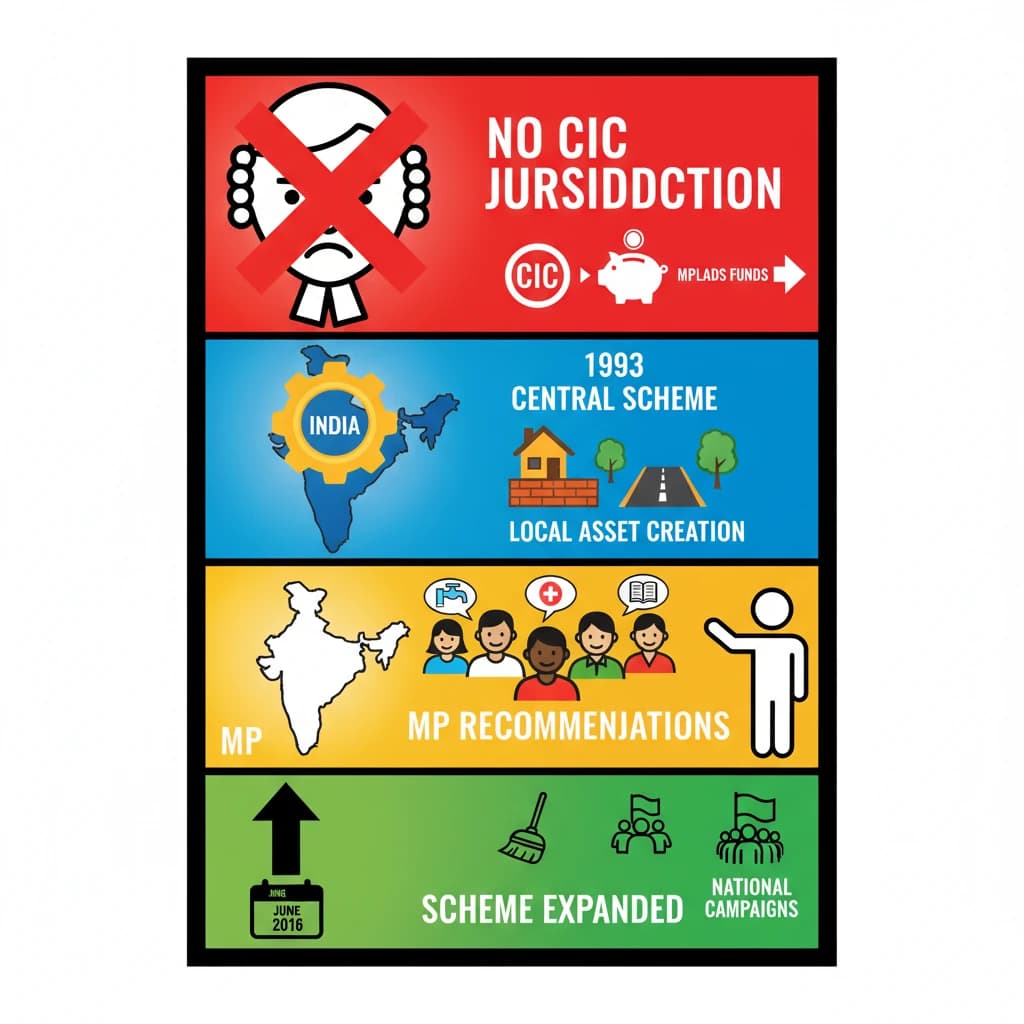
  • •Delhi High Court ruled that CIC has no jurisdiction over MPLADS fund utilization.
  • •MPLADS is a Central Sector Scheme, launched in 1993, for local asset creation.
  • •MPs recommend developmental works in areas like water, education, health, and roads.
  • •Scheme scope expanded in June 2016 to include national campaigns like Swachh Bharat Abhiyan.
  • •Each MP receives Rs. 5 crore annually (non-lapsable funds).
  • •The scheme lacks statutory backing, making it susceptible to arbitrary changes.
  • •Criticized by NCRWC (2002) and 2nd ARC (2007) for violating division of powers and encroaching on local bodies.

🧠 Memory Techniques
Memory Aid
98% Verified Content

📚 Reference Sources

•Ministry of Statistics and Programme Implementation (MoSPI) - Guidelines on MPLADS Scheme
•Reports of the National Commission to Review the Working of the Constitution (2002)
•Reports of the 2nd Administrative Reforms Commission (2007)
•News reports and legal analyses regarding the Delhi High Court ruling

Related Topics

Loading related topics...
Explore:Polity And Governance Topics·All Subjects·Daily Current Affairs·Editorial Analysis·Previous Year Questions·UPSC GPT
CIC Jurisdiction over MPLADS Funds - UPSC Polity And Governance