Loading page, please wait…
Vaidra Logo
Vaidra

Top 4 items + smart groups

UPSC GPT
New
Current Affairs
Daily Solutions
Daily Puzzle
Mains Evaluator

Version 2.0.0 • Built with ❤️ for UPSC aspirants

Loading...
Loading...
Loading...
Loading...
Loading...
Loading...
Loading...
Loading...
Loading...
Loading...
Loading...
Loading...
Loading...
Back
All Subjects

Topics

0 topics • 0 completed

Loading topics...
Loading...
Loading...
Loading...
Loading...
Loading...
Overall Progress0%

Nazol Land: Definition, Usage, and Recent Haldwani Demolition Drive - UPSC Polity And Governance

What is Nazol Land: Definition, Usage, and Recent Haldwani Demolition Drive in UPSC Polity And Governance?

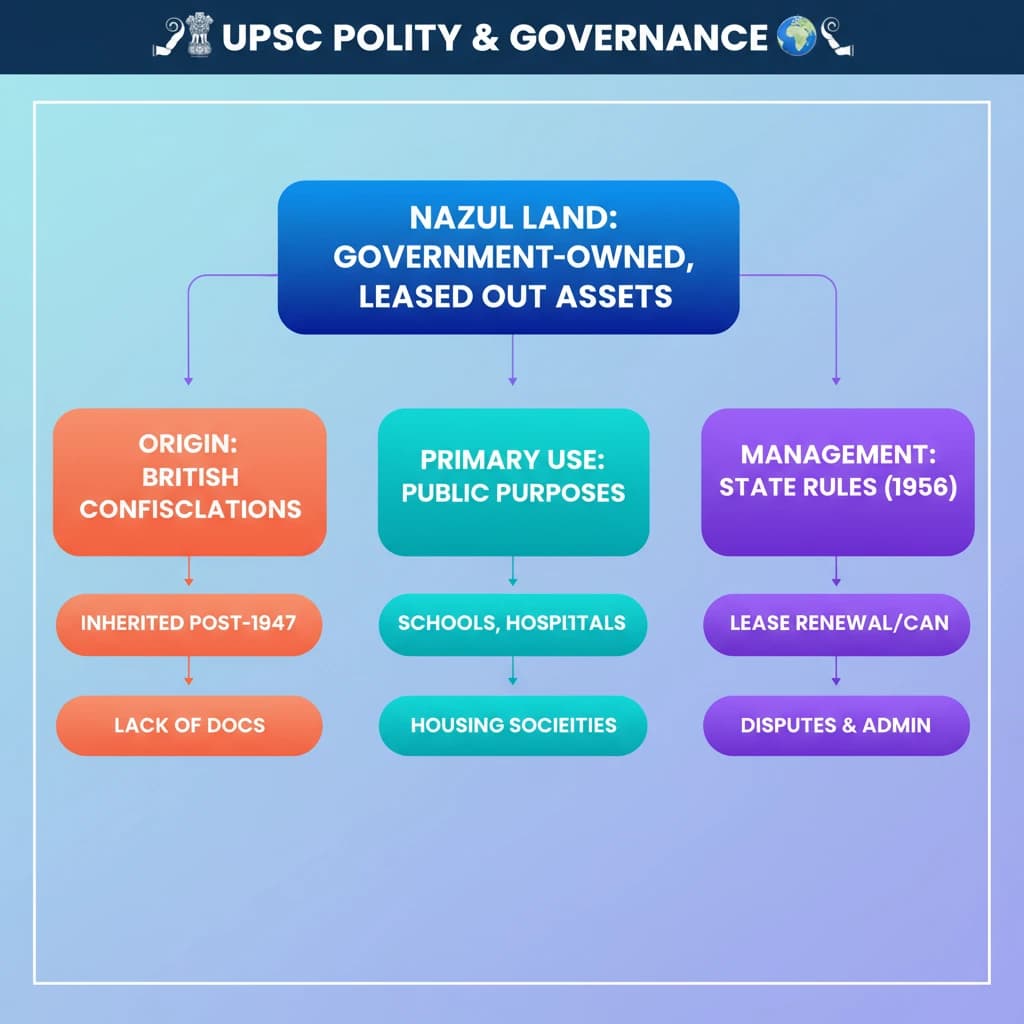
Nazol Land: Definition, Usage, and Recent Haldwani Demolition Drive is a key topic under Polity And Governance for UPSC Civil Services Examination. Key points include: Nazol land is government-owned but typically leased out, not directly administered.. It originated from lands confiscated by the British, inherited by states post-1947 due to lack of prior documentation.. Primarily used for public purposes like schools, hospitals, and housing societies on lease.. Understanding this topic is essential for both UPSC Prelims and Mains preparation.

Why is Nazol Land: Definition, Usage, and Recent Haldwani Demolition Drive important for UPSC exam?

Nazol Land: Definition, Usage, and Recent Haldwani Demolition Drive is a Medium-level topic in UPSC Polity And Governance. It is tested in both Prelims (factual MCQs) and Mains (analytical answer writing). Previous year UPSC questions have frequently covered aspects of Nazol Land: Definition, Usage, and Recent Haldwani Demolition Drive, making it essential for comprehensive IAS preparation.

How to prepare Nazol Land: Definition, Usage, and Recent Haldwani Demolition Drive for UPSC?

To prepare Nazol Land: Definition, Usage, and Recent Haldwani Demolition Drive for UPSC: (1) Study the comprehensive notes covering all key concepts on Vaidra. (2) Practice previous year questions on this topic. (3) Connect it with current affairs using daily updates. (4) Revise using key takeaways and mind maps available for Polity And Governance. (5) Write practice answers linking Nazol Land: Definition, Usage, and Recent Haldwani Demolition Drive to related GS Paper topics.

Key takeaways of Nazol Land: Definition, Usage, and Recent Haldwani Demolition Drive for UPSC

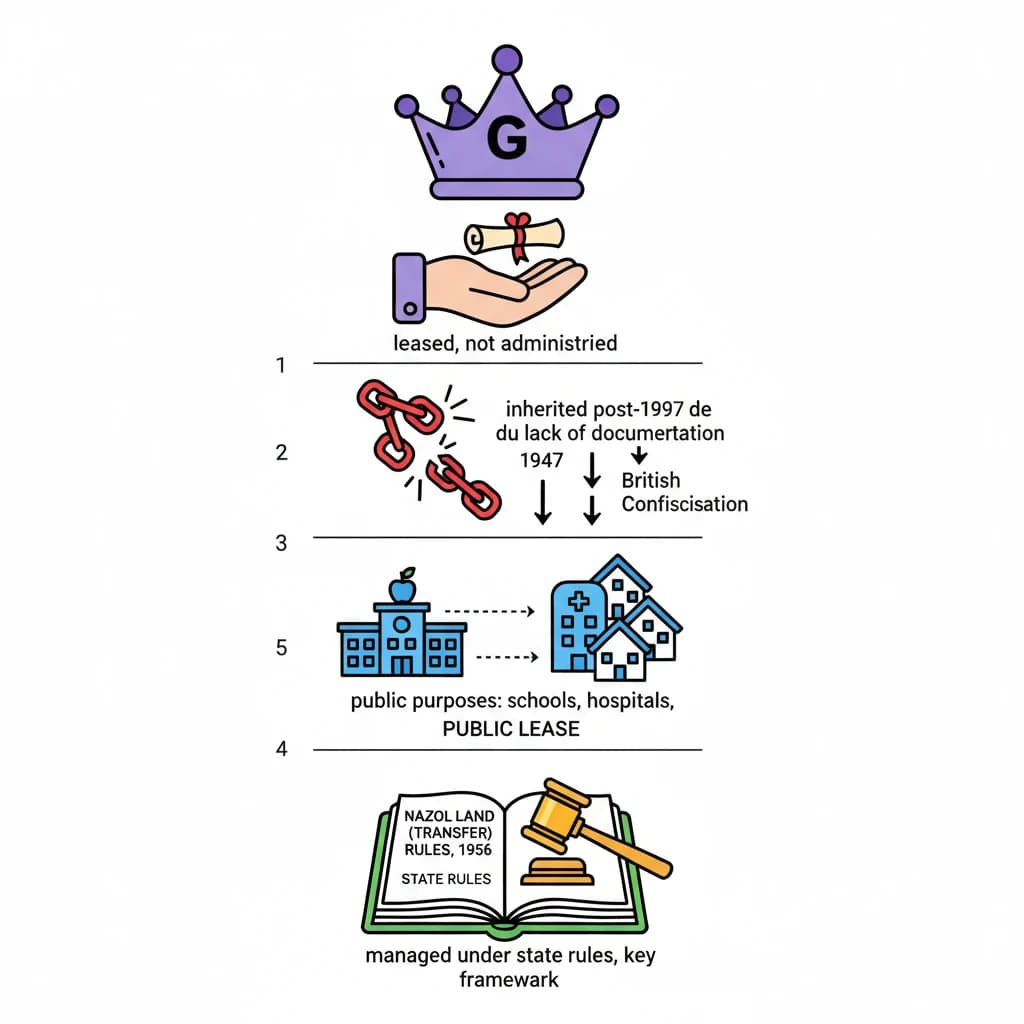
  • Nazol land is government-owned but typically leased out, not directly administered.
  • It originated from lands confiscated by the British, inherited by states post-1947 due to lack of prior documentation.
  • Primarily used for public purposes like schools, hospitals, and housing societies on lease.
  • Managed under state rules, with the Nazol Land (Transfer) Rules, 1956, being a key framework.
  • Leases can be renewed or cancelled by the government, often leading to disputes and administrative challenges.
Nazol Land: Definition, Usage, and Recent Haldwani Demolition Drive

Nazol Land: Definition, Usage, and Recent Haldwani Demolition Drive

Medium⏱️ 7 min read✓ 95% Verified
polity and governance

📖 Introduction

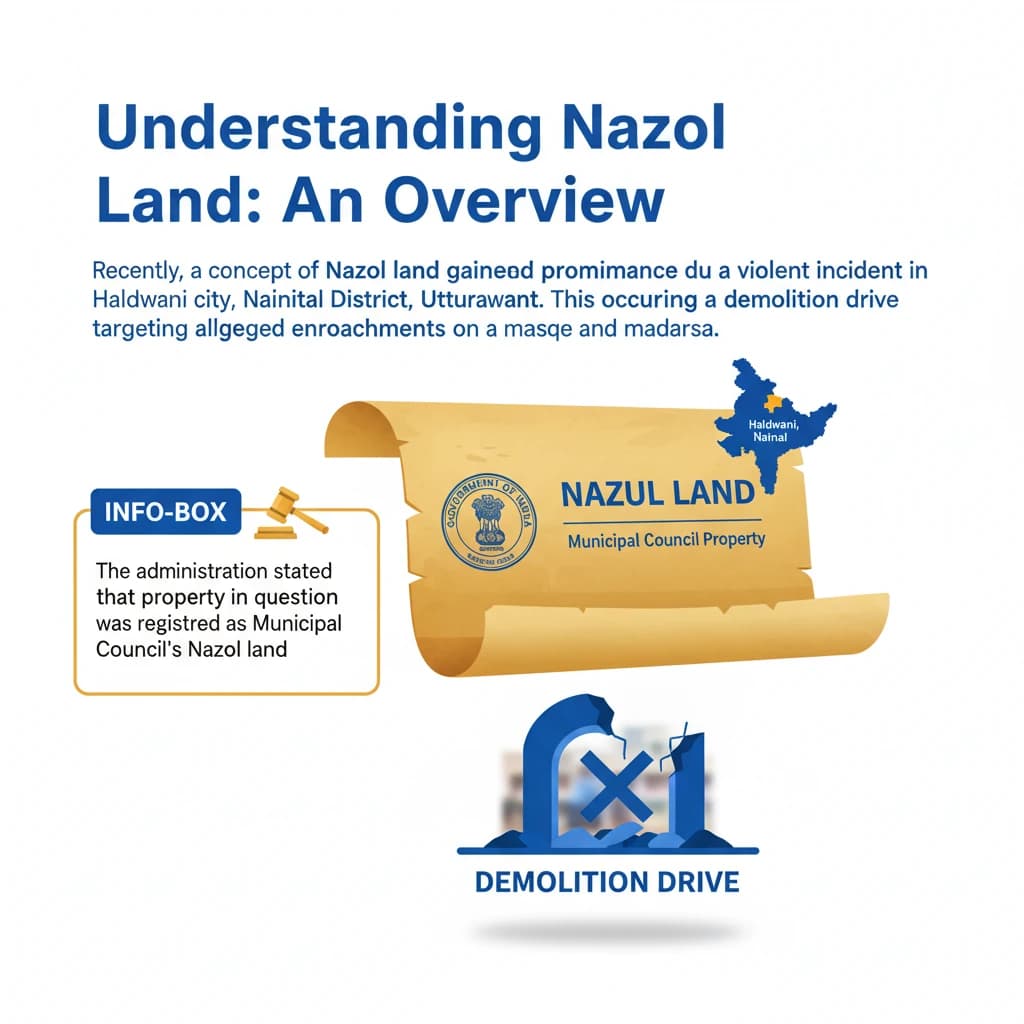
<h4>Understanding Nazol Land: An Overview</h4><p>Recently, the concept of <strong>Nazol land</strong> gained prominence due to a violent incident in <strong>Haldwani city</strong>, <strong>Nainital District</strong>, <strong>Uttarakhand</strong>. This occurred during a <strong>demolition drive</strong> targeting alleged encroachments on a mosque and madrasa.</p><div class='info-box'><p>The administration stated that the property in question was registered as <strong>Municipal Council's Nazol land</strong>, leading to the enforcement action.</p></div><h4>What is Nazol Land?</h4><p><strong>Nazol land</strong> refers to land that is officially owned by the <strong>government</strong>. However, it is typically not directly administered as general state property.</p><div class='key-point-box'><p>Instead, the state usually allots such land to various entities on a <strong>lease basis</strong>. These leases are granted for a fixed period, commonly ranging between <strong>15 and 99 years</strong>.</p></div><h4>Emergence of Nazol Land in India</h4><p>The origin of <strong>Nazol land</strong> dates back to the <strong>British colonial rule</strong> in India. During this period, numerous <strong>kings and kingdoms</strong> frequently revolted against British authority.</p><p>Upon defeating these rulers in battles, the British often confiscated their territories and lands. These lands then came under British control.</p><div class='info-box'><p>After <strong>India gained Independence</strong> in <strong>1947</strong>, the British vacated these acquired lands. Many former kings and royals, however, lacked proper documentation to establish their prior ownership.</p></div><p>Consequently, these lands were officially designated as <strong>Nazol land</strong>, signifying ownership by the respective <strong>state governments</strong>.</p><h4>Purpose and Utilisation of Nazol Land</h4><p>The government primarily uses <strong>Nazol land</strong> for various <strong>public purposes</strong>. This includes the development of essential infrastructure and community facilities.</p><ul><li>Construction of <strong>schools</strong> and <strong>hospitals</strong>.</li><li>Building <strong>Gram Panchayat offices</strong> and other administrative structures.</li></ul><p>Beyond public utilities, large tracts of <strong>Nazol land</strong> have also been allocated for <strong>housing societies</strong> in several Indian cities, typically under long-term leases.</p><h4>Legal Framework and Lease Management</h4><p>While many states have formulated their own <strong>government orders</strong> and rules for managing <strong>Nazol land</strong>, the primary legal instrument for its adjudication is the <strong>Nazol Land (Transfer) Rules, 1956</strong>.</p><div class='exam-tip-box'><p>Understanding the <strong>Nazol Land (Transfer) Rules, 1956</strong> is crucial for questions related to land administration and historical land tenure systems in UPSC exams (<strong>GS Paper II, III</strong>).</p></div><p>When a <strong>lease term expires</strong>, the lessee can submit a written application to the <strong>Revenue Department</strong> of the local development authority to request a renewal.</p><p>The government retains the discretion to either <strong>renew the lease</strong> or <strong>cancel it</strong>, thereby repossessing the <strong>Nazol land</strong>.</p><p>Across almost all major cities in India, <strong>Nazol land</strong> has been extensively allotted for a diverse range of purposes, reflecting its significant role in urban and rural development.</p>
Concept Diagram

💡 Key Takeaways

  • •Nazol land is government-owned but typically leased out, not directly administered.
  • •It originated from lands confiscated by the British, inherited by states post-1947 due to lack of prior documentation.
  • •Primarily used for public purposes like schools, hospitals, and housing societies on lease.
  • •Managed under state rules, with the Nazol Land (Transfer) Rules, 1956, being a key framework.
  • •Leases can be renewed or cancelled by the government, often leading to disputes and administrative challenges.

🧠 Memory Techniques
Memory Aid
95% Verified Content

📚 Reference Sources

•General knowledge of Indian land laws and history

Related Topics

Loading related topics...
Explore:Polity And Governance Topics·All Subjects·Daily Current Affairs·Editorial Analysis·Previous Year Questions·UPSC GPT
Nazol Land: Definition, Usage, and Recent Haldwani Demolition Drive - UPSC Polity And Governance