Loading page, please wait…
Vaidra Logo
Vaidra

Top 4 items + smart groups

UPSC GPT
New
Current Affairs
Daily Solutions
Daily Puzzle
Mains Evaluator

Version 2.0.0 • Built with ❤️ for UPSC aspirants

Loading...
Loading...
Loading...
Loading...
Loading...
Loading...
Loading...
Loading...
Loading...
Loading...
Loading...
Loading...
Loading...
Does Anti-Defection Law Apply to Rajya Sabha Elections? - UPSC Polity And Governance
Back
All Subjects

Topics

0 topics • 0 completed

Loading topics...
Loading...
Loading...
Loading...
Loading...
Loading...
Overall Progress0%

Does Anti-Defection Law Apply to Rajya Sabha Elections? - UPSC Polity And Governance

What is Does Anti-Defection Law Apply to Rajya Sabha Elections? in UPSC Polity And Governance?

Does Anti-Defection Law Apply to Rajya Sabha Elections? is a key topic under Polity And Governance for UPSC Civil Services Examination. Key points include: The Anti-Defection Law is enshrined in the Tenth Schedule of the Indian Constitution.. It was introduced by the 52nd Constitutional Amendment Act in 1985 to curb political defections.. Legislators can be disqualified for voluntarily giving up party membership or voting against the party whip.. Understanding this topic is essential for both UPSC Prelims and Mains preparation.

Why is Does Anti-Defection Law Apply to Rajya Sabha Elections? important for UPSC exam?

Does Anti-Defection Law Apply to Rajya Sabha Elections? is a Medium-level topic in UPSC Polity And Governance. It is tested in both Prelims (factual MCQs) and Mains (analytical answer writing). Previous year UPSC questions have frequently covered aspects of Does Anti-Defection Law Apply to Rajya Sabha Elections?, making it essential for comprehensive IAS preparation.

How to prepare Does Anti-Defection Law Apply to Rajya Sabha Elections? for UPSC?

To prepare Does Anti-Defection Law Apply to Rajya Sabha Elections? for UPSC: (1) Study the comprehensive notes covering all key concepts on Vaidra. (2) Practice previous year questions on this topic. (3) Connect it with current affairs using daily updates. (4) Revise using key takeaways and mind maps available for Polity And Governance. (5) Write practice answers linking Does Anti-Defection Law Apply to Rajya Sabha Elections? to related GS Paper topics.

Key takeaways of Does Anti-Defection Law Apply to Rajya Sabha Elections? for UPSC

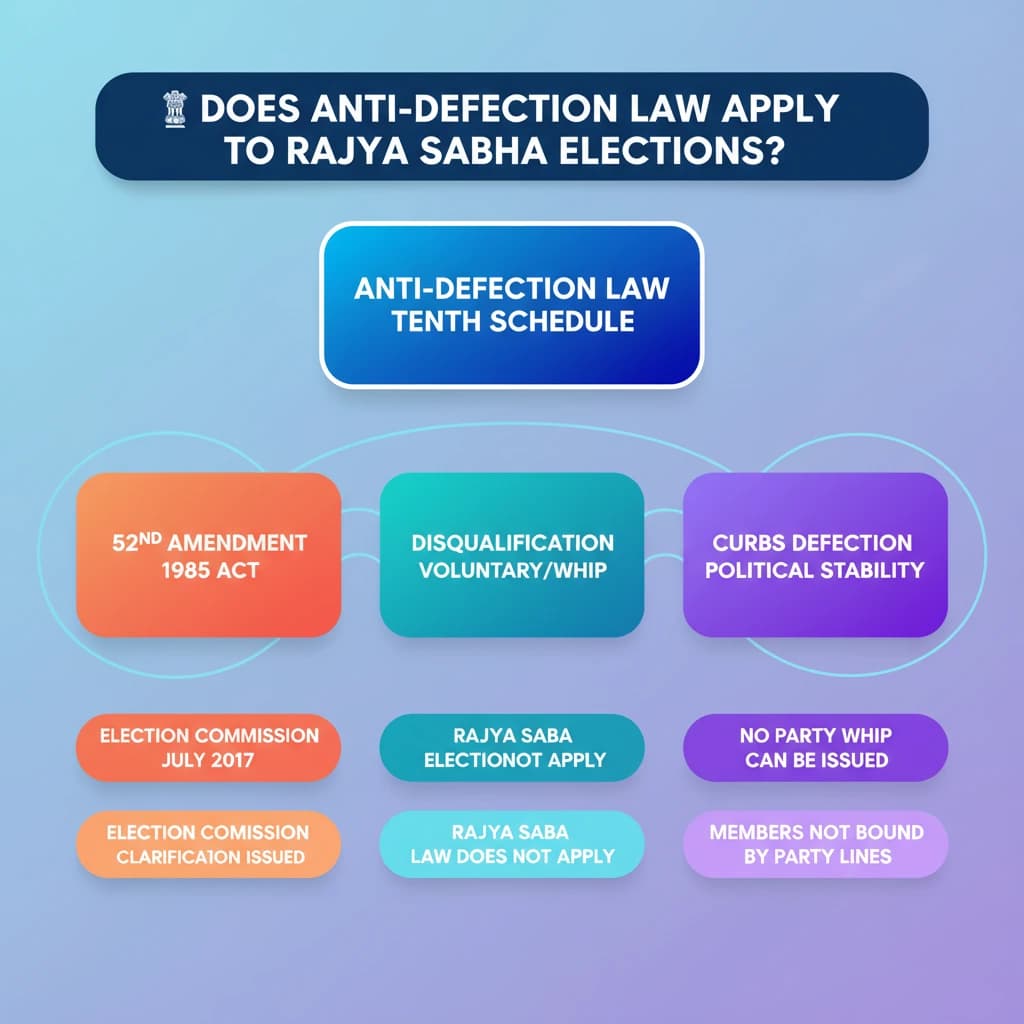
  • The Anti-Defection Law is enshrined in the Tenth Schedule of the Indian Constitution.
  • It was introduced by the 52nd Constitutional Amendment Act in 1985 to curb political defections.
  • Legislators can be disqualified for voluntarily giving up party membership or voting against the party whip.
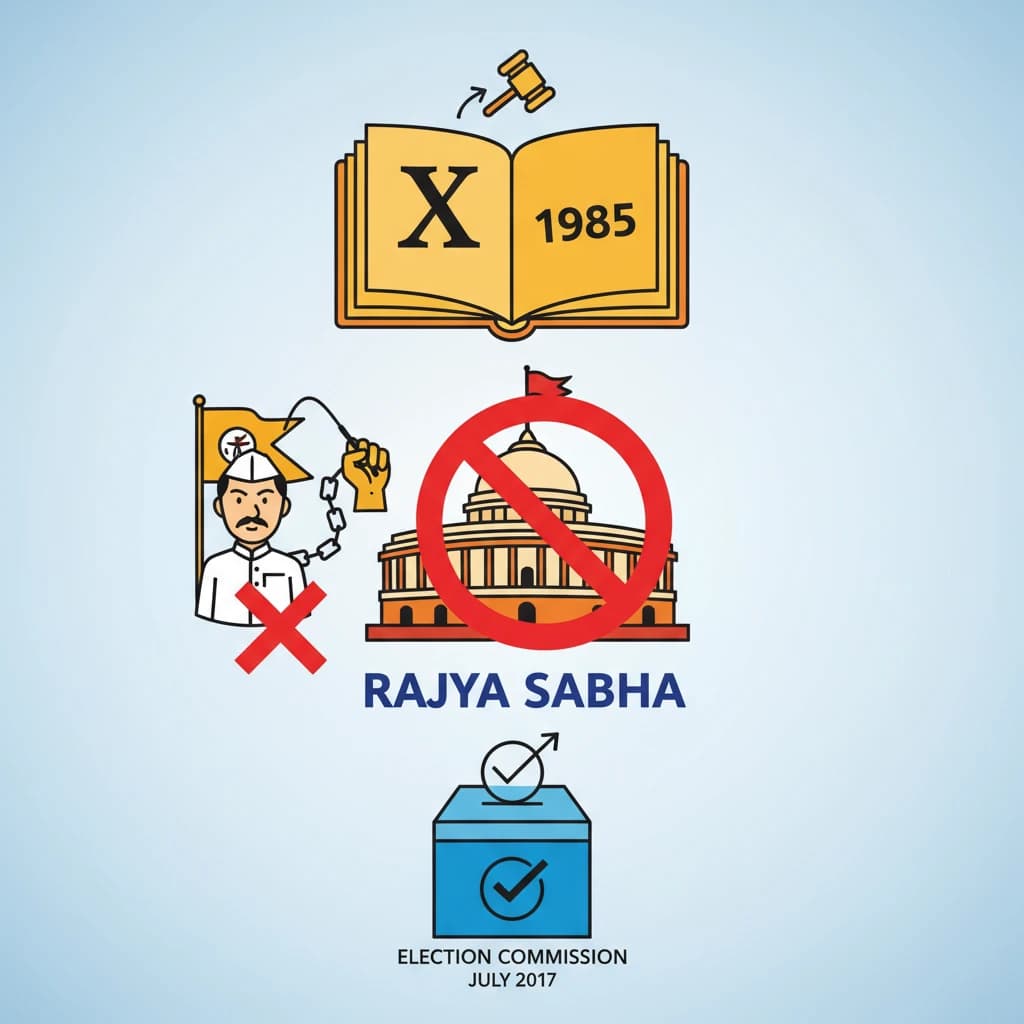
  • The Election Commission clarified in July 2017 that the Anti-Defection Law does NOT apply to Rajya Sabha elections.
  • Therefore, political parties cannot issue a whip to members for Rajya Sabha elections, and members are not bound by party instructions.
Does Anti-Defection Law Apply to Rajya Sabha Elections?

Does Anti-Defection Law Apply to Rajya Sabha Elections?

Medium⏱️ 6 min read✓ 98% Verified
polity and governance

📖 Introduction

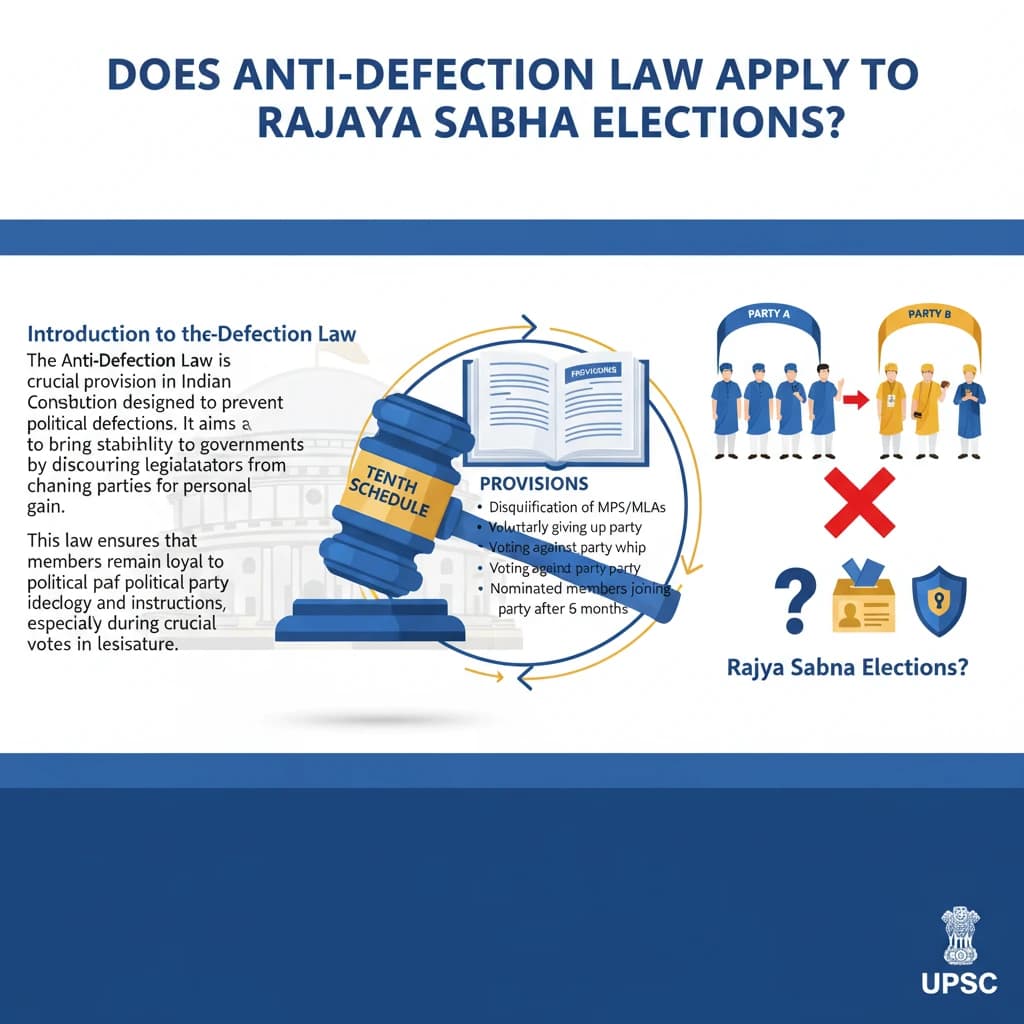
<h4>Introduction to the Anti-Defection Law</h4><p>The <strong>Anti-Defection Law</strong> is a crucial provision in the Indian Constitution designed to prevent political defections. It aims to bring stability to governments by discouraging legislators from changing parties for personal gain.</p><p>This law ensures that members remain loyal to their political party's ideology and instructions, especially during crucial votes in the legislature.</p><h4>The Tenth Schedule and its Provisions</h4><p>The <strong>Tenth Schedule</strong> of the Indian Constitution contains the specific provisions related to the <strong>Anti-Defection Law</strong>. It was incorporated into the Constitution through the <strong>52nd Constitutional Amendment Act</strong> in <strong>1985</strong>.</p><div class='info-box'><p><strong>Key Date:</strong> The <strong>52nd Constitutional Amendment Act</strong> was enacted in <strong>1985</strong>.</p><p><strong>Purpose:</strong> To combat the 'Aaya Ram Gaya Ram' phenomenon and ensure political stability.</p></div><p>Under this schedule, a member of Parliament (MP) or a state legislature (MLA/MLC) can be disqualified from their House on specific grounds.</p><h4>Grounds for Disqualification</h4><p>There are two primary grounds for disqualification under the <strong>Tenth Schedule</strong>:</p><ul><li><strong>Voluntarily Giving Up Membership:</strong> If a legislator voluntarily gives up the membership of their political party. This can be explicit (resignation) or implicit (acting against party interests).</li><li><strong>Voting Against Party Instructions:</strong> If a legislator votes or abstains from voting in the House contrary to any direction issued by their political party. Such directions are typically issued by the <strong>party whip</strong>.</li></ul><div class='key-point-box'><p>The <strong>party whip</strong> is an official who ensures the attendance and voting of party members according to the party's instructions.</p></div><h4>Applicability to Rajya Sabha Elections</h4><p>A significant clarification regarding the <strong>Anti-Defection Law</strong> pertains to its applicability during <strong>Rajya Sabha elections</strong>. The <strong>Election Commission of India (ECI)</strong> has explicitly stated its position on this matter.</p><div class='info-box'><p><strong>ECI Clarification Date:</strong> <strong>July 2017</strong>.</p><p><strong>Key Ruling:</strong> The <strong>Tenth Schedule</strong> and the <strong>Anti-Defection Law</strong> are <strong>not applicable</strong> to <strong>Rajya Sabha elections</strong>.</p></div><p>This means that political parties <strong>cannot issue a whip</strong> to their members for voting in <strong>Rajya Sabha elections</strong>. Consequently, members are <strong>not bound</strong> by party instructions in these specific elections.</p><div class='exam-tip-box'><p><strong>UPSC Insight:</strong> This distinction is crucial for both Prelims (factual recall) and Mains (analytical questions on electoral reforms or party discipline). Understanding why the law doesn't apply here reflects a deeper understanding of the electoral process for <strong>Rajya Sabha</strong>.</p></div>
Concept Diagram

💡 Key Takeaways

  • •The Anti-Defection Law is enshrined in the Tenth Schedule of the Indian Constitution.
  • •It was introduced by the 52nd Constitutional Amendment Act in 1985 to curb political defections.
  • •Legislators can be disqualified for voluntarily giving up party membership or voting against the party whip.
  • •The Election Commission clarified in July 2017 that the Anti-Defection Law does NOT apply to Rajya Sabha elections.
  • •Therefore, political parties cannot issue a whip to members for Rajya Sabha elections, and members are not bound by party instructions.

🧠 Memory Techniques
Memory Aid
98% Verified Content

📚 Reference Sources

•52nd Constitutional Amendment Act, 1985
•Election Commission of India's official clarifications (July 2017)
•Drishti IAS Summary on Anti-Defection Law

Related Topics

Loading related topics...
Explore:Polity And Governance Topics·All Subjects·Daily Current Affairs·Editorial Analysis·Previous Year Questions·UPSC GPT