📖 Introduction
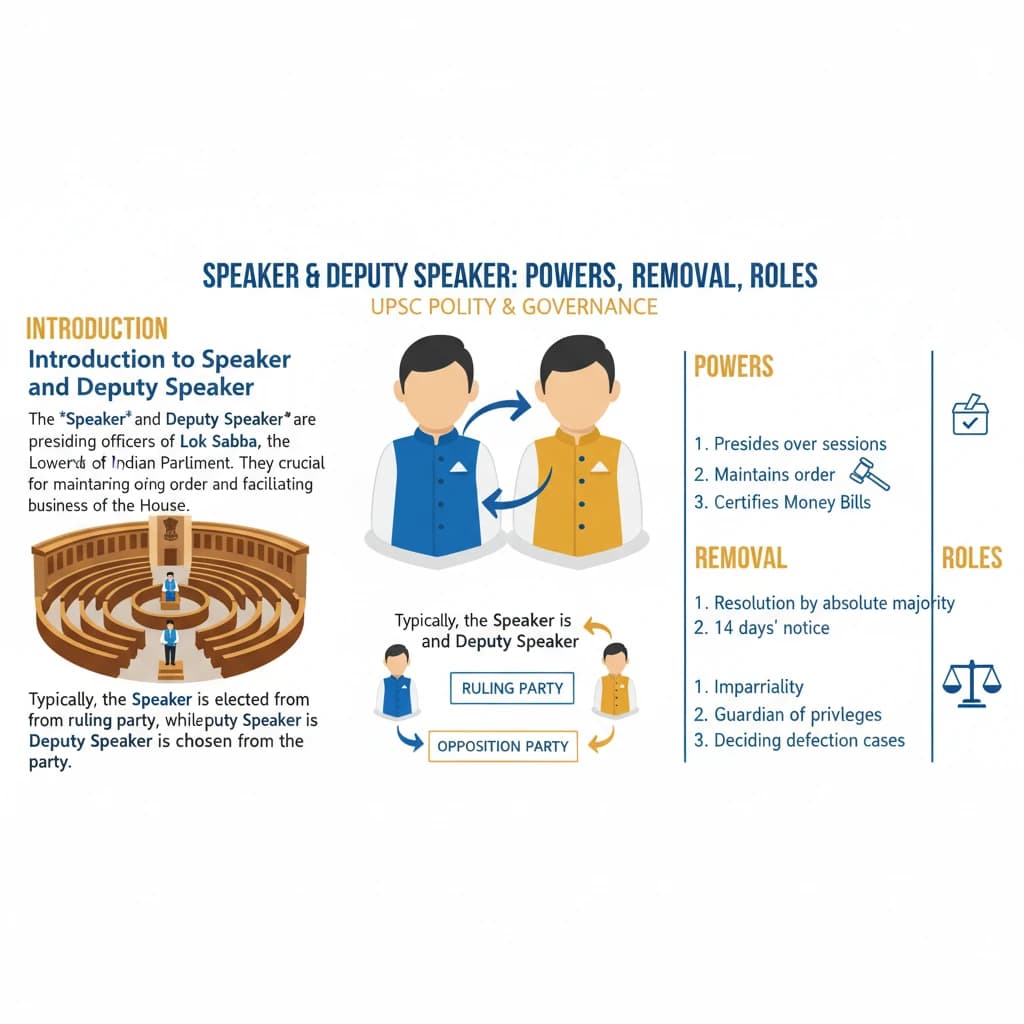
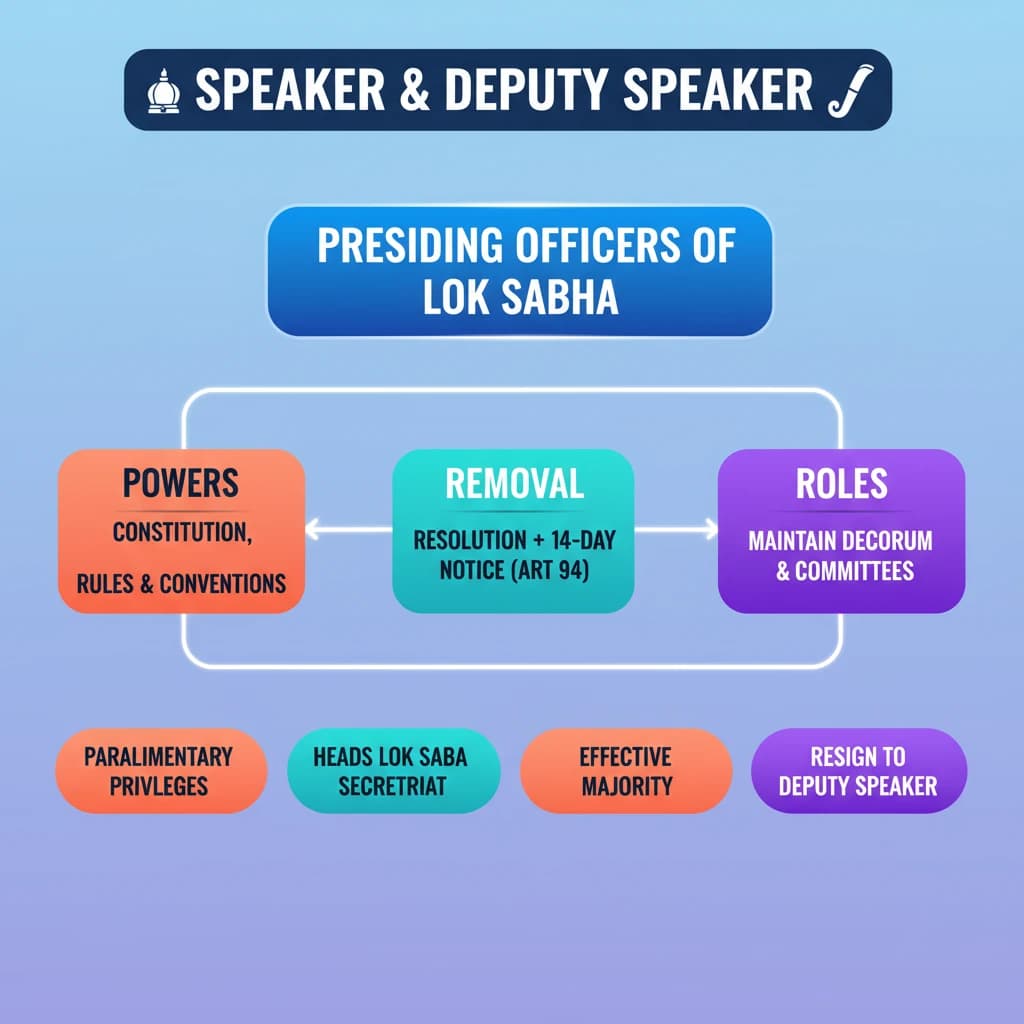
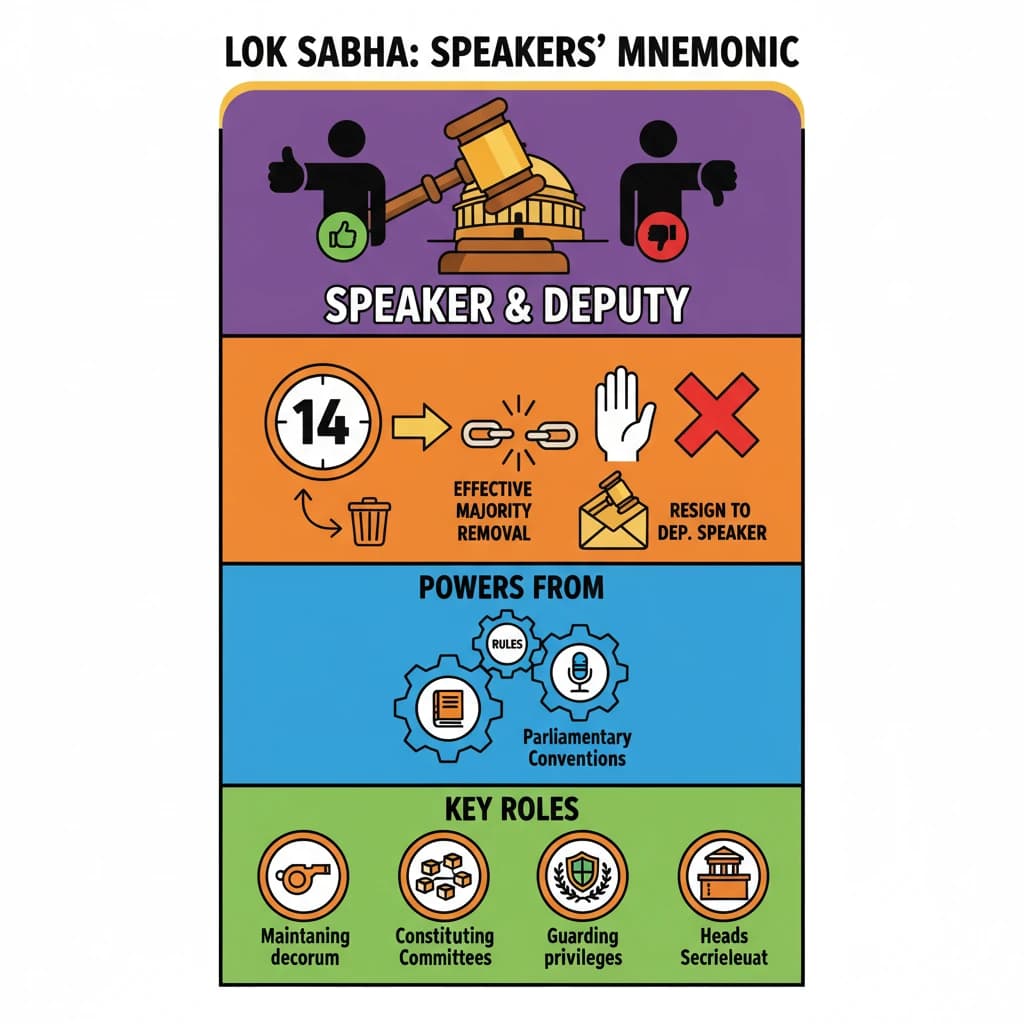
<h4>Introduction to Speaker and Deputy Speaker</h4><p>The <strong>Speaker</strong> and <strong>Deputy Speaker</strong> are the presiding officers of the <strong>Lok Sabha</strong>, the Lower House of the Indian Parliament. They are crucial for maintaining order and facilitating the business of the House.</p><p>Typically, the <strong>Speaker</strong> is elected from the <strong>ruling party</strong>, while the <strong>Deputy Speaker</strong> is chosen from the <strong>opposition party</strong>. This convention aims to ensure a balance and impartiality in the functioning of the House.</p><div class='info-box'><p><strong>Notable Exceptions:</strong></p><ul><li><strong>GMC Balayogi</strong> (12th Lok Sabha)</li><li><strong>Manohar Joshi</strong> (13th Lok Sabha)</li></ul><p>Both served as Speaker while belonging to <strong>non-ruling parties</strong>, demonstrating instances where this convention was not strictly followed.</p></div><p>Upon the <strong>dissolution of the Lok Sabha</strong>, the <strong>Speaker</strong> continues in office until the first meeting of the new assembly, when a new Speaker is elected. This ensures continuity in the legislative process.</p><h4>Election and Appointment</h4><p>The <strong>Speaker</strong> and <strong>Deputy Speaker</strong> are elected by the <strong>Lok Sabha</strong> from amongst its members. The process is governed by the <strong>Rules of Procedure and Conduct of Business of Lok Sabha</strong>.</p><div class='info-box'><p><strong>Constitutional Provision:</strong></p><ul><li><strong>Article 93</strong> of the <strong>Indian Constitution</strong> mandates the election of the <strong>Speaker</strong> and <strong>Deputy Speaker</strong> for the <strong>Lok Sabha</strong>.</li><li><strong>Article 178</strong> makes similar provisions for <strong>State Legislative Assemblies</strong>.</li></ul></div><h4>Removal of the Speaker and Deputy Speaker</h4><p>The <strong>Constitution of India</strong> empowers the <strong>Lok Sabha</strong> to remove its presiding officers. This process is a significant check on their authority and ensures accountability.</p><div class='key-point-box'><p><strong>Removal Process:</strong></p><ul><li>A <strong>resolution for removal</strong> can be initiated with a <strong>14-day prior notice</strong>.</li><li>The resolution must be passed by an <strong>effective majority</strong> of the House.</li><li>An <strong>effective majority</strong> means more than <strong>50% of the effective strength</strong> of the House (total strength minus vacancies).</li><li>This procedure is outlined in <strong>Article 94</strong> of the <strong>Indian Constitution</strong>.</li></ul></div><p>Beyond a resolution, a <strong>Speaker</strong> can also be removed if they are <strong>disqualified from being a Lok Sabha member</strong> under <strong>Sections 7 and 8</strong> of the <strong>Representation of the People Act, 1951</strong>.</p><p>The <strong>Speaker</strong> also has the option to <strong>resign</strong> from office by submitting their resignation to the <strong>Deputy Speaker</strong>.</p><div class='info-box'><p><strong>Constitutional Provisions on Removal:</strong></p><ul><li><strong>Article 94</strong> (Lok Sabha) and <strong>Article 179</strong> (Legislative Assembly) detail the vacation, resignation, and removal from office.</li><li><strong>Article 96</strong> (Lok Sabha) and <strong>Article 181</strong> (Legislative Assembly) state that the <strong>Speaker</strong> or <strong>Deputy Speaker</strong> shall not preside while a resolution for their removal is under consideration.</li></ul></div><h4>Sources of Speaker's Powers and Duties</h4><p>The authority of the <strong>Speaker of the Lok Sabha</strong> is derived from a combination of constitutional provisions, established rules, and parliamentary traditions.</p><ul><li><strong>Constitution of India:</strong> Provides the foundational framework and specific articles defining the office.</li><li><strong>Rules of Procedure and Conduct of Business of Lok Sabha:</strong> Detailed regulations governing the day-to-day functioning of the House.</li><li><strong>Parliamentary Conventions:</strong> Unwritten rules and practices that have evolved over time, filling gaps not explicitly covered by the Constitution or rules (often referred to as <strong>residuary powers</strong>).</li></ul><h4>Roles and Responsibilities of the Speaker</h4><p>The <strong>Speaker</strong> performs a multifaceted role, acting as the principal representative of the House, its guardian, and its chief administrator.</p><ul><li><strong>Presiding Officer:</strong> Oversees the sessions of the <strong>Lower House</strong>, ensuring <strong>discipline</strong> and <strong>decorum</strong> among members.</li><li><strong>Disciplinary Authority:</strong> Has the power to punish unruly behaviour and can even <strong>disqualify members</strong> on grounds of <strong>defection</strong> under the <strong>Tenth Schedule</strong> of the Constitution.</li><li><strong>Committee Formation:</strong> Constitutes the <strong>Committees of the House</strong> and directs their overall functioning.</li><li><strong>Guardian of Rights:</strong> Acts as the guardian of the <strong>rights and privileges</strong> of the House, its Committees, and individual members.</li><li><strong>Administrative Head:</strong> Heads the <strong>Lok Sabha Secretariat</strong>, managing administrative affairs and security arrangements within the <strong>Parliament Estate</strong>.</li><li><strong>Inter-Parliamentary Relations:</strong> Serves as the <strong>ex-officio President</strong> of the <strong>Indian Parliamentary Group</strong>, facilitating relations with other parliaments globally. Chairs the <strong>Conference of Presiding Officers of Legislative Bodies in India</strong>.</li></ul><h4>Provisions Ensuring Independence and Impartiality</h4><p>Several constitutional and procedural safeguards are in place to ensure the <strong>independence</strong> and <strong>impartiality</strong> of the <strong>Speaker's office</strong>, vital for the fair conduct of parliamentary business.</p><div class='key-point-box'><p><strong>Key Safeguards:</strong></p><ul><li><strong>Security of Tenure:</strong> The Speaker can only be removed by a resolution passed by an <strong>effective majority</strong> of the <strong>Lok Sabha</strong>, making arbitrary removal difficult.</li><li><strong>Salaries and Allowances:</strong> These are <strong>charged on the Consolidated Fund of India</strong>, meaning they are not subject to the annual vote of Parliament, insulating the Speaker from political pressure regarding remuneration. (<strong>Article 97</strong> and <strong>Article 186</strong>)</li><li><strong>Conduct Discussion:</strong> The Speaker's work and conduct cannot be discussed or criticised in the <strong>Lok Sabha</strong> except through a <strong>substantive motion</strong>, ensuring protection from frivolous accusations.</li><li><strong>Judicial Immunity:</strong> The Speaker's powers in regulating procedure, conducting business, or maintaining order within the House are generally <strong>not subject to the jurisdiction of any court</strong>.</li><li><strong>Casting Vote:</strong> The Speaker <strong>cannot vote in the first instance</strong>. They can only exercise a <strong>casting vote</strong> in the event of a tie, underscoring their impartial role.</li><li><strong>High Precedence:</strong> The Speaker is placed at the <strong>sixth rank</strong> in the <strong>order of precedence</strong>, alongside the <strong>Chief Justice of India</strong>, reflecting the high regard and importance of the office.</li></ul></div><h4>Speaker Pro Tem</h4><p>The office of the <strong>Speaker Pro Tem</strong> is a temporary arrangement made to facilitate the transition between one <strong>Lok Sabha</strong> and the next.</p><div class='info-box'><p><strong>Role and Appointment:</strong></p><ul><li>When the <strong>Speaker</strong> of the outgoing <strong>Lok Sabha</strong> vacates office before the first meeting of the newly-elected House, the <strong>President</strong> appoints a <strong>Speaker Pro Tem</strong>.</li><li>Traditionally, the <strong>senior most member</strong> of the <strong>Lok Sabha</strong> is chosen for this role.</li><li>The <strong>President</strong> himself administers the <strong>oath</strong> to the <strong>Speaker Pro Tem</strong>.</li></ul></div><p>The <strong>Speaker Pro Tem</strong> presides over the <strong>first sitting</strong> of the newly-elected <strong>Lok Sabha</strong> and possesses all the powers of the Speaker during this interim period.</p><p>Their primary responsibilities include <strong>administering oaths</strong> to the new members and overseeing the election of the new, permanent <strong>Speaker</strong>.</p><p>Once the new <strong>Speaker</strong> is elected by the House, the office of the <strong>Speaker Pro Tem</strong> automatically ceases to exist.</p>