Loading page, please wait…
Vaidra Logo
Vaidra

Top 4 items + smart groups

UPSC GPT
New
Current Affairs
Daily Solutions
Daily Puzzle
Mains Evaluator

Version 2.0.0 • Built with ❤️ for UPSC aspirants

Loading...
Loading...
Loading...
Loading...
Loading...
Loading...
Loading...
Loading...
Loading...
Loading...
Loading...
Loading...
Loading...
DPDP Act 2023 and the Issue of Personal Consent - UPSC Polity And Governance
Back
All Subjects

Topics

0 topics • 0 completed

Loading topics...
Loading...
Loading...
Loading...
Loading...
Loading...
Overall Progress0%

DPDP Act 2023 and the Issue of Personal Consent - UPSC Polity And Governance

What is DPDP Act 2023 and the Issue of Personal Consent in UPSC Polity And Governance?

DPDP Act 2023 and the Issue of Personal Consent is a key topic under Polity And Governance for UPSC Civil Services Examination. Key points include: DPDP Act 2023 mandates explicit, verifiable consent for personal data processing.. It grants individuals rights to access, correct, and erase their data.. Data localisation is required for certain sensitive personal data.. Understanding this topic is essential for both UPSC Prelims and Mains preparation.

Why is DPDP Act 2023 and the Issue of Personal Consent important for UPSC exam?

DPDP Act 2023 and the Issue of Personal Consent is a Medium-level topic in UPSC Polity And Governance. It is tested in both Prelims (factual MCQs) and Mains (analytical answer writing). Previous year UPSC questions have frequently covered aspects of DPDP Act 2023 and the Issue of Personal Consent, making it essential for comprehensive IAS preparation.

How to prepare DPDP Act 2023 and the Issue of Personal Consent for UPSC?

To prepare DPDP Act 2023 and the Issue of Personal Consent for UPSC: (1) Study the comprehensive notes covering all key concepts on Vaidra. (2) Practice previous year questions on this topic. (3) Connect it with current affairs using daily updates. (4) Revise using key takeaways and mind maps available for Polity And Governance. (5) Write practice answers linking DPDP Act 2023 and the Issue of Personal Consent to related GS Paper topics.

Key takeaways of DPDP Act 2023 and the Issue of Personal Consent for UPSC

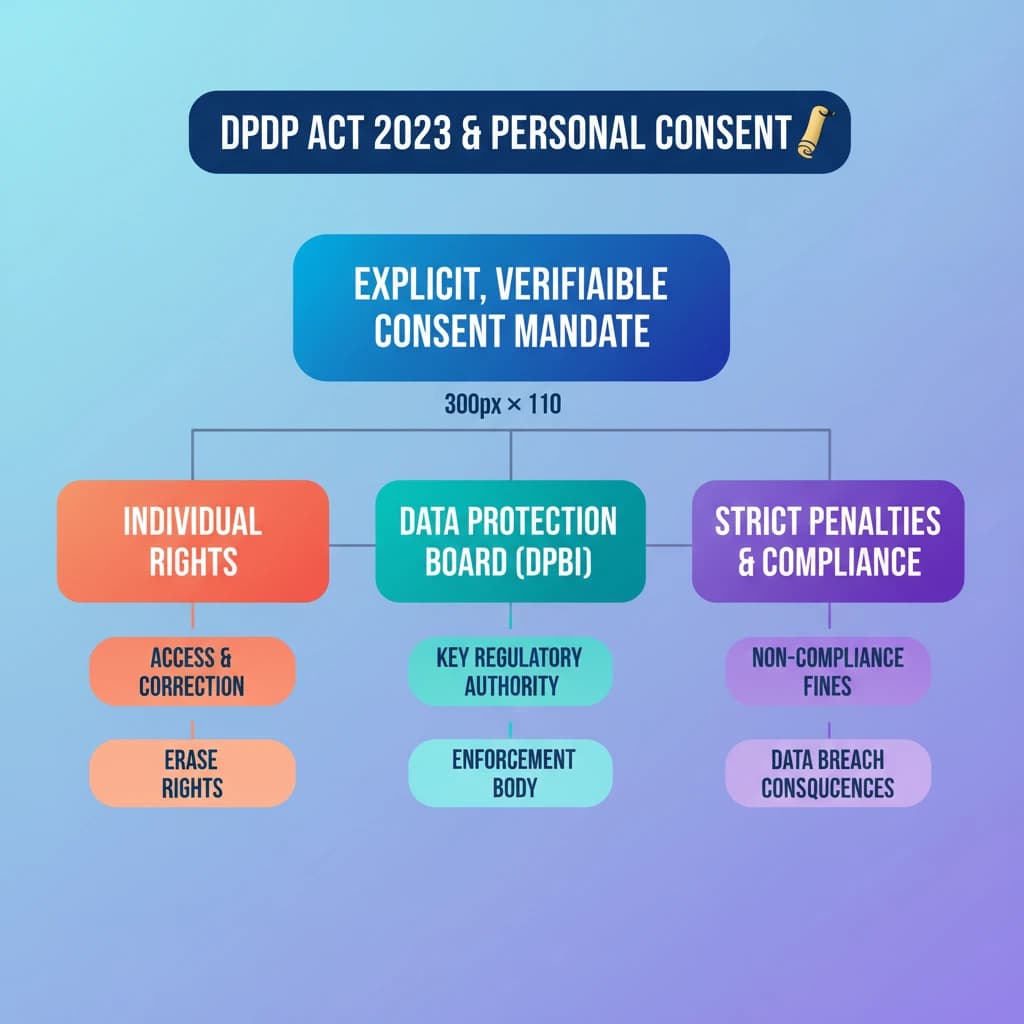
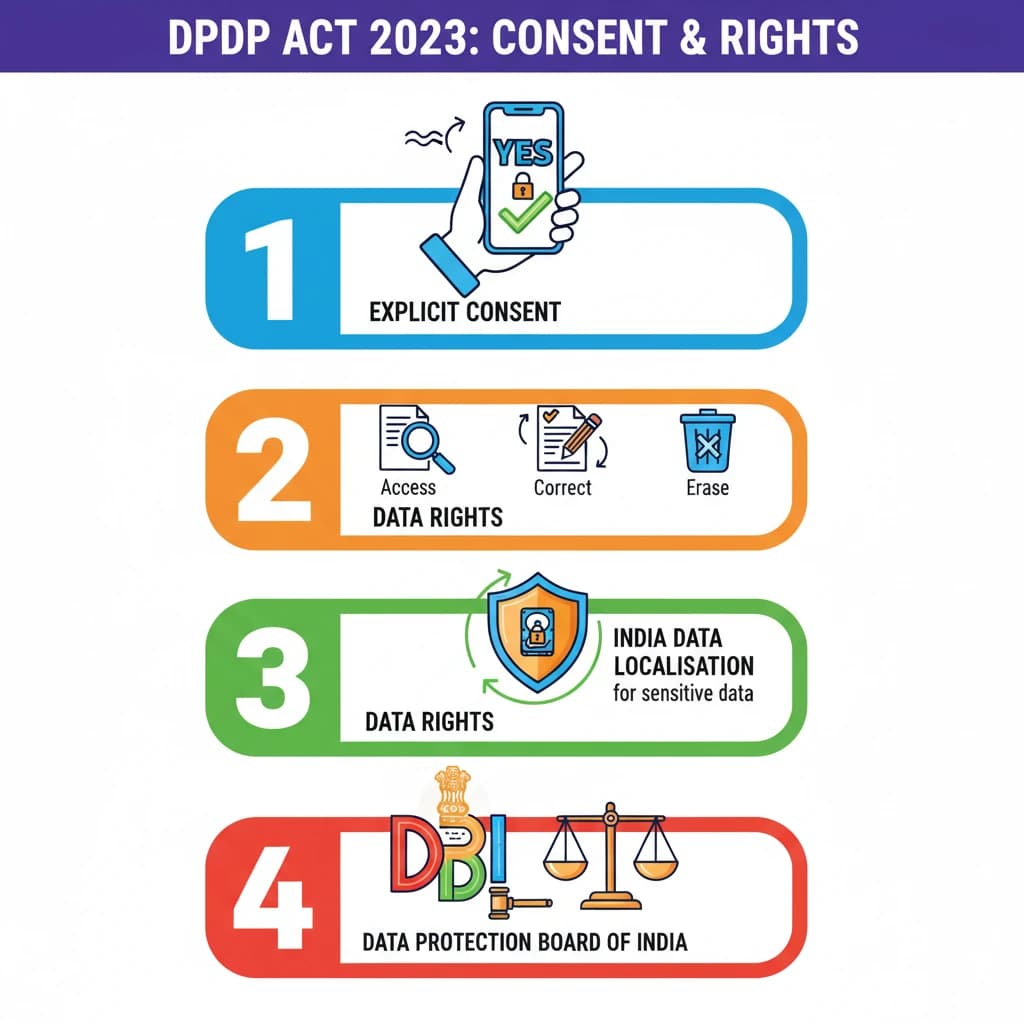
  • DPDP Act 2023 mandates explicit, verifiable consent for personal data processing.
  • It grants individuals rights to access, correct, and erase their data.
  • Data localisation is required for certain sensitive personal data.
  • The Data Protection Board of India (DPBI) is the key regulatory authority.
  • Strict penalties are imposed for non-compliance and data breaches.
  • The verifiable consent for children's data is a significant point of contention.
DPDP Act 2023 and the Issue of Personal Consent

DPDP Act 2023 and the Issue of Personal Consent

Medium⏱️ 8 min read✓ 95% Verified
polity and governance

📖 Introduction

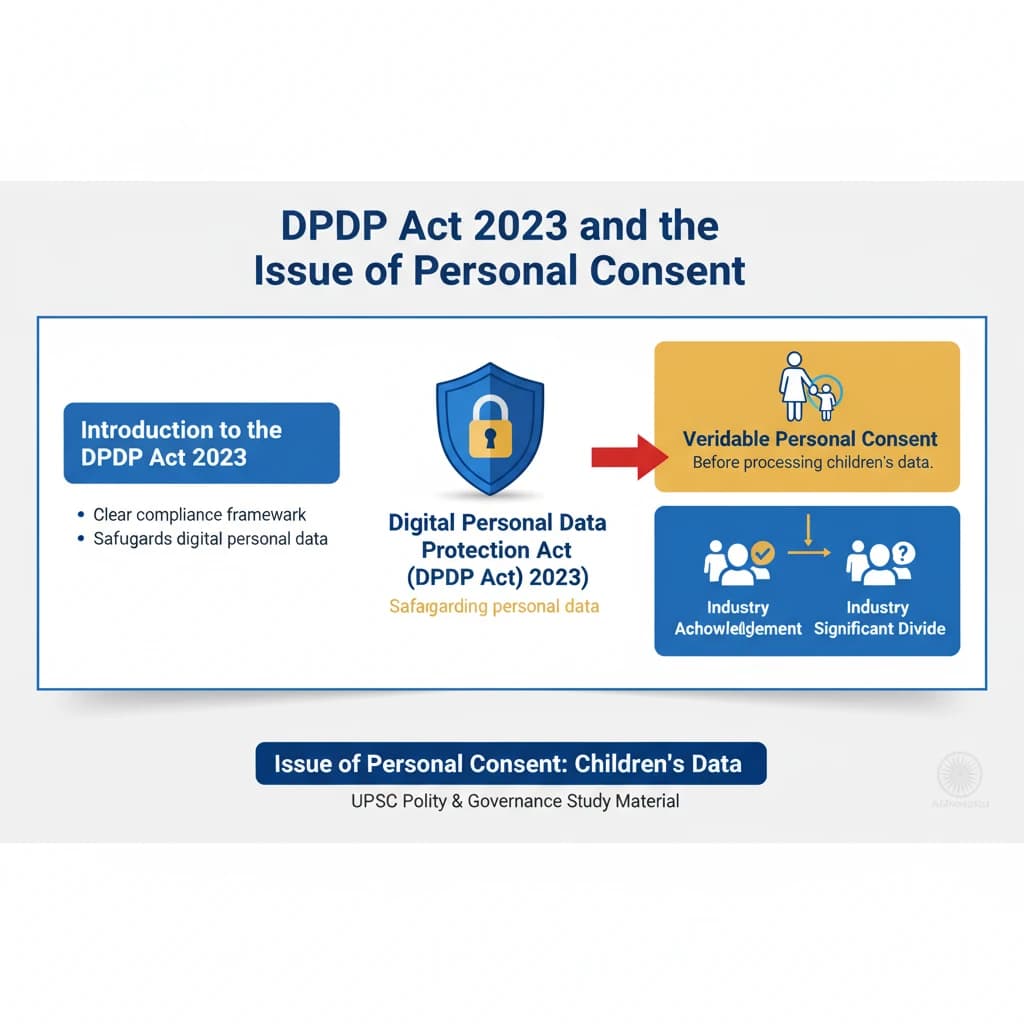
<h4>Introduction to the DPDP Act 2023</h4><p>The <strong>Digital Personal Data Protection Act (DPDP Act) 2023</strong> has been widely acknowledged by the industry for its clear compliance framework. This legislation aims to safeguard the personal data of individuals in the digital realm.</p><p>However, a specific provision concerning the requirement for <strong>verifiable personal consent</strong> before processing <strong>children's data</strong> has created a significant divide. This has led to discussions between industry stakeholders and the government.</p><h4>Right to Data Protection</h4><p>The DPDP Act 2023 significantly empowers individuals, known as <strong>Data Principals</strong>, with robust rights over their personal data. These rights ensure greater control and transparency regarding how their information is handled.</p><div class='key-point-box'><p>Key rights include the ability to <strong>access</strong>, <strong>correct</strong>, and demand the <strong>erasure</strong> of their personal data. This provides citizens with substantial authority over their digital footprint.</p></div><h4>Data Processing and Consent</h4><p>A cornerstone of the Act is the mandatory requirement for <strong>explicit consent</strong> from an individual before any personal data can be processed. This ensures that data collection is always consensual and transparent.</p><div class='info-box'><p>Organizations, referred to as <strong>Data Fiduciaries</strong>, must provide <strong>clear and specific consent forms</strong>. They are legally obligated to obtain this consent unequivocally before commencing any data collection activities.</p></div><h4>Data Localisation</h4><p>The Act includes provisions for <strong>data localisation</strong>, which stipulates that certain categories of <strong>sensitive personal data</strong> must be stored and processed exclusively within India's geographical boundaries.</p><div class='key-point-box'><p>This measure is designed to bolster <strong>data security</strong> and streamline the enforcement of data protection laws. It aims to prevent data from being subject to foreign jurisdictions without adequate safeguards.</p></div><h4>Regulatory Authority: Data Protection Board of India (DPBI)</h4><p>To ensure effective oversight and grievance redressal, the DPDP Act 2023 establishes a dedicated regulatory body: the <strong>Data Protection Board of India (DPBI)</strong>.</p><div class='info-box'><p>The <strong>DPBI</strong> is tasked with monitoring compliance, adjudicating disputes, and imposing appropriate penalties for any violations of the Act's provisions. It acts as the primary enforcement agency.</p></div><h4>Data Breach Notification</h4><p>A critical aspect of the Act is the mandate for organizations to promptly notify both affected individuals and the <strong>Data Protection Board of India (DPBI)</strong> in the event of any <strong>data breaches</strong>.</p><div class='key-point-box'><p>This provision promotes transparency and facilitates swift action to mitigate potential harm arising from data leaks or compromises of personal information.</p></div><h4>Fines and Penalties</h4><p>The DPDP Act 2023 prescribes stringent <strong>fines and penalties</strong> for non-compliance. These penalties are designed to be substantial, serving as a strong deterrent against violations.</p><div class='exam-tip-box'><p>UPSC candidates should note that the emphasis on significant penalties underscores the government's commitment to robust data protection. This can be a key point in answers related to <strong>governance and accountability</strong> (<strong>GS-II</strong>).</p></div>
Concept Diagram

💡 Key Takeaways

  • •DPDP Act 2023 mandates explicit, verifiable consent for personal data processing.
  • •It grants individuals rights to access, correct, and erase their data.
  • •Data localisation is required for certain sensitive personal data.
  • •The Data Protection Board of India (DPBI) is the key regulatory authority.
  • •Strict penalties are imposed for non-compliance and data breaches.
  • •The verifiable consent for children's data is a significant point of contention.

🧠 Memory Techniques
Memory Aid
95% Verified Content

📚 Reference Sources

•The Digital Personal Data Protection Act, 2023 (Official Gazette)
•PRS Legislative Research - Bill Summaries

Related Topics

Loading related topics...
Explore:Polity And Governance Topics·All Subjects·Daily Current Affairs·Editorial Analysis·Previous Year Questions·UPSC GPT