Loading page, please wait…
Vaidra Logo
Vaidra

Top 4 items + smart groups

UPSC GPT
New
Current Affairs
Daily Solutions
Daily Puzzle
Mains Evaluator

Version 2.0.0 • Built with ❤️ for UPSC aspirants

Loading...
Loading...
Loading...
Loading...
Loading...
Loading...
Loading...
Loading...
Loading...
Loading...
Loading...
Loading...
Loading...
Back
All Subjects

Topics

0 topics • 0 completed

Loading topics...
Loading...
Loading...
Loading...
Loading...
Loading...
Overall Progress0%
Public Accounts Committee (PAC) - UPSC Polity And Governance

Public Accounts Committee (PAC) - UPSC Polity And Governance

What is Public Accounts Committee (PAC) in UPSC Polity And Governance?

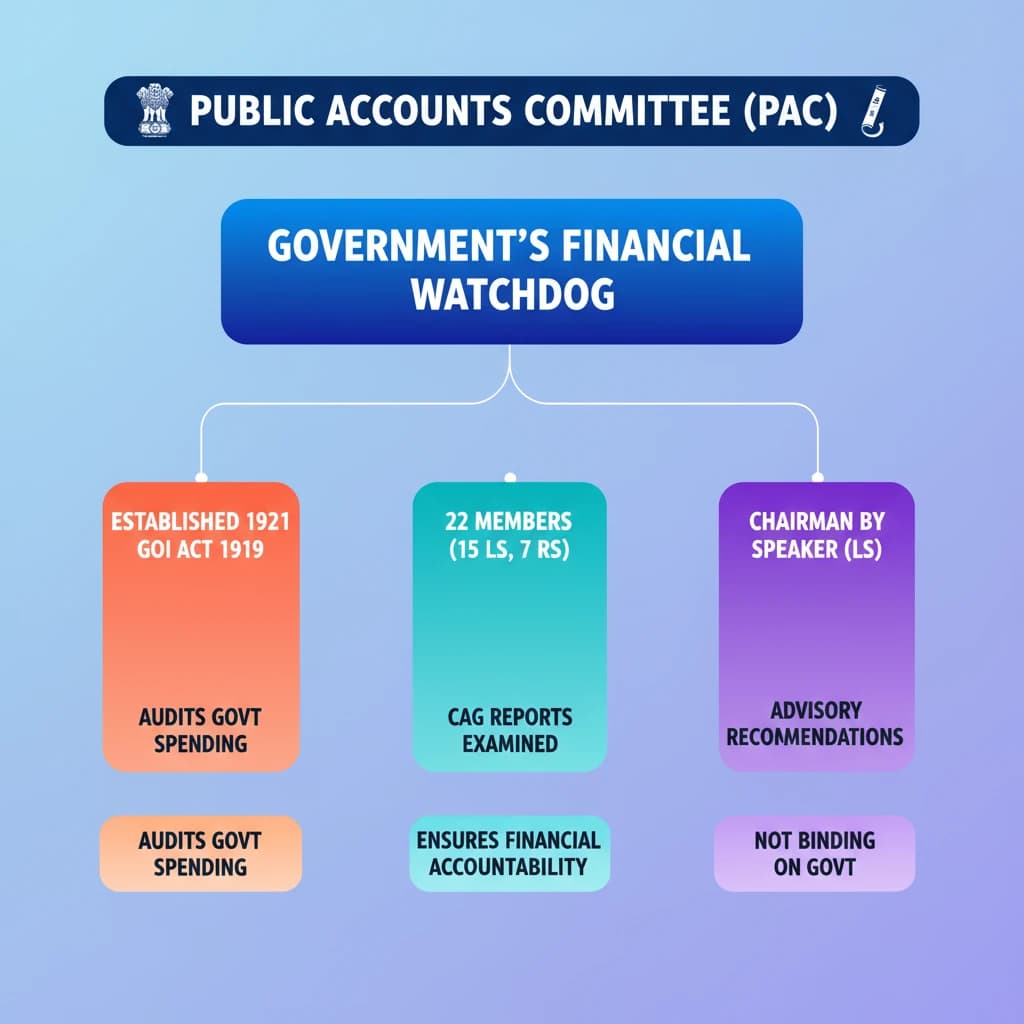
Public Accounts Committee (PAC) is a key topic under Polity And Governance for UPSC Civil Services Examination. Key points include: PAC audits government revenue and expenditure, ensuring financial accountability.. Established in 1921 under the Government of India Act, 1919.. Comprises 22 members (15 Lok Sabha, 7 Rajya Sabha) for a one-year term; Chairman appointed by Lok Sabha Speaker.. Understanding this topic is essential for both UPSC Prelims and Mains preparation.

Why is Public Accounts Committee (PAC) important for UPSC exam?

Public Accounts Committee (PAC) is a Medium-level topic in UPSC Polity And Governance. It is tested in both Prelims (factual MCQs) and Mains (analytical answer writing). Previous year UPSC questions have frequently covered aspects of Public Accounts Committee (PAC), making it essential for comprehensive IAS preparation.

How to prepare Public Accounts Committee (PAC) for UPSC?

To prepare Public Accounts Committee (PAC) for UPSC: (1) Study the comprehensive notes covering all key concepts on Vaidra. (2) Practice previous year questions on this topic. (3) Connect it with current affairs using daily updates. (4) Revise using key takeaways and mind maps available for Polity And Governance. (5) Write practice answers linking Public Accounts Committee (PAC) to related GS Paper topics.

Key takeaways of Public Accounts Committee (PAC) for UPSC

  • PAC audits government revenue and expenditure, ensuring financial accountability.
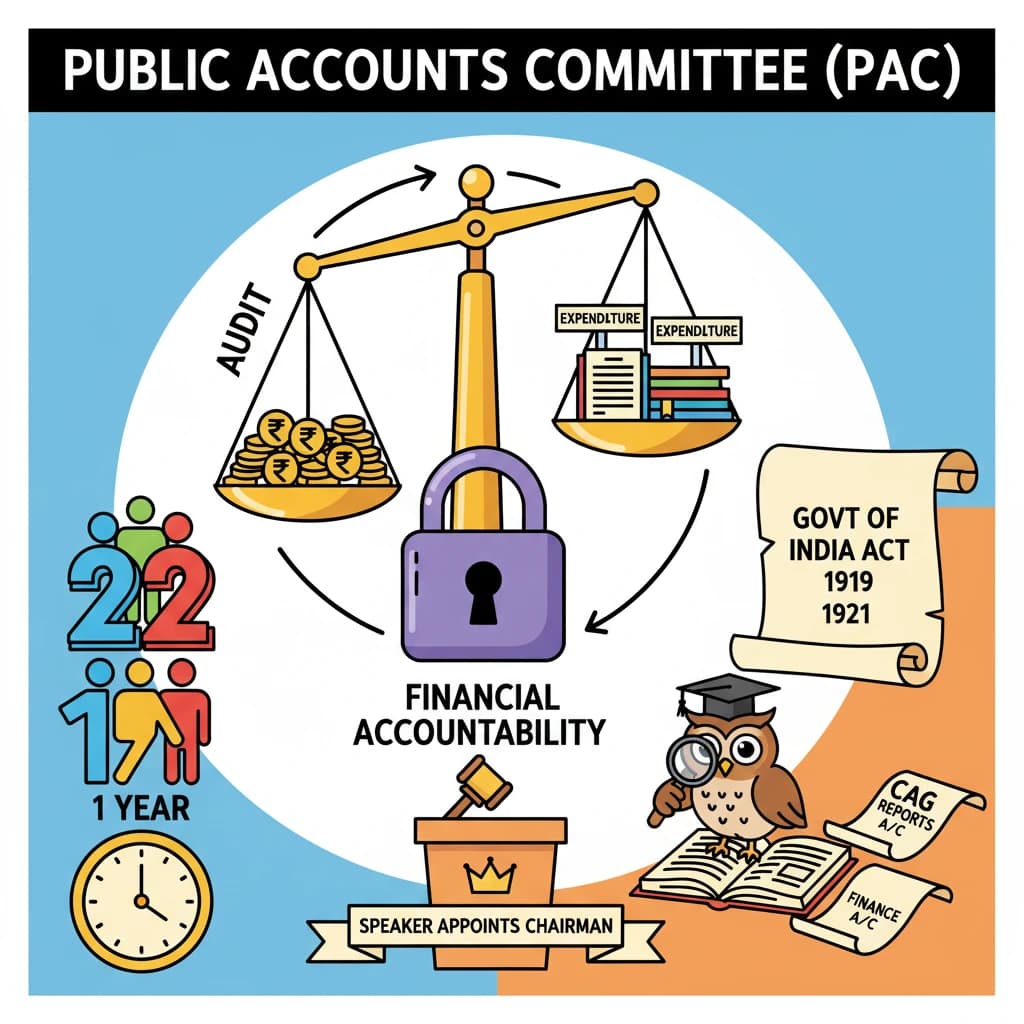
  • Established in 1921 under the Government of India Act, 1919.
  • Comprises 22 members (15 Lok Sabha, 7 Rajya Sabha) for a one-year term; Chairman appointed by Lok Sabha Speaker.
  • Examines CAG audit reports, appropriation accounts, and finance accounts.
  • Recommendations are advisory, not binding on the government.
  • No minister can be a member, ensuring impartiality.
Public Accounts Committee (PAC)

Public Accounts Committee (PAC)

Medium⏱️ 6 min read✓ 95% Verified
polity and governance

📖 Introduction

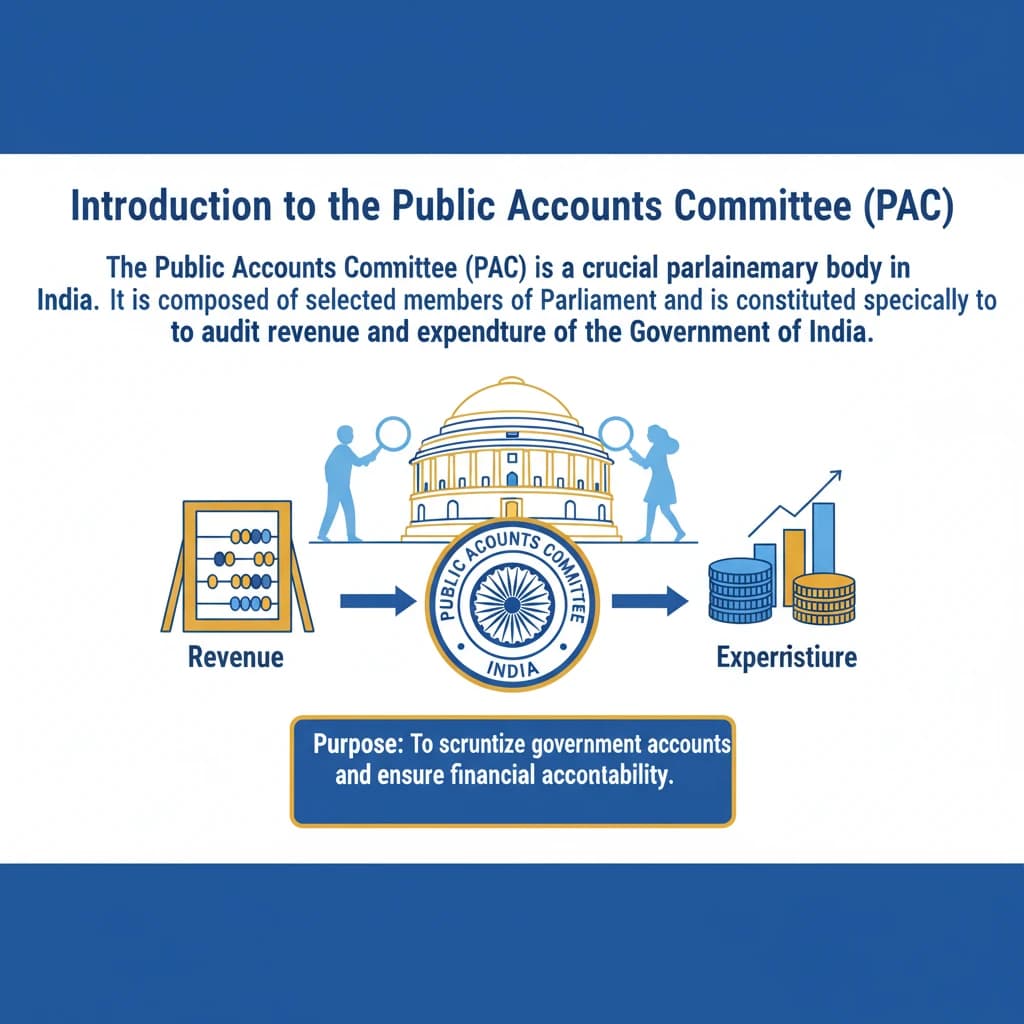
<h4>Introduction to the Public Accounts Committee (PAC)</h4><p>The <strong>Public Accounts Committee (PAC)</strong> is a crucial parliamentary body in India. It is composed of selected members of <strong>Parliament</strong> and is constituted specifically to audit the <strong>revenue</strong> and <strong>expenditure</strong> of the <strong>Government of India</strong>.</p><div class='info-box'><p><strong>Purpose:</strong> To scrutinize government accounts and ensure financial accountability.</p></div><h4>Constitutional Basis and Nature</h4><p><strong>Parliamentary committees</strong>, including the PAC, derive their authority from <strong>Article 105</strong> (powers, privileges, etc., of members of Parliament) and <strong>Article 118</strong> (rules of procedure) of the <strong>Constitution of India</strong>.</p><p>The PAC is one of the three significant <strong>Financial Parliamentary Committees</strong>. The other two are the <strong>Estimates Committee</strong> and the <strong>Committee on Public Undertakings</strong>.</p><div class='key-point-box'><p><strong>Key Restriction:</strong> No member of the PAC can hold a position as a <strong>government minister</strong>. This ensures impartiality in its oversight functions.</p></div><h4>Historical Background and Formation</h4><p>The establishment of the <strong>PAC</strong> dates back to <strong>1921</strong>. Its first mention was in the <strong>Government of India Act, 1919</strong>, famously known as the <strong>Montford Reforms</strong>.</p><p>The Committee is constituted <strong>every year</strong>. This annual formation is done under <strong>Rule 308</strong> of the <strong>Rules of Procedure and Conduct of Business in Lok Sabha</strong>.</p><h4>Composition of the Committee</h4><p>Presently, the <strong>Public Accounts Committee</strong> comprises a total of <strong>22 members</strong>. These members serve for a term of <strong>one year only</strong>.</p><ul><li><strong>15 members</strong> are elected by the <strong>Lok Sabha Speaker</strong> from among its members.</li><li><strong>7 members</strong> are elected by the <strong>Rajya Sabha Chairman</strong> from among its members.</li></ul><p>The <strong>Chairman</strong> of the Committee is appointed by the <strong>Speaker of Lok Sabha</strong>. Traditionally, the Chairman is from the opposition party, reinforcing its oversight role.</p><h4>Powers and Functions of the PAC</h4><p>The PAC performs several critical functions to ensure financial propriety and accountability:</p><ul><li>It examines the <strong>accounts showing the appropriation of funds</strong> granted by the House for expenditure.</li><li>It reviews the <strong>annual Finance Accounts</strong> of the government.</li><li>The Committee also reviews other accounts presented to the House that it deems appropriate. However, it excludes those related to <strong>Public Undertakings</strong>, as these are assigned to the <strong>Committee on Public Undertakings</strong>.</li><li>A significant function involves reviewing various <strong>Comptroller and Auditor General (CAG) Audit Reports</strong>. These reports cover revenue receipts, government expenditure by different Ministries/Departments, and accounts of autonomous bodies.</li></ul><div class='info-box'><p><strong>Crucial Assistance:</strong> The <strong>Comptroller and Auditor General (CAG)</strong> actively assists the committee during its investigations, providing expert insights and audit findings.</p></div><h4>Nature of Recommendations</h4><p>The recommendations made by the <strong>PAC</strong> are <strong>advisory</strong> in nature. They are <strong>not binding</strong> on the government.</p><p>This is because the PAC is an executive body that cannot issue direct orders. Ultimately, only <strong>Parliament</strong> as a whole can take a final decision on the committee's findings and recommendations.</p><div class='exam-tip-box'><p><strong>UPSC Insight:</strong> Understanding the <strong>advisory nature</strong> of PAC recommendations is crucial. While not binding, they carry significant moral and political weight, often leading to corrective action by the government.</p></div>
Concept Diagram

💡 Key Takeaways

  • •PAC audits government revenue and expenditure, ensuring financial accountability.
  • •Established in 1921 under the Government of India Act, 1919.
  • •Comprises 22 members (15 Lok Sabha, 7 Rajya Sabha) for a one-year term; Chairman appointed by Lok Sabha Speaker.
  • •Examines CAG audit reports, appropriation accounts, and finance accounts.
  • •Recommendations are advisory, not binding on the government.
  • •No minister can be a member, ensuring impartiality.

🧠 Memory Techniques
Memory Aid
95% Verified Content

Related Topics

Loading related topics...
Explore:Polity And Governance Topics·All Subjects·Daily Current Affairs·Editorial Analysis·Previous Year Questions·UPSC GPT