Loading page, please wait…
Vaidra Logo
Vaidra

Top 4 items + smart groups

UPSC GPT
New
Current Affairs
Daily Solutions
Daily Puzzle
Mains Evaluator

Version 2.0.0 • Built with ❤️ for UPSC aspirants

Loading...
Loading...
Loading...
Loading...
Loading...
Loading...
Loading...
Loading...
Loading...
Loading...
Loading...
Loading...
Loading...

No Detention Policy - UPSC Polity And Governance

What is No Detention Policy in UPSC Polity And Governance?

No Detention Policy is a key topic under Polity And Governance for UPSC Civil Services Examination. Key points include: NDP was introduced under Section 16 of the RTE Act, 2009.. It prohibited detention or expulsion of children up to Class 8.. Primary aim was to reduce dropout rates and eliminate fear of failure.. Understanding this topic is essential for both UPSC Prelims and Mains preparation.

Why is No Detention Policy important for UPSC exam?

No Detention Policy is a Medium-level topic in UPSC Polity And Governance. It is tested in both Prelims (factual MCQs) and Mains (analytical answer writing). Previous year UPSC questions have frequently covered aspects of No Detention Policy, making it essential for comprehensive IAS preparation.

How to prepare No Detention Policy for UPSC?

To prepare No Detention Policy for UPSC: (1) Study the comprehensive notes covering all key concepts on Vaidra. (2) Practice previous year questions on this topic. (3) Connect it with current affairs using daily updates. (4) Revise using key takeaways and mind maps available for Polity And Governance. (5) Write practice answers linking No Detention Policy to related GS Paper topics.

Key takeaways of No Detention Policy for UPSC

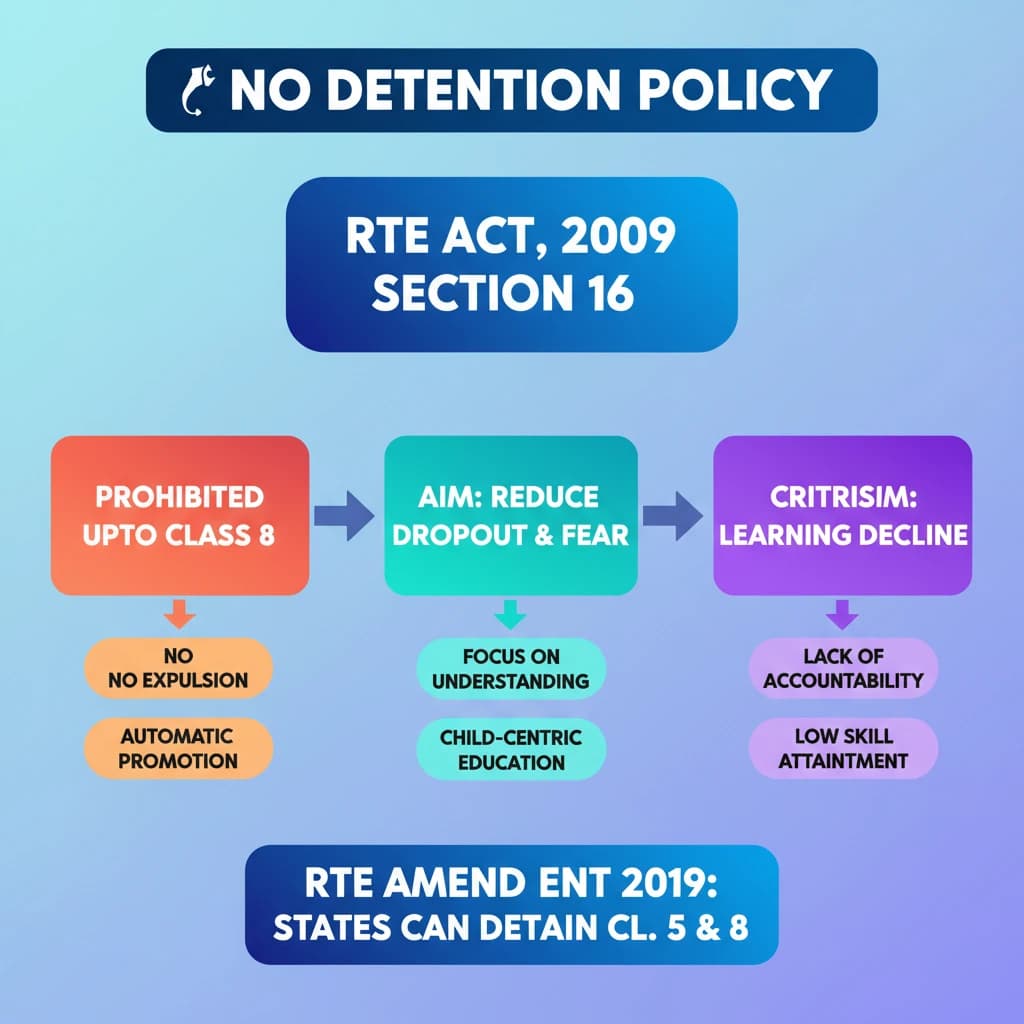
  • NDP was introduced under Section 16 of the RTE Act, 2009.
  • It prohibited detention or expulsion of children up to Class 8.
  • Primary aim was to reduce dropout rates and eliminate fear of failure.
  • Criticized for leading to declining learning outcomes and lack of accountability.
  • The RTE Act was amended in 2019, allowing states to reintroduce detention in Class 5 and Class 8.

No Detention Policy

No Detention Policy

Medium⏱️ 6 min read✓ 98% Verified
polity and governance

📖 Introduction

<h4>Introduction to No Detention Policy</h4><p>The <strong>No Detention Policy (NDP)</strong> was a significant provision introduced under the <strong>Right to Education (RTE) Act</strong>.</p><div class='info-box'><p>It was specifically enshrined in <strong>Section 16</strong> of the <strong>Right of Children to Free and Compulsory Education Act, 2009</strong>.</p></div><h4>Core Provisions of Section 16 of RTE Act</h4><p><strong>Section 16</strong> of the <strong>RTE Act</strong> outlined two primary stipulations concerning elementary education.</p><ul><li><strong>No expulsion:</strong> No child receiving <strong>elementary education</strong> shall be expelled from school.</li><li><strong>No retention:</strong> No child shall be retained or failed in any class up to <strong>Class 8</strong>.</li></ul><h4>Objective and Rationale</h4><p>The main objective of the <strong>No Detention Policy</strong> was to ensure that all children receive a <strong>minimum level of education</strong> without the fear of failure.</p><div class='key-point-box'><p>It aimed to remove the <strong>fear of failure</strong> among students, which was often cited as a major reason for high <strong>dropout rates</strong>, especially in primary and upper primary stages.</p></div><div class='exam-tip-box'><p>Understanding the <strong>rationale</strong> behind NDP is crucial for analyzing its impact and the subsequent debates around its continuation or repeal. This is often a topic in <strong>UPSC GS Paper II (Social Justice)</strong>.</p></div>
Concept Diagram

💡 Key Takeaways

  • •NDP was introduced under Section 16 of the RTE Act, 2009.
  • •It prohibited detention or expulsion of children up to Class 8.
  • •Primary aim was to reduce dropout rates and eliminate fear of failure.
  • •Criticized for leading to declining learning outcomes and lack of accountability.
  • •The RTE Act was amended in 2019, allowing states to reintroduce detention in Class 5 and Class 8.

🧠 Memory Techniques
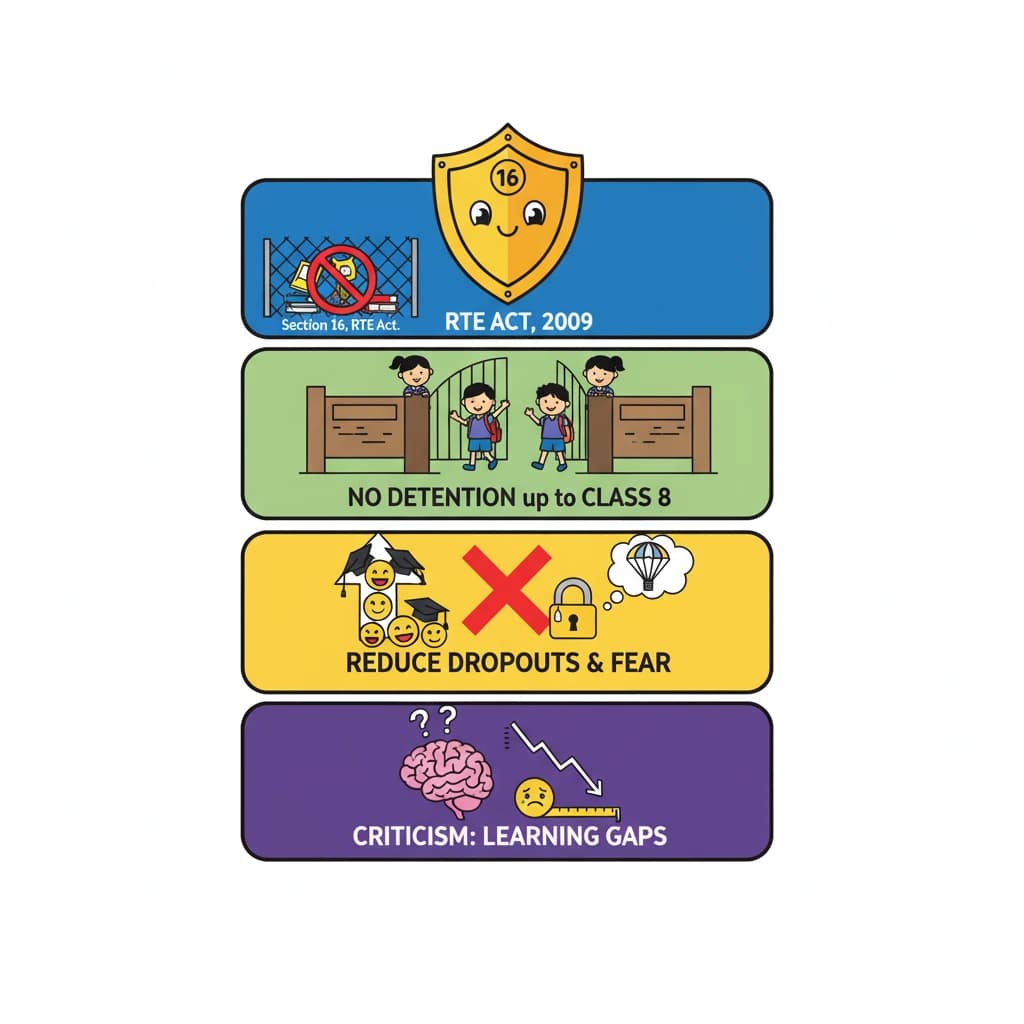
Memory Aid
98% Verified Content

📚 Reference Sources

•The Right of Children to Free and Compulsory Education (Amendment) Act, 2019
•Annual Status of Education Report (ASER) findings
•Reports of various Education Commissions (Kothari Commission, Santhanam Committee)

Related Topics

Loading related topics...
Explore:Polity And Governance Topics·All Subjects·Daily Current Affairs·Editorial Analysis·Previous Year Questions·UPSC GPT
Back
All Subjects

Topics

0 topics • 0 completed

Loading topics...
Loading...
Loading...
Loading...
Loading...
Loading...
Overall Progress0%
No Detention Policy - UPSC Polity And Governance