Loading page, please wait…
Vaidra Logo
Vaidra

Top 4 items + smart groups

UPSC GPT
New
Current Affairs
Daily Solutions
Daily Puzzle
Mains Evaluator

Version 2.0.0 • Built with ❤️ for UPSC aspirants

Loading...
Loading...
Loading...
Loading...
Loading...
Loading...
Loading...
Loading...
Loading...
Loading...
Loading...
Loading...
Loading...
What are SC’s Ruling Related to the Tenth Schedule and Rajya Sabha Election? - UPSC Polity And Governance
Back
All Subjects

Topics

0 topics • 0 completed

Loading topics...
Loading...
Loading...
Loading...
Loading...
Loading...
Overall Progress0%

What are SC’s Ruling Related to the Tenth Schedule and Rajya Sabha Election? - UPSC Polity And Governance

What is What are SC’s Ruling Related to the Tenth Schedule and Rajya Sabha Election? in UPSC Polity And Governance?

What are SC’s Ruling Related to the Tenth Schedule and Rajya Sabha Election? is a key topic under Polity And Governance for UPSC Civil Services Examination. Key points include: The SC upheld the open ballot system for Rajya Sabha elections (Kuldip Nayar, 2006) to ensure transparency and curb corruption.. Voting against a party candidate in Rajya Sabha elections does NOT automatically lead to Tenth Schedule disqualification for an MLA; only disciplinary action by the party (Kuldip Nayar, 2006).. Voluntarily giving up party membership under the Tenth Schedule is broader than formal resignation; it can be inferred from a member's conduct inside and outside the House (Ravi S. Naik, 1994).. Understanding this topic is essential for both UPSC Prelims and Mains preparation.

Why is What are SC’s Ruling Related to the Tenth Schedule and Rajya Sabha Election? important for UPSC exam?

What are SC’s Ruling Related to the Tenth Schedule and Rajya Sabha Election? is a Medium-level topic in UPSC Polity And Governance. It is tested in both Prelims (factual MCQs) and Mains (analytical answer writing). Previous year UPSC questions have frequently covered aspects of What are SC’s Ruling Related to the Tenth Schedule and Rajya Sabha Election?, making it essential for comprehensive IAS preparation.

How to prepare What are SC’s Ruling Related to the Tenth Schedule and Rajya Sabha Election? for UPSC?

To prepare What are SC’s Ruling Related to the Tenth Schedule and Rajya Sabha Election? for UPSC: (1) Study the comprehensive notes covering all key concepts on Vaidra. (2) Practice previous year questions on this topic. (3) Connect it with current affairs using daily updates. (4) Revise using key takeaways and mind maps available for Polity And Governance. (5) Write practice answers linking What are SC’s Ruling Related to the Tenth Schedule and Rajya Sabha Election? to related GS Paper topics.

Key takeaways of What are SC’s Ruling Related to the Tenth Schedule and Rajya Sabha Election? for UPSC

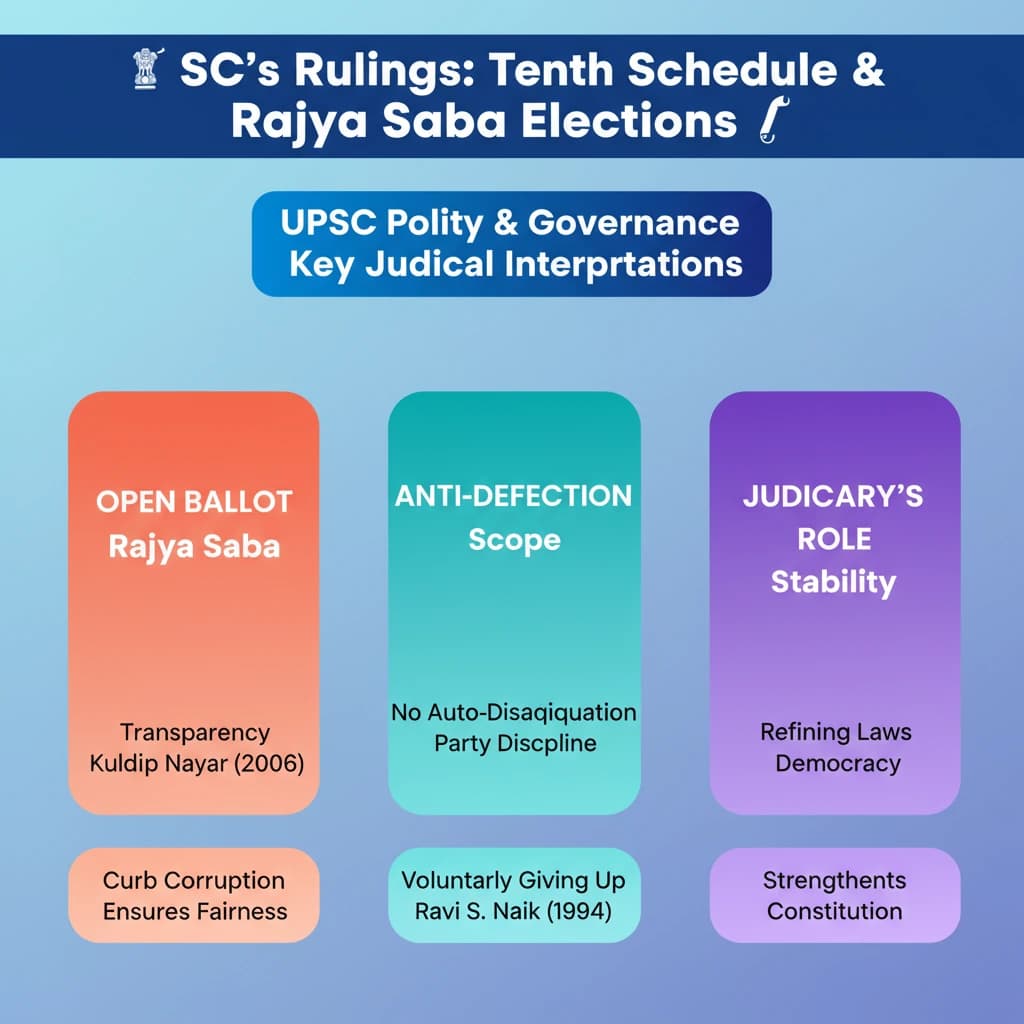
  • The SC upheld the open ballot system for Rajya Sabha elections (Kuldip Nayar, 2006) to ensure transparency and curb corruption.
  • Voting against a party candidate in Rajya Sabha elections does NOT automatically lead to Tenth Schedule disqualification for an MLA; only disciplinary action by the party (Kuldip Nayar, 2006).
  • Voluntarily giving up party membership under the Tenth Schedule is broader than formal resignation; it can be inferred from a member's conduct inside and outside the House (Ravi S. Naik, 1994).
  • The Anti-defection Law aims to ensure political stability and party discipline by preventing opportunistic defections.
  • These rulings highlight the judiciary's role in refining and strengthening constitutional provisions related to parliamentary democracy.
What are SC’s Ruling Related to the Tenth Schedule and Rajya Sabha Election?

What are SC’s Ruling Related to the Tenth Schedule and Rajya Sabha Election?

Medium⏱️ 6 min read✓ 98% Verified
polity and governance

📖 Introduction

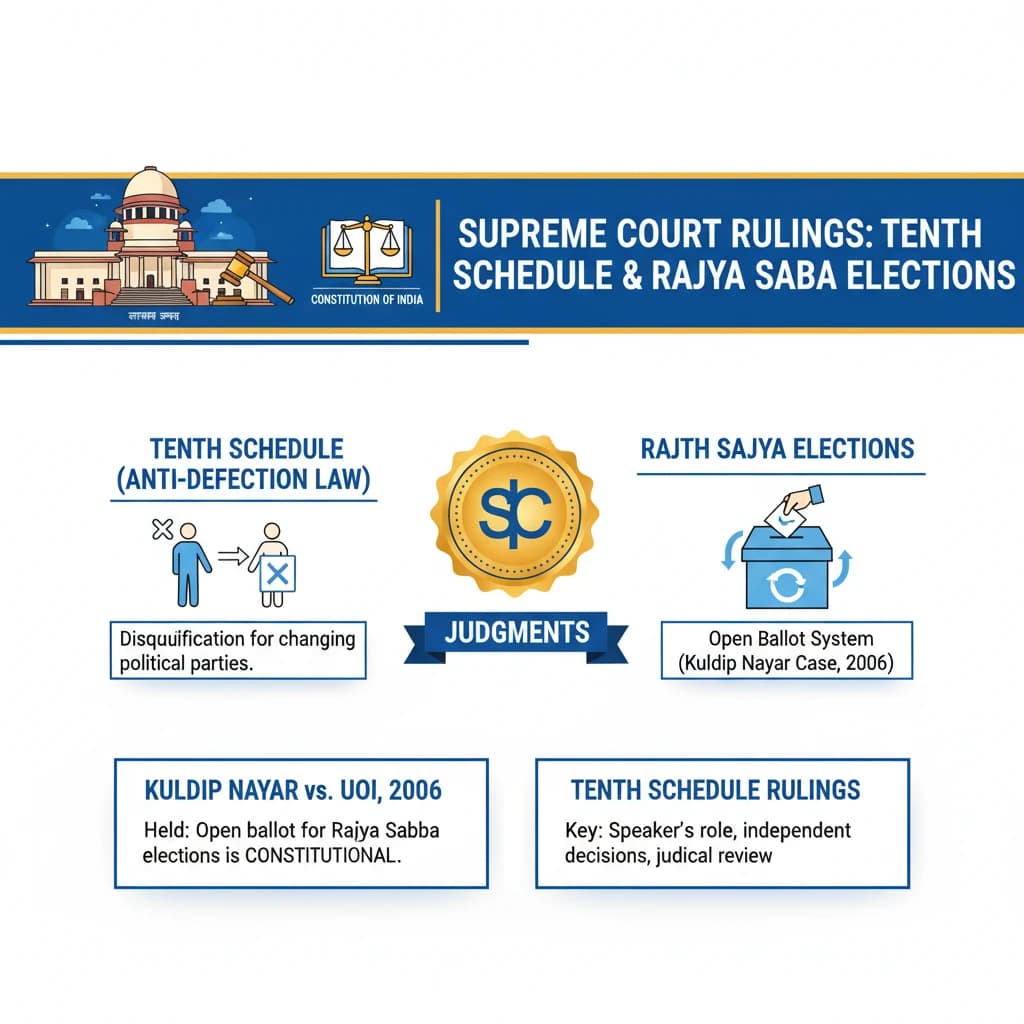
<h4>Supreme Court Rulings on Tenth Schedule and Rajya Sabha Elections</h4><p>The <strong>Supreme Court (SC)</strong> has delivered significant judgments that clarify the application of the <strong>Tenth Schedule</strong> (Anti-defection Law) and the procedure for <strong>Rajya Sabha elections</strong>. These rulings are crucial for understanding India's parliamentary democracy and party discipline.</p><h4>Kuldip Nayar vs. Union of India, 2006</h4><div class='info-box'><p><strong>Case:</strong> Kuldip Nayar vs. Union of India</p><p><strong>Year:</strong> 2006</p><p><strong>Key Area:</strong> Open ballot system for Rajya Sabha elections and disqualification under Tenth Schedule.</p></div><p>In this landmark case, the <strong>Supreme Court</strong> upheld the controversial system of <strong>open ballot</strong> for <strong>Rajya Sabha elections</strong>. The Court reasoned that if <strong>secrecy</strong> could become a source of <strong>corruption</strong>, then <strong>transparency</strong> possessed the capacity to eliminate it.</p><p>However, the Court also clarified a critical aspect concerning the <strong>Tenth Schedule</strong>. It held that an <strong>elected MLA</strong> of a political party would <strong>not face disqualification</strong> under the <strong>Tenth Schedule</strong> merely for <strong>voting against their party candidate</strong> in a <strong>Rajya Sabha election</strong>.</p><div class='key-point-box'><p>An <strong>MLA</strong> voting against the party candidate in <strong>Rajya Sabha elections</strong> may, at most, attract <strong>disciplinary action</strong> from their respective <strong>political party</strong>. This conduct alone does not constitute 'voluntarily giving up membership' or 'voting against party whip' in the context of the <strong>Tenth Schedule</strong> for disqualification from the legislature.</p></div><div class='exam-tip-box'><p>This ruling is vital for understanding the distinction between <strong>party discipline</strong> and <strong>constitutional disqualification</strong>. It highlights the limited scope of the <strong>Tenth Schedule</strong> in specific electoral contexts like <strong>Rajya Sabha polls</strong>. UPSC often tests nuances of <strong>Anti-defection Law</strong>.</p></div><h4>Ravi S. Naik and Sanjay Bandekar vs. Union of India, 1994</h4><div class='info-box'><p><strong>Case:</strong> Ravi S. Naik and Sanjay Bandekar vs. Union of India</p><p><strong>Year:</strong> 1994</p><p><strong>Key Area:</strong> Interpretation of "voluntarily giving up membership" under the Tenth Schedule.</p></div><p>The <strong>Supreme Court</strong> in this case provided a broader interpretation of what constitutes <strong>"voluntarily giving up membership"</strong> of a political party under the <strong>Tenth Schedule</strong>. This phrase is not restricted to merely formally <strong>resigning from the party</strong> to which a member belongs.</p><p>The Court stated that the <strong>conduct of a member</strong>, both <strong>inside and outside the House</strong>, can be examined to infer whether it qualifies as <strong>voluntarily giving up membership</strong>. This implies that actions, not just formal declarations, can lead to disqualification.</p><div class='key-point-box'><p>This ruling established that <strong>implied resignation</strong> through a member's actions or public statements can be grounds for disqualification under the <strong>Anti-defection Law</strong>, even without a formal resignation letter.</p></div><div class='exam-tip-box'><p>Understanding this interpretation is crucial for analyzing cases of defection and the powers of the <strong>Presiding Officer</strong> in deciding disqualification petitions. It expands the scope beyond explicit resignation, making <strong>conduct</strong> a key factor. Relevant for <strong>GS Paper 2: Polity</strong>.</p></div>
Concept Diagram

💡 Key Takeaways

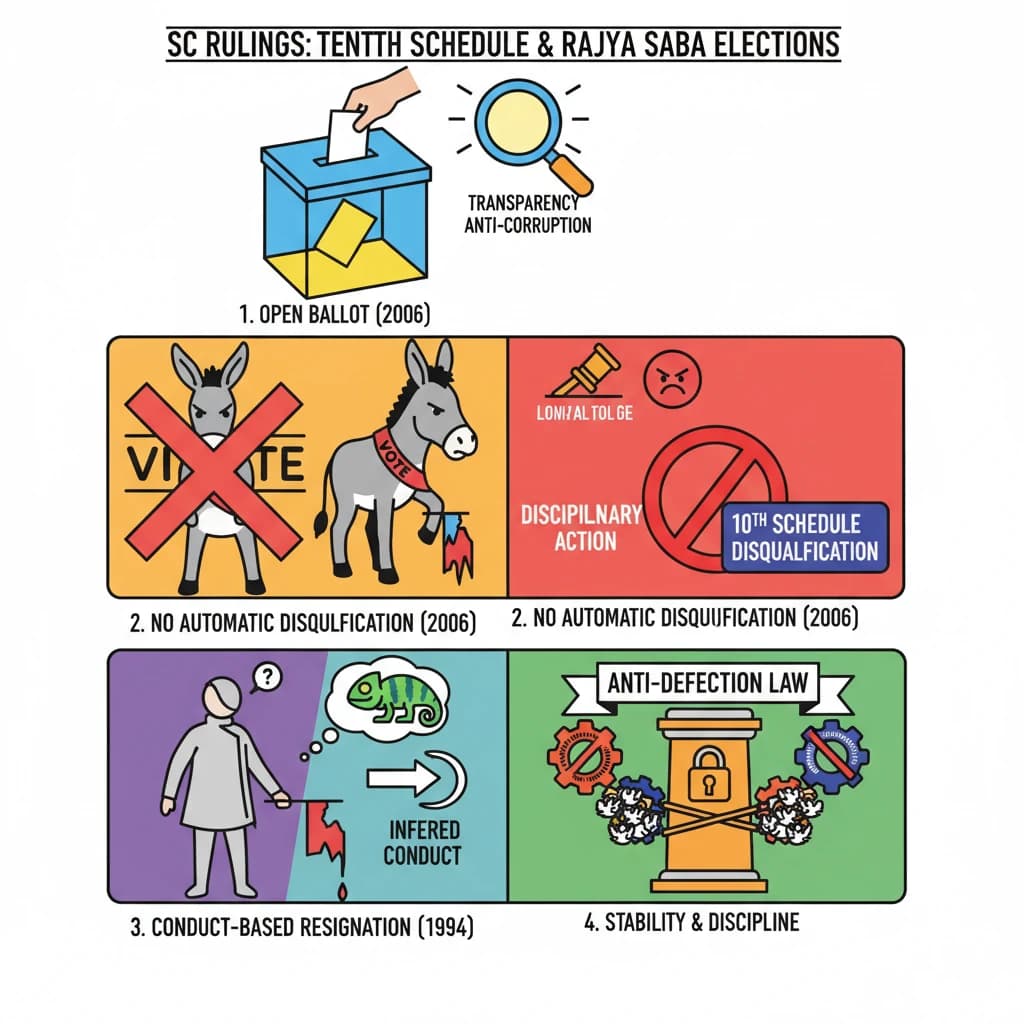
  • •The SC upheld the open ballot system for Rajya Sabha elections (Kuldip Nayar, 2006) to ensure transparency and curb corruption.
  • •Voting against a party candidate in Rajya Sabha elections does NOT automatically lead to Tenth Schedule disqualification for an MLA; only disciplinary action by the party (Kuldip Nayar, 2006).
  • •Voluntarily giving up party membership under the Tenth Schedule is broader than formal resignation; it can be inferred from a member's conduct inside and outside the House (Ravi S. Naik, 1994).
  • •The Anti-defection Law aims to ensure political stability and party discipline by preventing opportunistic defections.
  • •These rulings highlight the judiciary's role in refining and strengthening constitutional provisions related to parliamentary democracy.

🧠 Memory Techniques
Memory Aid
98% Verified Content

📚 Reference Sources

•The Constitution of India (Tenth Schedule)
•Supreme Court judgments: Kuldip Nayar vs. Union of India, 2006
•Supreme Court judgments: Ravi S. Naik and Sanjay Bandekar vs. Union of India, 1994

Related Topics

Loading related topics...
Explore:Polity And Governance Topics·All Subjects·Daily Current Affairs·Editorial Analysis·Previous Year Questions·UPSC GPT