Loading page, please wait…
Vaidra Logo
Vaidra

Top 4 items + smart groups

UPSC GPT
New
Current Affairs
Daily Solutions
Daily Puzzle
Mains Evaluator

Version 2.0.0 • Built with ❤️ for UPSC aspirants

Loading...
Loading...
Loading...
Loading...
Loading...
Loading...
Loading...
Loading...
Loading...
Loading...
Loading...
Loading...
Loading...
Back
All Subjects

Topics

0 topics • 0 completed

Loading topics...
Loading...
Loading...
Loading...
Loading...
Loading...
Overall Progress0%

Diplomatic Passport - UPSC Polity And Governance

What is Diplomatic Passport in UPSC Polity And Governance?

Diplomatic Passport is a key topic under Polity And Governance for UPSC Civil Services Examination. Key points include: Diplomatic passports (Type D) are issued for official government business abroad.. They are issued by the Ministry of External Affairs to IFS officers, Union Ministers, and MPs.. These passports confer specific legal privileges and immunities under international law.. Understanding this topic is essential for both UPSC Prelims and Mains preparation.

Why is Diplomatic Passport important for UPSC exam?

Diplomatic Passport is a Medium-level topic in UPSC Polity And Governance. It is tested in both Prelims (factual MCQs) and Mains (analytical answer writing). Previous year UPSC questions have frequently covered aspects of Diplomatic Passport, making it essential for comprehensive IAS preparation.

How to prepare Diplomatic Passport for UPSC?

To prepare Diplomatic Passport for UPSC: (1) Study the comprehensive notes covering all key concepts on Vaidra. (2) Practice previous year questions on this topic. (3) Connect it with current affairs using daily updates. (4) Revise using key takeaways and mind maps available for Polity And Governance. (5) Write practice answers linking Diplomatic Passport to related GS Paper topics.

Key takeaways of Diplomatic Passport for UPSC

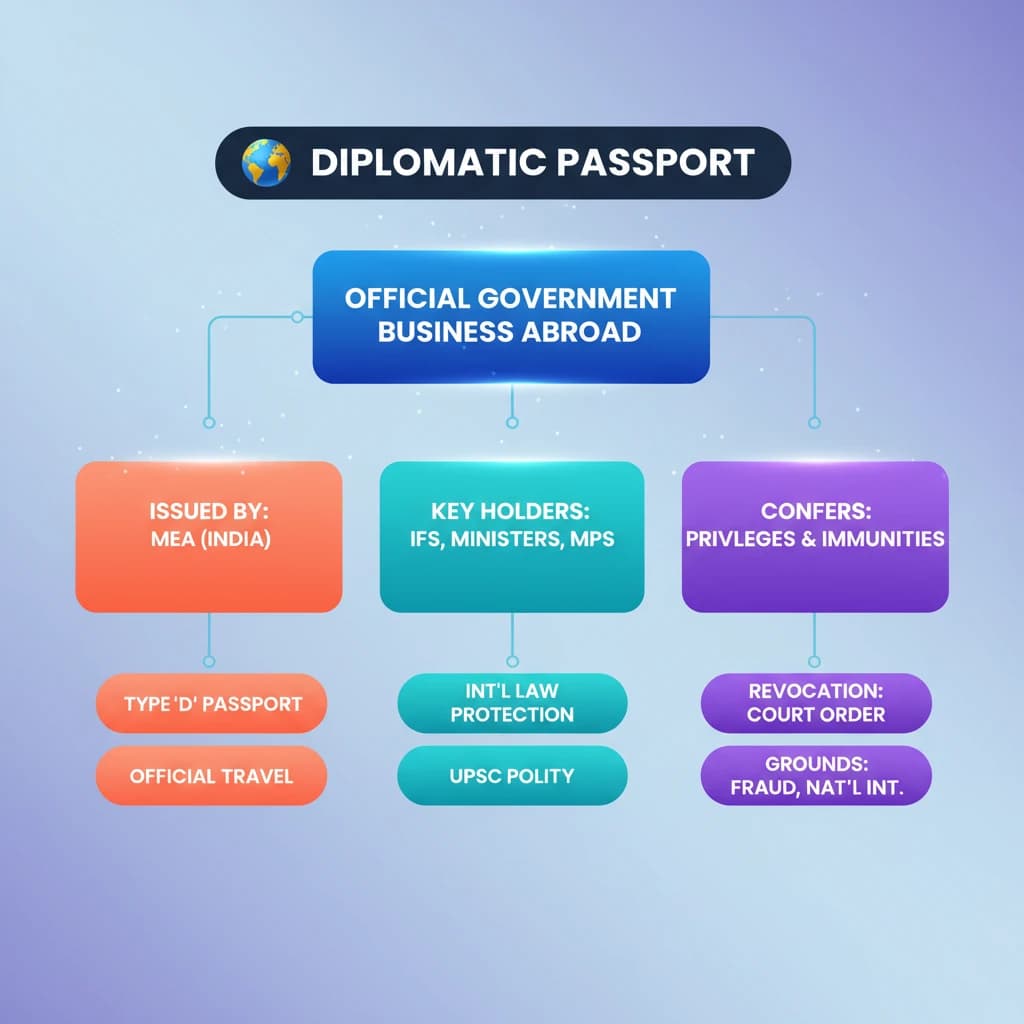
  • Diplomatic passports (Type D) are issued for official government business abroad.
  • They are issued by the Ministry of External Affairs to IFS officers, Union Ministers, and MPs.
  • These passports confer specific legal privileges and immunities under international law.
  • Revocation authority lies with the passport authority but requires a court order.
  • Grounds for revocation include wrongful possession, fraud, national interest, or criminal proceedings.
  • Diplomatic passports differ from regular passports and visas in purpose, issuing authority, and associated privileges.
Diplomatic Passport

Diplomatic Passport

Medium⏱️ 5 min read✓ 90% Verified
polity and governance

📖 Introduction

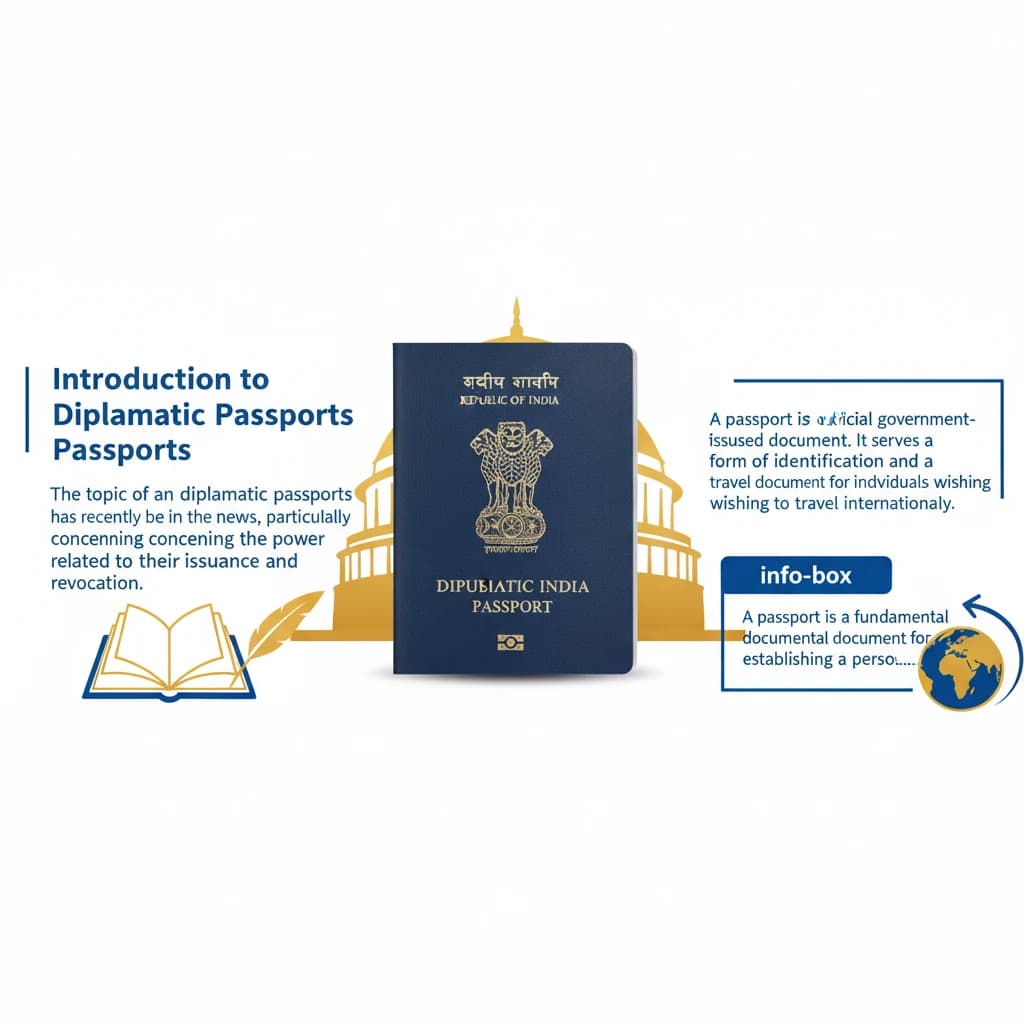
<h4>Introduction to Diplomatic Passports</h4><p>The topic of <strong>diplomatic passports</strong> has recently been in the news, particularly concerning the power related to their issuance and revocation.</p><p>A <strong>passport</strong> is an official government-issued document. It serves as a form of identification and a travel document for individuals wishing to travel internationally.</p><div class='info-box'><p>A <strong>passport</strong> is a fundamental document for establishing a person's <strong>identity</strong> and <strong>nationality</strong> for international travel purposes.</p></div><h4>Understanding Diplomatic Passports (Type D)</h4><p><strong>Diplomatic passports</strong> are specifically issued to individuals representing a country on official <strong>diplomatic missions</strong> or for <strong>government business</strong>.</p><p>These passports are utilized by <strong>diplomats, government officials</strong>, and in some cases, their immediate family members.</p><div class='key-point-box'><p><strong>Diplomatic passports</strong> are a form of identification that carries specific <strong>legal privileges and immunities</strong> under international law.</p></div><p>These privileges include <strong>immunity from arrest, detention</strong>, and certain <strong>legal proceedings</strong> in the host country, facilitating unhindered diplomatic functions.</p><h4>Eligibility for Diplomatic Passports in India</h4><p>In India, the <strong>Ministry of External Affairs’ Consular, Passport & Visa Division</strong> is responsible for issuing <strong>diplomatic passports</strong>.</p><div class='info-box'><p><strong>Diplomatic passports</strong> are also commonly known as <strong>Type D passports</strong>.</p></div><p>Eligibility extends to individuals falling into several specific categories:</p><ul><li><strong>Government-appointed individuals and officers</strong> working under <strong>Branches A and B of the Indian Foreign Service (IFS)</strong> who are traveling abroad for official business.</li><li><strong>Selected individuals on official travel</strong>, which includes <strong>Union Ministers</strong> and <strong>Members of Parliament (MPs)</strong>.</li></ul><h4>Revocation of Diplomatic Passports</h4><p>The authority to revoke a <strong>diplomatic passport</strong> lies with the designated <strong>passport authority</strong>.</p><p>Crucially, the government can only revoke a <strong>diplomatic passport</strong> after a <strong>court order</strong> to that effect has been issued.</p><div class='exam-tip-box'><p>Understanding the <strong>checks and balances</strong> on government power, especially concerning diplomatic instruments, is vital for <strong>UPSC Mains GS-II (Polity)</strong>.</p></div><p>Under the provisions of the <strong>Passport Act of 1967</strong>, a <strong>diplomatic passport</strong> may be revoked under several circumstances:</p><ul><li>If the holder is found to be in <strong>wrongful possession</strong> of the passport.</li><li>If it was obtained through the <strong>suppression of material information</strong>.</li><li>If the <strong>passport authority deems it necessary for India’s interests</strong>.</li><li>If the holder has been <strong>convicted or is facing criminal proceedings</strong> in India.</li></ul><h4>Key Differences: Passport vs. Visa</h4><table class='info-table'><tr><th>Feature</th><th>Passport</th><th>Visa</th></tr><tr><td><strong>Issuing Authority</strong></td><td><strong>Ministry of External Affairs of India</strong></td><td><strong>Embassy or Consulate</strong> of the foreign country</td></tr><tr><td><strong>Purpose</strong></td><td><strong>Proof of Indian citizenship</strong> and identity for international travel</td><td><strong>Permission to enter</strong> a specific foreign country</td></tr><tr><td><strong>Validity</strong></td><td>Typically <strong>10 years</strong></td><td>Varies depending on type, country, and purpose</td></tr><tr><td><strong>Requirement</strong></td><td><strong>Mandatory</strong> for all Indian citizens traveling abroad (with exceptions)</td><td>Varies depending on the country (<strong>visa-free agreements</strong> exist)</td></tr></table>
Concept Diagram

💡 Key Takeaways

  • •Diplomatic passports (Type D) are issued for official government business abroad.
  • •They are issued by the Ministry of External Affairs to IFS officers, Union Ministers, and MPs.
  • •These passports confer specific legal privileges and immunities under international law.
  • •Revocation authority lies with the passport authority but requires a court order.
  • •Grounds for revocation include wrongful possession, fraud, national interest, or criminal proceedings.
  • •Diplomatic passports differ from regular passports and visas in purpose, issuing authority, and associated privileges.

🧠 Memory Techniques

Memory Aid
90% Verified Content

Related Topics

Loading related topics...
Explore:Polity And Governance Topics·All Subjects·Daily Current Affairs·Editorial Analysis·Previous Year Questions·UPSC GPT
Diplomatic Passport - UPSC Polity And Governance