Loading page, please wait…
Vaidra Logo
Vaidra

Top 4 items + smart groups

UPSC GPT
New
Current Affairs
Daily Solutions
Daily Puzzle
Mains Evaluator

Version 2.0.0 • Built with ❤️ for UPSC aspirants

Loading...
Loading...
Loading...
Loading...
Loading...
Loading...
Loading...
Loading...
Loading...
Loading...
Loading...
Loading...
Loading...
International Law Covering Diplomatic Passports - UPSC Polity And Governance
Back
All Subjects

Topics

0 topics • 0 completed

Loading topics...
Loading...
Loading...
Loading...
Loading...
Loading...
Overall Progress0%

International Law Covering Diplomatic Passports - UPSC Polity And Governance

What is International Law Covering Diplomatic Passports in UPSC Polity And Governance?

International Law Covering Diplomatic Passports is a key topic under Polity And Governance for UPSC Civil Services Examination. Key points include: Diplomatic passports are governed by specific international law frameworks.. The Vienna Convention on Diplomatic Relations (1961) is the primary treaty defining diplomatic privileges and immunities.. Operational Visa Exemption Agreements allow visa-free travel for diplomatic passport holders for official purposes.. Understanding this topic is essential for both UPSC Prelims and Mains preparation.

Why is International Law Covering Diplomatic Passports important for UPSC exam?

International Law Covering Diplomatic Passports is a Easy-level topic in UPSC Polity And Governance. It is tested in both Prelims (factual MCQs) and Mains (analytical answer writing). Previous year UPSC questions have frequently covered aspects of International Law Covering Diplomatic Passports, making it essential for comprehensive IAS preparation.

How to prepare International Law Covering Diplomatic Passports for UPSC?

To prepare International Law Covering Diplomatic Passports for UPSC: (1) Study the comprehensive notes covering all key concepts on Vaidra. (2) Practice previous year questions on this topic. (3) Connect it with current affairs using daily updates. (4) Revise using key takeaways and mind maps available for Polity And Governance. (5) Write practice answers linking International Law Covering Diplomatic Passports to related GS Paper topics.

Key takeaways of International Law Covering Diplomatic Passports for UPSC

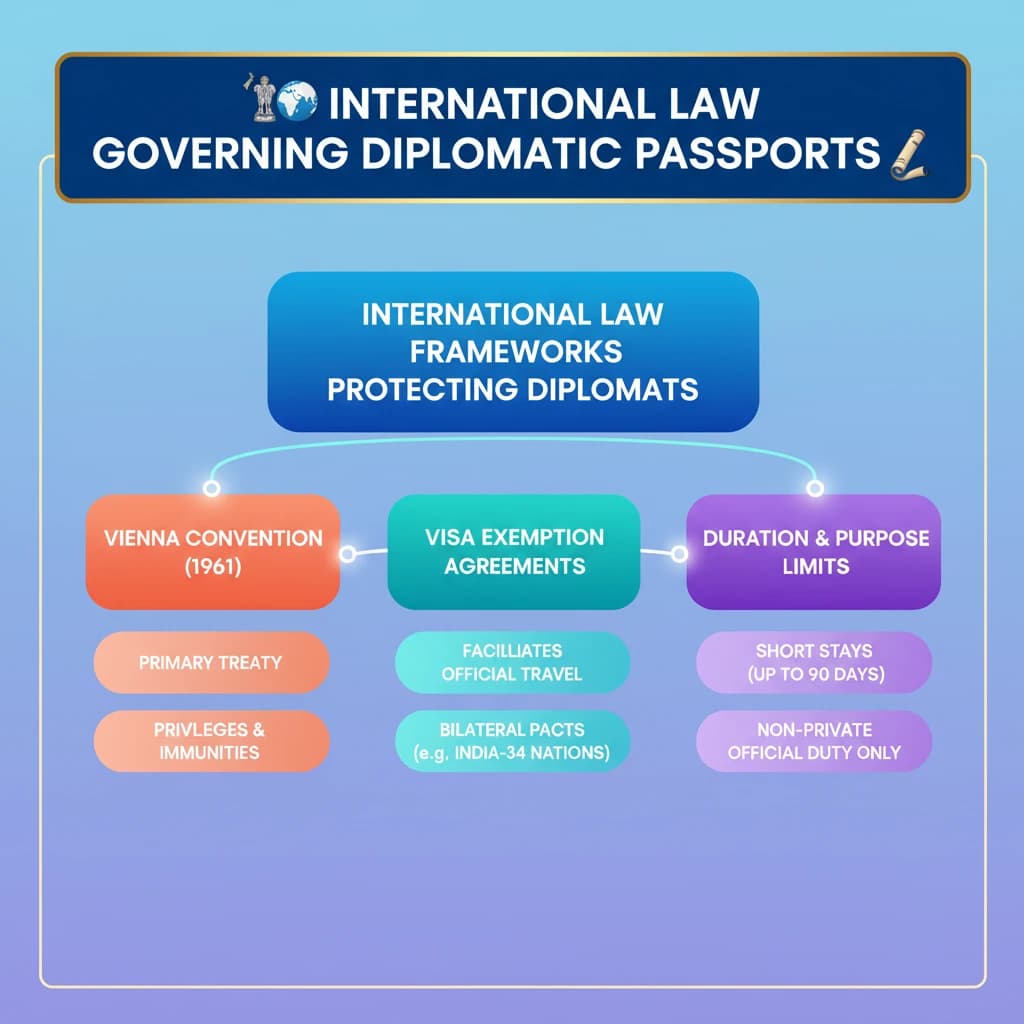
  • Diplomatic passports are governed by specific international law frameworks.
  • The Vienna Convention on Diplomatic Relations (1961) is the primary treaty defining diplomatic privileges and immunities.
  • Operational Visa Exemption Agreements allow visa-free travel for diplomatic passport holders for official purposes.
  • These visa exemptions are typically for short stays, often up to 90 days, and strictly for non-private travel.
  • India has such agreements with 34 countries, including Germany, facilitating its global diplomatic engagement.
International Law Covering Diplomatic Passports

International Law Covering Diplomatic Passports

Easy⏱️ 5 min read✓ 95% Verified
polity and governance

📖 Introduction

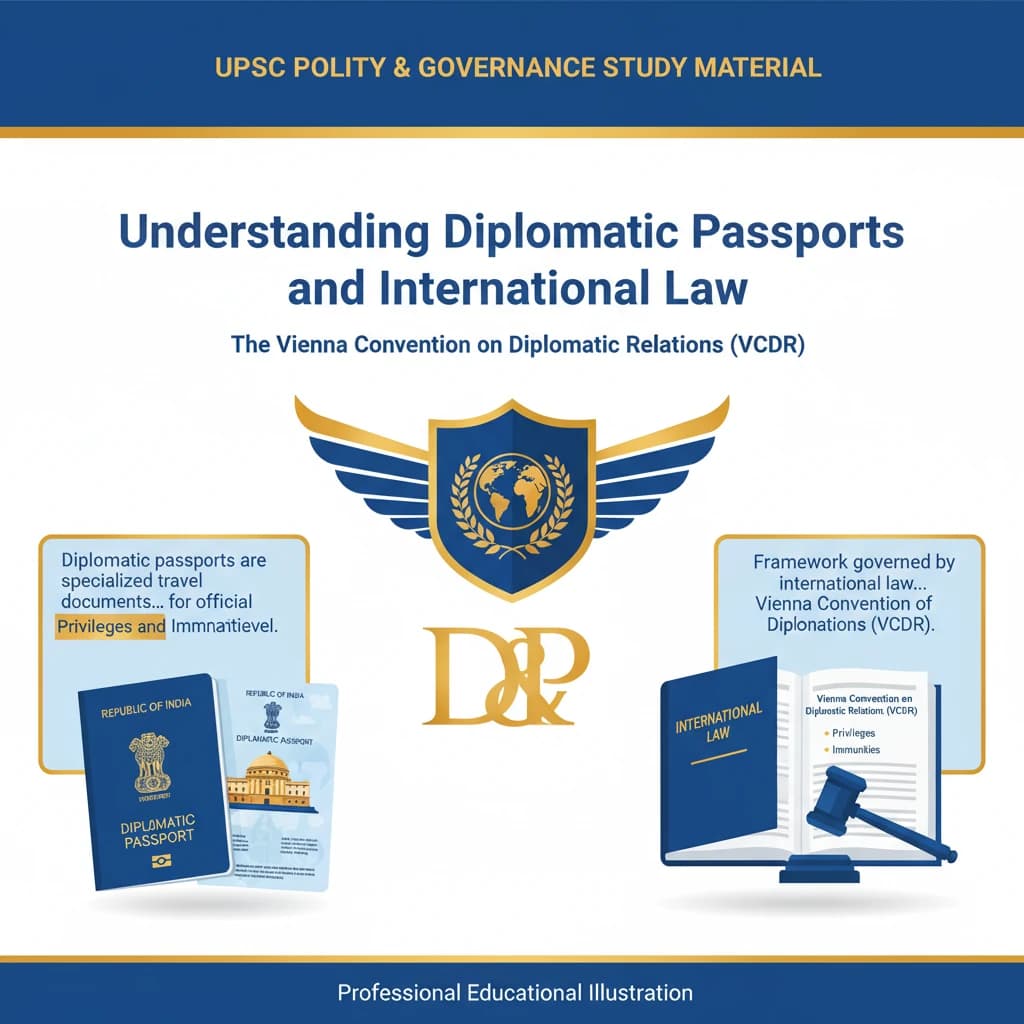
<h4>Understanding Diplomatic Passports and International Law</h4><p><strong>Diplomatic passports</strong> are specialized travel documents issued to government officials, primarily diplomats, for official international travel.</p><p>The framework governing their use, along with associated <strong>privileges</strong> and <strong>immunities</strong>, is firmly rooted in <strong>international law</strong>.</p><h4>The Vienna Convention on Diplomatic Relations (VCDR)</h4><p>The <strong>Vienna Convention on Diplomatic Relations (VCDR)</strong>, adopted in <strong>1961</strong>, stands as a cornerstone treaty in the realm of <strong>international law</strong>.</p><p>This convention meticulously outlines the comprehensive rules and regulations that define <strong>diplomatic law</strong>.</p><div class='key-point-box'><p>The fundamental objective of the <strong>VCDR</strong> is to ensure the efficient and effective performance of the functions of <strong>diplomatic missions</strong> as representatives of their respective states.</p></div><p>A critical component addressed by the <strong>VCDR</strong> is the precise definition and scope of <strong>privileges</strong> and <strong>immunities</strong> granted to individuals holding <strong>diplomatic passports</strong>.</p><div class='info-box'><ul><li><strong>Privileges</strong>: Refer to special advantages or benefits extended to diplomats.</li><li><strong>Immunities</strong>: Grant exemption from the legal jurisdiction or certain obligations of the host state.</li></ul></div><h4>Operational Visa Exemption Agreements</h4><p>In addition to the overarching <strong>VCDR</strong>, many countries forge bilateral <strong>Operational Visa Exemption Agreements</strong>.</p><p>These agreements are designed to significantly streamline and facilitate international travel for holders of <strong>diplomatic passports</strong>.</p><div class='info-box'><p>Under these specific agreements, <strong>diplomatic passport holders</strong> are permitted to enter and visit signatory countries <strong>without the requirement of a prior visa</strong>.</p></div><p>Typically, the duration for such visa-free stays is limited, commonly set at a maximum of <strong>90 days</strong>.</p><p>A crucial stipulation for utilizing this exemption is that the travel must be strictly for <strong>official purposes</strong> and <strong>not for private reasons</strong>.</p><p>This condition ensures that the privilege is exclusively used to support official duties and diplomatic functions.</p><h4>India's Engagement with Visa Exemption Agreements</h4><p><strong>India</strong> actively participates in this system of international cooperation, reinforcing its global diplomatic outreach.</p><p>The nation has successfully established a substantial number of <strong>operational visa exemption agreements</strong> with various countries.</p><div class='info-box'><p>Currently, <strong>India</strong> maintains these vital agreements with a total of <strong>34 countries</strong> worldwide.</p></div><p>A prominent example of a country with which <strong>India</strong> has such a reciprocal agreement is <strong>Germany</strong>.</p><div class='exam-tip-box'><p>Understanding these conventions and agreements is paramount for <strong>UPSC Mains GS-II</strong>, particularly in sections pertaining to <strong>international relations</strong> and the practical implementation of <strong>India's foreign policy</strong>.</p></div>
Concept Diagram

💡 Key Takeaways

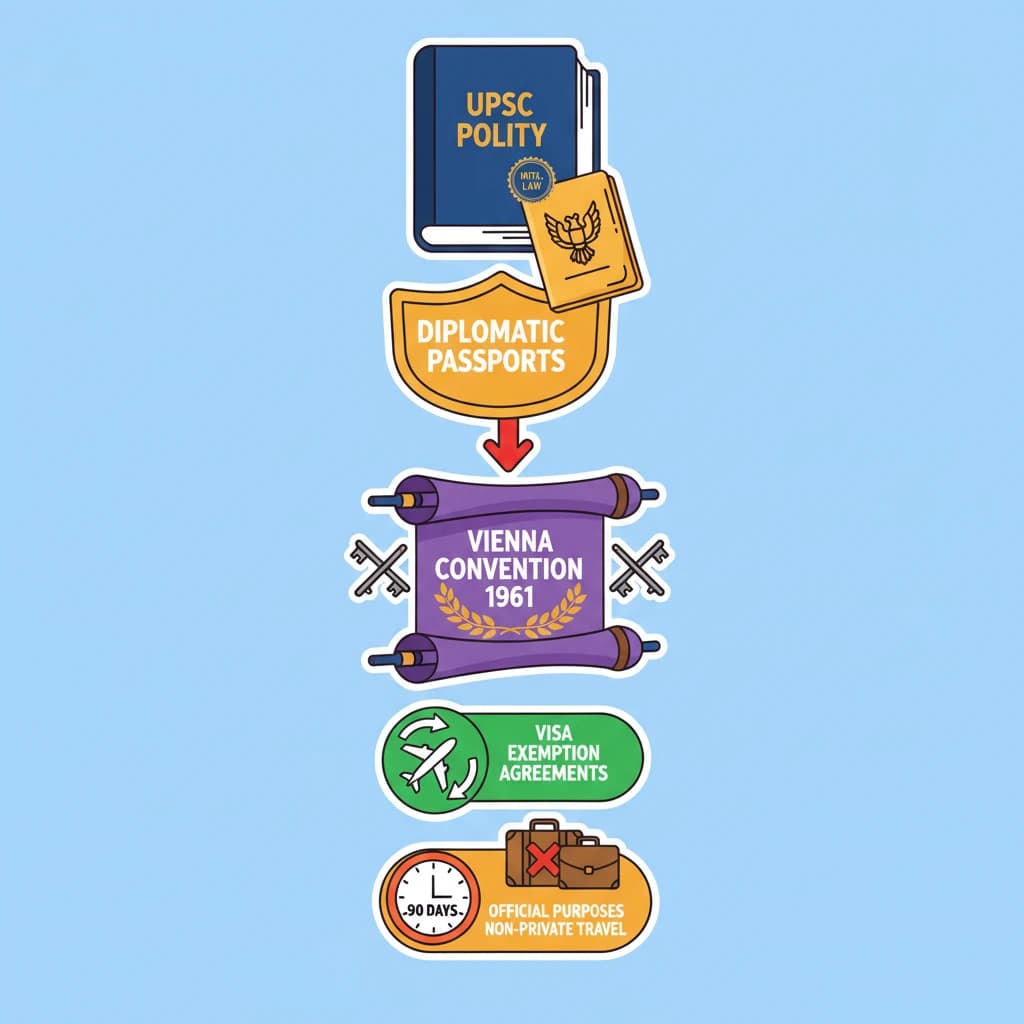
  • •Diplomatic passports are governed by specific international law frameworks.
  • •The Vienna Convention on Diplomatic Relations (1961) is the primary treaty defining diplomatic privileges and immunities.
  • •Operational Visa Exemption Agreements allow visa-free travel for diplomatic passport holders for official purposes.
  • •These visa exemptions are typically for short stays, often up to 90 days, and strictly for non-private travel.
  • •India has such agreements with 34 countries, including Germany, facilitating its global diplomatic engagement.

🧠 Memory Techniques
Memory Aid
95% Verified Content

📚 Reference Sources

•Vienna Convention on Diplomatic Relations (1961)
•Standard International Law Texts on Diplomatic Relations

Related Topics

Loading related topics...
Explore:Polity And Governance Topics·All Subjects·Daily Current Affairs·Editorial Analysis·Previous Year Questions·UPSC GPT