Joint Sitting of Parliament and Leader of House - UPSC Polity And Governance
What is Joint Sitting of Parliament and Leader of House in UPSC Polity And Governance?
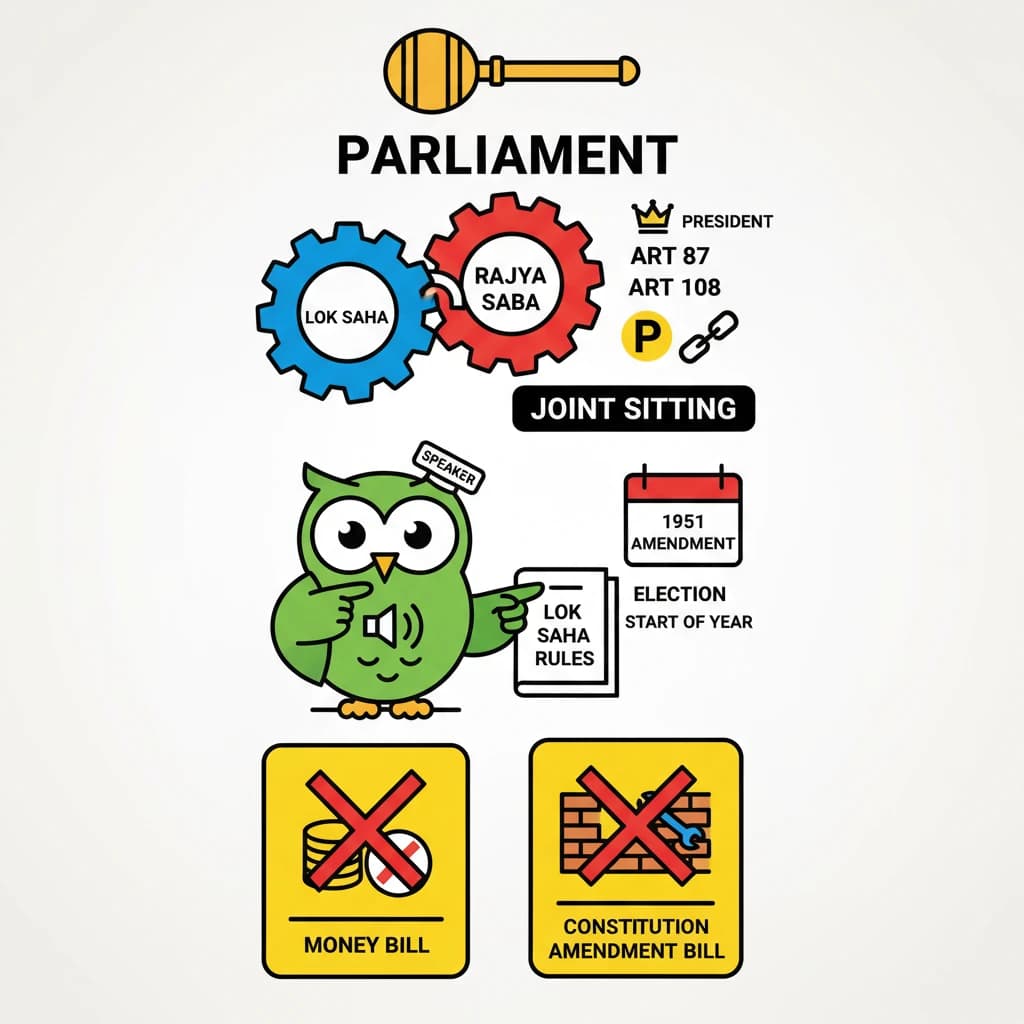
Joint Sitting of Parliament and Leader of House is a key topic under Polity And Governance for UPSC Civil Services Examination. Key points include: Joint Sittings are for Presidential addresses (Article 87) or resolving legislative deadlocks (Article 108).. Article 87 was amended in 1951 for addresses after general elections and at the start of each year.. Joint Sittings for bills are chaired by the Lok Sabha Speaker and follow Lok Sabha rules.. Understanding this topic is essential for both UPSC Prelims and Mains preparation.
Why is Joint Sitting of Parliament and Leader of House important for UPSC exam?
Joint Sitting of Parliament and Leader of House is a Medium-level topic in UPSC Polity And Governance. It is tested in both Prelims (factual MCQs) and Mains (analytical answer writing). Previous year UPSC questions have frequently covered aspects of Joint Sitting of Parliament and Leader of House, making it essential for comprehensive IAS preparation.
How to prepare Joint Sitting of Parliament and Leader of House for UPSC?
To prepare Joint Sitting of Parliament and Leader of House for UPSC: (1) Study the comprehensive notes covering all key concepts on Vaidra. (2) Practice previous year questions on this topic. (3) Connect it with current affairs using daily updates. (4) Revise using key takeaways and mind maps available for Polity And Governance. (5) Write practice answers linking Joint Sitting of Parliament and Leader of House to related GS Paper topics.
Key takeaways of Joint Sitting of Parliament and Leader of House for UPSC
- Joint Sittings are for Presidential addresses (Article 87) or resolving legislative deadlocks (Article 108).
- Article 87 was amended in 1951 for addresses after general elections and at the start of each year.
- Joint Sittings for bills are chaired by the Lok Sabha Speaker and follow Lok Sabha rules.
- Money Bills and Constitution Amendment Bills are exceptions to joint sittings.
- Only three bills (Dowry Prohibition, Banking Service Commission Repeal, POTA) have passed via joint sittings.
- The Leader of the House manages government business; PM is usually LoH in Lok Sabha, a nominated minister in Rajya Sabha.
- LoH is defined by parliamentary rules, not the Constitution.
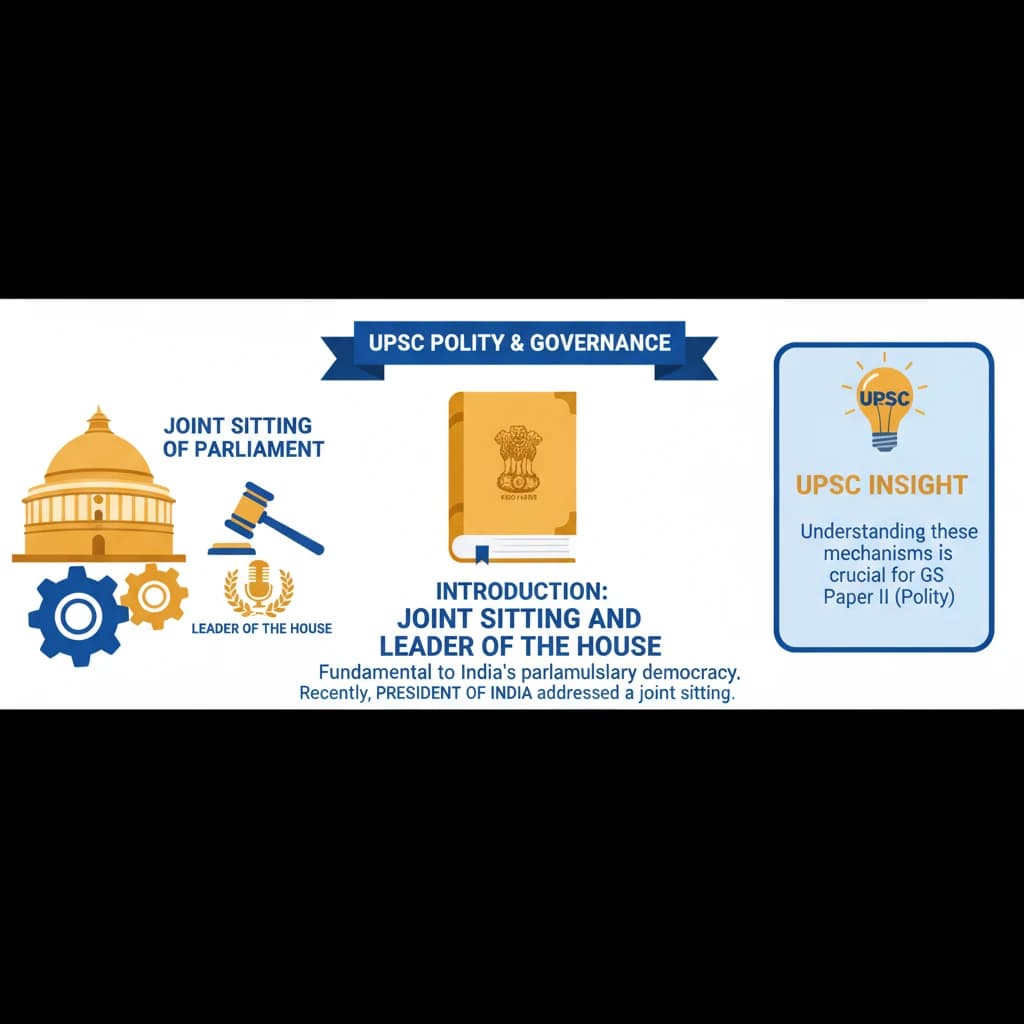
Joint Sitting of Parliament and Leader of House
📖 Introduction
💡 Key Takeaways
- •Joint Sittings are for Presidential addresses (Article 87) or resolving legislative deadlocks (Article 108).
- •Article 87 was amended in 1951 for addresses after general elections and at the start of each year.
- •Joint Sittings for bills are chaired by the Lok Sabha Speaker and follow Lok Sabha rules.
- •Money Bills and Constitution Amendment Bills are exceptions to joint sittings.
- •Only three bills (Dowry Prohibition, Banking Service Commission Repeal, POTA) have passed via joint sittings.
- •The Leader of the House manages government business; PM is usually LoH in Lok Sabha, a nominated minister in Rajya Sabha.
- •LoH is defined by parliamentary rules, not the Constitution.
🧠 Memory Techniques