Loading page, please wait…
Vaidra Logo
Vaidra

Top 4 items + smart groups

UPSC GPT
New
Current Affairs
Daily Solutions
Daily Puzzle
Mains Evaluator

Version 2.0.0 • Built with ❤️ for UPSC aspirants

Loading...
Loading...
Loading...
Loading...
Loading...
Loading...
Loading...
Loading...
Loading...
Loading...
Loading...
Loading...
Loading...
Back
All Subjects

Topics

0 topics • 0 completed

Loading topics...
Loading...
Loading...
Loading...
Loading...
Loading...
Overall Progress0%

What are the Constitutional Provisions that Mandate the Provision of Legal Services in India? - UPSC Polity And Governance

What is What are the Constitutional Provisions that Mandate the Provision of Legal Services in India? in UPSC Polity And Governance?

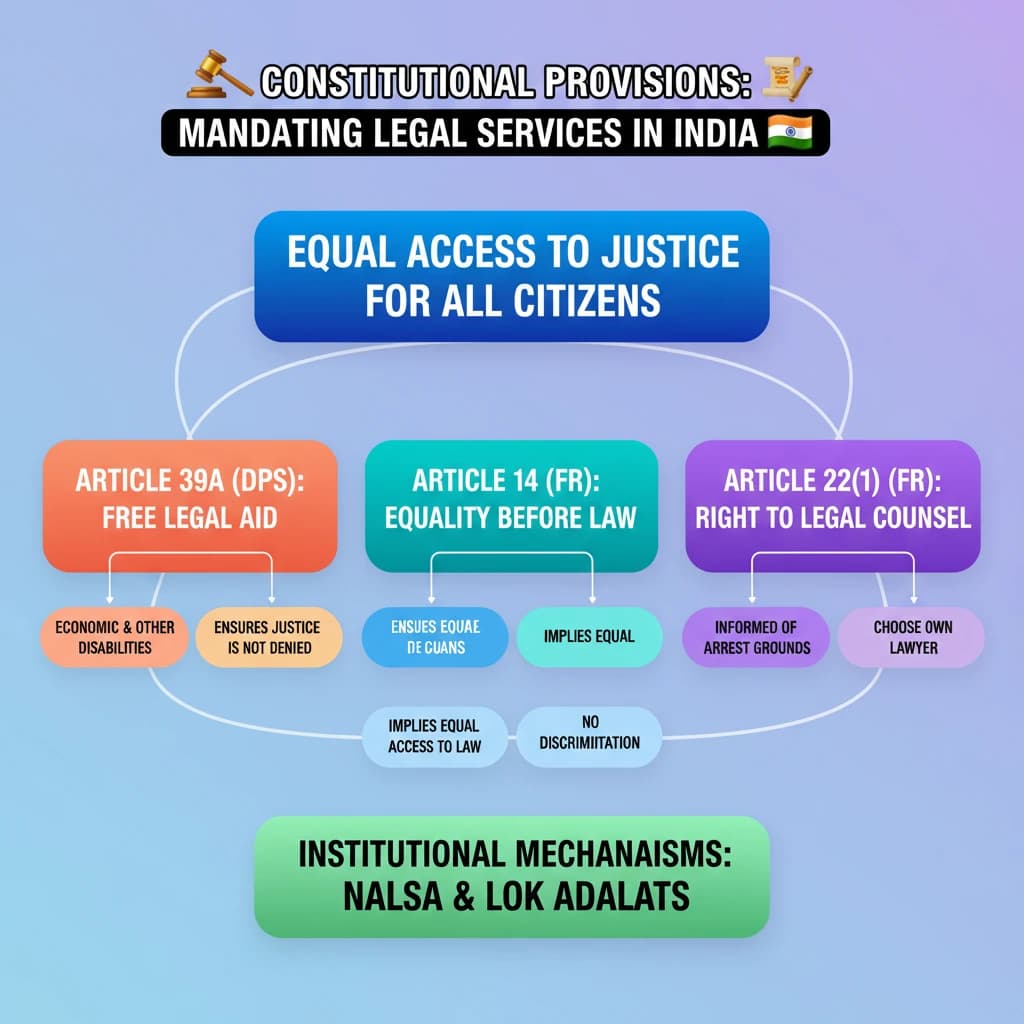
What are the Constitutional Provisions that Mandate the Provision of Legal Services in India? is a key topic under Polity And Governance for UPSC Civil Services Examination. Key points include: Article 39A (DPSP) mandates free legal aid for economic/other disabilities.. Article 14 (FR) ensures equality before law, implying equal access to justice.. Article 22(1) (FR) guarantees right to be informed of arrest grounds and legal counsel.. Understanding this topic is essential for both UPSC Prelims and Mains preparation.

Why is What are the Constitutional Provisions that Mandate the Provision of Legal Services in India? important for UPSC exam?

What are the Constitutional Provisions that Mandate the Provision of Legal Services in India? is a Medium-level topic in UPSC Polity And Governance. It is tested in both Prelims (factual MCQs) and Mains (analytical answer writing). Previous year UPSC questions have frequently covered aspects of What are the Constitutional Provisions that Mandate the Provision of Legal Services in India?, making it essential for comprehensive IAS preparation.

How to prepare What are the Constitutional Provisions that Mandate the Provision of Legal Services in India? for UPSC?

To prepare What are the Constitutional Provisions that Mandate the Provision of Legal Services in India? for UPSC: (1) Study the comprehensive notes covering all key concepts on Vaidra. (2) Practice previous year questions on this topic. (3) Connect it with current affairs using daily updates. (4) Revise using key takeaways and mind maps available for Polity And Governance. (5) Write practice answers linking What are the Constitutional Provisions that Mandate the Provision of Legal Services in India? to related GS Paper topics.

Key takeaways of What are the Constitutional Provisions that Mandate the Provision of Legal Services in India? for UPSC

  • Article 39A (DPSP) mandates free legal aid for economic/other disabilities.
  • Article 14 (FR) ensures equality before law, implying equal access to justice.
  • Article 22(1) (FR) guarantees right to be informed of arrest grounds and legal counsel.
  • These provisions collectively obligate the State to ensure justice is not denied due to socio-economic barriers.
  • NALSA and Lok Adalats are key institutional mechanisms implementing these mandates.
What are the Constitutional Provisions that Mandate the Provision of Legal Services in India?

What are the Constitutional Provisions that Mandate the Provision of Legal Services in India?

Medium⏱️ 4 min read✓ 98% Verified
polity and governance

📖 Introduction

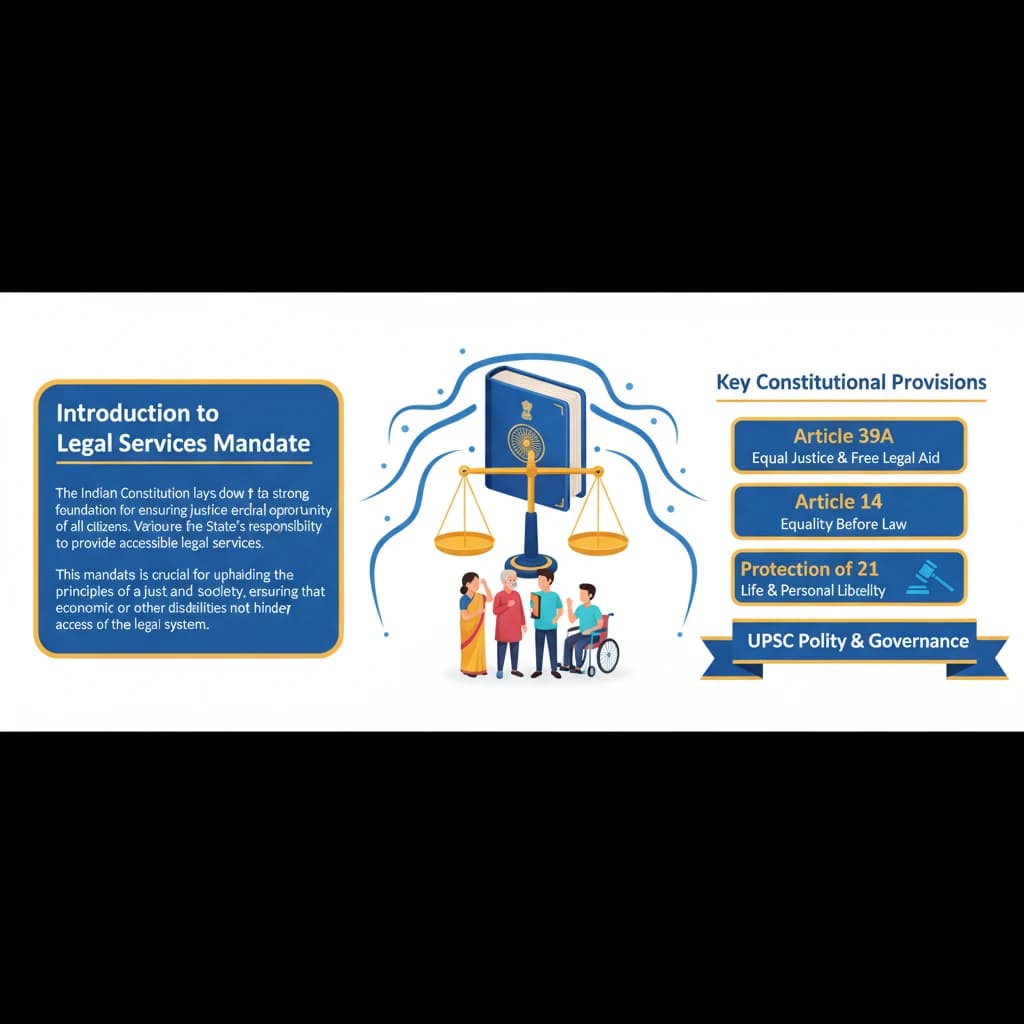
<h4>Introduction to Legal Services Mandate</h4><p>The <strong>Indian Constitution</strong> lays down a strong foundation for ensuring <strong>justice</strong> and <strong>equal opportunity</strong> for all citizens. Various provisions underscore the State's responsibility to provide accessible legal services.</p><p>This mandate is crucial for upholding the principles of a just and equitable society, ensuring that economic or other disabilities do not hinder access to the legal system.</p><h4>Article 39A: Free Legal Aid</h4><p><strong>Article 39A</strong> is a Directive Principle of State Policy (DPSP) that specifically mandates the provision of free legal aid. It was inserted into the Constitution by the <strong>42nd Amendment Act of 1976</strong>.</p><div class='info-box'><p><strong>Article 39A states:</strong> "The State shall secure that the operation of the legal system promotes justice, on a basis of equal opportunity, and shall, in particular, provide <strong>free legal aid</strong>, by suitable legislation or schemes or in any other way, to ensure that opportunities for securing justice are not denied to any citizen by reason of <strong>economic or other disabilities</strong>."</p></div><div class='key-point-box'><p>This article transforms the ideal of justice into a constitutional obligation, requiring the State to take proactive steps to bridge the gap in legal access.</p></div><h4>Article 14: Right to Equality</h4><p><strong>Article 14</strong>, a Fundamental Right, guarantees <strong>equality before the law</strong> and <strong>equal protection of the laws</strong> within the territory of India. This principle inherently requires that all individuals, irrespective of their socio-economic status, have equal access to legal remedies.</p><p>Denying legal assistance to the poor would violate the spirit of equality, as it would create an unequal playing field in the pursuit of justice.</p><h4>Article 22(1): Rights of Arrested Persons</h4><p><strong>Article 22(1)</strong> is another fundamental right that reinforces the need for legal services, particularly for those arrested or detained. It provides crucial safeguards for individuals facing legal proceedings.</p><div class='info-box'><p><strong>Article 22(1) states:</strong> "No person who is arrested shall be detained in custody without being informed, as soon as may be, of the <strong>grounds for such arrest</strong> nor shall he be denied the right to consult, and to be defended by, a <strong>legal practitioner of his choice</strong>."</p></div><div class='exam-tip-box'><p>While <strong>Article 39A</strong> is a DPSP, <strong>Articles 14</strong> and <strong>22(1)</strong> are Fundamental Rights. This distinction is important for understanding their enforceability and the State's direct obligation.</p></div>
Concept Diagram

💡 Key Takeaways

  • •Article 39A (DPSP) mandates free legal aid for economic/other disabilities.
  • •Article 14 (FR) ensures equality before law, implying equal access to justice.
  • •Article 22(1) (FR) guarantees right to be informed of arrest grounds and legal counsel.
  • •These provisions collectively obligate the State to ensure justice is not denied due to socio-economic barriers.
  • •NALSA and Lok Adalats are key institutional mechanisms implementing these mandates.

🧠 Memory Techniques

Memory Aid
98% Verified Content

📚 Reference Sources

•Drishti IAS Summary on Constitutional Provisions for Legal Services
•Legal Services Authorities Act, 1987

Related Topics

Loading related topics...
Explore:Polity And Governance Topics·All Subjects·Daily Current Affairs·Editorial Analysis·Previous Year Questions·UPSC GPT
What are the Constitutional Provisions that Mandate the Provision of Legal Services in India? - UPSC Polity And Governance