Loading page, please wait…
Vaidra Logo
Vaidra

Top 4 items + smart groups

UPSC GPT
New
Current Affairs
Daily Solutions
Daily Puzzle
Mains Evaluator

Version 2.0.0 • Built with ❤️ for UPSC aspirants

Loading...
Loading...
Loading...
Loading...
Loading...
Loading...
Loading...
Loading...
Loading...
Loading...
Loading...
Loading...
Loading...
Back
All Subjects

Topics

0 topics • 0 completed

Loading topics...
Loading...
Loading...
Loading...
Loading...
Loading...
Overall Progress0%

National Commission for Scheduled Castes (NCSC): Composition & Functions - UPSC Polity And Governance

What is National Commission for Scheduled Castes (NCSC): Composition & Functions in UPSC Polity And Governance?

National Commission for Scheduled Castes (NCSC): Composition & Functions is a key topic under Polity And Governance for UPSC Civil Services Examination. Key points include: The NCSC is a constitutional body established under Article 338 for Scheduled Castes.. It comprises a Chairperson, Vice-Chairperson, and three members, all appointed by the President.. Key functions include investigating safeguards, inquiring into complaints, and advising on SC socio-economic development.. Understanding this topic is essential for both UPSC Prelims and Mains preparation.

Why is National Commission for Scheduled Castes (NCSC): Composition & Functions important for UPSC exam?

National Commission for Scheduled Castes (NCSC): Composition & Functions is a Medium-level topic in UPSC Polity And Governance. It is tested in both Prelims (factual MCQs) and Mains (analytical answer writing). Previous year UPSC questions have frequently covered aspects of National Commission for Scheduled Castes (NCSC): Composition & Functions, making it essential for comprehensive IAS preparation.

How to prepare National Commission for Scheduled Castes (NCSC): Composition & Functions for UPSC?

To prepare National Commission for Scheduled Castes (NCSC): Composition & Functions for UPSC: (1) Study the comprehensive notes covering all key concepts on Vaidra. (2) Practice previous year questions on this topic. (3) Connect it with current affairs using daily updates. (4) Revise using key takeaways and mind maps available for Polity And Governance. (5) Write practice answers linking National Commission for Scheduled Castes (NCSC): Composition & Functions to related GS Paper topics.

Key takeaways of National Commission for Scheduled Castes (NCSC): Composition & Functions for UPSC

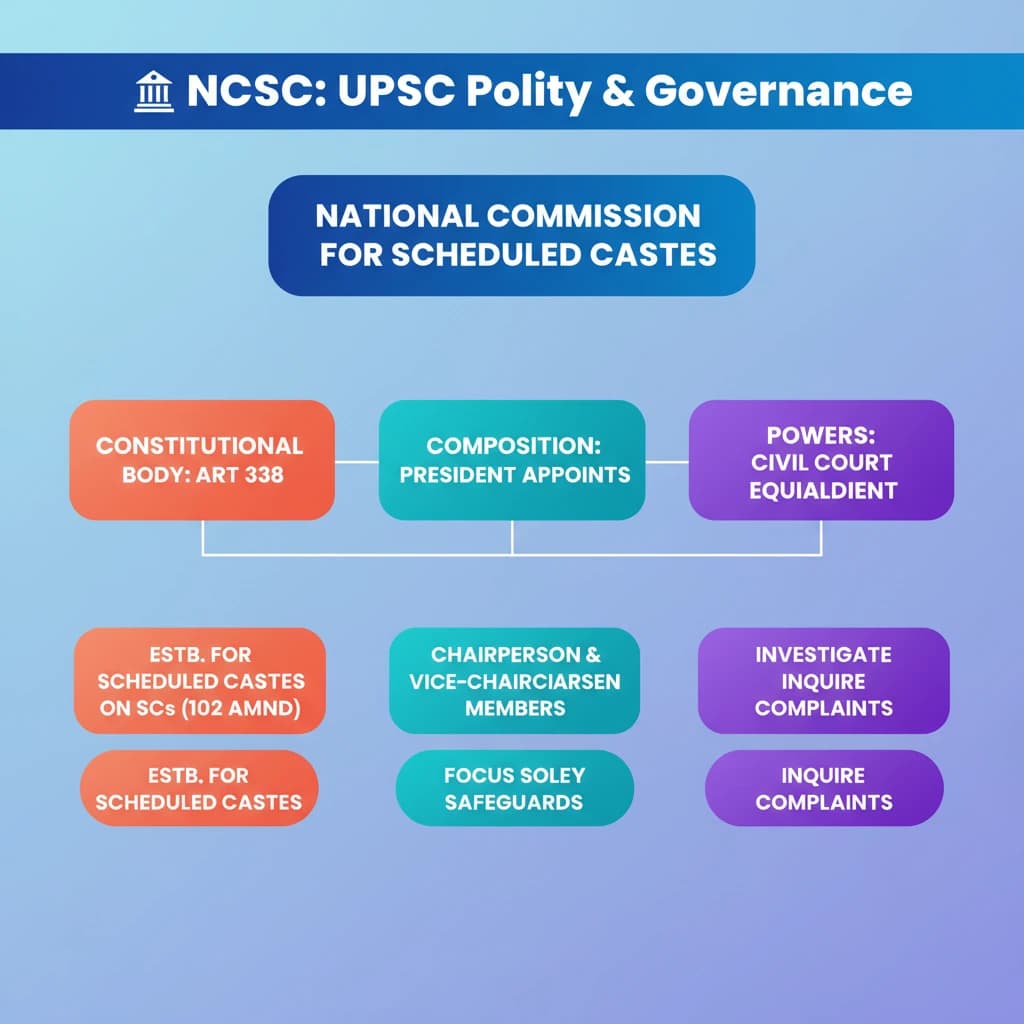
  • The NCSC is a constitutional body established under Article 338 for Scheduled Castes.
  • It comprises a Chairperson, Vice-Chairperson, and three members, all appointed by the President.
  • Key functions include investigating safeguards, inquiring into complaints, and advising on SC socio-economic development.
  • The NCSC holds powers equivalent to a civil court for inquiries and investigations.
  • The 102nd Amendment Act, 2018, relieved NCSC of its responsibilities towards OBCs, focusing solely on SCs.
  • Central and state governments must consult NCSC on major policy matters affecting SCs.

National Commission for Scheduled Castes (NCSC): Composition & Functions

National Commission for Scheduled Castes (NCSC): Composition & Functions

Medium⏱️ 8 min read✓ 98% Verified
polity and governance

📖 Introduction

<h4>Introduction to the National Commission for Scheduled Castes (NCSC)</h4><p>The <strong>National Commission for Scheduled Castes (NCSC)</strong> is a crucial <strong>constitutional body</strong> in India. Established with the primary objective of safeguarding the interests of the <strong>Scheduled Castes (SCs)</strong>, it plays a pivotal role in ensuring their protection and development.</p><p>Its mandate extends to investigating, monitoring, and advising on matters related to the constitutional and legal safeguards provided for the SC community.</p><h4>Composition of the NCSC</h4><p>The Commission is structured to ensure comprehensive representation and effective functioning. It consists of a specific number of members, each appointed by the President of India.</p><div class='info-box'><ul><li><strong>Chairperson</strong>: Leads the Commission.</li><li><strong>Vice-Chairperson</strong>: Assists the Chairperson.</li><li><strong>Three additional Members</strong>: Contribute to the Commission's work.</li></ul><p>All members are appointed by the <strong>President of India</strong> through a <strong>warrant under his hand and seal</strong>.</p><p>The <strong>conditions of service</strong> and <strong>tenure of office</strong> for the Chairperson, Vice-Chairperson, and Members are also determined by the <strong>President</strong>.</p></div><h4>Key Functions of the NCSC</h4><p>The NCSC is entrusted with a broad range of responsibilities aimed at protecting and promoting the welfare of Scheduled Castes. These functions are critical for monitoring the implementation of various safeguards.</p><ul><li>To <strong>investigate and monitor</strong> all matters relating to the <strong>constitutional and other legal safeguards</strong> for the <strong>Scheduled Castes</strong> and to evaluate their working.</li><li>To <strong>inquire into specific complaints</strong> concerning the <strong>deprivation of rights and safeguards</strong> of the <strong>Scheduled Castes</strong>.</li><li>To <strong>participate and advise</strong> on the <strong>planning process of socio-economic development</strong> of the <strong>Scheduled Castes</strong> and to evaluate the progress of their development under the <strong>Union or a state</strong>.</li><li>To <strong>present to the President</strong>, annually and at such other times as it may deem fit, <strong>reports</strong> upon the working of those safeguards.</li><li>To make <strong>recommendations</strong> as to the measures that should be taken by the <strong>Union or a state</strong> for the effective implementation of those safeguards and other measures for the <strong>protection, welfare, and socio-economic development</strong> of the <strong>Scheduled Castes</strong>.</li></ul><div class='key-point-box'><p><strong>Historical Mandate Change (102nd Amendment)</strong>:</p><p>Till <strong>2018</strong>, the Commission was also required to discharge similar functions with regard to the <strong>Other Backward Classes (OBCs)</strong>. However, it was relieved from this responsibility by the <strong>102nd Amendment Act, 2018</strong>. A separate <strong>National Commission for Backward Classes (NCBC)</strong> was established with constitutional status by this amendment.</p></div><h4>Powers of the NCSC</h4><p>To effectively carry out its functions, the NCSC is vested with significant powers, enabling it to conduct thorough investigations and inquiries.</p><div class='info-box'><p>The Commission is empowered to <strong>regulate its own procedure</strong>, ensuring operational autonomy.</p><p>While investigating any matter or inquiring into any complaint, the Commission possesses all the <strong>powers of a civil court</strong> trying a suit. These powers include:</p><ul><li><strong>Summoning and enforcing the attendance</strong> of any person and examining him on oath.</li><li><strong>Receiving evidence on affidavits</strong>.</li><li><strong>Requisitioning any public record</strong> from any court or office.</li></ul></div><div class='key-point-box'><p><strong>Mandatory Consultation</strong>:</p><p>The <strong>Central and state governments</strong> are legally required to <strong>consult the Commission</strong> on all <strong>major policy matters affecting the Scheduled Castes</strong>. This provision underscores the NCSC's advisory and oversight role in governance.</p></div>
Concept Diagram

💡 Key Takeaways

  • •The NCSC is a constitutional body established under Article 338 for Scheduled Castes.
  • •It comprises a Chairperson, Vice-Chairperson, and three members, all appointed by the President.
  • •Key functions include investigating safeguards, inquiring into complaints, and advising on SC socio-economic development.
  • •The NCSC holds powers equivalent to a civil court for inquiries and investigations.
  • •The 102nd Amendment Act, 2018, relieved NCSC of its responsibilities towards OBCs, focusing solely on SCs.
  • •Central and state governments must consult NCSC on major policy matters affecting SCs.

🧠 Memory Techniques
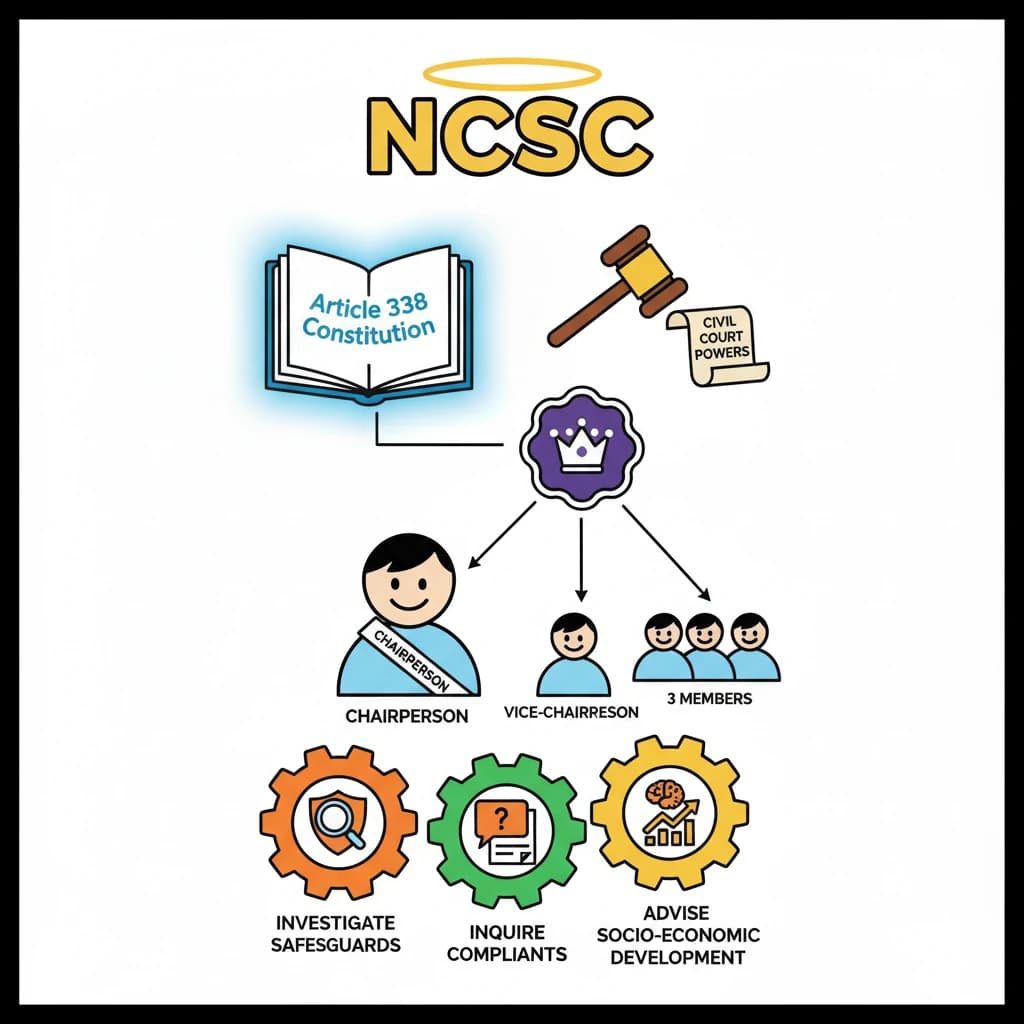
Memory Aid
98% Verified Content

📚 Reference Sources

•National Commission for Scheduled Castes (NCSC) official website
•Ministry of Social Justice and Empowerment, Government of India publications
•Drishti IAS Summary (provided source material)

Related Topics

Loading related topics...
Explore:Polity And Governance Topics·All Subjects·Daily Current Affairs·Editorial Analysis·Previous Year Questions·UPSC GPT
National Commission for Scheduled Castes (NCSC): Composition & Functions - UPSC Polity And Governance