Loading page, please wait…
Anna Chakra and SCAN for Reforming PDS System - UPSC Polity And Governance
What is Anna Chakra and SCAN for Reforming PDS System in UPSC Polity And Governance?
Anna Chakra and SCAN for Reforming PDS System is a key topic under Polity And Governance for UPSC Civil Services Examination. Key points include: Anna Chakra and SCAN are tech-driven reforms for India's PDS.. Anna Chakra optimizes foodgrain supply chain using algorithms, developed with WFP and IIT-Delhi FITT.. SCAN portal streamlines state subsidy claims under NFSA 2013, enhancing fund utilization and reducing leakages.. Understanding this topic is essential for both UPSC Prelims and Mains preparation.
Why is Anna Chakra and SCAN for Reforming PDS System important for UPSC exam?
Anna Chakra and SCAN for Reforming PDS System is a Medium-level topic in UPSC Polity And Governance. It is tested in both Prelims (factual MCQs) and Mains (analytical answer writing). Previous year UPSC questions have frequently covered aspects of Anna Chakra and SCAN for Reforming PDS System, making it essential for comprehensive IAS preparation.
How to prepare Anna Chakra and SCAN for Reforming PDS System for UPSC?
To prepare Anna Chakra and SCAN for Reforming PDS System for UPSC: (1) Study the comprehensive notes covering all key concepts on Vaidra. (2) Practice previous year questions on this topic. (3) Connect it with current affairs using daily updates. (4) Revise using key takeaways and mind maps available for Polity And Governance. (5) Write practice answers linking Anna Chakra and SCAN for Reforming PDS System to related GS Paper topics.
Key takeaways of Anna Chakra and SCAN for Reforming PDS System for UPSC
- Anna Chakra and SCAN are tech-driven reforms for India's PDS.
- Anna Chakra optimizes foodgrain supply chain using algorithms, developed with WFP and IIT-Delhi FITT.
- SCAN portal streamlines state subsidy claims under NFSA 2013, enhancing fund utilization and reducing leakages.
- PDS, under NFSA 2013, ensures food security for two-thirds of India, managed by Central and State Govts.
- PDS evolved from WWII rationing to Targeted PDS (1997) and Antyodaya Anna Yojana (2000), now focused on efficiency and transparency.
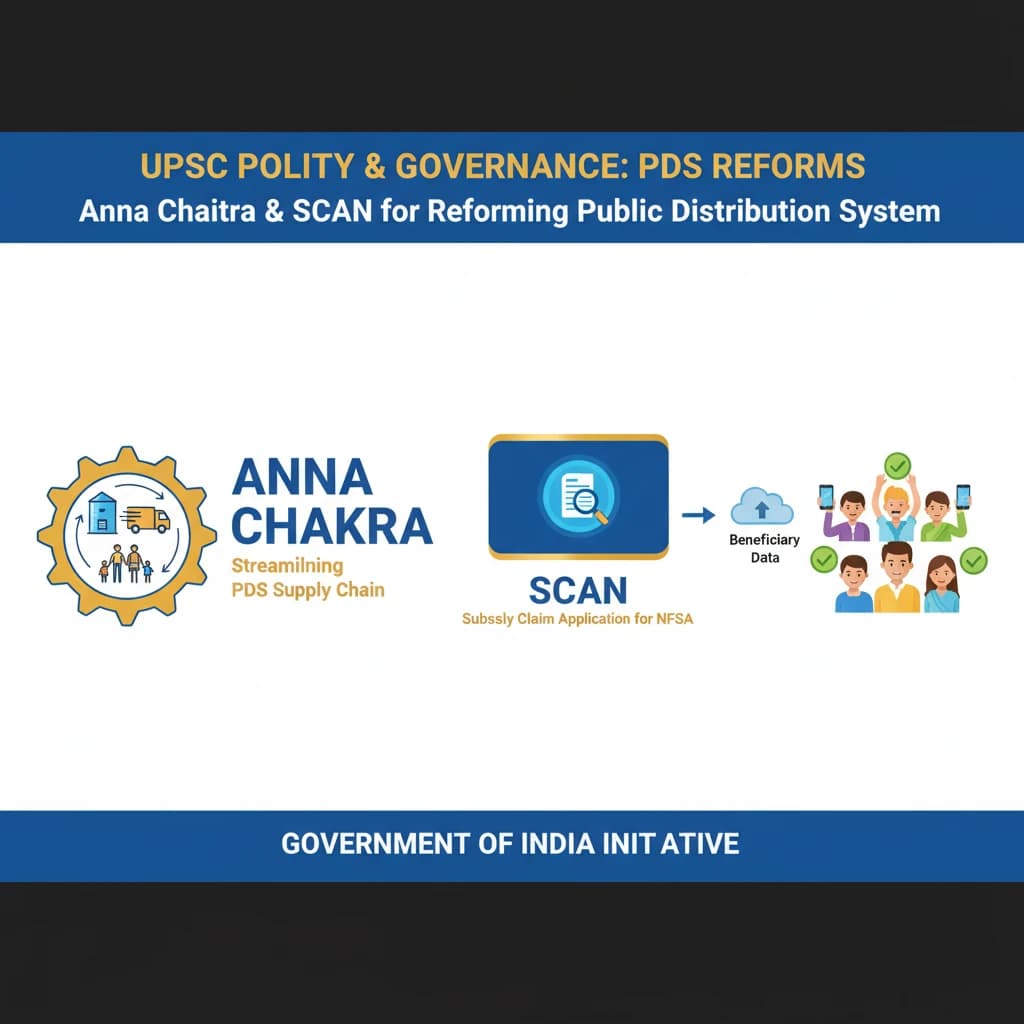
Anna Chakra and SCAN for Reforming PDS System
Medium⏱️ 8 min read
polity and governance
📖 Introduction
Introduction to PDS Reforms
The government, through an entity referred to as Energy in the source material, has launched significant initiatives: Anna Chakra and the SCAN (Subsidy Claim Application for NFSA) portal. These initiatives aim to modernize India’s Public Distribution System (PDS).
The primary goal is to enhance the efficiency of the PDS supply chain. It also seeks to streamline the subsidy claim process, ultimately benefiting millions of citizens who rely on these vital food security programs.
Key Objective: Modernize PDS by improving supply chain efficiency and streamlining subsidy claims.
About Anna Chakra
Anna Chakra is a groundbreaking tool designed to optimize the supply chain of the PDS across India. It represents a significant step towards leveraging technology for better food distribution.
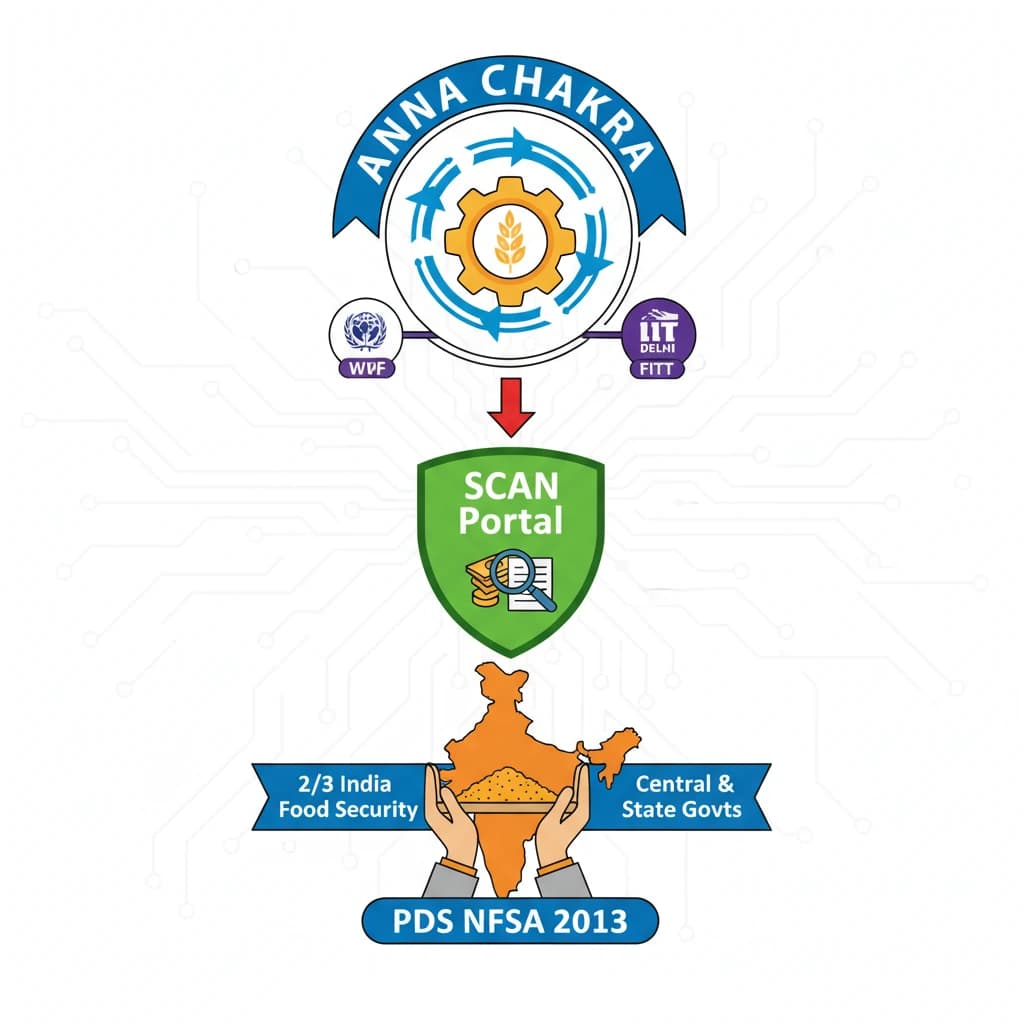
Development Collaboration: Anna Chakra was developed in collaboration with the World Food Programme (WFP) and the Foundation for Innovation and Technology Transfer (FITT) at IIT-Delhi.
This initiative utilizes advanced algorithms. These algorithms are crucial for identifying the most optimal routes for the transportation of food grains, reducing wastage and improving delivery times.
About SCAN System
The SCAN portal is specifically designed to streamline the subsidy claim process for states. This process operates under the framework of the National Food Security Act (NFSA) 2013.
It plays a vital role in modernizing PDS operations, leading to better utilization of funds. This aligns with broader government technology initiatives aimed at reducing leakages in the system.
The SCAN system enhances food security for an estimated 80 crore people. It also offers significant environmental and economic benefits by making the subsidy process more transparent and efficient.
What is PDS?
The Public Distribution System (PDS) is a cornerstone of India's food security architecture. It was established to combat food scarcity and ensure access to essential foodgrains.
Core Function: The PDS provides foodgrains at affordable prices to eligible beneficiaries across the country.
It operates primarily under the provisions of the National Food Security Act (NFSA) 2013. This act ensures food security for nearly two-thirds of India’s population, based on Census 2011 data.
Nodal Ministry: The Ministry of Consumer Affairs, Food, and Public Distribution is the nodal ministry responsible for the PDS.
Evolution of PDS
The Public Distribution System (PDS) in India has a rich history, originating during World War II as a wartime rationing measure. It has undergone several transformative phases.
- 1960s Expansion: PDS expanded significantly in the 1960s due to widespread food shortages. This period saw the establishment of the Agriculture Prices Commission and the Food Corporation of India (FCI) to ensure domestic procurement and storage.
- 1970s Universalization: By the 1970s, PDS transitioned into a universal scheme, aiming to cover all citizens.
- 1992 RPDS: In 1992, the Revamped Public Distribution System (RPDS) was launched. Its objective was to strengthen and expand the PDS reach, particularly in remote, hilly, and inaccessible areas.
- 1997 TPDS: The Targeted Public Distribution System (TPDS) was introduced in 1997. This marked a shift towards focusing on the poor by categorizing beneficiaries into Below Poverty Line (BPL) and Above Poverty Line (APL) households.
- 2000 AAY: The Antyodaya Anna Yojana (AAY), launched in 2000, further refined targeting. It specifically aimed to provide highly subsidized foodgrains to the poorest among the poor families.
Management of PDS
The management of the PDS is a joint responsibility, shared between the Central Government and the State/Union Territory (UT) Governments. Each level has distinct, crucial responsibilities.
Central Government's Role (via FCI): Handles procurement, storage, transportation, and bulk allocation of foodgrains.
State Governments are responsible for the local administration and implementation of the system. This includes identifying eligible households and issuing ration cards.
State Government's Role: Manages local distribution, identifies eligible households, issues ration cards, and supervises Fair Price Shops (FPSs).
Commodities Distributed
The PDS primarily distributes a range of essential commodities to ensure food security. These staples form the core of the food basket provided.
- Primary Commodities: Wheat, rice, sugar, and kerosene are the main items distributed through PDS.
- Additional Commodities: Some states also distribute supplementary items. These can include pulses, edible oils, and salt, depending on local needs and state policies.
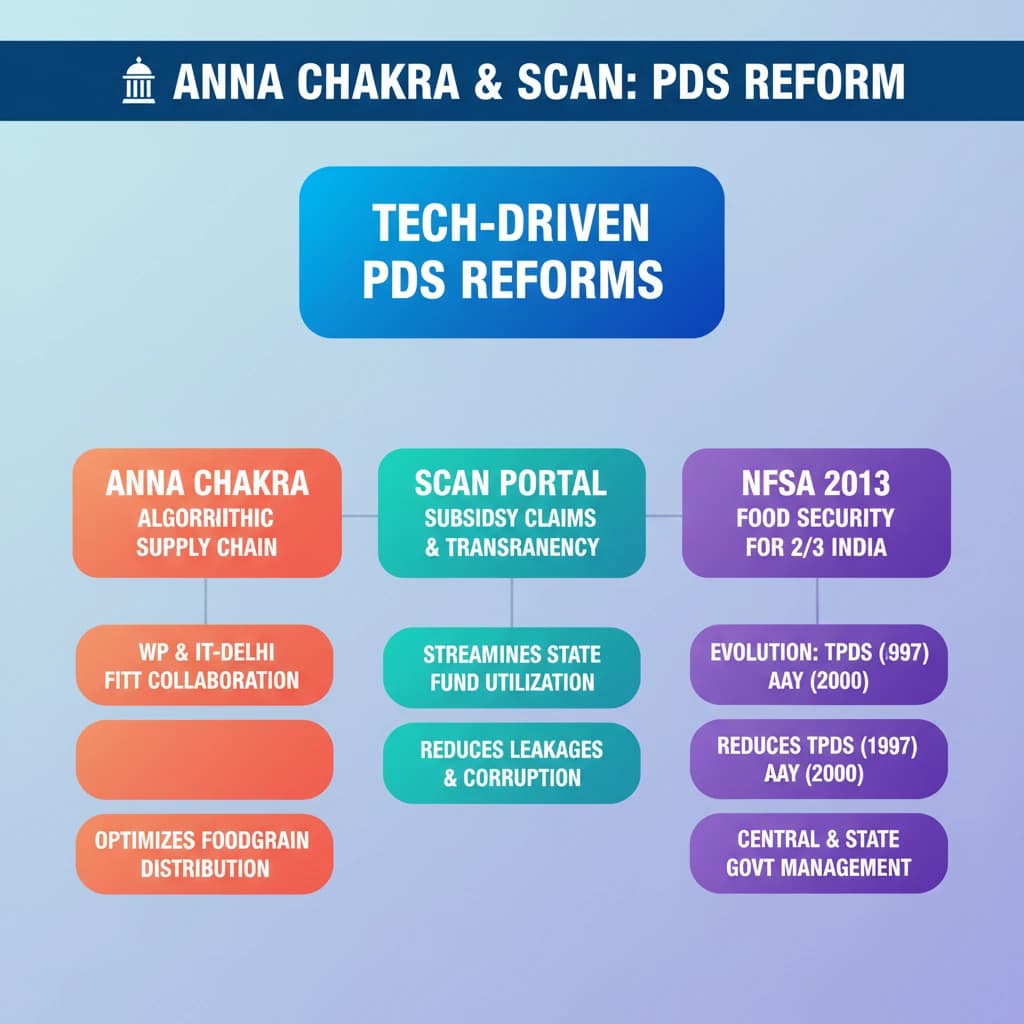
💡 Key Takeaways
- •Anna Chakra and SCAN are tech-driven reforms for India's PDS.
- •Anna Chakra optimizes foodgrain supply chain using algorithms, developed with WFP and IIT-Delhi FITT.
- •SCAN portal streamlines state subsidy claims under NFSA 2013, enhancing fund utilization and reducing leakages.
- •PDS, under NFSA 2013, ensures food security for two-thirds of India, managed by Central and State Govts.
- •PDS evolved from WWII rationing to Targeted PDS (1997) and Antyodaya Anna Yojana (2000), now focused on efficiency and transparency.
🧠 Memory Techniques
95% Verified Content
📚 Reference Sources
•National Food Security Act (NFSA) 2013
•Ministry of Consumer Affairs, Food, and Public Distribution official documents (implied)