Loading page, please wait…
Appointment of Chief Justice of India - UPSC Polity And Governance
What is Appointment of Chief Justice of India in UPSC Polity And Governance?
Appointment of Chief Justice of India is a key topic under Polity And Governance for UPSC Civil Services Examination. Key points include: CJI is appointed by the President under Article 124(2) of the Constitution.. The senior-most Supreme Court judge, based on length of service, is conventionally designated as CJI.. Qualifications for a Supreme Court judge include being a citizen of India.. Understanding this topic is essential for both UPSC Prelims and Mains preparation.
Why is Appointment of Chief Justice of India important for UPSC exam?
Appointment of Chief Justice of India is a Medium-level topic in UPSC Polity And Governance. It is tested in both Prelims (factual MCQs) and Mains (analytical answer writing). Previous year UPSC questions have frequently covered aspects of Appointment of Chief Justice of India, making it essential for comprehensive IAS preparation.
How to prepare Appointment of Chief Justice of India for UPSC?
To prepare Appointment of Chief Justice of India for UPSC: (1) Study the comprehensive notes covering all key concepts on Vaidra. (2) Practice previous year questions on this topic. (3) Connect it with current affairs using daily updates. (4) Revise using key takeaways and mind maps available for Polity And Governance. (5) Write practice answers linking Appointment of Chief Justice of India to related GS Paper topics.
Key takeaways of Appointment of Chief Justice of India for UPSC
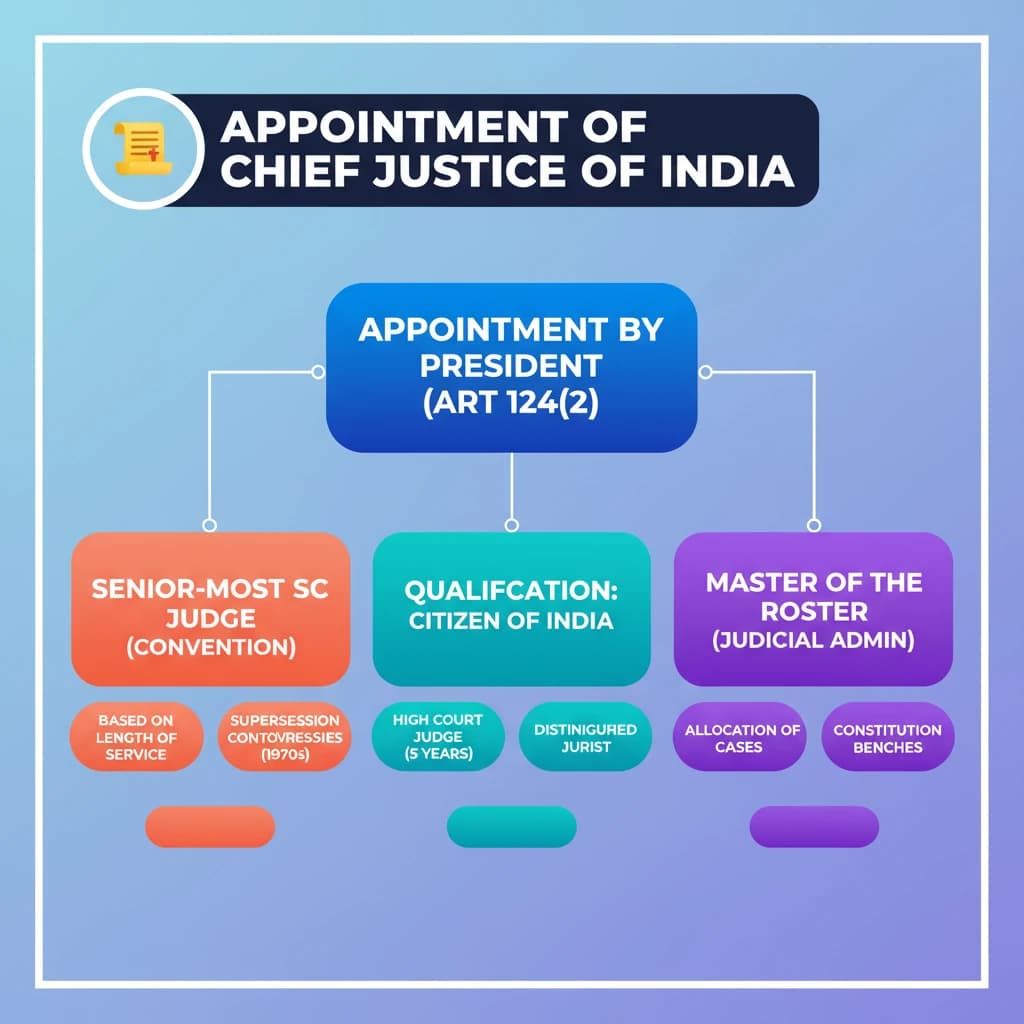
- CJI is appointed by the President under Article 124(2) of the Constitution.
- The senior-most Supreme Court judge, based on length of service, is conventionally designated as CJI.
- Qualifications for a Supreme Court judge include being a citizen of India.
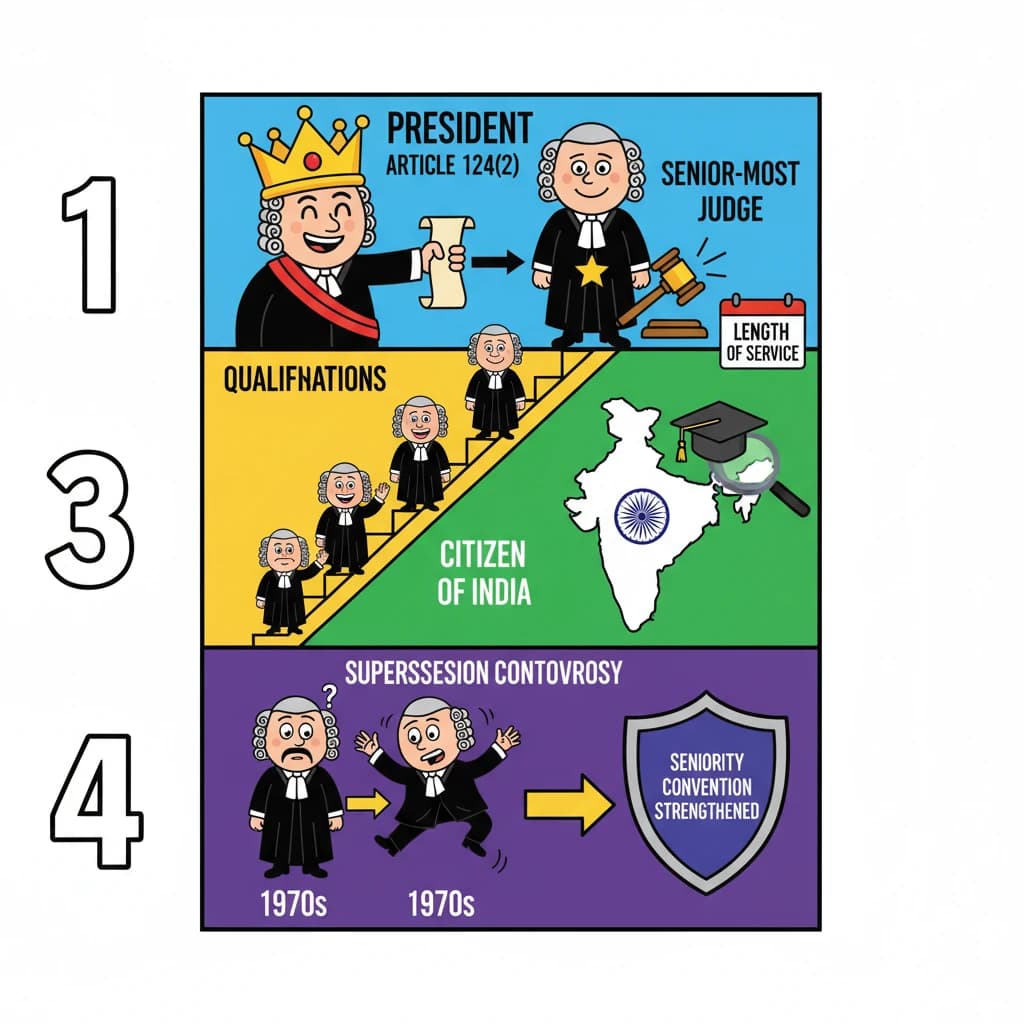
- The 1970s witnessed supersession controversies, leading to strengthening of the seniority convention.
- The CJI is the 'master of the roster' and plays a crucial role in judicial administration.
- Debates around the Collegium System for judicial appointments remain a contemporary issue.

Appointment of Chief Justice of India
Medium⏱️ 8 min read
polity and governance
📖 Introduction
Recent Context: 51st CJI Appointment
Recently, the President of India administered the oath of office to Justice Sanjiv Khanna as the Chief Justice of India (CJI).
He succeeded Justice D.Y. Chandrachud, becoming the 51st CJI of India. This appointment adheres to the established conventions for judicial leadership.
Key Fact: Justice Sanjiv Khanna is the 51st Chief Justice of India, following Justice D.Y. Chandrachud.
Constitutional Provisions for CJI Appointment
A Supreme Court judge, including the Chief Justice of India, is appointed by the President of India. This power is derived from Article 124 (2) of the Constitution of India.
As per a long-standing convention, the senior-most judge of the Supreme Court is designated as the Chief Justice of India. This convention ensures predictability and upholds the independence of the judiciary.
Convention of Seniority: The seniority of a judge is measured by their length of service on the Supreme Court. This is the primary criterion for becoming the CJI.
Qualifications for a Supreme Court Judge
To be appointed as a Supreme Court judge, a person must meet specific constitutional qualifications. The foundational requirement is citizenship.
- He should be a citizen of India.
UPSC Insight: While the source mentions only citizenship, recall other qualifications like judicial experience (High Court judge for 5 years) or advocate experience (High Court for 10 years), or being a distinguished jurist, as per Article 124(3). For CJI, these apply first, then seniority.
💡 Key Takeaways
- •CJI is appointed by the President under Article 124(2) of the Constitution.
- •The senior-most Supreme Court judge, based on length of service, is conventionally designated as CJI.
- •Qualifications for a Supreme Court judge include being a citizen of India.
- •The 1970s witnessed supersession controversies, leading to strengthening of the seniority convention.
- •The CJI is the 'master of the roster' and plays a crucial role in judicial administration.
- •Debates around the Collegium System for judicial appointments remain a contemporary issue.
🧠 Memory Techniques
95% Verified Content
📚 Reference Sources
•Supreme Court of India Official Website
•Press Information Bureau (PIB) releases on CJI appointments
•Drishti IAS Study Material (provided source)